

Order Total (1 Item Items):
Shipping Destination:

Michele Troja (11 results)
Skip to main search results
Search filters
Product Type
- All Product Types
- Books (11)
- Magazines & Periodicals (No further results match this refinement)
- Comics (No further results match this refinement)
- Sheet Music (No further results match this refinement)
- Art, Prints & Posters (No further results match this refinement)
- Photographs (No further results match this refinement)
- Maps (No further results match this refinement)
- Manuscripts & Paper Collectibles (No further results match this refinement)
Condition Learn more
- New (5)
- As New, Fine or Near Fine (No further results match this refinement)
- Very Good or Good (1)
- Fair or Poor (No further results match this refinement)
- As Described (5)
Binding
- All Bindings
- Hardcover (8)
- Softcover (No further results match this refinement)
Collectible Attributes
- First Edition (5)
- Signed (No further results match this refinement)
- Dust Jacket (No further results match this refinement)
- Seller-Supplied Images (8)
- Not Print on Demand (6)
Language (1)
Price
- Any Price
- Under US$ 25 (No further results match this refinement)
- US$ 25 to US$ 50
- Over US$ 50
Free Shipping
Seller Location
Seller Rating
-
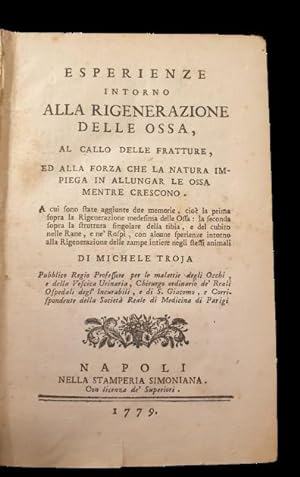
Esperienze intorno alla Rigenerazione delle Ossa, al callo delle Fratture, ed alla forza che la Natura impiega in allungar le ossa mentre crescono. (Insieme con:) Giuseppe, TESTA. Considerazioni sulla formazione del Callo nelle Fratture delle Ossa Umane. Palermo, F. Lao, 1842. (Insieme con:) Professeur Gerdy. Note sur la Structure des Os.
Published by Napoli, nella Stamperia Simoniana,, 1779
Seller: Libreria Antiquaria Dentis (ALAI - ILAB), Torino, TO, Italy
Seller rating 5 out of 5 stars

First Edition
Rilegato. Condition: molto buono. prima edizione. Napoli, nella Stamperia Simoniana, 1779. In-4 antico (18,5 cm x 11,9 cm.). Pp. XIX, 288, (2), 13, 7. Rilegatura ottocentesca in mezza tela marrone, piatti marmorizzati. Esemplare in più che buono stato di conservazione generale; qua e la' con fioriture dovute al tipo di carta. Edizione originale di questi ulteriori studi osteologici, molto piu' rara delle opere precedenti. Il Troja ammette il processo di ossificazione avvenire merce' d'un umore effuso tra il periostio e l'osso che prima di convertirsi in sostanza ossea si rappiglia in filamenti gelatinosi e cartilaginei. La parte IV del volume e' dedicata agli studi sull'anatomia patologica delle ossa. Nel capitolo V l'autore tratta particolarmente delle necrosi, della carie ossea e dell'osteite rarefacente esponendo concetti molto originali; nel capitolo VI, che tratta del rachitismo, esprime idee diverse da quelle correnti allora. Il Troja diede indubbiamente un contributo sostanziale di cognizioni sulla fisiologia ed istologia dell'osso, contributo che fu seme fecondo di scoperte posteriori utilizzate a fini pratici. Bibliografia: Hirsch, V, p. 642. De Renzi, V, p. 213. Leonardo, Lives of master surgeons, p. 428. Bader, Genesi ed evoluzione dell'ortopedia italiana, pp. 89-94. Manca alle biblioteche mediche di Osler, Cushing e Waller.
-

Anmerkung über H. Troja Experimenta de novorum ossium regeneratione, von dem Herrn Professor Blumbach (pp.101-106).
Publication Date: 1790
Seller: Antiq. F.-D. Söhn - Medicusbooks.Com, Marburg, Germany
Seller rating 5 out of 5 stars
First Edition
Richter's Chir. Bibl., 6/1. - Hrsg. v. August Gottlieb Richter. - Frankenthal, im Verlag der Gegelischen Buchdruckerey und Buchhandlung, 1790, 8°, 182 , (2) pp., Interimsbindung; unaufgeschnitten. Erste Frankenthaler Ausgabe! Michele Troja (1747-1827) ist vor allem für seine Studien über die Ernährung und Regeneration von Knochen bekannt, ein Thema, das damals im Mittelpunkt des akademischen Interesses stand. Sogar Spallanzani interessierte sich dafür und erwähnte in seinen Briefen die Arbeit von Troja, wenn auch ohne große Begeisterung. Diese negative Beurteilung scheint heute nicht gerechtfertigt, denn Troja verbesserte die Untersuchungstechniken erheblich. So tauchte er die Knochen in Salpetersäure, um die Knochenstruktur hervorzuheben, und benutzte Zinksulfat, um die Zellen zu färben und mikroskopische Strukturen besser sichtbar zu machen. Johann Friedrich Blumenbach (1752-1840) Anatom und Anthropologe. "Er gilt als wesentlicher Begründer der Zoologie und Anthropologie als wissenschaftliche Disziplinen. Bedeutend war er auch als Gegner des Glaubens an die permanente Urzeugung und der Präformationslehre, als Vertreter des Vitalismus sowie als Rassentheoretiker und einer der Begründer des wissenschaftlichen Antirassismus." wiki.
-
Neue Beobachtungen und Versuche über die Knochen. Nach nie bekannt gemachten Originale aus dem Italiänischen ins Deutsche übertragen, umgearbeitet, mit Anmerkungen, Zuäzen und einer Biographie des Verfassers versehen von Dr. J. J. Albrecht von Schönberg
Published by Erlangen JJ Palm und Ernst Enke, 1828
4°, XXVIII, SS. 29-198, ( 1 S. Druckfehler), (1 S. Verlagsanzeigen), 5 gefaltete Kupferstichtafeln, vollständig, Ohalbldr.; Papier leicht nachgedunkelt; Am Anfang und Ende etwas fleckig; guter Zustand.
-
De Novorum Ossium, in Integris aut Maximis, ob Morbos, Deperditionibus, Regeneratione Experimenta.
Seller: Jonathan A. Hill, Bookseller Inc., New York, NY, U.S.A.
Seller rating 5 out of 5 stars
First Edition
Three folding engraved plates & one folding printed table. x, [11]-240 pp. 8vo, cont. vellum over boards (binding a little soiled & stained). Paris: F.A. Didot, 1775. First edition. Troja (1747-1827), studied medicine at Naples and in 1774 he went to Paris where he began the research on the formation of bone tissue and bone generation which made him famous. Although Réaumur and Trembley had earlier demonstrated the regrowth of limbs in crustacea and polyps, no one before had considered the possibility of regrowth of bones. "Troja demonstrated that if a foreign body is introduced into the marrow cavity of a long bone, the bony cylinder dies and a new bone is formed all around the necrotic one, the latter being eventually eliminated. Accordingly, Troja suggested that in treating extensive caries of the bone, marrow should be destroyed, so that new bone formation would result."Leonardo, Lives of Master Surgeons, p. 428. Troja later took up again his work on bone surgery and regeneration. In 1814 he first described the perforating connective-tissue fibers, usually known as "Sharpey's fibers." Fine crisp copy. Ex Bibliotheca Mechanica. ? D.S.B., XIII, pp. 464-65. Hirsch, V, p. 642"a very important work" (in trans.).
-
![Seller image for Neue Beobachtungen und Versuche uber die Knochen 1828 [LeatherBound] for sale by True World of Books](https://pictures.abebooks.com/inventory/md/md31616548761.jpg)
Neue Beobachtungen und Versuche uber die Knochen 1828 [LeatherBound]
Publication Date: 2025
LeatherBound. Condition: New. BOOKS ARE EXEMPT FROM IMPORT DUTIES AND TARIFFS; NO EXTRA CHARGES APPLY. LeatherBound edition. Condition: New. Reprinted from 1828 edition. Leather Binding on Spine and Corners with Golden leaf printing on spine. Bound in genuine leather with Satin ribbon page markers and Spine with raised gilt bands. A perfect gift for your loved ones. Pages: 215 NO changes have been made to the original text. This is NOT a retyped or an ocr'd reprint. Illustrations, Index, if any, are included in black and white. Each page is checked manually before printing. As this print on demand book is reprinted from a very old book, there could be some missing or flawed pages, but we always try to make the book as complete as possible. Fold-outs, if any, are not part of the book. If the original book was published in multiple volumes then this reprint is of only one volume, not the whole set. Sewing binding for longer life, where the book block is actually sewn (smythe sewn/section sewn) with thread before binding which results in a more durable type of binding. Pages: 215.
-
![Seller image for Osservazioni ed esperimenti sulle ossa : in supplemento ad un'opera sulla rigenerazione delle ossa i 1814 [LeatherBound] for sale by True World of Books](https://pictures.abebooks.com/inventory/md/md31533621678.jpg)
LeatherBound. Condition: New. BOOKS ARE EXEMPT FROM IMPORT DUTIES AND TARIFFS; NO EXTRA CHARGES APPLY. LeatherBound edition. Condition: New. Reprinted from 1814 edition. Leather Binding on Spine and Corners with Golden leaf printing on spine. NO changes have been made to the original text. This is NOT a retyped or an ocr'd reprint. Illustrations, Index, if any, are included in black and white. Each page is checked manually before printing. Pages: 316 As this print on demand book is reprinted from a very old book, there could be some missing or flawed pages, but we always try to make the book as complete as possible. Fold-outs, if any, are not part of the book. If the original book was published in multiple volumes then this reprint is of only one volume, not the whole set. Sewing binding for longer life, where the book block is actually sewn (smythe sewn/section sewn) with thread before binding which results in a more durable type of binding. Pages: 316 Language: Italian.
-
![Seller image for Neue Beobachtungen und Versuche uber die Knochen : Mit 5 Kupfertaf. 1828 [Leather Bound] for sale by True World of Books](https://pictures.abebooks.com/inventory/md/md31619116866.jpg)
Neue Beobachtungen und Versuche uber die Knochen : Mit 5 Kupfertaf. 1828 [Leather Bound]
Publication Date: 2025
LeatherBound. Condition: NEW. LeatherBound edition. Condition: New. Reprinted from 1828 edition. Leather Binding on Spine and Corners with Golden leaf printing on spine. Bound in genuine leather with Satin ribbon page markers and Spine with raised gilt bands. A perfect gift for your loved ones. NO changes have been made to the original text. This is NOT a retyped or an ocr'd reprint. Illustrations, Index, if any, are included in black and white. Each page is checked manually before printing. As this print on demand book is reprinted from a very old book, there could be some missing or flawed pages, but we always try to make the book as complete as possible. Fold-outs, if any, are not part of the book. If the original book was published in multiple volumes then this reprint is of only one volume, not the whole set. Sewing binding for longer life, where the book block is actually sewn (smythe sewn/section sewn) with thread before binding which results in a more durable type of binding. Pages: 216.
-
Leather Bound. Condition: New. Language: Italian. Language: Italian. Presenting an Exquisite Leather-Bound Edition, expertly crafted with Original Natural Leather that gracefully adorns the spine and corners. The allure continues with Golden Leaf Printing that adds a touch of elegance, while Hand Embossing on the rounded spine lends an artistic flair. This masterpiece has been meticulously reprinted in 2025, utilizing the invaluable guidance of the original edition published many years ago in 1803. The contents of this book are presented in classic black and white. Its durability is ensured through a meticulous sewing binding technique, enhancing its longevity. Imprinted on top-tier quality paper. A team of professionals has expertly processed each page, delicately preserving its content without alteration. Due to the vintage nature of these books, every page has been manually restored for legibility. However, in certain instances, occasional blurriness, missing segments, or faint black spots might persist. We sincerely hope for your understanding of the challenges we faced with these books. Recognizing their significance for readers seeking insight into our historical treasure, we've diligently restored and reissued them. Our intention is to offer this valuable resource once again. We eagerly await your feedback, hoping that you'll find it appealing and will generously share your thoughts and recommendations. Lang: - Italian, Pages:- 82, Print on Demand. If it is a multi-volume set, then it is only a single volume. We are specialised in Customisation of books, if you wish to opt different color leather binding, you may contact us. This service is chargeable. Product Disclaimer: Kindly be informed that, owing to the inherent nature of leather as a natural material, minor discolorations or textural variations may be perceptible. Explore the FOLIO EDITION (12x19 Inches): Available Upon Request. 82 82.
-
Neue Beobachtungen und Versuche über die Knochen: Mit 5 Kupfertafeln 1828 [Leather Bound]
Publication Date: 2024
Leather Bound. Condition: New. Language: German. Language: German. Presenting an Exquisite Leather-Bound Edition, expertly crafted with Original Natural Leather that gracefully adorns the spine and corners. The allure continues with Golden Leaf Printing that adds a touch of elegance, while Hand Embossing on the rounded spine lends an artistic flair. This masterpiece has been meticulously reprinted in 2024, utilizing the invaluable guidance of the original edition published many years ago in 1828. The contents of this book are presented in classic black and white. Its durability is ensured through a meticulous sewing binding technique, enhancing its longevity. Imprinted on top-tier quality paper. A team of professionals has expertly processed each page, delicately preserving its content without alteration. Due to the vintage nature of these books, every page has been manually restored for legibility. However, in certain instances, occasional blurriness, missing segments, or faint black spots might persist. We sincerely hope for your understanding of the challenges we faced with these books. Recognizing their significance for readers seeking insight into our historical treasure, we've diligently restored and reissued them. Our intention is to offer this valuable resource once again. We eagerly await your feedback, hoping that you'll find it appealing and will generously share your thoughts and recommendations. Lang: - German, Pages: - 218, Print on Demand. If it is a multi-volume set, then it is only a single volume. We are specialised in Customisation of books, if you wish to opt different color leather binding, you may contact us. This service is chargeable. Product Disclaimer: Kindly be informed that, owing to the inherent nature of leather as a natural material, minor discolorations or textural variations may be perceptible. Explore the FOLIO EDITION (12x19 Inches): Available Upon Request. 218 218.
-
De novorum ossium in integris out maxime ob morbos deperditionibus regeneratione experimenta. Ubi, maximâ Materiae affinitate, breviter de Fracturis, & de Vi quam Naturan impendit in ossibus elongandis, .
Publication Date: 1775
Seller: Antiq. F.-D. Söhn - Medicusbooks.Com, Marburg, Germany
Seller rating 5 out of 5 stars
First Edition
Lutetiae Parisiorum, Didot, 1775, 12°, 240 pp., mit 3 gefalteten Kupferstichtafeln und 1 gefalteten Tabelle, etwas späterer Halbledereinband mit Rückenvergoldung; minimal fleckig. First Edition! Troja is known especially for his studies on the nutrition and regeneration of bones, a subject that was the focus of academic interest at that time. Even Spallanzani became interested in it; and in his letters he referred to the work of Troja, although apparently without great enthusiasm. Such an unfavorable judgment does not appear justified today, for Troja considerably improved the techniques of study. For instance, he used immersion in nitric acid to bring out bone structure and applied zinc sulfate to obtain coloration of the cells and improve the visibility of microscopic structures. "Troja demonstrated that if a foreign body is introduced into the marrow cavity of a long bone, the bony cylinder dies and a new bone is formed all around the necrotic one, the latter being eventually eliminated. Accordingly, Troja suggested that in treating extensive caries of the bone, marrow should be destroyed, so that new bone formation would result."- Leonardo, Lives of Master Surgeons, p. 428. Troja later took up again his work on bone surgery and regeneration. In 1814 he first described the perforating connective-tissue fibers, usually known as "Sharpey's fibers." Michele Troja (1747-1827) "studied medicine at Naples and then won a competition for the post of assistant surgeon at that city's Hospital of San Giacomo degli Spagnoli. In 1774 he obtained a scholarship for postgraduate study that enabled him to go to Paris, where he began the research on the formation of bone callus and bone regeneration that made him famous. For this work, which continued that of Henri-Louis Duhamel du Monceau, he was nominated corresponding member of the Paris Academy and was invited by Diderot to write a number of articles for the supplement of the Encyclopedic. When he returned home in 1779, Troja was given the chair of ophthalmology at the University of Naples, a post established especially for him, since the subject had not been taught there until then. In the following year he became surgeon of the king's chamber for having successfully cured the crown prince of a disease. In 1802 Troja campaigned successfully for the creation of a commission to spread the knowledge and use of Jenner's smallpox vaccination. Troja's research on the eye is preserved in a volume of lectures on eye diseases. In urology he studied the diseases of the bladder and of the urinary system in general, and invented the flexible catheter. This invention derived from his active interest in and knowledge of India rubber, which had just been introduced into Europe. In addition to his own work in anatomy and microscopy, Troja collaborated with G. S. Poli for I many years in the latter's investigations on the anatomy of mollusks." Carlo Castelani, DSB XIII, pp.464-465 Blake 459; Waller 9685; DSB XIII, p.465; Hirsch-H. V, p.642.
-
Neue Beobachtungen über Versuche über die Knochen.
Publication Date: 1828
Seller: Antiq. F.-D. Söhn - Medicusbooks.Com, Marburg, Germany
Seller rating 5 out of 5 stars
First Edition
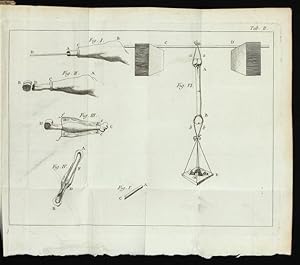
Erlangen, bei J.J.Palm und Ernst Enke, 1828, 4°, XXVIII, pp.29-198, ( 1 p. Druckfehler), (1 p. Verlagsanzeigen), 5 gefaltete Kupferstichtafeln, Halbledereinband der Zeit; St.a.Tit., Rücken erneuert, feines Exemplar. Erste deutsche Ausgabe "Nach dem nie bekannt gemachten Originale aus dem Italiänischen ins Deutsche übertragen, umgearbeitet, mit Anmerkungen, Zusätzen und einer Biographe des Verfassers versehen von Dr. J.J. Albrecht Schönberg". Einen Höhepunkt und zugleich Abschluss der experimentellen Forschung zur Knochenregeneration im 18. Jh. stellen die bestechenden Versuche von Michele Troja (1747-1828) dar. Um den Einfluss des Marks bzw. der Markhaut und des Periosts auf die Knochenbildung zu studieren, zerstörte er diese getrennt bei Tauben. Nach Amputation des Fußes oberhalb des Gelenks und Zerstörung des Marks und der Markhaut (Endost) kam es zur Knochenneubildung um den knöchernen Amputationsstumpf herum; nach der gleichen Amputation mit Entfernung des Periosts am knöchernen Amputationsstumpf trat die Knochenneubildung in der Markhöhle auf. Troja zog in seiner 1. Veröffentlichung "De novorum ossium regeneratione experimenta" (1775) - deren schlechtes Latein Haller beklagte - keine klaren Schlussfolgerungen aus seinen Experimenten. Trotz der Feststellung: "Nun behaupte ich, dass aus allem hier Gesagten klar hervorgeht: 1. Die Beinhaut sei das grosse Organ, das die Knochen selbst zur Bildung vorbereite, sowohl für das Wachstum, als für die Erzeugung der Knochen. Wo die Beinhaut fehlt, fand die Verknöcherung nicht statt", erkannte Troja auch in seinen späteren Mitteilungen das Periost nicht als Knochenbildner an und stellte sich damit, wie wir gesehen haben, gegen Duhamel du Monceau. Selbst Haller,der die brillianten Versuche Trojas bewunderte, wurde nicht klug aus seinen Vorstellungen über die Funktion der Knochenhaut: "Ist denn nun das Periost die Grundlage des neuen Knochens oder nur sein formgebendes Prinzip? (Num periosteum novi ossis aut materies sit aut modulus?)". So unterschiedlich und vielfältig die Vorstellungen über die Frakturheilung und Kallusbildung im 18. Jh. auch waren - nur eine Auswahl kontroverser Konzepte konnte skizziert werden - eines war doch deutlich geworden: dass der Knochen über ein natürliches Heilungs- und Regenerationsvermögen verfügt. Diese durch Experimente gefestigte Einsicht blieb nicht ohne Folgen für den chirurgischen Alltag. Mindestens teilweise wird das Eintreten für den Extremitätenerhalt bei komplexen Frakturen mit deren Heilungs- und Regenerationsfähigkeit begründet, so beispielsweise vom berühmten Oberwundarzt Friederich des Grossen, Johann Ulrich Bilguer (1720-1796), in seiner "Abhandlung über den seltenen Gebrauch. des Ablösens der menschlichen Glieder" (1761)." Vom Wandel unserer Vorstellungen über die Frakturheilung und Kallusbildung. Der Orthopäde 29 (2000), pp.1072-1081 Michele Troja, "zu Neapel, geb. 23. Juni 1747 zu Andria, studirte von 1765 an in Neapel, wurde durch Concurs Unter-Chirurg im Osp. S. Giacomo de' Spagnuoli, ging 1774, mit einem Stipendium versehen, nach Paris, wurde bald nach seiner Zurückkunft als Ober-Chirurg im Hosp. der Unheilbaren angestellt und bei demselben Lehrer der Augenheilkunde und der Krankhheiten der Harnorgane. Wegen glücklicher Behandlung des Kronprinzen wurde er 1781 zum Leibchirurgen der Königin Caroline und darauf auch des Königs ernannt und begleitete als solcher 1799 die königl. Familie nach Sicilien, kehrte aber 1812 nach Neapel zurück. Von seinen literar. Arbeiten sind anzuführen eine Uebersetzung von PORTAL'S während Troja's Aufenthalt in Paris erschienenem: "Rapport. . . sur les effets des vapeurs méphitiques . . . . avec , un précis des moyens. . . . . pour rappeler à la vie ceux qui ont été suffoques" (Neapel 1777) in's Italien. und als Frucht seiner früheren und in Paris fortgesetzten Versuche: "De novorum ossium in integris aut maxime ob morbos deperditionibus regeneratione experimenta" (Paris 1775; .


![Seller image for Lettera apologetica sulla vaccina in cui si esaminano le opposizioni di ogni genere fatte alla vaccinazione in Napoli 1803 [Leather Bound] for sale by Gyan Books Pvt. Ltd.](https://pictures.abebooks.com/inventory/md/md31434502290.jpg)
![Seller image for Neue Beobachtungen und Versuche über die Knochen: Mit 5 Kupfertafeln 1828 [Leather Bound] for sale by Gyan Books Pvt. Ltd.](https://pictures.abebooks.com/inventory/md/md31594718682.jpg)
