
Milli Davidis (1 results)
 More images
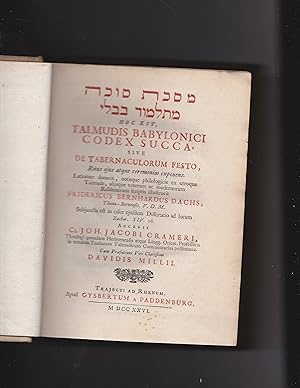
Maseket sukah mi-talmud Bavli hoc est, Talmudis Babylonici codex succa' sive de tabernaculorum festo, ritus ejus atque ceremonias exponens Latinitate donavit, notisque philologicis ex utroque Talmude, aliisque veterum ac modernorum rabbinorum scriptis illustravit Fridericus Bernhardus Dachs. Accedit Cl. Joh. Jacobi Crameri. Cum praefatione viri clarissimi Davidis Millii
Dachs, Fridericus Bernhardus, editor ; Cramer, Johann Jakob; Milli, Davidis
Language: Hebrew
Published by Gysbertum a Paddenburg, Utrecht 1726
- Hardcover
Seller: Meir Turner, New York, NY, U.S.A.Meir Turner
Contact seller5-star sellerCondition: Used - Very good
US$ 850.00
US$ 10.00 shippingShips within U.S.A.Quantity: 1 available
Hardcover. Condition: Very Good. No Jacket. In Hebrew and Latin. 8 leaves, 580 pages, 8 leaves of 3 indices. 206 x 156 x 47 mm. Vellum binding with gilt embossement: The Society of Writers to the Signet. Sukkah is a book of the Mishnah and Talmud. It is the sixth volume in the Order (Mishnaic section) of Moed. Sukkah deals prima…rily with laws relating to the Jewish holiday of Sukkot. It has five chapters. Included in its scope are the topics of: The Sukkah, or hut, which is lived in during Sukkot; Laws concerning each of the four species of vegetation which are waved during prayers over the holiday; The Celebration of the Water-Drawing (Hebrew: Simkhat Beit Ha-Sho'evah) which took place at the Temple in Jerusalem on the nights of Sukkot. The Society of Writers to Her Majesty's Signet is a private society of Scottish solicitors, dating back to 1594 and part of the College of Justice. Writers to the Signet originally had special privileges in relation to the drawing up of documents which required to be signeted, but these have since disappeared and the Society is now an independent, non-regulatory association of solicitors. The Society maintains the Category A listed Signet Library, part of the Parliament House complex in Edinburgh, and members of the Society are entitled to the postnominal letters WS. Solicitors in Scotland were previously known as "writers"; Writers to the Signet were the solicitors entitled to supervise use of the King's Signet, the private seal of the early Kings of Scots. Records of that use date back to 1369. In 1532, the Writers to the Signet were included as Members in the newly established College of Justice, along with the Faculty of Advocates and the Clerks of the Court of Session. The Society was established in 1594, when the King's Secretary, as Keeper of the Signet, gave commissions to a Deputy Keeper and 18 other writers. Writers to the Signet began as clerks to the Keeper of the Signet, and were afforded the privileges of freedom from taxation by the Burgh of Edinburgh, exemption from military duty, and rights of audience before the bar of the College of Justice. Writers were involved in drawing up summonses to the Court of Session. Writers were, however, de jure prohibited from acting as procurators but de facto this was often ignored. In 1599 it was proposed that the Faculty of Advocates and the Society of Writers be merged into a single organisation, but the Writers were against it. Such an idea was again proposed in 1633, but the Writers again opposed it. In civil actions in the Court of Session a pursuer is required to have his writ stamped with the Signet to give him authority from the monarch to serve the writ on the defender. That conferral, called "passing the Signet," was previously carried out by the Signet Office, the administration of which was one of the Society's responsibilities. In 1976 the Signet Office was merged into the General Department of the Court of Session and the Society was relieved of any responsibility for it. Nevertheless, the requirement of "passing the Signet" survives. The Signet Library was designed by Robert Reid with interiors by William Stark. It was finished in 1822 in time for the visit to Edinburgh of George IV. William Henry Playfair and William Burn were also involved in working on the building. The building is a classical masterpiece and is a category A listed building. The Society has become an independent professional body of solicitors. Its stated purpose is "promoting the highest standards in legal services" through the provision of education services including the Professional Competence Course (PCC) and courses in Continuing Professional Development.
