Order Total (1 Item Items):
Shipping Destination:

Mnemonics (3 results)
Author:
mnemonics
Refine with Advanced Search
Skip to main search results
Search filters
Product Type
- All Product Types
- Books (3)
- Magazines & Periodicals (No further results match this refinement)
- Comics (No further results match this refinement)
- Sheet Music (No further results match this refinement)
- Art, Prints & Posters (No further results match this refinement)
- Photographs (No further results match this refinement)
- Maps (No further results match this refinement)
- Manuscripts & Paper Collectibles (No further results match this refinement)
Condition Learn more
- New (No further results match this refinement)
- As New, Fine or Near Fine (No further results match this refinement)
- Very Good or Good (No further results match this refinement)
- Fair or Poor (No further results match this refinement)
- As Described (3)
Binding
- All Bindings
- Hardcover (No further results match this refinement)
- Softcover (1)
Collectible Attributes
- First Edition (2)
- Signed (1)
- Dust Jacket (No further results match this refinement)
- Seller-Supplied Images (3)
- Not Print on Demand (3)
Language (1)
Price
- Any Price
- Under US$ 25 (No further results match this refinement)
- US$ 25 to US$ 50 (No further results match this refinement)
- Over US$ 50
Free Shipping
- Free Shipping to U.S.A. (No further results match this refinement)
Seller Location
Seller Rating
-
Memo-Prop: A Super Memory for Everyone
Published by Bijou Hollywood Studios, Hollywood, 1949
Seller: Peruse the Stacks, ABAA, Gig Harbor, WA, U.S.A.
Association Member: ABAA CBA ILAB
Seller rating 5 out of 5 stars

First Edition Signed
First edition. A self-published system for memory improvement from the "self-taught 'Wizard' of the Art of Memory," M.A. Ree, actually Emmerich or Emery Bernauer. This copy warmly inscribed to Felix Guggenheim, German American publisher and literary agent in Los Angeles, and his wife, Evelyn. Bernauer published this booklet and another calledMedical Scrapbook,which he sold via mail and by advertising through magazines such asPopular ScienceandAmazing Stories.The yearMemo-Propwas published, Bernauer had a daughter, also named Evelyn, who went on to become a child tv star starring as "Eloise" in the adaptation of the Kay Thompson book. Evelyn (Rudie) is now the co-artistic director of the Santa Monica Playhouse, as well as a writer and director. She has noted in an email which can be found on occultathesauri, she uses her fathers memory system to this day. Not surprisingly, we find no mention of this publication in OCLC. 11x8.5" [4], 41pp. Inscribed by the author to Felix and Evelyn Guggenheim on the title page. Mimeographed sheets, with tables, illustrations, diagrams, etc. Illustrated card wrappers, staple bound and reinforced with red tape. Few light stains and some toning to covers, small tear along bottom edge. Very good.
-
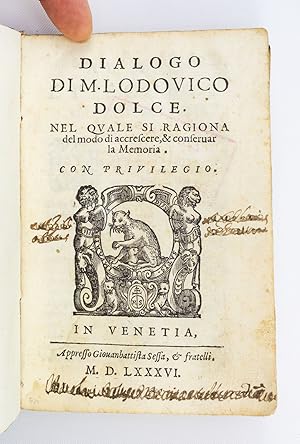
DIALOGO DI M. LODOVICO DOLCE. NEL QUALE SI RAGIONA DEL MODO DI ACCRESCERE, & CONSERVAR LA MEMORIA
Published by appresso Giovanni Battista II Sessa & fratres, Venezia [Venice], 1586
Seller: Phillip J. Pirages Rare Books (ABAA), McMinnville, OR, U.S.A.
Seller rating 3 out of 5 stars

147 x 100 mm. (5 3/4 x 4"). 118, [1] leaves. Contemporary limp vellum, flat spine with title written in ink, newer (20th century?) endpapers. With eight half-page woodcuts in the text and 15 full-page woodcuts. Verso of title page with red ink "Duplicate" stamp of the library of Bernard Zufall. Young, "Bibliography of Memory," p. 91; Mortimer, Italian 157 (for 1562 edition, mentioning 1586 edition); EDIT16 CNCE 17422; USTC 827157. See also: Terpening, "Lodovico Dolce, Renaissance Man of Letters." ?Vellum a little wrinkled and somewhat soiled, but the simple binding still sound; first and last two quires with faint dampstain to lower quadrant, occasional minor browning or foxing, but still excellent internally, generally clean and fresh. Using charming woodcuts to help the reader visualize the methods described, this is a treatise on memory that explores how one can systematically employ various tricks and devices to increase retention and preserve information. The work is an Italian paraphrase in dialogue form of the "Congestorium Artificiose Memorie" by Johann Host von Romberch, printed by Giorgio de' Rusconi in 1520 and reprinted by the Sessa press in 1533; both of these earlier editions used the same blocks (except for that on f. H6r, which Mortimer notes is a "close copy" of the original) that appear in the present copy. Dolce's treatise was first printed by the Sessa brothers in 1562. Among the illustrations, there are three of special note: a cut of the human head, its cerebral cavity labelled with parts relevant to the memory; a row of 10 woodcut images of items to be found in a Renaissance library, as tools to be used in a memory system; and, perhaps most significant, a city view that includes the exterior of a bookstore, with books on display in the window. This cut is one of the earliest graphic depictions of the outside of bookselling premises to appear in a book. Italian writer and scholar Lodovico Dolce (1510? - 68) was a highly influential figure in 16th century Venetian art and literature. According to Terpening, Dolce was "responsible for over a quarter of the books published in Venice in his time," including works in most major genres, translations of Greek poetry and plays, and numerous original compositions. As such, he "played a decisive role in the dissemination of culture in the cinquecento." Today Dolce is chiefly remembered for his work "L'Aretino," a dialogue on painting and art criticism. The present copy comes from the library of magician and memory expert Bernard Zufall (1894-1971), known as the "Human Encyclopedia." Zufall amassed the largest known collection of books on mnemonics, in excess of 1,000 titles, which (except for duplicates like the present work) he donated to Yale University.
-
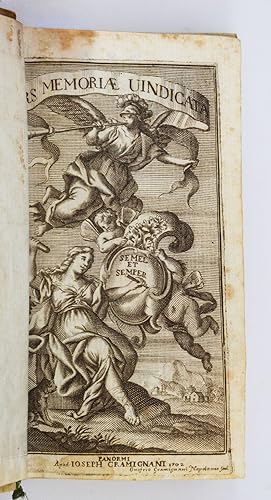
ARS MEMORIAE VINDICATA: ACCESSIT ARTIFICIUM POETICUM AD SCRIPTURAS DIVINAS IN PROMPTU HABENDAS
Published by Joseph Gramignami, Panormi [Palermo], 1702
Seller: Phillip J. Pirages Rare Books (ABAA), McMinnville, OR, U.S.A.
Seller rating 3 out of 5 stars
First Edition
FIRST EDITION. 140 x 70 mm. (5 1/2 x 3"). 24 p.l., 225, [115] pp. Contemporary stiff vellum, smooth spine with gilt lettering. Added engraved allegorical title page, printer's device on printed title page, wood-engraved head- and tailpieces. Final [114] pages printed vertically. Verso of title page with red ink "Duplicate" stamp of the library of Bernard Zufall. âVellum lightly smudged and with slight crease at one corner, short, thin stain to text of two facing leaves, text versos with small inner margins, bottom edges of charts trimmed very close (sometimes just grazing text, but without costing any complete letters), isolated minor foxing and other trivial defects, but a generally clean and pleasing copy, without any fatal condition issue. This 18th century work on the art of memory comes from the library assembled by a magician known as the "Human Encyclopedia." Bernard Zufall (1894-1971) amassed what was considered to be the largest collection devoted to mnemonics, with more than 1,000 titles; he bequeathed all but a few duplicates (of which this is one) to Yale University. Giovanni Brancaccio (1673 - after 1738) was an attorney in Sicily who also took an interest in literature and medicine, and who had a special curiosity about memory. In this work, he cites feats of memory by historical figures, before presenting tips for memorizing Holy Scripture. This is a book rarely seen in the marketplace, and OCLC finds just eight copies in libraries, three of these in North America.