

Order Total (1 Item Items):
Shipping Destination:

Multipe Authors (11 results)
Skip to main search results
Search filters
Product Type
- All Product Types
- Books (2)
- Magazines & Periodicals (No further results match this refinement)
- Comics (No further results match this refinement)
- Sheet Music (No further results match this refinement)
- Art, Prints & Posters (No further results match this refinement)
- Photographs (No further results match this refinement)
- Maps (No further results match this refinement)
- Manuscripts & Paper Collectibles (9)
Condition Learn more
- New (No further results match this refinement)
- As New, Fine or Near Fine (No further results match this refinement)
- Very Good or Good (10)
- Fair or Poor (1)
- As Described (No further results match this refinement)
Binding
Collectible Attributes
- First Edition (No further results match this refinement)
- Signed (7)
- Dust Jacket (No further results match this refinement)
- Seller-Supplied Images (8)
- Not Print on Demand (11)
Language (1)
Free Shipping
Seller Location
Seller Rating
-

After Dinner Stories by Famous Men: As told by King George of England, President Wilson [& others including 5 women
Published by HEARST'S INTERNATIONAL LIBRARY CO, NEW YORK, NY, 1914
Hardcover. Condition: Good. OWNER NAME; NO MARKING; SOME PASTEDOWNS INSIDE BACK COVER.
-
Cooking Out-Of-Doors
Published by Girl Scouts Of America, 1946
Seller: Crotchety Rancher's Books, Dalton Gardens, ID, U.S.A.
Seller rating 5 out of 5 stars

Paperback. Condition: Good. Sharon Melick (illustrator). Softcover, Rare Out Of Print Cookbook Put Together By The Girl Scouts Of America Just After Wwii. Bit Yellow With Age, But Overall In Very Good Condition, Front Cover Has A Light Coffee Ring Stain On It And A Scuff From Someone Removing A Tag In The Past.
-

1957 Internal US Navy Documents Transferring a Reserve Commander to Raleigh, North Carolina
Published by United States, 1957
Seller: Katz Fine Manuscripts Inc., Cochrane, AB, Canada
Seller rating 5 out of 5 stars
Manuscript / Paper Collectible
Ephemera. Condition: Good. On offer are two United States Navy internal documents, dated 1957, regarding Commander Thomas F. Armstrong's posting. Commander Armstrong served in the United States Naval Reserve. On September 20, 1957, he had written to the Commandant, SIXTH Naval District inquiring about a request to be attached to the Naval Reserve unit in Raleigh, North CarolinaThe reply, dated September 26th, indicates that no decision has been made and that he remains on temporary pay status. The second document is titled Office Memorandum United States Government and is dated September 30, 1957. It requests that orders be issued assigning Armstrong as Commanding Officer of the Naval Reserve unit in Raleigh, North Carolina. For a historian, especially a US Naval historian, these documents are classic examples of the Naval administration and bureaucracy in place at that time. The first document measures 10.5 inches by 8.0 inches. It is a carbon copy of a letter. The paper is in good condition and the text is quite legible. The second document measures 5.25 inches by 8.0 inches. It is a memo. The paper is in good condition and the typed contents are quite legible. ; 8vo 8" - 9" tall; 2 pages.
-

Lovely Collection of Manuscripts from 18th and 19th Century France
Published by France
Seller: Katz Fine Manuscripts Inc., Cochrane, AB, Canada
Seller rating 5 out of 5 stars
Manuscript / Paper Collectible Signed
Ephemera. Condition: Good. Dust Jacket Condition: No Dust Jacket. On offer is a fine collection of documents and fragments of French correspondence from the 18th and19th centuries. This collection contains four manuscripts from 18th century France and one printed pastoral letter from the Cardinal Archbishop of the French Archdiocese of Bourges. The first document is dated 1711. The handwriting in the document is beautiful calligraphy. It appears to have been written by Jan (possible Jean) d'Alencon, Sieur des Esssrts, a titled property in west central France. Our informal research has not been able to find any additional biographical information about him. The second document is a printed form dating from some time in the middle of the 18th century. Stamped into heavy paper is a tax assessment form Droits Royaux Sur Les Soyes (Royal Duties on Silks). Following blank spaces for a vendor to record their name and details of the shipment, is a notation about "Lyon". Lyon was the heart of the French and European silk industry. From the 15th and 16th centuries, silk was traded in the great fairs held in the city. In 1540 the French king, Francois I, granted Lyon a total monopoly on raw silk imports into France. Lyon became the capital of the European silk trade. The third document is dated 1773. It bears a faded crest/coat of arms imprint. The signature is not quite readable. The handwriting on this document is also a very beautiful, precise calligraphy, The fourth document is dated 1777 as well. It appears to be a legal document, requesting an adjournment of a possible action or dispute between two persons, one of whom is identifies as Jean Baptiste d"Estienne de Barlemont. This document also bears a seal with the word : Provence" clearly marked. The fourth document was written in 1777. This document contains a fair amount of verifiable information within it. It appears to have been written to the Intendant or Governor of the port of La Rochelle on France's north west coast. This man was Marie-Pierre-Charles Meulan d'Ablois. He was Intendant from 1739 to 1814. The letter was written by Pierre Jean Vanhoogwerff. According to records, Vanhoogwerff was a businessman and merchant trader. He owned a ship called "La Betsy" and was an active player in the African slave trade. He was also, according to this letter, serving as Vice Consul for the King of Denmark in the port of La Rochelle. The purpose of his letter was to seek relief from a particular tax imposed quite likely on his own ship. He refers to "Monseigneur De Sartine" when referencing this tax. "Monseigneur De Sartine" was Antoine de Sartine, the powerful Secretary of the Navy for Louis XVI. De Sartine was a highly accomplished bureaucrat who had honed his administrative skills during a 15-year tenure as the Lieutentant General of Police for the City of Paris. The de facto chief administrative officer for the city, he instituted a wide range of very successful reforms to the city, significantlyenhancing life for the ordinary Parisian. Among his accomplishments was establishing a Police Secret Service that became the model for all secret services across Europe. He was singularly responsible for imprisoning a very large percentage of those held in the Bastille something that would come back to haunt him in the future. It is reported that he once boasted to Louis XV, "Sire, whenever three people speak to one another in the street, one of them will be mine. " As Minister of the Navy, he overhauled the country's vast harbour and shipping tax system. At the bottom of the letter is a notation dated Jan 29th, 1778 granting the request. The final document is a printed address written by the Cardinal Archbishop of the Diocese of Bourges. This man was Jean Pierre Boyer. Boyer was born in 1827. He was ordained a Catholic priest in 1854 and consecrated a Bishop in 1878. Pope Leo XIII created him Cardinal in 1895. Boyer passed away in 1896 at the age of 67. The document is a pastoral letter entitled Nos Destinees Eternelles et Mandement Pour le Saint Te.
-
Marquess De Auxillon's 1800s Property Tax Documents from Sauveterre, France
Published by Sauveterre, France
Seller: Katz Fine Manuscripts Inc., Cochrane, AB, Canada
Seller rating 5 out of 5 stars
Manuscript / Paper Collectible
Ephemera. Condition: Good. Dust Jacket Condition: No Dust Jacket. On offer is a collection of a minor French nobleman's receipts and documents dated 1870 to 1873.This collection of two dozen documents tell the tax story of the Auxillon (sometimes spelled Auxilhon) property in the town of Sauveterre in southern France. The property in question is a castle built in the 16th century by the Auxillon family. To this day, the property is owned by descendants of the founding Auxillons. The Auxillion family originally came from the Picardy region of France. The original castle that sat on the lot in Sauveterre had been destroyed in the early 1400's and was sold as a ruin to the Auxillion family who rebuilt it over a number of years. During the French Revolution, it was looted by mobs when the owners fled for their lives. After the Restoration, the castle was returned to the family and it was reconstructed. These documents detail some of the various taxes that the family paid during the years 1870 to 1873. Some taxes are on the real property and chattels. Other taxes refer to road maintenance and upkeep. In 1870, the property belonged to Clemence Anne De Rocus de Cahuzac, the widow of Maximilien August de Gairaud d'Auxillon, the Marquis de Auxillon. He had passed away in 1860. The note is unaddressed and unsigned but appears to be a reply to an inquiry on tax amounts owing: An excerpt of the note follows: Madame la Marquise d'Auxillon est imposee pour le vacants qu'elle jouit a 66Ff d'impot. Si le Counseil municipal n'avait pas egard a la grande quantite de vacants qu'elle jouit, elle devrait payer au tous des autres d'etenteurs de vacants la somme de 166Fr. [Translation: Madame la Marquise d'Auxillon is taxed for the vacancy she experiences at 66Ff of tax. If the City Council had not taken into consideration the large number of vacancies she experiences, she would have to pay to all the other vacancy holders the sum of 166Fr. ]. The taxes she pays are, relative to average annual income, substantial, which suggests that the family is well off. For an economist, these receipts are detailed and give a very good picture of part of the tax burden of owning such a property in France under Napoleon III. These were turbulent times as military tensions between France and Prussia were at an all-time high. In fact, during this year, war would break out between the two countries. France would suffer a humiliating defeat and this laid the foundations for WWI. The collection includes a one page Note (8.5"x7") , 15 tax receipts of varying sizes and eight tax notices. ; Manuscripts; 24 pages.
-

19th Century Letter to French University Dean from Staff Requesting Autonomy in Their Roles
Published by France
Seller: Katz Fine Manuscripts Inc., Cochrane, AB, Canada
Seller rating 5 out of 5 stars
Manuscript / Paper Collectible Signed
Ephemera. Condition: Good. Dust Jacket Condition: No Dust Jacket. On offer is an excellent communication between a 19th century French university dean and several ofhis staff. The document is a letter, written by 3 persons to an unidentified 'Dean' (Doyen). Context puts this in an academic setting. The letter opens with this: nous nous honourons toujours des function que vous voulez bien nous confuie; nous pouvons repondre de notre zele a les remplir; mais nous avons de nos lumieres une assez juste definace pour croire n'avoir bien fait qu'an moment ou vous avez sanctione notre ouvrage ce qui nous donneroit quelque confinace dans le travail que nous allons mettre sous vos yeux est la bonte du principe qui nous a de conduir; car quoique nous fuissons disposes a ecouter vos interests l'espirit de conpra dont il sembloir permis d'attendre et de savoir quelque inspirations. [Translation: we are always honoured by the functions that you are willing to entrust to us; we can answer with our zeal to fulfill them; but we have of our lights a fair enough definition to believe that we have done well only when you have sanctioned our work, which gives us some confinement in the work that we are going to put before your eyes is the goodness of the principle that has led us; for even though we are willing to listen to your interests, the spirit of understanding seems to allow us to wait and to await some inspirations]. This 8 page letter is an excellent example to the tenor and substance of academic exchanges that were taking place in the academic environment of early 19th century France. For an academic or academic manager, it would be a fine addition to a personal collection. The document is 8 pages in length and is comprised of 2 sheets of paper, both folded in half to create 2 leaves. The paper is a pale blue in colour. The pages measure 8.75 inches by 6.75 inches and are in good condition. The handwriting is legible. ; Manuscripts; 8vo 8" - 9" tall; 8 pages; Signed by Author.
-
19th Century Collection of French Letters to Paris Nobleman Marquis de Beaumont
Published by France
Seller: Katz Fine Manuscripts Inc., Cochrane, AB, Canada
Seller rating 5 out of 5 stars
Manuscript / Paper Collectible Signed
Ephemera. Condition: Good. Dust Jacket Condition: No Dust Jacket. On offer is a collection of eight letters written to a French nobleman, Marquis de Beaumont of Paris, between 1852 and 1886. Our research points to this being André Jacques Leopold Bonnin de la Bonninière de Beaumont. The Beaumont family is an old, tiled family in France whose roots for back to the 11th century in southeastern France. Over the centuries, the Beaumont family evolved along 4 main lines or branches. Throughout their history, the Beaumonts played central roles in France's public life, most often in the military. The list of accomplishments and honours that members of the family have earned in the service of France are extensive. The letters were written by a variety of people and offer an interesting look at some of the relationships the Marquis had with others and things that attracted his interest, as illustrated in this excerpts: Je ont empresse de mettre totes vos yeux un feuilleton de Musee des Sciences traitant de la formation de houilles comme devant attirer toute notre attention.[1856, Godefray]. [Translation: I have hastened to put in front of your eyes an article from the Museum of Science dealing with the formation of hard coal as if it should attract our full attention]. Je te remercie mon cher de la confiance que tu as en moi. Je t'en remercie du fait du coeur et voudrais pouvoir t'eu temoingnir ma gratitude autrement que par de remerciements bien sincere[Undated]. [Translation: I thank you, my dear, for the trust you have in me. I thank you from the bottom of my heart and I would like to be able to show my gratitude to you other than with sincere thanks]. Most of these letters bear an embossed coat of arms, including that of the prestigious Jockey Club de Paris. Obviously, this is a man who is well-connected and also held in high esteem. For a social historian, these letters offer a glimpse into the life of a French nobleman in the last half of the 19th century. Letters were written between 1852 and 1886, and there is one undated letter. All letters are in good condition, showing normal signs of age. All letters in this collection measure 8.25" x 5.25". ; Letters; 8vo 8" - 9" tall; 8 pages; Signed by Author.
-
27 Letters Spanning 108 Years Related to the Société Des Auteurs Et Compositeurs Dramatiques
Published by N.D., France
Seller: Katz Fine Manuscripts Inc., Cochrane, AB, Canada
Seller rating 5 out of 5 stars
Manuscript / Paper Collectible Signed
Ephemera. Condition: Fair. Dust Jacket Condition: No Dust Jacket. On offer is a terrific collection of correspondence with France's most prestigious literary societies, the Société des Auteurs et Compositeurs Dramatiques (SADC) , which translates to the Society of Dramatic Authors and Composers (SDAC). These letters span more than a century, from 1880-1988, and offer both a sample of SDAC activities and a hint as to what was happening over the century within the world of the arts in France. The history of the SADC (SDAC) dates back to 1777, when a group of twenty-two authors, led by Pierre-Augustin Caron de Beaumarchais, got together to form the first "Society for dramatic legislation" and laid down the basis for the Society of Dramatic Authors and Composers: SDAC. Among de Beaumarchais' many works was the play Marriage of Figaro upon which the great opera by Mozart is based. In addition to being very much a Renaissance man, Beaumarchais was an early supporter of the American Revolution. Originally he called their group the "Bureau of Dramatic Legislation" and its goal was to have legislation passed that would protect the interests of authors and their works in short authors' rights (as distinct from copyright). It is the founding act of the organization which in 1829 will merge with another group to form the SADC (SDAC). From that time onward, SADC (SDAC) has been in the forefront internationally in advancing the rights of authors of all types of creative works to ensure that they are justly compensated for their efforts. Along with other organizations, it played a key role in the 1886 Berne Convention, the international agreement governing copyright which continues to this day as the World Intellectual Property Organization, an official organization within the United Nation. It participates in both national and international debates and activities to protect and promote the interests of those working in the creative arts. The letters are varied in content and appearance, and are from many different authors. Some are on letterhead. One bears a monogram. Several are from 'Agents' which suggests that SDAC operated through a series of agencies located in major cities throughout France and in neighbouring countries. This from their Agent in Brussels on his letterhead, written in 1880: Cher Monsieur Roger Mr m'advise que les auteurs dedu Petit Due [ ] authorise M. Laurion arepresenter leurmeme. Ils retiramet aussi la piece [ ] de theatre Fantastic Parisienne.[Translation: Dear Mr. Roger Mr. [ ] advises me that the authors of the Petit Due [ ] authorize Mr. Laurion to represent themselves. They also withdraw the play [ ] from the theatre Fantastic Parisienne.]In a 1909 letter from SACD's Mon Agency, under the direction of Jules Friart, the society's Agent-General is advised that: J'ai le honeur de vous faire connaitre comme suite a votre lettre des Janvier courant y'en effet une representation de la piece intitulie "Les Nuits Du Hampton Club" a ete donnee au theatre de cette ville le 5 decembre 1908.[Translation: I have the honour to inform you that, following your recent letter of January, a performance of the play entitled "Les Nuits Du Hampton Club" was given at the theatre of this city on December 5, 1908]. Friart was active in the theatre world of Mons and in the 1830's was the stage manager for a theatre in the City. During WWI, the Society continued to function, although it was certainly effected by it in many ways. There are two letters from a lawyer in Avignon. In one letter dated 1915, he writes: J'ai l'honneur de vous expose que j'avais organise le 10 juillet dernier une representation de charite au theatre municipal d'Avignon au profit de l'oeuvre des [ ] de la guerre.[Translation: I have the honour to inform you that on July 10th I had organized a charity performance at the municipal theatre of Avignon for the benefit of the work of the [ ] of the war.]. Following WWII, the Society maintained its activities, as evidenced by a card sent from the Society's Agent in Brussels in 1949.
-
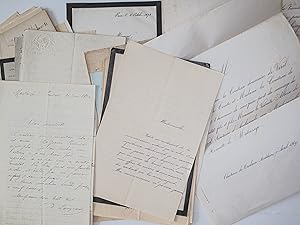
20 Years Worth of Personal Correspondence of a 19th Century Upper Class French Woman
Seller: Katz Fine Manuscripts Inc., Cochrane, AB, Canada
Seller rating 5 out of 5 stars
Manuscript / Paper Collectible Signed
No Binding. Condition: Good. No Jacket. On offer is an outstanding collection of 53 pieces of personal correspondence to and from a wealthy woman in the late 19th century France. The letters were written between 1869 and 1889. The majority consist of personal correspondence but there are several other items with them including an invoice and some wedding announcements. From context, it appears that these letters and documents belonged to Alice Reveliere. Also referred to as Alice Crotot-Reveliere, it seems that she lived in the small community of Chateau Renaud to the north of Paris. Our informal research has found references to a Count Etienne Reveliere and the name Etienne appears in several letters. Some of the letters bear an embossed coat of arms with the notation "Chateau Renard". As well, there are two formal wedding announcements of the marriages of children of Viscount de Maleissye which would normally not be directed to people outside their social class. Many of the letters are addressed to either "Mademoiselle" or, in some cases "Ma Chere Marie" As it happens, the recipient in this case is Mlle Marie Distriut. Our informal research has not been able to turn up any additional biographical information about her. Reveliere and Distiut carried on an extensive correspondence. Other letters are exchanged between her and a woman named Alice Blanchet. As all use the salutation "Mademoiselle", the reader may assume they are unmarried, possibly younger women. Other connections include letters from two attorneys based in Chateau Renard discussing her affairs. There is correspondence from her bankers in Paris detailing financial transactions. The following are some excerpts which can give a flavour of the collection: Loins de vous je n' aurais pas demain le bonheur de vous presenter de vive vous mes souhaites de nouvel an. [Translation: Far from you tomorrow I would not have the happiness to present to you my new year wishes December, 1880, letter from Alice Blanchet].This letter, written by Marie Destiut to Alice Reveliere reveals a warm closeness between the tow. And, like many of the letters she received, contains a reply. An excerpt follows: Chere MademoiselleDimanche nous avons ete bien contents en voyant arrives M Etienne; Je vous [ ] dans l'espereance que vous acceptez la petite invitation de celle qui vous embasse[Translation: Dear MissSunday we were very happy when we saw M Etienne arriving; I in the hope that you accept the little invitation from the one who kisses you]Releviere replies as follows: Ma Chere MarieJe vous remercie de votre amable invitation mais je crians de ne pouvant repondre malgre le desire.[Translation: My Dear MarieThank you for your kind invitation but I cry out that I cannot answer despite the desire]There is correspondence from Crotet-Releviere s bankers in Paris confirming a stock transaction. Charles Laurent s letterhead indicates that he is an Agent de Change or Stockbroker, located in Paris. In this correspondence, the stockbroker indicates that his client is active in the stock market. A statement of account from her broker shows a credit balance in her account of 80531.75 francs, equal to approximately US$1.1 million today. To put this into perspective, the average daily wage in France at this time was about US$1.00 per day. The wedding announcements included in the archive invite the recipient to the marriage of the daughter of Monsieur the Viscount and Madam the Viscountess of Maleissye to Monsieur Viscount Alban de Virel, Secretary of Embassy. For a social historian, this collection of letters offers an outstanding window into the life a very wealthy woman living in the Second French Republic. The letters are warm and friendly. Yet they also point to her family s wealth. Taken together, one can see a vivid contrast with the life of an ordinary woman of average means in late 19th century rural France. This collection consists of 53 letters. Although of various sizes, they are for the most part about 8.25 inches. Signed by Author(s).
-

1865 Voyage Archive of the Spanish Coolie-Ship "encarnación", Including Arrival Notice, Telegram, Quarantine Actas, Mariel Certification, the Signed Manifest and More
Publication Date: 1865
Seller: Katz Fine Manuscripts Inc., Cochrane, AB, Canada
Seller rating 5 out of 5 stars
Manuscript / Paper Collectible Signed
No Binding. Condition: Good. No Jacket. On offer is a rare, tightly focused five-day Cuban colonial archive documenting how the Spanish barque Encarnación and the 283 Chinese indentured labourers she carried from Macao were processed by the Cuban state in March 1865. Produced between March 20 24 and docketed throughout as File No. 539, these thirteen manuscript documents capture in unusually complete form the procedures applied to a coolie ship upon arrival: medical inspection, mortality reporting, judicial review, administrative circulation, and the first legal redistribution of labourers. The Encarnación is a known vessel in the scholarship of the Chinese coolie trade. As John Asome notes, she made eight voyages between 1853 and 1871, transporting 2,547 migrants with a 4.91% mortality rate. Her 1864 65 voyage left Macao on November 23, 1864 and arrived in Havana with 274 survivors. The Mariel medical reports preserved here describe a voyage marked by ophthalmia, ulcers, dysentery, anasarca, pulmonary fevers, and one death from tuberculosis. These records show how inspectors evaluated health conditions, certified compliance, and recorded disease patterns at the moment of landing. The Chinese coolie trade (1847 1874) relied on a bureaucratic system designed to present indenture as free contracting while maintaining strict control over labourers. This archive documents that machinery with rare clarity. It includes two Mariel medical actas (one a four-page certified report), a mortality declaration, a judicial referral ordering confirmation of the labourers legal status, a police authorization permitting disembarkation, a final sanitary clearance, and the four-folio passenger manifest listing all 283 individuals by Chinese and assigned Christian names. The final document assigns 36 labourers to patrons and orders the issuance of their cédulas. All thirteen pieces were created within a single week, giving the file remarkable internal coherence. March 20 is the most active day, generating the arrival notice, the telegram declaring the ship del todo perdida, the consignees petition, the mortality note, both Mariel actas, and the complete passenger manifest. Subsequent days carry the process forward with judicial review (March 21), police authorization and sanitary clearance (March 22), forwarding of medical documents (March 23), and labour assignment (March 24). Together, these papers reveal how Havana and Mariel authorities transformed an arriving vessel into a legally documented source of plantation labour. For institutions or collectors focused on Chinese diaspora history, Caribbean labour systems, colonial governance, or the transition from slavery to contract labour, this is a rare survival: a near-complete administrative cycle tracing the arrival, inspection, documentation, and redistribution of a single coolie ship in real time. Condition is very good, with strong legibility throughout and the four-folio manifest complete and structurally sound. [This is a condensed listing to meet this site's word count requirements. Please contact us for a full, detailed listing and to discuss acquisition]. Signed by Author(s).
-
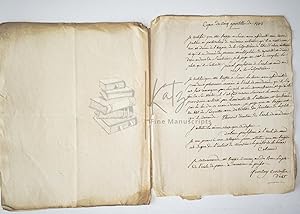
1816 Archive of Reference Letters for Applicants for Director of the Necker Enfants Malades Hospital
Publication Date: 1816
Seller: Katz Fine Manuscripts Inc., Cochrane, AB, Canada
Seller rating 5 out of 5 stars
Manuscript / Paper Collectible Signed
No Binding. Condition: Good. No Jacket. On offer is an excellent collection of reference letters for applicants to replace the Director of The Necker Enfants Malades Hospital, one of France s foremost hospitals. From the context of the letters, it appears that in 1816, the Director of the Necker Hospital, one Monsieur Mougenot, had passed away. A number of applications for his position were received. These letters speak to the applications of three doctors who are seeking appointment to the position. Each extols the virtues of the relevant applicant and offers an insight into the medical practices of the times. There are also references to "le Vicomte" or Viscount. Indeed, there are letter addressed to simply Le Vicomte". Context suggests that this could be a reference to François Alexandre Frédéric de La Rochefoucauld-Liancourt, duc de Rochefoucauld. There is no direct evidence but Rochefoucauld was a very prominent social reformer of the time. He was active in the administration and operations of medical facilities. He was one of the first promoters of vaccinations in France. He had established a dispensary in Paris and he was an active member of the central boards of administration for hospitals. Alternatively, a second possibility for the unidentified Vicomte is Mathieu Jean Felicité de Montmorency, duc de Montmorency-Laval. Montmerency was a very close friend to Germaine de Stael, the daughter of Jacques and Suzanne Necker, Montmorency was also a senior member of the French nobility, wealthy and very well connected in Paris. Of Doctor Nysten, an unsigned letter states: Il a fait partie de la commission educale que le gouvrenment envoya dans le midi d'Espagne en 1805 pour arretez le progress de la fievre jaunes. [Translation: He was part of the educational commission that the government sent to the south of Spain in 1805 to stop the progress of the yellow fever]. Another is a note from Dr. Nysten to his father. There is evident pride in this short missive: Je veut envoi cher papa un note qui m'ete donne par un de ma collegues. [Translation: I want to send dear Papa a note that was given to me by one of my colleagues]. Another applicant, a Monsieur Trederu, submits a glowing letter of reference from the curator of the Mazarine Library. The du Bois letter is a request to an unnamed Vicomte to discuss the vacancy at Necker Enfants Malades. Again, context suggests that the obvious unnamed Vicomte is in fact Rochefoucauld as he was deeply involved in the social and medical issues in Paris at that time. Philibert du Bois, secretaire general de l'academie de medecine de paris est venu pour avoir l'honneur de vous presenter les respects et vous prieur de vouloir bien etre favorable a la demands qu'il a presentie au confeil des hospices relativement a la place vacante a l'hopital Necker et l'hopital des enfants[Translation: Philibert du Bois, secretary-general of the medical academy of Paris has come to have the honour to pay you his respects and to ask you to be favourable to his request to the council of hospices concerning the vacant place at the Necker hospital and the children's hospital]. History of The Necker Enfants Malades Hospital: The Necker Enfants Malades Hospital is a French teaching hospital It was created in 1920 by the merger of Necker Hospital (Hôpital Necker) , which was founded in 1778 by Suzanne Necker, (wife of France s Minister of Finance, Jacques Necker) and the Sick Children's Hospital located next door. The Sick Children s Hospital is the oldest children's hospital in the Western world, founded in 1801. Jacques Necker was a leader in the movement to reform crowded hospitals by building smaller treatment centres closer to the patients' neighbourhoods. Madame Necker subsequently remodelled an old monastery into the hospital which, prior to the French Revolution, was known as the Hospice de Charité. Male and female patients were kept separate from each other, as many hospitals of the time did. Triage procedures, established all over Paris. Signed by Author(s).


