Order Total (1 Item Items):
Shipping Destination:

Murphy Sambrook (1 results)
Skip to main search results
Search filters
Product Type
- All Product Types
- Books (1)
- Magazines & Periodicals (No further results match this refinement)
- Comics (No further results match this refinement)
- Sheet Music (No further results match this refinement)
- Art, Prints & Posters (No further results match this refinement)
- Photographs (No further results match this refinement)
- Maps (No further results match this refinement)
- Manuscripts & Paper Collectibles (No further results match this refinement)
Condition Learn more
- New (No further results match this refinement)
- As New, Fine or Near Fine (No further results match this refinement)
- Very Good or Good (1)
- Fair or Poor (No further results match this refinement)
- As Described (No further results match this refinement)
Binding
- All Bindings
- Hardcover (No further results match this refinement)
- Softcover (1)
Collectible Attributes
- First Edition (1)
- Signed (No further results match this refinement)
- Dust Jacket (No further results match this refinement)
- Seller-Supplied Images (1)
- Not Print on Demand (1)
Language (1)
Price
- Any Price
- Under US$ 25 (No further results match this refinement)
- US$ 25 to US$ 50
- Over US$ 50 (No further results match this refinement)
Free Shipping
- Free Shipping to U.S.A. (No further results match this refinement)
Seller Location
Seller Rating
-
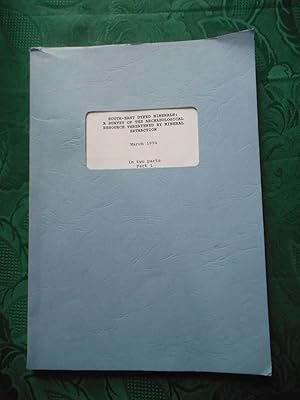
South-East Dyfed Minerals: A Survey of the Archaeological Resource Threatened by Mineral Extraction" March 1994: In Two Parts - Part 1.
Published by Printed for CADW, Cardiff, 1994
Seller: Sue Lloyd-Davies Books, CARMARTHEN, United Kingdom
Seller rating 5 out of 5 stars

First Edition
US$ 34.35
US$ 35.93 shipping
Ships from United Kingdom to U.S.A.Quantity: 1 available
Add to basketPaperback. Condition: Very Good. Dust Jacket Condition: No Dust Jacket. First Edition. A Report commissioned by CADW prepared by the Authors, and with Dyfed Archaeological Trust as Consultants. Seemingly privately produced in a 'Thesis' format with blue card covers and printed computer typescript inside. The former owner has written the title to the spine in ink. Clean and sound except that the first page is beginning to come adrift from the glue holding the text block into the cover. No inscriptions or other marks, minimal shelfwear. Approximately 42 pages of A4, printed on one side only, followed by 27 maps, some A4, some folded A3. Some of the maps are beginning to escape from the glue as well, but holding so far. Apparently this is a report which remains unpublished according to some sources. The purpose of this project is to gain more information on the sites and monuments and associated landscapes of S. E. Dyfed threatened by mineral extraction. This will enable the Trust & Cadw to assess their relative importance & provide a consistent and objective basis for planning advice. Initially, a desk top study was carried out. The information gained from this was supported by field visits to rapidly assess the present state of the archaeological resource. In total, about 850 new sites were identified & examined. Many other sites which were recorded only through documentary sources on Dyfed Archaeological Trust's Sites & Monuments Record, also benefited from a field visit. The greatest number & highest density of sites were recorded on Carboniferous limestone & millstone grit. The vast majority of these sites are associated with the limestone extraction & burning industry. The number & density of archaeological sites on the coal measures was far lower. Here, though, there is a greater range of archaeological sites & a greater diversity in the historic landscape. Except for the working areas of large quarries, all the land with planning permission for quarrying was examined. Because of lack of time, it was not possible to visit all the sites which British Coal have designated as areas of future interest. However, an approximately equal amount of ground was examined in the field, in the limestone/millstone grit part of the survey and in the coal-field survey area. Because of the large number of sites associated with limestone quarrying & burning recorded in this survey, a greater emphasis was placed on the background study of this industry rather than on the study of the coal mining industry and sites of earlier periods. All the records generated during the course of this survey have been integrated with Dyfed Archaeological Trust's computer-held Sites and Monuments Record. The numbers referred to in this study are the record numbers on the SMR (see section 11 Catalogue of sites). Part One Only. See Images. ; 4to 11" - 13" tall.