Order Total (1 Item Items):
Shipping Destination:

Murray John Sutherland (4 results)
Skip to main search results
Search filters
Product Type
- All Product Types
- Books (2)
- Magazines & Periodicals (1)
- Comics (No further results match this refinement)
- Sheet Music (No further results match this refinement)
- Art, Prints & Posters (No further results match this refinement)
- Photographs (No further results match this refinement)
- Maps (No further results match this refinement)
- Manuscripts & Paper Collectibles (1)
Condition Learn more
- New (No further results match this refinement)
- As New, Fine or Near Fine (No further results match this refinement)
- Very Good or Good (4)
- Fair or Poor (No further results match this refinement)
- As Described (No further results match this refinement)
Binding
Collectible Attributes
- First Edition (1)
- Signed (1)
- Dust Jacket (No further results match this refinement)
- Seller-Supplied Images (3)
- Not Print on Demand (4)
Language (1)
Free Shipping
- Free Shipping to U.S.A. (No further results match this refinement)
Seller Location
Seller Rating
-

Soft cover. Condition: Very Good. 44 pages. Jacqueline Rose "David Grossman's Dilemma" / David Thomason "Joan Didion Goes Back Home" / David Edgar "Arthur Miller and the Oblong Blur" / Ross McKibbin "Who Wrecked the Tory Party?" / John Gittings "Chiang Kai-shek" / Michael Wood "'The Master'" / Christopher Tayler "Robert Stone" / Tessa Hadley "Anne Tyler" / Theo Tait "Paul Auster" / Peter Campbell at the Hayward Gallery / John Sutherland "The John Murray Archive" / Geoffrey Best "Prof: The Lige of Frederick Lindemann".
-
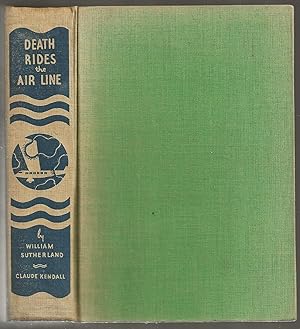
DEATH RIDES THE AIR LINE **INSCRIBED COPY**
Published by Claude Kendall, N.Y., 1934
First Edition Signed
Cloth. Condition: Very Good. No Jacket. First Edition. 1st US edition. Spine faded, as well as edges else a very good or betted copy of this scarce title. INSCRIBED and dated by the author (using his real name John M. Cooper) at front endpaper. "As Sutherland writes in his preface: "I have endeavored, moreover, by the use of a somewhat unusual structural design, to help the reader see the people concerned in it as they really were, rather than as the conventional, puppet-like characters of works of fiction." After only fifty-three pages--in which Sutherland assembles the crew and passengers on a plane taking off from Boston, murders one of the passengers over New York (stabbing), and brings Detective-Inspector Grady in to investigate--Sutherland leaves the present in order give us flashbacks into the lives of the murder victim, ruthless newspaper publisher Walter Schlaf, and four passengers: Russell DeWitt, New York judge, Marguerite Rose, good time gal, Timothy Cowley, gangster, and August Jensen, pilot. Sutherland notes that the events depicted in the novel occur "during the final days of Prohibition" and he hopes that this fact will "add some special interest, as well as throw some more light on the conditions which that unfortunate law produced in America." The Rose and Cowley sections take particular advantage of this setting." -- 'The Passing Tramp' blog. Check out the blog for a more detailed review. Inscribed By the Author. Book.
-

BIRTH CONTROL - A Statement of Christian Doctrine against the Neo-Malthusians
Published by NY, P.J.Kenedy, 1925. [, 1925
Hardcover. Condition: Very Good. ] Hardback, 12mo, 5 x 7 1/2 inches, terracotta cloth covers w/ spine titling gilt & ofc titling debossed, x + 160 pages, VG+/no dj (stiff clear acetate dustwrapper provided to preserve condition). Snug binding w/ hinges intact & scant signs of any wear. Original owner's smallish bookplate (as Ioannis Gregorii Murray) centered ifc & his signature as "J.G. Murray" at a 45 degree angle ffep. Rather minor amount of Murray's pencil in the margin areas (mostly bracketing) + 4 of his bullet points under the penciled heading "Birth Control" on the blank page at the rear facing p. 160, the last page of the book. Wiki information: "John Gregory Murray (February 26, 1877-October 11, 1956) was an American prelate of the Roman Catholic Church. He served as Archbishop of Saint Paul from 1931 until his death in 1956, having previously served as Auxiliary Bishop of Hartford (1920-1925) and Bishop of Portland (1925-1932)." RWR5 Philosophy & Religion Ethics Morality Abortion Law Planned Parenthood Roe v. Wade Privacy Women's Right to Chose Unwanted Pregnancy Unborn Child Provenance.
-
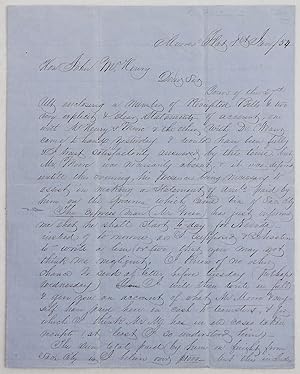
Murray, John Sutherland (1818-1882); Moore, Henry M. Original Autograph Letter Signed from Moores Flat (a Gold Mining Town Later Abandoned in the Early 20th Century), Written by a California Forty-Niner and Talking about the Construction of a "Store-Room" in the General Store or the Hotel of Town Founder H.M. Moore, Successful Gold Mining, When "an Ounce of Beautiful Gold" was Obtained after an Hour Washing "under Disadvantageous Circumstances," Nevada County Pioneer and Gold Miner James Weaver, &c. Moores Flat (Nevada Co.): 1 January 1854.
Publication Date: 1854
Seller: Globus Rare Books & Archives, San Francisco, CA, U.S.A.
Seller rating 5 out of 5 stars

Manuscript / Paper Collectible
None. Condition: Very Good. Quarto bifolium (ca. 25x20 cm). 3 pp. Brown ink on laid paper. Docketed on verso of the second leaf. Fold marks, but overall a very good letter, written in a legible hand. Historically significant content-rich original letter, from the first years of the gold mining town of Moores Flat (Nevada Co.) and closely related to its founder Henry M. Moore. In 1851, Moore became the first settler who brought his family to a flat site on the Middle Yuba River, several kilometres northeast of the North Bloomfield, and the growing mining camp was named after him (Bean, E.F. Bean's History and Directory of Nevada County, California. Nevada, 1867, p. 402). "Shortly thereafter, Moore's Flat became an important hydraulic mining town, with large-scale operations at Moore's Flat, Orleans Flat, Woolsey Flat, Snow Point, and Snow Tent. By 1880, the town had grown to a population of 500, but 1884 brought the Sawyer Decision, which effectively put an end to large-scale hydraulic mining in the northern Sierra Nevada. The district and town lived on while the emphasis changed from hydraulic mining to drift mining and the lode mines. The only significant drifting was done at Snow Point. The mines began to fail in 1895, and the town of Moore's Flat was abandoned" ( see more ). The last mail coach to Moores Flat arrived in September 1914 (Old Mining Town Erased from Post Office Map// The Grizzly Bear, Vol. XVI, No. 1, whole No. 91, November 1914, p. 23). In the 1850s-1860s, Henry M. Moore was known to keep the only hotel and serve as the postmaster in Moores Flat (Bean's History and Directory of Nevada County, California, p. 406). The letter is written by Moore's partner, John Sutherland Murray - a California pioneer, who arrived in San Francisco from New Zealand in 1849, and since 1850 mined and worked as a land surveyor in the Nevada County, residing in Eureka (Graniteville since 1867). The letter, addressed to one "John McHenry" (apparently, the investor of Murray and Moore's partnership), provides a detailed account of the partners' expenses related to the construction of Moore's general store (or possibly the hotel) in Moore's Flat. Murray talks about what they spent on hauling, "teamsters'" salary, delivery of hardware, groceries, ale and porter, &c., the progress of the construction of the "store-room," and mentions their recent success in gold mining. " They washed the other day one hour under disadvantageous circumstances & obtained an ounce of beautiful gold. " He also briefly talks about "Dr. Weaver" - apparently, a Nevada county pioneer Dr. James Weaver, who mined for gold near Eureka and in 1853 constructed the famous 30-mile long water ditch, named "Memphis Race." Despite the overall positive tone of the letter, Murray & Moore apparently ran into problems with John McHenry. In January 1855, the Supreme Court of California had a hearing on the dispute between the two parties (Reports of Cases Determined in the Supreme Court of the State of California. Vol. 5. San Francisco, 1906, pp. 90-93). Overall an important early California pioneering and gold mining letter. Excerpts from the letter: " Dear Sir, Yours of the 27th ult. enclosing a number of receipted bills & two very explicit & dear statements of account, one with McHenry & Moore & the other with Dr. Weaver came to hand yesterday & would have been fully & [most?] satisfactory answered by this time, but Mr. Moore was necessarily absent & it was deferred until this evening, his presence being necessary to assist in making a statement of accounts paid by him on the groceries which came via of Sac. City. The express man (Mr. Green) had just informed me that he shall start today for Nevada instead of tomorrow, as I supposed, & I hasten to write a line or two, that you may not think me negligent. I know of no other chance to send a letter before Tuesday (perhaps Wednesday) & will then write in full & give you an account of what Mr. Moore & myself have paid here in cash to teamsters, & for whic.