Order Total (1 Item Items):
Shipping Destination:

Mydorge (60 results)
Author:
mydorge
Refine with Advanced Search
Skip to main search results
Search filters
Product Type
- All Product Types
- Books (60)
- Magazines & Periodicals (No further results match this refinement)
- Comics (No further results match this refinement)
- Sheet Music (No further results match this refinement)
- Art, Prints & Posters (No further results match this refinement)
- Photographs (No further results match this refinement)
- Maps (No further results match this refinement)
- Manuscripts & Paper Collectibles (No further results match this refinement)
Condition Learn more
- New (49)
- As New, Fine or Near Fine (4)
- Very Good or Good (1)
- Fair or Poor (No further results match this refinement)
- As Described (6)
Binding
Collectible Attributes
- First Edition (2)
- Signed (No further results match this refinement)
- Dust Jacket (No further results match this refinement)
- Seller-Supplied Images (33)
- Not Print on Demand (27)
Language (3)
Free Shipping
Seller Location
Seller Rating
-

PAP. Condition: New. New Book. Shipped from UK. Established seller since 2000.
-

-
Examen du Livre des Recreations Mathematiques, Et de Ses Probl?me en G?om?trie, M?canique, Optique Et Catoptrique: O? Sont Aussi Discut?es Et Restabiles Plusieurs Exp?riences Physiques Y Propos?es (Classic Reprint)
Seller: PBShop.store UK, Fairford, GLOS, United Kingdom
Seller rating 5 out of 5 stars

US$ 34.97
US$ 6.73 shipping
Ships from United Kingdom to U.S.A.Quantity: 15 available
Add to basketPAP. Condition: New. New Book. Shipped from UK. Established seller since 2000.
-
Condition: As New. Unread book in perfect condition.
-

PAP. Condition: New. New Book. Shipped from UK. Established seller since 2000.
-
Examen du Livre des Recreations Mathematiques, Et de Ses Problemes en Geometrie, Mechanique, Optique Et Catoptrique (Classic Reprint)
Seller: PBShop.store UK, Fairford, GLOS, United Kingdom
Seller rating 5 out of 5 stars
US$ 35.13
US$ 6.73 shipping
Ships from United Kingdom to U.S.A.Quantity: 15 available
Add to basketPAP. Condition: New. New Book. Shipped from UK. Established seller since 2000.
-

-

HRD. Condition: New. New Book. Shipped from UK. Established seller since 2000.
-

HRD. Condition: New. New Book. Shipped from UK. Established seller since 2000.
-
Examen Dv Livre Des Recreations Mathematiqves: Et De Ses Problemes En Geometrie, Mechanique, Optique, & Catoptrique. Où Sont Aussi Discutées & ... Physiques Y Proposees (French Edition)
Seller: Ria Christie Collections, Uxbridge, United Kingdom
Seller rating 5 out of 5 stars
US$ 34.94
US$ 16.06 shipping
Ships from United Kingdom to U.S.A.Quantity: Over 20 available
Add to basketCondition: New. In.
-
Examen du Livre des Recreations Mathematiques, Et de Ses Probl?me en G?om?trie, M?canique, Optique Et Catoptrique: O? Sont Aussi Discut?es Et Restabiles Plusieurs Exp?riences Physiques Y Propos?es (Classic Reprint)
Seller: PBShop.store UK, Fairford, GLOS, United Kingdom
Seller rating 5 out of 5 stars
US$ 44.63
US$ 7.87 shipping
Ships from United Kingdom to U.S.A.Quantity: 15 available
Add to basketHRD. Condition: New. New Book. Shipped from UK. Established seller since 2000.
-
Examen du Livre des Recreations Mathematiques, Et de Ses Problemes en Geometrie, Mechanique, Optique Et Catoptrique Classic Reprint
Seller: PBShop.store UK, Fairford, GLOS, United Kingdom
Seller rating 5 out of 5 stars
US$ 44.79
US$ 7.87 shipping
Ships from United Kingdom to U.S.A.Quantity: 15 available
Add to basketHRD. Condition: New. New Book. Shipped from UK. Established seller since 2000.
-
Examen Dv Livre Des Recreations Mathematiqves: Et De Ses Problemes En Geometrie, Mechanique, Optique, & Catoptrique. Où Sont Aussi Discutées & Restabl
Seller: GreatBookPricesUK, Woodford Green, United Kingdom
Seller rating 5 out of 5 stars
US$ 34.93
US$ 20.11 shipping
Ships from United Kingdom to U.S.A.Quantity: Over 20 available
Add to basketCondition: New.
-
Examen Dv Livre Des Recreations Mathematiqves: Et De Ses Problemes En Geometrie, Mechanique, Optique, & Catoptrique. Où Sont Aussi Discutées & Restabl
Seller: GreatBookPricesUK, Woodford Green, United Kingdom
Seller rating 5 out of 5 stars
US$ 37.63
US$ 20.11 shipping
Ships from United Kingdom to U.S.A.Quantity: Over 20 available
Add to basketCondition: As New. Unread book in perfect condition.
-

In-4° pp. da 271 a 350, bross. edit. intonso.
-
-

Examen Dv Livre Des Recreations Mathematiqves: Et De Ses Problemes En Geometrie, Mechanique, Optique, & Catoptrique. Où Sont Aussi Discutées & ... Physiques Y Proposees (French Edition)
Seller: Ria Christie Collections, Uxbridge, United Kingdom
Seller rating 5 out of 5 stars
US$ 44.83
US$ 16.06 shipping
Ships from United Kingdom to U.S.A.Quantity: Over 20 available
Add to basketCondition: New. In.
-
US$ 23.96
Free Shipping
Ships from United Kingdom to U.S.A.Quantity: Over 20 available
Add to basketPaperback. Condition: New. Print on Demand. This book harnesses mathematical and theoretical principles to present various puzzles and questions that can be solved through logic, rather than complex equations. The problems range from basic number games like doubling and tripling numbers to more complex geometry and physics conundrums. The author provides detailed solutions and explanations for each problem, making it accessible to readers of all skill levels. Within the history of mathematical recreation, this book stands out for its unique blend of entertainment and intellectual stimulation. The problems presented are not only fun to solve but also encourage critical thinking, problem-solving, and a deeper understanding of mathematical concepts. The book delves into the fascinating world of mathematical paradoxes, where seemingly simple questions lead to unexpected and counterintuitive answers. It explores the surprising connections between seemingly unrelated mathematical topics, revealing the elegance and interconnectedness of the subject. This book is not just a collection of puzzles; it is an invitation to explore the beauty and power of mathematics. Through its engaging challenges and thought-provoking insights, this book encourages readers to rediscover the joy of learning and the satisfaction of solving problems. This book is a reproduction of an important historical work, digitally reconstructed using state-of-the-art technology to preserve the original format. In rare cases, an imperfection in the original, such as a blemish or missing page, may be replicated in the book. print-on-demand item.
-

Examen Du Livre Des Recreations Mathematiques (1639)
Language: French
Published by Kessinger Publishing, LLC, 2009
ISBN 10: 1104745607 ISBN 13: 9781104745608
Condition: New. KlappentextrnrnThis scarce antiquarian book is a facsimile reprint of the original. Due to its age, it may contain imperfections such as marks, notations, marginalia and flawed pages. Because we believe this work is culturally important, we have.
-
US$ 24.11
Free Shipping
Ships from United Kingdom to U.S.A.Quantity: Over 20 available
Add to basketPaperback. Condition: New. Print on Demand. This book brings together a collection of mathematical problems, puzzles, and games that have intrigued and entertained people for centuries. The author, a renowned mathematician, presents them with clear explanations and solutions, making them accessible to readers of all levels. From the ancient Greeks' geometric puzzles to the Renaissance fascination with perspective, this book explores the rich history of mathematical recreation. It delves into the mathematical principles behind juggling, the physics of spinning tops, and the strategy of board games. Beyond their entertainment value, these problems and puzzles offer a glimpse into the fundamental principles of mathematics. They challenge our assumptions, stimulate our creativity, and reveal the beauty and elegance of the subject. This book provides a unique and engaging way to explore the world of mathematics, fostering an appreciation for its power and versatility. This book is a reproduction of an important historical work, digitally reconstructed using state-of-the-art technology to preserve the original format. In rare cases, an imperfection in the original, such as a blemish or missing page, may be replicated in the book. print-on-demand item.
-

Examen Du Livre Des Recreations Mathematiques (1639)
Language: French
Published by Kessinger Publishing, LLC Jul 2009, 2009
ISBN 10: 1104745607 ISBN 13: 9781104745608
Taschenbuch. Condition: Neu. Neuware - This scarce antiquarian book is a facsimile reprint of the original. Due to its age, it may contain imperfections such as marks, notations, marginalia and flawed pages. Because we believe this work is culturally important, we have made it available as part of our commitment for protecting, preserving, and promoting the world's literature in affordable, high quality, modern editions that are true to the original work.
-
Condition: Sehr gut. Zustand: Sehr gut | Seiten: 450 | Sprache: Französisch | Produktart: Bücher | Keine Beschreibung verfügbar.
-

Condition: Sehr gut. Zustand: Sehr gut | Seiten: 450 | Sprache: Französisch | Produktart: Bücher | Keine Beschreibung verfügbar.
-
Examen du livre des récréations mathématiques : et des problèmes en géométrie, mécanique, optique, et catoptrique. Où sont aussi discutées & restablies plusieurs expériences physiques y proposées.
Published by Charles Osmont, Rouen, 1639
Seller: Bonnefoi Livres Anciens, Paris, France
Association Member: ILAB
Seller rating 5 out of 5 stars
4 parties en 1 vol. in-12 de (16)-280 pp., 43 vignettes gravées sur bois pour la première partie, 63 pp., 25 vignettes gravées sur bois pour la deuxième partie, 1 f.n.ch., pp. [65]-106-(10) pp. 1 f.bl., 12 gravures sur bois pour la troisième partie. [Relié à la suite] :[HENRION (Didier)] Nottes sur les récréations mathématiques. Par D.H.P.E.M. Rouen, Charles Osmont, 1639. 39 pp., 4 vignettes gravées sur bois, vélin souple, dos lisse avec titre manuscrit (reliure de l?époque). Troisième édition du commentaire de Claude Mydorge sur La Récréation Mathématique de Jean Leucheron.L?ouvrage se compose de quatre parties, les deux premières contiennent des problèmes ?plaisants et facétieux? d?arithmétique, de géométrie, d?astrologie, de perspective et d?optique. La troisième partie est exclusivement consacrée aux feux d?artifice et contient des recettes pour la fabrication de la poudre. La dernière partie, par Henrion, professeur de mathématiques à Paris et l?un des premiers scientifiques à avoir rédigé un traité sur les logarithmes, renferme des notes et des corrections des erreurs se trouvant dans les parties précédentes.Le Jésuite Jean Leucheron (vers 1591-1670) était professeur de philosophie et de mathématiques. Il avait publié en 1624 à Pont-à-Mousson, sous le pseudonyme de H. van Etten, un rarissime ouvrage de jeux mathématiques intitulé La Récréation mathématique ou Entretiens facétieux sur plusieurs plaisants problèmes en fait d?arithmétique, de géométrie. Grand amateur de géométrie, le juriste, mathématicien, géomètre et physicien Claude Mydorge (1585?1647) développa également un goût particulier pour les jeux et récréations mathématiques et fit rapidement imprimer une nouvelle édition augmentée de ses commentaires de l?ouvrage de Leucheron.Mydorge collabora et se lia d?amitié avec Descartes. Son intérêt pour les sections coniques le conduisit aussi à s?intéresser aux lois de l?optique et à l?astronomie. « Claude Mydorge, a friend of Descartes and an eminent geometer, [.] was also well versed in optics » (DSB).Cet ouvrage connut un formidable succès et fut réimprimé à de très nombreuses reprises au cours du XVIIe siècle.Illustré de 84 charmantes vignettes sur bois représentant tous les sujets abordés, y compris un bois décrivant une camera obscura.Feuillet D (première partie) déchiré en coin avec perte de quelques lettres et feuillet B2 (deuxième partie) déchiré en marge avec perte de quelques lettres. Pâles mouillures, vélin sali avec perte de peau sur le second plat.
-
Examen du Livre des Recreations Mathematiques, et de ses Problemes en Geometrie, Mecanique, Optique et Catoptrique. Où sont aussi discutées & restablies plusieurs experiences Physiques y proposées
Published by Chez Rolet Boutonné, Paris, 1638
Seller: Michael Treloar Booksellers ANZAAB/ILAB, Adelaide, SA, Australia
Association Member: ANZAAB ILAB
Seller rating 5 out of 5 stars
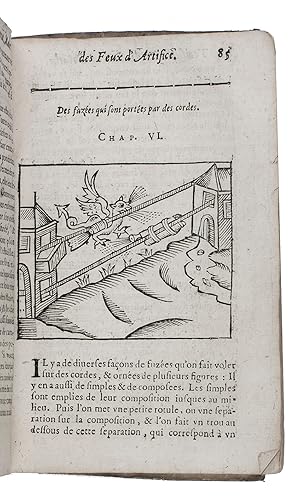
Hardcover. 2nd Edition. Paris, Chez Rolet Boutonné, 1638 [second edition]/ 1630. Octavo (170 × 105 mm), four parts bound as one volume, [xvi], 280; 64 (last blank); [63]-106, [12] (index, last three blank); and 39, [1] (blank) pages with woodcut printer's devices on the four title pages, and 84 illustrations throughout (approximately 80 woodcut illustrations and a few type-set diagrams). There are five leaves missing from the 'Troisième Partie' (F4, F5, G1, G4 and G5: pages 85-90, 95-96, and 101-104). Nineteenth century half calf and marbled boards (now lacking the leather corner-pieces, revealing earlier full vellum boards underneath); covers a little worn; light tidemark to the bottom inner corner of the text block throughout; a little worming to the top (blank) margin of the first 25 leaves; insect damage to the bottom edge (extending at most a few millimetres into the wide blank bottom margins); first title leaf dusty and a little soiled; the five missing leaves notwithstanding, overall a very presentable copy. The second edition of Claude Mydorge's expanded edition and critique of this popular early work of recreational mathematics, first published in 1624 and usually attributed to Jean Leurechon. Each of Leurechon's mathematical problems is reprinted here in roman type, with Mydorge's explanatory notes and criticism following in italic. The third part, albeit relatively insubstantial (only 44 well-illustrated pages), is devoted exclusively to fireworks and their construction, which probably explains the few missing leaves. The subtitle is: 'Composée d'un receuil de plusieurs plaisantes & recreatives inventions de feux d'artifice, plus la maniere de faire toutes sortes de fuzées, tant simples que doubles, avec leur composition, le tout representé par figures [sic]' [Comprising a collection of several pleasant and recreative inventions of fireworks, plus the manner of making all sorts of rockets, both single and double, with their composition, all represented in figures]. This third part, together with the second, made its first appearance in a 1628 edition of 'Récréations Mathématiques' published by Charles Osmont at Rouen. Their authorship has not been established (HEEFER, Albrecht: 'Récréations Mathématiques (1624), A Study on its Authorship, Sources and Influence', revised 7 October 2004). The fourth part, 'Nottes [sic] sur les Recreations .' is by D.H.P.E.M. [Denis Henrion, Professeur ès Mathématiques]. Claude Mydorge (1585-1647), French mathematician, was a friend of René Descartes, with whom he shared a strong interest in optics and the nature of vision. 'Mydorge's first major work was the "Examen du livre des Récréations mathématiques", published in 1630. As the title suggests, it was a work on recreational mathematics and was effectively a critique of Laurechon's [sic] book on the theme ['Récréations mathématiques' by the French Jesuit, Jean Leurechon, writing under the pen name of van Etten, first appeared in 1624]. However, it was through his work on conic sections that Mydorge made the greatest scientific impact' (The Cambridge Descartes Lexicon, online). Provenance: a 1713 signature on the first page; an early ownership inscription ('Micha[el] Hutchins His Book') on a preliminary page; 'G.S. Kingston Sept 1834' on the front pastedown: Sir George Strickland Kingston (1807-1880), the South Australian pioneer, engineer and politician (deputy-surveyor-general under Colonel William Light, co-discoverer of the River Torrens, first Speaker in the House of Assembly.
-

Examen du livre des recreations mathemathiques et des ses problèmes en Geometrice, Mechanique, Optique & Catoptrique. - La seconde partie des recreations - La troisiesme partie (Tres partes en un volumen).
Published by Rouen. Iean Boulley., 1639
Seller: MUNDUS LIBRI- ANA FORTES, Salamanca, SA, Spain
Association Member: AILA ILAB LIBRIS
Seller rating 5 out of 5 stars
Encuadernación de tapa dura. Condition: Bueno. texto. 8º. Encuadernación de tapa dura. . La obra de Mydorge, amigo de Descartes, con el que elaboró numerosos instrumentos ópticos, se encuadra en la tradición de los tratados matemáticos que incorporan la pirotecnia como parte de su estudio. Curioso libro con abundantes grabados xilográficos en. 280 p., 106p., 22h. Buen estado. Portada de la primera parte facsimilada. Piel moderna con nervios y dorados en lomera. Español.
-
![Seller image for Examen du livre des recreations mathematiques, et de ses problemes en geometrie, mechanique, optique, & catoptrique. Ou sont aussi discutees & restablies plusieurs experiences physique et proposees 1643 [LeatherBound] for sale by S N Books World](https://pictures.abebooks.com/inventory/md/md30638147062.jpg)
Leatherbound. Condition: NEW. BOOKS ARE EXEMPT FROM IMPORT DUTIES AND TARIFFS; NO EXTRA CHARGES APPLY. Leatherbound edition. Condition: New. Leather Binding on Spine and Corners with Golden leaf printing on spine. Bound in genuine leather with Satin ribbon page markers and Spine with raised gilt bands. Pages: 456. A perfect gift for your loved ones. Reprinted from 1643 edition. NO changes have been made to the original text. This is NOT a retyped or an ocr'd reprint. Illustrations, Index, if any, are included in black and white. Each page is checked manually before printing. As this print on demand book is reprinted from a very old book, there could be some missing or flawed pages, but we always try to make the book as complete as possible. Fold-outs, if any, are not part of the book. If the original book was published in multiple volumes then this reprint is of only one volume, not the whole set. IF YOU WISH TO ORDER PARTICULAR VOLUME OR ALL THE VOLUMES YOU CAN CONTACT US. Resized as per current standards. Sewing binding for longer life, where the book block is actually sewn (smythe sewn/section sewn) with thread before binding which results in a more durable type of binding. Language: French Pages: 456.
-
Prodromi catoptricorum et dioptricorum, sive conicorum operis ad abdita radii reflexi et refracti mysteria praevii & facem praeferentis. Libri quatuor priores [Liber primus et secundus]. D. A. L. G.
Published by Jean Dedin, Paris, 1631
Seller: SOPHIA RARE BOOKS, Koebenhavn V, Denmark
Seller rating 4 out of 5 stars

First Edition
First edition. AUTHOR'S PRESENTATION COPY. First edition, extremely rare author's presentation copy, of all four books of this important work on conic sections, intended to provide the geometrical basis for the study of optics. "Mydorge's work on conic sections contains hundreds of problems published for the first time, as well as a multitude of ingenious and original methods that later geometers frequently used, usually without citing their source" (DSB). Books I and II (pp. 1-134) were first published separately in 1631; a second edition appeared in 1639 with two additional books. The present copy has the first edition of the first two books, with the 1631 title page, bound up with the last two books from the second edition. A printed paper slip Libri quatuor priores has been pasted over Liber primus et secundus on the title to accommodate the added books, and a large section of text has also been pasted over the original on page 67 corresponding to changes in book I made between the 1631 and 1639 editions. The 1631 edition is very much rarer than the 1639: OCLC lists only five copies of the former - Danish Royal Library (but this copy is actually of the 1641 edition), Columbia, NYPL, Zürich, BNF - but 24 of the latter; COPAC adds copies of the 1631 edition at Oxford, Cambridge and UCL. It is likely that the 1631 edition was printed in very small numbers and was mostly, if not entirely, intended for presentation: the copies at Columbia, Zürich and BNF all have authorial corrections. The only other copy of the 1631 edition to have appeared at auction was Michel Chasles' copy, last sold in 1972. "In his study of conic sections Mydorge continued the work of Apollonius, whose methods of proof he refined and simplified . Mydorge asserts that if from a given point in the plane of a conic section radii to the points of the curve are drawn and extended in a given relationship, then their extremities will be on a new conic section similar to the first. This statement constitutes the beginnings of an extremely fruitful method of deforming figures; it was successfully used by La Hire and Newton, and later by Poncelet and, especially, by Chasles, who named it deformation homographique. "Mydorge posed and solved the following problem in [book] III: 'On a given cone place a given conic section' - a problem that Apollonius had solved only for a right cone. Mydorge was also interested in geometric methods used in approximate construction, such as that of a regular heptagon. Another problem that Mydorge solved by approximation - although he did not clearly indicate his method - was that of transforming a square into an equivalent regular polygon possessing an arbitrary number of sides" (DSB) "Mydorge (1585-1647) was born in Paris to one of the wealthiest families in France. He was educated at the Jesuit College of La Flèche and subsequently trained as a lawyer, before embarking on a legal and administrative career. After serving as conseiller to the court of the Grand Châtelet, he became treasurer of the généralité of Amiens, the collector general being a direct agent of the king. Mydorge's chosen employment allowed him sufficient time to combine public office with the life of a savant. Residing in what remained of the ancient Palais des Tournelles, he first met Descartes around 1625, becoming one of his most faithful friends and helping to establish his reputation in Paris. The mathematician Claude Hardy, a leading figure in the scientific circles around Mersenne, Roberval, and Étienne Pascal, lodged with him while he was producing his edition of Euclid's Elements. "Mydorge shared with Descartes a strong interest in optics and the nature of vision. It is well known that in order to promote his friend's investigations on these topics, he commissioned the production of innumerable parabolic, hyperbolic, oval, and elliptic lenses, reputedly spending in excess of 100,000 écus on optical instruments over the years. Both men were interested particularly in refraction, and when Descartes, independently of Snell, discovered the law of refraction, he persuaded Mydorge to have a hyperbolic glass made in order to test his discovery" (Cambridge Descartes Lexicon). Mydorge was also a friend of Fermat and Mersenne, and in 1638 played a role in settling the dispute between Descartes and Fermat that had arisen when Fermat refuted Descartes' Dioptrique. Mydorge played an important role in Descartes' discovery of the sine law of refraction, which the two men almost certainly formulated in 1626 (Sasaki, p. 175). "In a letter to Mersenne from around 1627, Mydorge used a rule to calculate angles of refraction, given the angles of one pair of incident and refracted rays . The rule comes down to a cosecant 'law' . Later in the letter, Mydorge applied this rule to lenses and transformed it into sine form. Mydorge's rule embodies the two assumptions that formed the core of Descartes' derivation of the sine law in La Dioptrique" (pp. 126-127). Publication of the present work was sponsored by Sir Charles Cavendish (?1595-1654), to whom the book is dedicated - Mydorge calls Cavendish "extremely skilled in all mathematics and a very dear friend to me" (Malcolm & Stedall, p. 88). Cavendish seems to have developed contacts with foreign mathematicians and by the summer of 1631 was corresponding with Mydorge. In 1671 John Collins wrote "'they complaine in france (as we doe here) that their Booksellers will not undertake to print mathematicall Bookes there, thence it came to passe that the four latter books of Mydorge were never printed, as the former had not been unless Sir Charles Cavendish had given 50 crownes as a Dowry with it" (Collins to Gregory, 14 March 1671/2 in Newton, Correspondence 47). The manuscript of 'the four latter books' was apparently taken to England by Cavendish's brother William and Thomas Wriothesley, Earl of Southampton, and then lost. The first four books were reissued in 1641 and 1660, and under the title De sectionibus c.
-
Examen du livre des recreations mathematiques et de ses problemes en geometrie, mechanique, optique, & catoptrique. Où sont aussi discutées, & restablies plusieurs experiences physique y proposées.Including:- La seconde partie des recreations mathematiques. Composee de plusieurs problèmes plaisans & facetieux en faict d'arithmetique, géometrie, astrologie, optique, perspective, mechanique, & chymie, & autres rares secrets non encre veus, ny mis en lumiere.- La troisieme partie des recreations mathematiques. Composée de faire toutes sortes de fuzées, tant simples que doubles, avec leur composition, le tout representé par figures.
Published by Charles Osmont,, Rouen,, 1643
Seller: Antiquariaat FORUM BV, Houten, Netherlands
Seller rating 5 out of 5 stars
US$ 1,668.68
US$ 28.93 shipping
Ships from Netherlands to U.S.A.Quantity: 1 available
Add to basketVery rare fourth edition of the commentary of Claude Mydorge (1585-1647) on the Récreations mathématiques by "H. van Etten" (Jean Leurechon). Mydorge corrected the numerous mistakes made by Leurechon in these mathematical diversions and "added several physical experiments as well as comments that he claimed were intended only for his friends". Several of examples and comments by Mydorge, also appear in the works of his friend Descartes, making it "reasonable to conclude that many of the other mechanical problems discussed by Mydorge in this work were also known to Descartes and one can easily imagine Descartes as one of the friends participating in the discussions of these problems alluded to in the prefatory remarks" (Hattab).The "diversions" consist of numerous problems for which a mathematical solution is presented, most of them illustrated by a woodcut. For instance, Mydorge (following Leurechon) informs the reader how to make water in a glass boil without fire, "to make a door open from both sides; to build a bridge all round the earth which will not fall when its supports are removed; to keep all the water in the world in the air without a single drop falling to earth". The third chapter, on fireworks, contains even more spectacular problems, such as "if all the gunpowder in the world were put in a globe of glass or paper and set on fire all at once, what would happen? Nothing, since the pressure would be equal in every direction" (Thorndike).Binding soiled and spine with a few holes; lower part loose in binding. First 50 pages creased; several marks and thumbing throughout. A fair, probably well-used copy.l Worldcat (1 copy); for Mydorge: DSB IX, pp. 598-599; Hattab, Descartes on forms and mechanisms, pp. 90-92; Thorndike VII, pp. 593-594. Contemporary limp vellum, with the manuscript title on the spine. With numerous woodcut illustrations illustrating the problems. Pages: [1], [1 blank], [5], [1 blank], [7], [1 blank], 280, 63, [1 blank], [1], [1 blank], [2], 67-106, [43], [1 blank] pp.
-
![Seller image for Claudii Mydorgii,. Prodromi catoptricorum et dioptricorum . libri quatuor 1639 [LeatherBound] for sale by True World of Books](https://pictures.abebooks.com/inventory/md/md31617422165.jpg)
LeatherBound. Condition: New. BOOKS ARE EXEMPT FROM IMPORT DUTIES AND TARIFFS; NO EXTRA CHARGES APPLY. LeatherBound edition. Condition: New. Reprinted from 1639 edition. Leather Binding on Spine and Corners with Golden leaf printing on spine. Bound in genuine leather with Satin ribbon page markers and Spine with raised gilt bands. A perfect gift for your loved ones. Pages: 319 NO changes have been made to the original text. This is NOT a retyped or an ocr'd reprint. Illustrations, Index, if any, are included in black and white. Each page is checked manually before printing. As this print on demand book is reprinted from a very old book, there could be some missing or flawed pages, but we always try to make the book as complete as possible. Fold-outs, if any, are not part of the book. If the original book was published in multiple volumes then this reprint is of only one volume, not the whole set. Sewing binding for longer life, where the book block is actually sewn (smythe sewn/section sewn) with thread before binding which results in a more durable type of binding. Pages: 319.




![Seller image for Prodromi catoptricorum et dioptricorum, sive conicorum operis ad abdita radii reflexi et refracti mysteria praevii & facem praeferentis. Libri quatuor priores [Liber primus et secundus]. D. A. L. G. for sale by SOPHIA RARE BOOKS](https://pictures.abebooks.com/inventory/md/md22861563662.jpg)