

Order Total (1 Item Items):
Shipping Destination:

Ostriker Steinhardt (1 results)
Skip to main search results
Search filters
Product Type
- All Product Types
- Books (1)
- Magazines & Periodicals (No further results match this refinement)
- Comics (No further results match this refinement)
- Sheet Music (No further results match this refinement)
- Art, Prints & Posters (No further results match this refinement)
- Photographs (No further results match this refinement)
- Maps (No further results match this refinement)
- Manuscripts & Paper Collectibles (No further results match this refinement)
Condition Learn more
- New (No further results match this refinement)
- As New, Fine or Near Fine (No further results match this refinement)
- Very Good or Good (No further results match this refinement)
- Fair or Poor (No further results match this refinement)
- As Described (1)
Binding
- All Bindings
- Hardcover (No further results match this refinement)
- Softcover (No further results match this refinement)
Collectible Attributes
- First Edition (1)
- Signed (No further results match this refinement)
- Dust Jacket (No further results match this refinement)
- Seller-Supplied Images (1)
- Not Print on Demand (1)
Language (1)
Price
- Any Price
- Under US$ 25 (No further results match this refinement)
- US$ 25 to US$ 50 (No further results match this refinement)
- Over US$ 50
Free Shipping
- Free Shipping to U.S.A. (No further results match this refinement)
Seller Location
Seller Rating
-
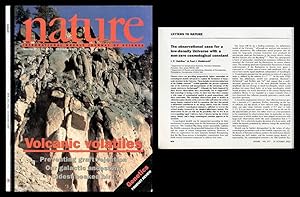
The Observational Case for a Low Density Universe With a Non-Zero Cosmological Constant in Nature 377, No. 6550, October 19, 1995, pp. 600-602
Published by Macmillan, London, 1995
First Edition
1st Edition. FIRST EDITION IN ORIGINAL WRAPS OF OSTRIKER & STEINHARDT'S CASE FOR A POSITIVE COSMOLOGICAL CONSTANT DERIVED FROM THEIR META ANALYSIS. Three years later their findings were verified by supernova observations. In "the 1990s, issues surrounding the age of the universe and new astronomical measurements of large-scale structure led scientists to propose a role for a positive cosmological constant" (History of Physics: The Wenner Collection). In this paper, Jeremiah (Jerry) Paul Ostriker and Paul J. Steinhardt make their case based on a much broader array of observational data than had yet been accomplished. Ostriker and Steinhardt argue that "observations are providing progressively tighter constraints on cosmological models advanced to explain the formation of large-scale structure in the Universe" (Ostriker & Steinhardt, 1995, 600). By reviewing the current observational constraints, then, they show those constraints "can work in concert to determine the theoretical framework and parameters that describe our universe" (Bahcall, Unsolved Problems in Astrophysics, 44). Using a "concordance of cosmological observations to show there must be a non-zero dark energy component today, more than 65 percent of the total energy density, sufficient to cause the expansion of the universe to accelerate (Ostriker & Steinhardt, 1995, 600). In 1998, two competing teams of astrophysicists and astronomers confirmed Ostriker and Steinhardt's finding that the expansion of the universe was accelerating rather than decelerating. Ostriker and Steinhardt concluded their paper with an interesting, oft-cited question:".perhaps we have already identified models which, in broad outline, capture the essential properties of the large-scale universe. Should this be the case, a challenge arises: how can we explain the non-zero value of the cosmological constant from a theoretical point of view?" (Ostriker & Steinhardt, 602). CONDITION & DETAILS: London: Macmillan. First edition in original wraps. Complete single issue. 4to. 11 x 8.5 inches (275 x 213mm). Tightly bound and bright and clean throughout. Very good condition.
