
Pavlov Ivan: Signed (11 results)
 More images
Published by Chicago: University of Chicago Press, 1949. 1949
- Hardcover
- First Edition
- Signed
Seller: Scientia Books, ABAA ILAB, Arlington, MA, U.S.A.Scientia Books, ABAA ILAB
Contact seller4-star sellerCondition: Used - Very good
US$ 200.00
US$ 8.00 shippingShips within U.S.A.Quantity: 1 available
Hardcover. Condition: Very Good. Dust Jacket Included. 1st Edition. Frontispiece, xiii, 365 pp. Original cloth. Very Good, in dust jacket. First Edition. Inscribed: "To Mr. Rollin D. Hemens/ I shall always remember/ with very great pleasure your/ friendly cooperation during the/ publication of this book./ B. P. Babkin./ February… 1, 1950" (see photos). Boris Babkin died May 3, 1950, so there was not a long period between the publication of his book in 1949 and his death in 1950 for Babkin to have signed copies. In his Foreword (see photo; p. vii), Babkin writes: "I am Pavlov s senior surviving pupil. I knew him well for thirty five years--from 1901 to the time of his death in 1936. I served for ten years as his assistant in the Department of Physiology at the Institute of Experimental Medicine in St. Petersburg. Our association in the laboratory developed into a lasting friendship. These circumstances entitle me to speak of Pavlov as a contemporary who was familiar with his scientific activity throughout the greater part of his life. Since the year 1949 is the centenary of I. P. Pavlov s birth, I felt that for me it was a duty as well as a privilege to communicate to those interested in his life and work all that I know about him. There was another consideration which influenced me in my decision to write this biography. It seemed to me that an account of Pavlov's life by one of his contemporaries who was closely associated with him might be of some value to future students of the cultural development of Russia." The Biographical Memoir of Babkin as a Fellow of the Royal Society of London makes this addtional point: "In November of 1949 he published Pavlov, an intimate and warm biography of his great teacher and friend. His urge to write this biography arose not only from his admiration and indebtedness to Pavlov, but because of the appearance of several biographies of Pavlov in Soviet Russia which he regarded as being inaccurate and politically biased.". Signed by Author(s).
 More images
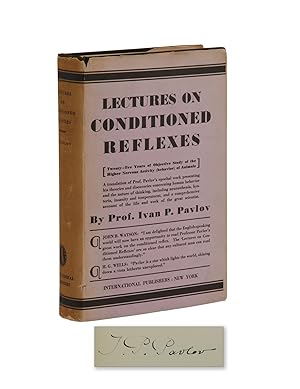
Published by International Publishers, New York 1928
- Hardcover
- First Edition
- Signed
Seller: Burnside Rare Books, ABAA, Portland, OR, U.S.A.Burnside Rare Books, ABAA
Contact seller5-star sellerCondition: Used - Very good
US$ 12,500.00
Free ShippingShips within U.S.A.Quantity: 1 available
Hardcover. Condition: Very Good. Dust Jacket Condition: Very Good. First Edition in English. First edition in English. Signed by Ivan P. Palov on the half-title page. (2) 414 (2) pp, illus. Bound in black ribbed cloth with gilt lettering. Very Good with minor rubbing to cloth, slight bruising to spine ends. Small split to inner…hinge. Contents have modest toning, rear hinge exposed and binding at rear tender. Laid-in is an envelope addressed to Pavlov at Institute for Experimental Research, Moscow, USSR dated 1935. Several other related pamphlets and ephemera are laid-in. Very Good dust jacket unclipped ($6.50) with toned and sunned spine, chipping to ends, small split to foot, rear flap at joint, and light soiling. Archival repair to recto mending a large split at front spine joint. The Russian behavioral psychologist's famous work on mental conditioning. Uncommon signed.
 More images
Published by [Worcester MA: 1930.] 1930
- Softcover
- First Edition
- Signed
Seller: Scientia Books, ABAA ILAB, Arlington, MA, U.S.A.Scientia Books, ABAA ILAB
Contact seller4-star sellerCondition: Used - Very good
US$ 1,500.00
US$ 8.00 shippingShips within U.S.A.Quantity: 1 available
Soft cover. Condition: Very Good. 1st Edition. Pp. 207-220. Original wrappers. Horizontal crease. Ink name stamp of Dr. U. J. Bijlsma on front wrapper. Ink notation "1SU-23" on front wrapper. First Edition. INSCRIBED BY I. PAVLOV: "Vom Verfasser" (see photo). Pavlov's paper is Chapter 11 in Psychologies of 1930, edited by Carl M…urchison (Worcester, Mass: Clark University Press, 1930.) It is a revised version of the presentation by Pavlov at an international congress of psychology at Yale University in New Haven CT in September 1929. "Hoping to popularize his research abroad and eager to escape the wearing and increasingly worrisome realities of Soviet life, Pavlov determined from the earliest days of 1929 to attend two international conferences scheduled for the United States in August and September: the Physiological Congress at Harvard University and the Psychological Congress at Yale. . . . Pavlov received a hero's welcome at both the physiology congress (August 19-23) and the psychology congress (September 1-8), but his was the triumph of an iconic figure, a symbol. . . . What he said at these gathering was clearly much less important than who he was and what he had come to symbolize. . . . The consistently enthralled accounts of his appearances . . . dwelled . . . upon the great liveliness and energy of this great old man of physiology, this passionate gray-bearded Russian who had survived so much adversity, defied his country's Communist rulers, and come to symbolize the possibility that experimental biology might explain and control human nature. . . . After the congress, the Pavlovs traveled with the Cannons to their home in New Hampshire, and then continued north to visit the Babkins in Montreal before going to New Haven for the psychology congress. Like the physiology congress, this was the first of its kind convened in the United States, which now boasted fully half of the world's psychologists. Pavlov was again accorded an honored place, delivering the first plenary lecture [the work offered here]. And again it was his affect and stature that commanded attention. Vladimir [Pavlov's son] informed Babkin that 'In New Haven, they hailed his paper, singling him out as they had in Boston, and his lecture was an enormous success. . . . Papa himself was very content with his encounter with the psychologists, who completely agree with him about many things' " (Todes, Ivan Pavlov, a Russian Life in Science, pp. 565-568). "Pavlov's talk was revised and published as 'A Brief Outline of the Higher Nervous Activity' [offered here], in Murchison, Psychologies of 1930" (Todes, ibid., fn. 14 on p. 795). Signed by Author(s).
 More images
Published by Wiesbaden: J F Bergmann, 1911. 1911
- Softcover
- Signed
Seller: Scientia Books, ABAA ILAB, Arlington, MA, U.S.A.Scientia Books, ABAA ILAB
Contact seller4-star sellerCondition: Used - Very good
US$ 1,750.00
US$ 8.00 shippingShips within U.S.A.Quantity: 1 available
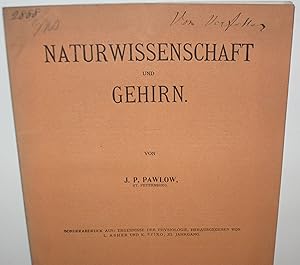
Soft cover. Condition: Very Good. Pp. 345-356. Original orange wrappers. Vertical crease. Very Good. INSCRIBED BY PAVLOV: "Vom Verfasser". This is a lecture Pavlov gave December 28, 1909, at the 12th Congress of Russian Naturalists and Physicians. There are two separate printings of the lecture, both published by J. F. Bergmann,… with small differences in the text. The version offered here, published in 1911, is an offprint from Volume XI of Ergebnisse der Physiologie. The other version, published in 1910, has this printed on the front wrapper: "Vortrag gehalten in der allgemeinen Versammlung des XII. Kongresses Russischer Naturforscher und Ärzte in Moskau am 28. Dez. 1909 (10. Januar 1910 N. ST.) Autorisierte Übersetzung von Dr. G. W. Volborth." The pagination in the 1910 version is different: 1 leaf, [3]-19 pp. The lecture appeared in English translation as chapter X "Natural Science and the Brain (Read before the Congress of Scientists and Physicians, Moscow, December, 1909)" in Pavlov's Lectures on Conditioned Reflexes. Daniel P. Todes writes about the lecture: "Summarizing the achievements of CR research in a lively speech on 'Natural Science and the Brain' [OFFERED HERE] to a packed room at the Congress of Naturalists and Physicians in Moscow in December 1909, Pavlov noted 'the investigator who ventures to register the entire influence of the environment on the animal organism requires completely unique research equipment. He must hold all external influences in his own hands . This is why these investigations demand a completely unique laboratory of a type that does not now exist--where there are no accidental sounds, sudden fluctuations in light, sudden drafts of air, and so forth, where, in short, there is the greatest possible constancy'. This new lab also required apparatuses for the precise and measurable excitation of the animal in various ways. Differentiation experiments had demonstrated the extreme sensitivity of the dog's analyzers to even slight variations in the speed of a metronome and to sounds not discernible by the human ear. Bitter experience had shown that 'an unexpected vibration of the building or a noise from the street' could disrupt the most painstakingly prepared trial. Research on higher nervous activity, then, required an unprecedented level of control over the experimental setting: 'Here, truly, there must proceed a competition between contemporary techniques of physical experimentation and the perfection of the animal analyzers.' He ended this speech with an appeal to Russian pride and Moscow's special enterpreneurial energy. He had probably already made contact with the organization . . . that would finance his Towers of Silence. The Kh. S. Ledentsov Society for the Development of Experimental Sciences and Their Practical Applications. . . . Pavlov sent the society a copy of his speech and a brief inquiry about its willingness to finance 'the creation in our country of a new type of laboratory for the study of the human brain.' By May 1910, the Society had approved Pavlov's plan for a new building adjacent to his existing lab at the IEM" (Daniel P. Todes, Ivan Pavlov, a Russian Life in Science, pp. 305-06). Signed by Author(s).
 More images
Published by München: J. F. Bergmann, 1926. 1926
- Hardcover
- Signed
Seller: Scientia Books, ABAA ILAB, Arlington, MA, U.S.A.Scientia Books, ABAA ILAB
Contact seller4-star sellerCondition: Used - Good
US$ 6,500.00
US$ 8.00 shippingShips within U.S.A.Quantity: 1 available
Hardcover. Condition: Good. xi, 329, [1] pp; 3 figs.; 1 leaf of ads. Contemporary cloth. CONDITION NOTE: slight musty odor. Tape stain on verso of half-title. Stain on vertical fore edge. Neat pencil underlining on p. 44, 50, 55, 85, 87, 88, 89, 91, 97, 98, 195, 198. Repair in gutter margin between p. 320 and 321. Good. NOTE abo…ut Photographs: ABEBooks allows only 5 photographs. I will send additional photographs upon request. INSCRIBED BY IVAN PAVLOV (on the half-title of the book) to Erik Karlmark: "Herrn Dr. Erik Karlmark/ von dankbaren Verfasser." Erik Karlmark was a Swedish forensic pathologist. WITH: Photograph of Ivan Pavlov, SIGNED "J. PAVLOV". The photograph (approx. 2.5" x 3.5") is mounted on the half-title. WITH: part of Envelope, ADDRESSED IN INK BY IVAN PAVLOV to Erik Karlmark. With Russian, cancelled stamps, dated 1928. With return address (ink-stamped) "Envoi de l'Academie des Sciences de Russie. Bureau des echanges internationaux." Written in ink over this ink stamp: "Expéd. J. P. Pavlov/ V.O. Fligne 2/ Léningrad U.R.S.S." This part of the envelope is mounted to the verso of the front flyleaf. WITH: part of Envelope, ADDRESSED IN INK BY IVAN PAVLOV to Erik Karlmark. With Russian, cancelled stamps, dated 1921. With return address (ink-stamped) "Envoi de l'Academie des Sciences de Russie. Bureau des echanges internationaux." This part of the Envelope is mounted to the recto of the rear flyleaf. On the verso of the half-title is an inscription in Swedish: 17/11/61: "Till minne av professor/ Ivan Alexandrowitch/ Podkopaeff till hans/ vän, Från hans datter/ Leningrad./ Erik Kallmark blev god/ vän med Podkapaeff i/ Leningrad 1926. Senare/ bodde Podkopaeff . i Stockholm på/ 1926 års fysiolog congress/ hos Erik Kallmark och/ hans mor." With a loose photograph of Nikolai Aleksandrovich Podkopaev [1892-1950] bearing, on the verso, a presentation inscription in Russian from his daughter dated 1961. First Edition in German (from the third Russian edition). Garrison-Morton 1445 (citing 1st ed. in English, 1928). The original Russian title translates as "Twenty years of experiments in the objective study of higher nervous activity (behavior) of animals: conditioned reflexes." The first three Russian editions appeared in 1923, 1924, and 1925. "Over a quarter of a century ago Pavlov began . . . to study the activity of the higher parts of the brain by physiological methods, mainly through the use of his conditioned reflexes. This book shows the historical development of the subject from the very beginning to the present, and it contains most of the important facts which he has discovered" (W. Horsley Gantt, Preface to his English translation of this work. Signed by Author(s).
 More images
Published by Paris: Masson, 1901. 1901
- Hardcover
- Signed
Seller: Scientia Books, ABAA ILAB, Arlington, MA, U.S.A.Scientia Books, ABAA ILAB
Contact seller4-star sellerCondition: Used - Very good
US$ 4,500.00
US$ 8.00 shippingShips within U.S.A.Quantity: 1 available
Hardcover. Condition: Very Good. x, 287, [1] pp. Recent 1/4-leather and marbled boards. Ink stamps on verso of title page and on p. 287. Vertical crease in text. Very Good. INSCRIBED BY PAVLOV: "Hommage de l'auteur." First Edition in French of Garrison-Morton 1022 (citing 1st Russian ed., 1897): "Pavlov made perhaps the greatest… contribution to our knowledge of the physiology of digestion. Especially notable was his method of producing gastric and pancreatic fistulae for the purpose of his experiments." The French translation contains a new Preface by Pavlov, as well as an additional ninth Leçon (pp. 243-84): "Elle contient, en outre, toute une partie documentaire nouvelle qui fait le sujet d'une leçon entièrement surajoutée (IXe Leçon). Cette leçon reproduit, d'une part, tous les faits expérimentaux que j'aieu l'occasion de signaler dans mon discours à la Société des médecins russes de Saint-Pétersbourg, au mois de décembre 1899. J'y ai consigné, d'autre part, les résultats des recherches qui, depuis lors, se sont poursuivies jusqu'à ce jour dans mon laboratoire. Le médecin y trouvera, en particulier, tout notre matériel actuel d'études de pathologie et de thérapeutique expérimentales de la digestion" (p. x). Grolier, Medicine 85. Grolier, Science 83. Norman 1664. Heirs of Hippocrates 2129. LeFanu, Notable Medical Books from the Lilly Library, p. 241. Dibner, Heralds of Science 135. PMM 385. Signed by Author(s).
 More images
Published by Moscow & Leningrad: Dosidarstvennoye izdatel'stvo, 1928. 1928
- Hardcover
- First Edition
- Signed
Seller: Scientia Books, ABAA ILAB, Arlington, MA, U.S.A.Scientia Books, ABAA ILAB
Contact seller4-star sellerCondition: Used - Very good
US$ 5,000.00
US$ 8.00 shippingShips within U.S.A.Quantity: 1 available
Hardcover. Condition: Very Good. 1st Edition. Frontispiece, 388 pp; 10 text figs. Original cloth. Very Good. Fourth Russian Edition of Garrison-Morton 1445 (citing 1st ed. in English, 1928). SIGNED BY PAVLOV: "To Miss Betty Ross/ I. Pavlov/ 1928." The title translates as "Twenty years of experiments in the objective study of hig…her nervous activity (behavior) of animals: conditioned reflexes." The first three Russian editions appeared in 1923, 1924, and 1925. "Over a quarter of a century ago Pavlov began . to study the activity of the higher parts of the brain by physiological methods, mainly through the use of his conditioned reflexes. This book shows the historical development of the subject from the very beginning to the present, and it contains most of the important facts which he has discovered" (W. Horsley Gantt, Preface to his translation of this work. Signed by Author(s).

- Softcover
- Signed
- Manuscript
Seller: Markus Brandes Autographs GmbH, Kesswil, TG, SwitzerlandMarkus Brandes Autographs GmbH
Contact seller3-star sellerCondition: Used
US$ 4,460.99
US$ 34.39 shippingShips from Switzerland to U.S.A.Quantity: 1 available
Autograph letter signed, one pages, 8 x 8,75 inch (lined paper - affixed on cardboard), 27.11.1929, in German, to the Berlin physiologist Adolf Bickel, who had congratulated him on his 80th birthday in an article in the scientific magazine `Archiv für Verdauungskrankheiten` (published by Pavlov), written and signed in black ink…"I. Pawlow", attractively mounted (removable) for fine display with a photograph, shows Ivan Pavlov in a head and shoulders portrait (altogether 16,5 x 11,75 inch), with intersecting letter folds, and browning - in fine condition."Hochverehrter Herr College,Empfangen Sie meinen innigsten Dank für die in grössten Grade freundschaftliche Charakteristik, welche Sie mir im `Archiv für Verdauungskrankheiten` gegeben haben. Ich meine, dass ganze Sache in der beständigen Benutzung des physiologischen Wissens für sich liegt. Besten Dank für die Zusendung Ihres Separat-abdrucks. Mit herzlichem Gruss - Ihr ergebener - I. Pawlow"Translated:"Dear colleague,Receive my heartfelt thanks for the most friendly characteristics that you have given me in the `Archiv für Verdauungskrankheiten` [=`Archive for digestive diseases`]. I think that the whole thing lies in the constant use of physiological knowledge. Thank you for sending your separate impression. With best wishes - Yours sincerely - I. Pawlow".
 More images
Published by Moscow: Priroda, 1917 1917
- Signed
Seller: Peter Harrington. ABA/ ILAB., London, United KingdomPeter Harrington. ABA/ ILAB.
Contact seller5-star sellerCondition: Used
US$ 7,821.81
US$ 29.06 shippingShips from United Kingdom to U.S.A.Quantity: 1 available
Second and expanded edition, presentation copy, inscribed by the author in Russian on the title page, "To my deeply respected comrade Vladimir Andreevich Oppel, from the author, who is much obliged and wishes him good health" (our translation). These lectures on the principle digestive glands remain the greatest single contribut…ion to the physiology of digestion. Oppel (1872-1932) was an eminent Russian surgeon and pioneer of battlefield medicine. He established systems of surgical care in combat zones and stressed the importance of immediate treatment at the scene. His acquaintance with Pavlov (1849-1936) stemmed from the Military Medical Academy in St Petersburg, where Pavlov was chair of hysiology and Oppel was head of the surgical pathology department. Oppel went on to found the first Russian War Surgery Department and Clinic in 1931, based at the academy. These lectures were a significant contribution to Pavlov's 1904 Nobel Prize in Physiology or Medicine. They were delivered in 1896 in St Petersburg and published the following year. Pavlov's earliest experiments involved the reflex action induced in dogs from the sight and smell of food, but his later experiments tackled the far more complicated process involved in stimuli other than food, such as the rattle of a familiar platter. "From a series of experiments increasingly detailed, and a tabulation of results increasingly exact, he found that virtually any natural phenomenon may be developed into a conditional stimulus to produce the selected response. The elaboration of these experiments and their extension to children demonstrated how great a proportion of human behaviour is explicable as a series of conditioned reflexes. Indeed some psychologists seem nowadays to believe that behaviour is all. Pavlov's results are, indeed, clearly complementary to those of Freud and many regard them as of more fundamental significance" (PMM). Babkin, pp. 261-9; Dibner 135; Garrison-Morton 1022; Grolier Medicine 85; Horblit 83; Printing and the Mind of Man 385 (all for first edition). Octavo. Half-tone portrait of the author, diagrams within text. Original light brown buckram, spine and covers lettered in black, front cover blocked in black with decorative banner and foliate columns. Shelf mark annotations in blue ink to title page. Cloth unmarked and presenting well, extremities lightly worn, prelims a little creased, contents evenly toned, else clean: a very good copy.

Photograph signed Ivan Pavlov".
Pavlov, Ivan, Russian physiologist known primarly for his work in classical conditioning; Nobel Prize in 1904 (1839-1936).
Published by no place, no date
- Signed
- Manuscript
Seller: Kotte Autographs GmbH, Roßhaupten, , GermanyKotte Autographs GmbH
Contact seller5-star sellerCondition: Used
US$ 14,167.12
US$ 22.92 shippingShips from Germany to U.S.A.Quantity: 1 available
9¼ x 7 inch. Pavlov signed at lower right. Bachrach, the photographer, signed at lower right. A wonderful, waist-up portrait. - His most famous experiment involved ringing a bell each time before he gave a dog food. The dog would begin to salivate to salivate in response to the bell. Pavlov called the bell a conditioned stimulus… because of its association with food. He won the Nobel Prize for Physiology or Medicine in 1904. - Christie's, New York, Dec. 9, 1998.
 More images
Language: German
- Signed
- Manuscript
Seller: Scientia Books, ABAA ILAB, Arlington, MA, U.S.A.Scientia Books, ABAA ILAB
Contact seller4-star sellerCondition: Used - Very good
US$ 4,500.00
US$ 8.00 shippingShips within U.S.A.Quantity: 1 available
No Binding. Condition: Very Good. One leaf, written on both sides. Very Good. Here is a complete English translation: "Dear friend, Permit me to call you so. My warmest congratulations on your engagement. Only marriage, a family of one's own, makes a man's life complete. I remember well how my capacity for work grew and deepened… after marriage, in the circumstances of family life. It always seemed to me that my best work came at the same time as major family events (like the birth of children). I hope and fervently wish that your marriage will be the happiness and the energy of your life also. My wife and children remember well your stay in Petersburg and send you warm greetings." There is a three line note in another hand at the bottom of the verso of the leaf. Pavlov (b. 1849) married Serafima in 1881. They had five children, the first of whom died young. The other four children were: Vladimir b. 1884; Vera b. 1890; Viktor b. 1892; Vsevolod b. 1893. There is a lot of information about Pavlov's family throughout the biography by Daniel Todes, "Ivan Pavlov, a Russian Life in Science". Quoting from p. 131 in Chapter 9 of the Todes biography ("The Pavlovs of St. Petersburg") in which Pavlov spoke of his home life with wife and family (mid-1890s): "The couple's domestic arrangements, then, had long since been 'turned by life onto the ordinary road' (in Pavlov's unintentionally prophetic phrase of earlier years) when he approached Serafima for a serious conversation on that subject at mid-decade: 'I've long wanted to talk with you seriously about our personal relations. You know that I long dreamed of your participation in my scientific work. . . . Your illness and the difficult conditions of our life prevented us from fulfilling this plan. Now, seeing your. . . exalted understanding of the obligations of motherhood and finding in you always an interesting and spiritually kindred companion and a considerate friend, who has freed me from all minor tasks, I find that for me nothing could be more pleasant and useful than the atmosphere that I find at home, where I can rest from my scientific thoughts. It would be hard for me to also breathe at home a physiological atmosphere.' ". Signed by Author(s).


