Order Total (1 Item Items):
Shipping Destination:

Philibert Comte Gramont (6 results)
Skip to main search results
Search filters
Product Type
- All Product Types
- Books (6)
- Magazines & Periodicals (No further results match this refinement)
- Comics (No further results match this refinement)
- Sheet Music (No further results match this refinement)
- Art, Prints & Posters (No further results match this refinement)
- Photographs (No further results match this refinement)
- Maps (No further results match this refinement)
- Manuscripts & Paper Collectibles (No further results match this refinement)
Condition Learn more
- New (No further results match this refinement)
- As New, Fine or Near Fine (1)
- Very Good or Good (2)
- Fair or Poor (No further results match this refinement)
- As Described (3)
Binding
- All Bindings
- Hardcover (5)
- Softcover (No further results match this refinement)
Collectible Attributes
- First Edition (1)
- Signed (No further results match this refinement)
- Dust Jacket (No further results match this refinement)
- Seller-Supplied Images (3)
- Not Print on Demand (6)
Language (2)
Free Shipping
- Free Shipping to U.S.A. (No further results match this refinement)
Seller Location
Seller Rating
-

The Memoirs of Count de Gramont
Published by London, UK Bickers & Son, 1906
Seller: Sequitur Books, Boonsboro, MD, U.S.A.
Association Member: IOBA
Seller rating 5 out of 5 stars

Hardcover. Condition: Good. xxxvi, 376 pages : portraits ; 23 cm Hardcover. Publisher's red cloth with gold lettering and armorial seal. Old split to spine edge (but reglued). Clean, unmarked pages. Ships daily.
-
Memoires de la vie du Comte de Grammont: contenant particulierement l'histoire amoureuse de la cour d'Angleterre, sous le regne de Charles II.
Language: French
Published by Cologne (Köln), Pierre Marteau, 2. ed. MDCCXIV - 1714, 1714
Seller: Antiquariat Carl Wegner, Berlin, B, Germany
Association Member: GIAQ
Seller rating 5 out of 5 stars
Hardcover. Kl.-8°, Reliure d'origine en cuir avec titre doré au dos. La reliure est frottée et légèrement abîmée sur les bords ; la charnière avant est fendue. 301 pages. Les premières pages présentent des bords légèrement humides. Couverture intérieure avant avec ex-libris héraldique monté (sans nom). Dans l'ensemble, l'ouvrage reste en assez bon état. -- Original-Lederband mit Rückentitel in goldener Prägung. Der Einband ist berieben und randbestoßen, Vorderes Gelenk ist gaplatzt. 301 Seiten. Die ersten Seiten sind etwas feuchtrandig, vorderer Innendeckel mit montiertem heraldischem Ex-Libris (ohne Name). Insgesamt noch ganz gut erhalten. -- Bitte Portokosten außerhalb EU erfragen! / Please ask for postage costs outside EU! / S ' il vous plait demander des frais de port en dehors de l ' UE! // Bitte beachten Sie auch unsere Fotos! / Please also note our photos! / Veuillez noter nos photos -- Genießen Sie den Jahresanfang mit unterhaltender Lektüre! - Bei uns finden Sie das richtige Geschenk! -- Wir kaufen Ihre werthaltigen Bücher! Gr471.
-
Memoirs of Count Grammont by Count A. Hamilton. Translated from the French with notes and illustrations. In two volumes.
Published by London : WH Reid,, 1828
Seller: Antiquariat Hartmut R. Schreyer, Augsburg, Germany
Seller rating 5 out of 5 stars
vii, 285 u. 331 S. mit 68 Stahlstich-Porträts. Gr-8°. Schwarze Leder-Einbande der Zeit mit reicher Goldprägung u. Goldschnitt. »The Quarto-Edition«. - Philibert de Gramont (1621-1707), seit 1679 comte de Toulongeon, war ein französischer Offizier, Hof- und Edelmann am Hof Ludwigs XIV. Er wurde vor allem durch seine Liebesabenteuer bekannt und hinterließ Memoiren, die ein wertvolles Bild vom Hofleben im 17. Jahrhundert geben. - (leichte Gebrauchsspuren, Ecken etw. bestoßen; tlw. stockfleckig).
-
Memoirs of Count Grammont [sic]
Published by John C. Nimmo, 1896
First Edition
Leather Binding. Condition: Near Fine. No Jacket. First Edition. 8vo - over 7¾" - 9¾" tall. Near fine (hints of fading & wear). 8vo ca. 275/vol+pl Edited with notes by Sir Walter Scott. With 12 etchings by L. Boisson after original designs by C. Delort. Memoir of the notorious French gambler, libertine and attendee a t the court of Louis XIV (1621-1707), written by his brother-in-law (partly from dictation by Gramont himself); originally published in France in 1713 . Attractively bound in contemporary 3/4 green morocco over cloth, top edge gilt., marbled endpapers, spines elaborately triple-ruled in gilt with geometric designs. The binding has an appropriately Anglo-French flavor, and is a pleasing and appropriate presence.12 Etchings.
-
Mémoires du Comte de Grammont
Published by Chez Edwards [1793], London, 1793
Seller: Sanctuary Books, A.B.A.A., New York, NY, U.S.A.
Seller rating 5 out of 5 stars
Hardcover. Condition: Very Good. 4to (298 x 241mm). 313, 77pp. [3] index. Double-page engraved frontispieces, to left, portrait of Antoine Hamilton and right, building of Somer Hill House in Turnbridge Wells. 78 engraved plates from portraits in the royal collections at Windsor and elsewhere. Contemporary red straight-grain morocco, ruled in gilt, gilt doublures, gilt edges; (occasionally foxed, slight offsetting from plates; very slight edgewear). Ex-libris of the Earl of Minto, his arms and motto Credunt quod vident (seeing is believing) to plate on front pastedown. Large paper-copy of this edition of a popular account containing amorous intrigue at the English court of Charles II. The work was written between 1704 and 1710 by Antoine Hamilton; Irish author and brother-in-law to the Comte de Gramont. It was first published anonymously in 1713 (apparently without Hamilton's knowledge) under the rubric of Cologne, although it was really printed in the Netherlands. Upwards of thirty editions and translations have since appeared, the best of the French being Renouard's (1812). The Mémoires du Comte de Grammont have been acknowledged to be a masterpiece of French literature; Voltaire went so far as to say that Hamilton was the first to discover the essential genius of the French language. The memoir was said to have been written at Gramont's dictation, but it is very evident that Hamilton's influence is the most considerable. Even so, at the end of the first chapter, Hamilton wrote "To himself we owe these Memoirs since I only hold the pen." When the Mémoires were finished it is said that Gramont sold the manuscript for 1500 francs; and kept most of the money himself. Fontenelle, then censor of the press, refused to license the book for it contained some ruthless expositions of court-life. But Gramont himself appealed to the chancellor and the prohibition was removed. Gramont died on 10 January 1707, and the Mémoires appeared six years later. The work remains a masterpiece of style and of witty portraiture. Cohen-de Ricci 472; Gay-Lemonnyer III, 128 ("la plus belle édition et la plus curieuse par ses notes"); Tchemerzine (1977) III, 657.
-
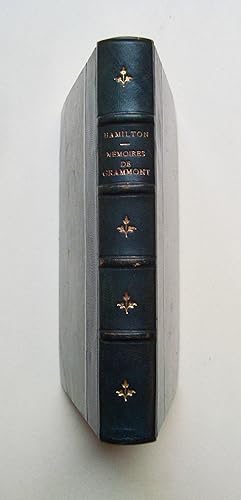
Paris : Paulin, 1847 - petit in-12 (9,5x14,5 cm) demi-veau, dos à nerfs avec fleurons, titre et auteur dorés, 364 pages - petites rousseurs sinon bon état - Livres.


![Seller image for Memoirs of Count Grammont [sic] for sale by Arundel Books](https://pictures.abebooks.com/inventory/md/md4666575499.jpg)