
Phnom Penh (12 results)

- Softcover
Seller: WeBuyBooks, Rossendale, LANCS, United KingdomWeBuyBooks
Contact seller5-star sellerCondition: Used - Good
US$ 7.62
US$ 11.71 shippingShips from United Kingdom to U.S.A.Quantity: 1 available
Condition: Good. Most items will be dispatched the same or the next working day. A copy that has been read but remains in clean condition. All of the pages are intact and the cover is intact and the spine may show signs of wear. The book may have minor markings which are not specifically mentioned.

Preah Neang Tevi. Collections of the National Museum Phnom Penh.
Preah Neang Tevi. - National Museum Phnom Penh. - Khun Samen:
Language: English
Published by National Museum Phnom Penh, first ed. 2005 2005
- Softcover
- First Edition
Seller: Antiquariat Carl Wegner, Berlin, B, GermanyAntiquariat Carl Wegner
Contact seller5-star sellerCondition: Used
US$ 32.24
US$ 10.43 shippingShips from Germany to U.S.A.Quantity: 1 available
Softcover. 4°, Original softcover with 129 pages, many monochrome and some color illustrations. Clean, good condition. -- Originalbroschur mit 129 Seiten, vielen einfarbigen und einigen farbigen Abbildungen. Sauberer, guter Zustand. -- Bitte Portokosten außerhalb EU erfragen! / Please ask for postage costs outside EU! / S ' il v…ous plait demander des frais de port en dehors de l ' UE! // Bitte beachten Sie auch unsere Fotos! / Please also note our photos! / Veuillez noter nos photos -- Ob Sonnenschein oder warmer Regen: mit einem interessanten Buch kommen Sie immer gut durch den Tag. -- Wir kaufen Ihre werthaltigen Bücher! K03190Z-436852.
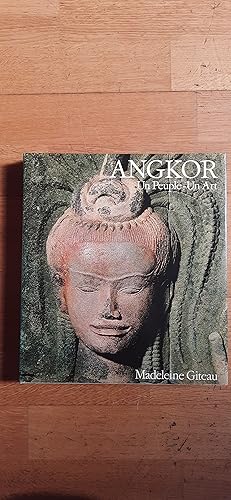
Published by Paris Bibliothèque des Arts 1976 1976
Seller: Librairie Sainte-Marie, Clamart, , FranceLibrairie Sainte-Marie
Contact seller5-star sellerCondition: Used
US$ 33.43
US$ 10.20 shippingShips from France to U.S.A.Quantity: 1 available
in-quarto, 287 pp., illustrations, noir et blanc et couleur, toile, sous jaquette, dans un emboitage La vie dans les provinces - La vie dans les bourgs et les villages - La vie dans Angkor - Les étapes de l'édification d'Angkor - Les activités populaires - La vie dans le Palais - Quelques images du Palais Royal - La fonction Roy…ale - La vie dans les Temples, les solennités - Les Ascètes dans la forêt - Rôle culturel des Temples et des Monastères - etc Très bon état.

Published by Ministere de l'Information du Gouvernement Royal du Cambodge-Phnom Penh
Seller: Wonder Book, Frederick, MD, U.S.A.Wonder Book
Contact seller5-star sellerCondition: Good. Good condition. No Dust Jacket French edition. (Cambodia, Books in French) A copy that has been read but remains intact. May contain markings such as bookplates, stamps, limited notes and highlighting, or a few light stains. NOT AVAILABLE FOR SHIPMENT OUTSIDE OF THE UNITED STATES.

Language: English
Published by Taylor & Francis 2019
Series: Routledge Studies in Modern History, Book 27 of 113. Book 27 of 113 - Routledge Studies in Modern History
- Softcover
Seller: moluna, Greven, , Germanymoluna
Contact seller5-star sellerCondition: New
US$ 93.56
US$ 56.79 shippingShips from Germany to U.S.A.Quantity: Over 20 available
Kartoniert / Broschiert. Condition: New. Brigadier General Boraden Nhem currently serves as assistant to General Tea Banh, Deputy Prime Minister and Minister of National Defense of Cambodia. He previously served as Deputy Director of the Institute of Military History. He is als.
 More images
Published by Kinkasha, 1981
- Hardcover
Seller: The Isseido Booksellers, ABAJ, ILAB, Tokyo, , JapanThe Isseido Booksellers, ABAJ, ILAB
Contact seller4-star sellerCondition: Used - Very good
US$ 120.20
US$ 37.00 shippingShips from Japan to U.S.A.Quantity: 1 available
Hardcover. Condition: Very Good. Dust Jacket Condition: Near Fine. Reprinted from Edition de l'Institut Bouddhique, 1967, 5th edition. (viii), 1888pp. Original cloth. Dust jacket. a fine copy.
 More images
Published by ?????. National Travel Company. (Circa1960s). 1960
- Softcover
Seller: Asia Bookroom ANZAAB/ILAB, Canberra, ACT, AustraliaAsia Bookroom ANZAAB/ILAB
Contact seller5-star sellerCondition: Used
US$ 218.53
US$ 21.25 shippingShips from Australia to U.S.A.Quantity: 1 available
Folding tourist brochure of Phnom Penh and environs, in total 64.5 x 49.8cm, 15 panels, folded size 21.5 x 9.8cm. Two maps, one of the city of Phnom Penh with street names in Khmer transliterated into Latin script (43 x 30cm). On reverse, a coloured topographical map of southen Cambodia showing border with Vietnam, (20 x 28.5cm)…. Numerous black and white photographic illustrations to accompany information on flights, trains, tourist entry requirements, sights of interest to tourists. All information in traditional Chinese characters. Slight browning on one panel, and two small holes mended with washi paper, else in very good condition. Of particular interest in the visitor information is a description of an area about 150 km from the city of Phnom Penh which tourists can visit to take photographs of, or hunt wild animals, as long as they bring their own rifles.

- Map
Seller: Geographicus Rare Antique Maps, Brooklyn, NY, U.S.A.Geographicus Rare Antique Maps
Contact seller4-star sellerVery good. Light soiling. Light wear along original folds. Size 17 x 11 Inches. A scarce c. 1967 French-language city map of Phnom-Penh, Cambodia. It depicts the city towards the end of the Sihanouk era, before a military coup in 1970 that brought a U.S.-aligned military government to power, which was soon overthrown by the Khme…r Rouge. A Closer Look The center of the city along the Tonle Sap is displayed with roads named and the location of 59 sites indicated, corresponding to an index at top. The marked sites include government offices, schools, museums, major hotels and restaurants, embassies, banks, airline offices, pharmacies and medical offices, and a club called 'Dancing Mékong'. Three landmarks are represented pictorially but not labeled - the pagoda of Wat Phnom towards the top, the X-shaped Central Market at left, and the Cambodian Royal Palace at bottom-right. Cambodia's Olympic Stadium The Olympic Stadium at bottom-left was built in 1964 with high aspirations and was one of the largest stadiums in Asia when completed, containing not only a grass field but also indoor facilities including Olympic-sized swimming pools. However, its use was limited due to political instability and warfare. The stadium did host the 1966 GANEFO (Games of New Emerging Forces) Games, meant as an alternative to the Olympics, which were deemed too colonialist / imperialist for not including several Communist, anti-colonial countries. Similarly, in 1965 it hosted a two FIFA World Cup qualifying matches between North Korea and Australia which was similarly due to the lack of diplomatic recognition for North Korea's government by Western countries. Under the Khmer Rouge, the stadium was used as an execution ground for officials of the Khmer Republic government, which overthrew Sihanouk in 1970 and aligned closely with the United States and South Vietnam. The stadium was remodeled in 2000 and still stands, recently hosting the 2023 Southeast Asian Games. The 'Pearl of Asia' and Its Destruction Phnom Penh was established as the capital of Cambodia in 1865 by King Norodom I (1860 - 1904). At the time, it was a waterlogged flood plain described by the 19th century historian Penny Edwards as 'best known for its vast tracts of mosquito-infested swampland, the stench of stagnant water and human waste, and frequent outbreaks of cholera'. The French established a protectorate in Cambodia in the 1870s and began to remake the city as a grand colonial capital in the spirit of Saigon or Hanoi, investing in a network of new avenues, parks, canals, markets, and railways. The Japanese invaded Cambodia in 1941, stationing troops in Phnom Penh, ending the French Era. At the end of World War II (1939 - 1945), King Norodom Sihanouk declared the independent Kingdom of Kampuchea, although it took another eight years before the French colonial administrators recognized the claim. This began the Sangkum Period, which was characterized by oddly fused monarchist and socialist values, including alignment with other Asian socialist and communist movements. Discontent with Sihanouk's governance and widespread corruption led to the more radicalized communism of Pol Pot to establish itself in rural areas by the mid-1960s. At the same time, the military aligned closely with the United States and South Vietnam, overthrowing Sihanouk in 1970, before themselves being ousted by the Khmer Rouge five years later. Under the Khmer Rouge, Phnom Penh, which had grown rapidly with the influx of refugees from rural areas, was mostly depopulated, and the city's former residents, who were deemed politically unreliable, suffered tremendously, with hundreds of thousands being murdered or dying from mistreatment and starvation. Publication History and Census This map was produced by an unknown maker. It is undated, but from context looks to date from the late 1960s. The only map in institutional collections which appears to match it is held by the Staatsbibliothek zu Berlin and is dated c.
 More images
Royaume du Cambodge Plan de la Ville de Phnom-Penh.
1935 Service Géographique de l'Indochine Wall Map of Phnom Penh, Cambodia
- Map
Seller: Geographicus Rare Antique Maps, Brooklyn, NY, U.S.A.Geographicus Rare Antique Maps
Contact seller4-star sellerVery good. Some light soiling. Size 52.5 x 28.25 Inches. This is the only known surviving example of an exceptional c. 1935 wall map of Phnom-Penh, capital of Cambodia - the largest and best map of Phnom-Penh during the peak of its colonial era urbanization and development, thus recording a host of ambitious projects, including…canals, parks, new neighborhoods, markets, railroads, and dredging efforts that transformed the swampy flood plain to a national capital. A Closer Look The map covers Phnom-Penh from the Mekong to the city limits and the borders of Kandal province. It is the product of a meticulous survey where even individual buildings are clearly illustrated. A host of new neighborhoods, civil projects, and grand boulevards are ghosted in - suggesting that these, most of which were realized by the late 1930s, were still under development. Among these is the current site of Orussey Market, here labeled 'Reserve pour Marche'. This map features primarily Khmer placenames, a sharp contrast to comparable commercial maps of the same period. For example, the prominent Avenues Verneville and Piquet are here identified as Rukhak Vithei Preah Mona Ksat Trianei Kossomak (Preah Moha Ksatreiyani Kossamak, 106) and Rukhak Vithei Okhna Phlong (Oknha Ing Bun Hoaw, 108). While undated, the mapping of the Phnom Penh - Poipet Railway, here terminating at a large central station, gives us a terminus post quem of 1932, and the various projected but incomplete developments a terminus ad quem of 1938. The map bears a pencil annotation in the lower right that reads, 'Huot-Luon S.G.K.' This was likely the former owner, probably an official with the Service Géographique Khmer (1959 - present). 'Belle Epoque' of Phnom-Penh Phnom-Penh was established as the capital of Cambodia in 1865 by King Norodom I (1860 - 1904). At the time, it was a waterlogged flood plain described by the 19th-century historian Penny Edwards as best known for its vast tracts of mosquito-infested swampland, the stench of stagnant water and human waste, and frequent outbreaks of cholera. The French established a protectorate in Cambodia in the 1870s and began to remake the city as a grand colonial capital in the spirit of Saigon or Hanoi. Land reclamation efforts along the Tonle Sap River led to the construction of a Grand Canal, located roughly between avenues 106 (Avenue Verneville) and 108 (Avenue Piquet). This was followed by a railroad in the 1920s and the dredging and gridding of the region to the south of 108th Avenue (Avenue Piquet). The Grand Canal was filled and replaced with broad avenues and a park (Freedom Park) in the 1920s. The Phnom-Penh Railway Station - shown here as no. 18 - was completed in 1932 at the western end of Freedom Park. Likewise, the impressive Psar Themy or New Market (no. 85), completed in 1935, was built in a grandiose domed style using a then innovative material - reinforced concrete. The Japanese invaded Cambodia in 1941, stationing troops in Phnom-Penh, ending the French Era. At the end of WWII (1939 - 1945), King Norodom Sihanouk declared the independent Kingdom of Kampuchea. However, it took another 8 years before the French colonial administrators recognized the claim. Publication History and Census This map features no imprint or date, though we can loosely assign a timeframe based on the ephemeral content. Given the precision and detail, it was likely produced by the Service Géographique de l'Indochine out of Saigon. This is the only known example.

- Map
Seller: Geographicus Rare Antique Maps, Brooklyn, NY, U.S.A.Geographicus Rare Antique Maps
Contact seller4-star sellerVery good. Slight soiling and wear on old fold lines. Size 30.25 x 22 Inches. A rare c. 1960 map of Phnom Penh, capital of Cambodia, during the Sangkum Period when it was known as the 'Pearl of Asia'. The map represents the final days of a golden era of development for Phnom Penh, as major urban projects, canals, and dredging ef…forts drained the swampy flood plain. It also includes the initial layout and planning of the elite Khan Toul Kouk neighborhood. A Closer Look The map is based on an earlier map first published in the 1930s under French colonial auspices - with significant updates and revisions to the date of publication. It covers the city from the Mekong to Beng Kâk and the Phnom Penh - Poipet Railway. New planned neighborhoods and widespread urbanization then under development are defined by ghosted-in street grids. The map is surrounded by a street and building index, and important structures are illustrated pictorially. The Belle Époque of Phnom-Penh Phnom Penh was established as the capital of Cambodia in 1865 by King Norodom I (1860 - 1904). At the time, it was a waterlogged flood plain described by the 19th century historian Penny Edwards as 'best known for its vast tracts of mosquito-infested swampland, the stench of stagnant water and human waste, and frequent outbreaks of cholera'. The French established a protectorate in Cambodia in the 1870s and began to remake the city as a grand colonial capital in the spirit of Saigon or Hanoi. Land reclamation efforts along the Tonle Sap River led to the construction of a Grand Canal, located roughly between avenues 106 (Avenue Verneville) and 108 (Avenue Piquet). This was followed by a railroad in the 1920s, and the dredging and gridding of the region to the south of 108th Avenue (Avenue Piquet). The Grand Canal was filled and replaced with broad avenues and a park (Freedom Park) in the 1920s. The Phnom Penh Railway Station - shown here - was completed in 1932 at the western end of Freedom Park. Likewise, the impressive Psar Themy or New Market was built in a grandiose domed style using a then innovative material - reinforced concrete. The Japanese invaded Cambodia in 1941, stationing troops in Phnom Penh, ending the French Era. At the end of WWII (1939 - 1945), King Norodom Sihanouk declared the independent Kingdom of Kampuchea, although it took another 8 years before the French colonial administrators recognized the claim. This began the Sangkum Period, which was characterized by oddly fused monarchist and socialist values. Discontent with Sihanouk's governance and widespread corruption led to the more radicalized communism of Pol Pot by the mid 1960s. Publication History and Census The map is undated, and no publisher is named. It is however derived from an earlier variant published in the 1920s-30s under the French colonial administration. The present state, judging from the widespread urbanization, we can loosely date the map to about 1960 - during the Sangkum Period. There are no other known examples.

- Softcover
- Print on Demand
Seller: moluna, Greven, , Germanymoluna
Contact seller5-star sellerCondition: New
US$ 52.22
US$ 56.79 shippingShips from Germany to U.S.A.Quantity: Over 20 available
Condition: New. Dieser Artikel ist ein Print on Demand Artikel und wird nach Ihrer Bestellung fuer Sie gedruckt. Joanne Zucchetto, MSW, maintains a private practice for individual and group therapy clients in Washington, D.C. She has previously worked in the trauma treatment programs at Sheppard and Enoch Pratt Hospital, and the… Psychiatric Institu.

- Hardcover
- Print on Demand
Seller: moluna, Greven, , Germanymoluna
Contact seller5-star sellerCondition: New
US$ 161.64
US$ 56.79 shippingShips from Germany to U.S.A.Quantity: Over 20 available
Condition: New. Dieser Artikel ist ein Print on Demand Artikel und wird nach Ihrer Bestellung fuer Sie gedruckt. Joanne Zucchetto, MSW, maintains a private practice for individual and group therapy clients in Washington, D.C. She has previously worked in the trauma treatment programs at Sheppard and Enoch Pratt Hospital, and the… Psychiatric Institu.


