
Pieck Michael (21 results)

- Softcover
Seller: California Books, Miami, FL, U.S.A.California Books
Contact seller4-star sellerCondition: New
US$ 29.00
Free ShippingShips within U.S.A.Quantity: Over 20 available
Condition: New.

- Softcover
Seller: California Books, Miami, FL, U.S.A.California Books
Contact seller4-star sellerCondition: New
US$ 29.00
Free ShippingShips within U.S.A.Quantity: Over 20 available
Condition: New.

- Softcover
Seller: California Books, Miami, FL, U.S.A.California Books
Contact seller4-star sellerCondition: New
US$ 29.00
Free ShippingShips within U.S.A.Quantity: Over 20 available
Condition: New.

- Softcover
Seller: California Books, Miami, FL, U.S.A.California Books
Contact seller4-star sellerCondition: New
US$ 29.00
Free ShippingShips within U.S.A.Quantity: Over 20 available
Condition: New.

- Softcover
Seller: AHA-BUCH GmbH, Einbeck, GermanyAHA-BUCH GmbH
Contact seller5-star sellerCondition: New
US$ 21.47
US$ 69.96 shippingShips from Germany to U.S.A.Quantity: 1 available
Taschenbuch. Condition: Neu. Druck auf Anfrage Neuware - Printed after ordering - Seminar paper from the year 2011 in the subject Didactics - English - Literature, Works, grade: 1,0, University of Cologne (Englisches Seminar), course: Sitcom and Violence - Einführungsseminar Literaturwissenschaft, language: English, abstract: Vi…olence and its various forms of representation have been a recurring source of comedy and humour throughout the history of comedic literature.(.)As Schneider et al. have shown, violence can be interpersonal, collective, or even self-inflicted. Forms of violence can be both physical and non-physical. Whereas violence in its blunt physical or verbal appearance is usually easy to define and comprehend, this may not necessarily be the case with its non-physical and non-verbal forms. The mode in which characters or groups are represented within a narrative or a plot can be an effective form of violence, too, as Armstrong and Tennenhouse have proposed.A good example of how a national stereotype is ridiculed in a sitcom is the Emmy-awarded episode 'An Affair to Forget' from the sitcom Frasier aired in 1995. In this episode the protagonist Frasier believes that his brother's wife has an affair with her fencing instructor, who is German. This fencing instructor, named Gunnar, is portrayed in an assumed stereotypical way: He is blond and tall and he does not speak any English--although his wife does fluently. He seems to be hot-tempererd so that the accuse of having stolen a shoe (a misunderstanding) makes him attack Frasier's brother with his fence. It may be the depiction of Gunnar as an alleged typical German, as well as the representation of Germanness in general, which have prompted the producers of the German dubbing to change Gunnar and his wife's nationality from German to Danish in the German version of the episode. To a German audience this depiction of their own national stereotype may appear so grotesque that they would either not recognize themselves or even feel offended. In addition, the bigger part of the jokes in this episode, which rely on mutual not-understanding, would not work if the whole episode was presented in just one language, namely German.The question now arises whether such a depiction of a German stereotype is a deliberate disparagement of all Germans, and thus a representation of violence. Is it another form ofGerman-bashing as it was popular among the British tabloid at the beginning of the millennium This essay will examine the representation of German stereotypes in the American media in general and its depiction in the second season of Frasier in particular. It will present a short overview of the historical developments with special regard to the employment of German stereotypes in the United States.

- Softcover
Seller: AHA-BUCH GmbH, Einbeck, GermanyAHA-BUCH GmbH
Contact seller5-star sellerCondition: New
US$ 21.47
US$ 70.05 shippingShips from Germany to U.S.A.Quantity: 1 available
Taschenbuch. Condition: Neu. Druck auf Anfrage Neuware - Printed after ordering - Seminar paper from the year 2009 in the subject English Language and Literature Studies - Literature, grade: 1,3, University of Cologne (Englisches Seminar), course: Hauptseminar Old English Prose, language: English, abstract: Lives of saints were…a very popular genre in Christian Europe throughout the entire Middle Ages, and their popularity did not cease until the Reformation in the 16th century. Since Late Antiquity two basic concepts of saints' lives had evolved, the passio ('passion') and the vita ('life'). 'The passio was the literary form appropriate for a saint who had been martyred for his/her faith, whereas the vita properly pertained to a confessor (that is, a saint whose impeccable service to God constituted a metaphorical, not real, martyrdom).' (Lapidge 1991: 252)Saints' lives circulated widely in Anglo-Saxon England, most of which were composed in Latin. At the end of the 10th century the monk and author Ælfric of Eynsham translated a collection of forty lives of saints into the Old English vernacular. Together with his Catholic Homilies, they represent the heyday of Old English prose in the late 10th and early 11th century. The overall intention of his Lives of Saints is the same, namely to commemorate a saint on his or her feast day, and to instruct and edify the reader or hearer. The particular lives, however, are treated individually according to the different concepts, the passio and the vita. Two of Ælfric's Lives of Saints, St Edmund's and St Ætheldryth's, represent these two concepts. The former describes a man's life of active participation with a Christian impetus culminating in martyrdom and death, whereas the latter represents a woman's life remote from worldly affairs, which can also be described as a passive life.Ælfric was not just a learned monk and translator but a formidable writer and stylist in his mother tongue. The fact that he had written a book for teaching Latin in Old English leads to the assumption that he must have been familiar with the peculiarities of grammatical constructions in both languages. A comparison between The Life of St Edmund (passio) and the Life of St Æthelthryth (vita), will show that--despite many parallels--he strengthens the individual concepts, male and active vs. female and passive, not only by purely stylistic but also grammatical means.

- Softcover
Seller: AHA-BUCH GmbH, Einbeck, GermanyAHA-BUCH GmbH
Contact seller5-star sellerCondition: New
US$ 21.47
US$ 69.99 shippingShips from Germany to U.S.A.Quantity: 1 available
Taschenbuch. Condition: Neu. Druck auf Anfrage Neuware - Printed after ordering - Seminar paper from the year 2010 in the subject Didactics - English - Literature, Works, grade: 1,3, University of Cologne (Englisches Seminar), course: Hauptseminar 'English Literature from Chaucer to Shakespeare', language: English, abstract: Thi…s paper will scrutinize the 'Miller's Tale' and the 'Reeve's Tale' with regard to their erotic contents and the instances of obscene speech. The main emphasis will be put on a discussion on the genre of the tales as well as the question, whether instances of eroticism are really the light-hearted expression of joyful lust, or rather skillful narrative means serving both the authentic representation of the characters and the emphasizing of the tales' overall morals.There is hardly any period in history that has preoccupied people of later eras as much as the Middle Ages. They have been a recurring popular subject in literature over the last two hundred years. The film industry could not go without them. One reason for this fascination might be the fact that the Middle Ages are both a part of our own history, still visible in magnificent church buildings, and an era that lies half a millennium away from us. This distance and a rather limited knowledge about the 'real' circumstances contribute to a hazy image leaving plenty of space for interpretation and imagination.A popular view on the Middle Ages from our perspective is that of jaunty folk, who enjoyed their lives being free of the restraints of our modern society. It is therefore not surprising that the Italian director Pier Paolo Pasolini chose the 'Canterbury Tales' for one of the films in his Trilogy of Life the other two being Bocaccio's 'The Decameron and Arabian Nights'. Pasolini made his films in a time which today is referred to as the 'Sexual Revolution'. Perhaps it was the undisguised depiction of sexuality in some of the 'Canterbury Tales' which had inspired him to adapt them for the screen.One of the 'Canterbury Tales' we find in Pasolini's film is the 'Miller's Tale'. It is the second story being told, after the 'Knight's Tale', and it forms a unit, or a diptych, together with the Reeve's Tale, which follows. One does not have to approve of Pasolini's intentions in order to acknowledge the erotic elements in both of these tales. Having a closer look at the instances of eroticism in the tales leads to the question of the author's motivation to employ them. Are the 'Miller's' and the 'Reeve's Tale' erotic stories written with the intention to arouse sexual feelings, or were they rather meant to challenge and provoke the contemporary authorities Was it common literary practice in Chaucer's time to use erotic or obscene speech, or did he break new ground in literature.

- Softcover
Seller: preigu, Osnabrück, Germanypreigu
Contact seller5-star sellerCondition: New
US$ 21.47
US$ 81.27 shippingShips from Germany to U.S.A.Quantity: 5 available
Taschenbuch. Condition: Neu. The Joy of Lust? The Depiction and Function of Eroticism in Chaucer's "Miller's Tale" and "Reeve's Tale" | Michael Pieck | Taschenbuch | 28 S. | Englisch | 2016 | GRIN Verlag | EAN 9783668313644 | Verantwortliche Person für die EU: GRIN Publishing GmbH, Waltherstr. 23, 80337 München, info[at]grin[dot…]com | Anbieter: preigu.

- Softcover
Seller: preigu, Osnabrück, Germanypreigu
Contact seller5-star sellerCondition: New
US$ 21.47
US$ 81.27 shippingShips from Germany to U.S.A.Quantity: 5 available
Taschenbuch. Condition: Neu. Sitcom And "German-Bashing" | The representation of Germanness in the second season of the American sitcom Frasier with special regard to "An Affair to Forget" | Michael Pieck | Taschenbuch | 24 S. | Englisch | 2011 | GRIN Verlag | EAN 9783640909247 | Verantwortliche Person für die EU: GRIN Publishin…g GmbH, Waltherstr. 23, 80337 München, info[at]grin[dot]com | Anbieter: preigu.

- Softcover
Seller: preigu, Osnabrück, Germanypreigu
Contact seller5-star sellerCondition: New
US$ 21.47
US$ 81.27 shippingShips from Germany to U.S.A.Quantity: 5 available
Taschenbuch. Condition: Neu. Old English Prose: Passio and Vita | Two Concepts of a Saint's Life in Anglo-Saxon England | Michael Pieck | Taschenbuch | 36 S. | Englisch | 2010 | GRIN Verlag | EAN 9783640626199 | Verantwortliche Person für die EU: GRIN Publishing GmbH, Waltherstr. 23, 80337 München, info[at]grin[dot]com | Anbiete…r: preigu.
- Softcover
Seller: Buchpark, Trebbin, , GermanyBuchpark
Contact seller5-star sellerCondition: Used - Fine
US$ 17.15
US$ 121.91 shippingShips from Germany to U.S.A.Quantity: 1 available
Condition: Sehr gut. Zustand: Sehr gut | Sprache: Englisch | Produktart: Bücher | Seminar paper from the year 2010 in the subject Didactics for the subject English - Literature, Works, grade: 1,3, University of Cologne (Englisches Seminar), course: Hauptseminar ¿English Literature from Chaucer to Shakespeare¿, language: English,… abstract: This paper will scrutinize the ¿Miller¿s Tale¿ and the ¿Reeve¿s Tale¿ with regard to their erotic contents and the instances of obscene speech. The main emphasis will be put on a discussion on the genre of the tales as well as the question, whether instances of eroticism are really the light-hearted expression of joyful lust, or rather skillful narrative means serving both the authentic representation of the characters and the emphasizing of the tales¿ overall morals. There is hardly any period in history that has preoccupied people of later eras as much as the Middle Ages. They have been a recurring popular subject in literature over the last two hundred years. The film industry could not go without them. One reason for this fascination might be the fact that the Middle Ages are both a part of our own history, still visible in magnificent church buildings, and an era that lies half a millennium away from us. This distance and a rather limited knowledge about the ¿real¿ circumstances contribute to a hazy image leaving plenty of space for interpretation and imagination. A popular view on the Middle Ages from our perspective is that of jaunty folk, who enjoyed their lives being free of the restraints of our modern society. It is therefore not surprising that the Italian director Pier Paolo Pasolini chose the ¿Canterbury Tales¿ for one of the films in his Trilogy of Life the other two being Bocacciös ¿The Decameron and Arabian Nights¿. Pasolini made his films in a time which today is referred to as the ¿Sexual Revolution¿. Perhaps it was the undisguised depiction of sexuality in some of the ¿Canterbury Tales¿ which had inspired him to adapt them for the screen. One of the ¿Canterbury Tales¿ we find in Pasolini¿s film is the ¿Miller¿s Tale¿. It is the second story being told, after the ¿Knight¿s Tale¿, and it forms a unit, or a diptych, together with the Reeve¿s Tale, which follows. One does not have to approve of Pasolini¿s intentions in order to acknowledge the erotic elements in both of these tales. Having a closer look at the instances of eroticism in the tales leads to the question of the author¿s motivation to employ them. Are the ¿Miller¿s¿ and the ¿Reeve¿s Tale¿ erotic stories written with the intention to arouse sexual feelings, or were they rather meant to challenge and provoke the contemporary authorities? Was it common literary practice in Chaucer¿s time to use erotic or obscene speech, or did he break new ground in literature.
- Softcover
Seller: Buchpark, Trebbin, , GermanyBuchpark
Contact seller5-star sellerCondition: Used
US$ 17.69
US$ 121.91 shippingShips from Germany to U.S.A.Quantity: 1 available
Condition: Hervorragend. Zustand: Hervorragend | Sprache: Englisch | Produktart: Bücher | Seminar paper from the year 2010 in the subject Didactics for the subject English - Literature, Works, grade: 1,3, University of Cologne (Englisches Seminar), course: Hauptseminar ¿English Literature from Chaucer to Shakespeare¿, language:…English, abstract: This paper will scrutinize the ¿Miller¿s Tale¿ and the ¿Reeve¿s Tale¿ with regard to their erotic contents and the instances of obscene speech. The main emphasis will be put on a discussion on the genre of the tales as well as the question, whether instances of eroticism are really the light-hearted expression of joyful lust, or rather skillful narrative means serving both the authentic representation of the characters and the emphasizing of the tales¿ overall morals. There is hardly any period in history that has preoccupied people of later eras as much as the Middle Ages. They have been a recurring popular subject in literature over the last two hundred years. The film industry could not go without them. One reason for this fascination might be the fact that the Middle Ages are both a part of our own history, still visible in magnificent church buildings, and an era that lies half a millennium away from us. This distance and a rather limited knowledge about the ¿real¿ circumstances contribute to a hazy image leaving plenty of space for interpretation and imagination. A popular view on the Middle Ages from our perspective is that of jaunty folk, who enjoyed their lives being free of the restraints of our modern society. It is therefore not surprising that the Italian director Pier Paolo Pasolini chose the ¿Canterbury Tales¿ for one of the films in his Trilogy of Life the other two being Bocacciös ¿The Decameron and Arabian Nights¿. Pasolini made his films in a time which today is referred to as the ¿Sexual Revolution¿. Perhaps it was the undisguised depiction of sexuality in some of the ¿Canterbury Tales¿ which had inspired him to adapt them for the screen. One of the ¿Canterbury Tales¿ we find in Pasolini¿s film is the ¿Miller¿s Tale¿. It is the second story being told, after the ¿Knight¿s Tale¿, and it forms a unit, or a diptych, together with the Reeve¿s Tale, which follows. One does not have to approve of Pasolini¿s intentions in order to acknowledge the erotic elements in both of these tales. Having a closer look at the instances of eroticism in the tales leads to the question of the author¿s motivation to employ them. Are the ¿Miller¿s¿ and the ¿Reeve¿s Tale¿ erotic stories written with the intention to arouse sexual feelings, or were they rather meant to challenge and provoke the contemporary authorities? Was it common literary practice in Chaucer¿s time to use erotic or obscene speech, or did he break new ground in literature.

- Hardcover
Seller: Celler Versandantiquariat, Eicklingen, , GermanyCeller Versandantiquariat
Contact seller5-star sellerCondition: Used
US$ 16.74
US$ 44.12 shippingShips from Germany to U.S.A.Quantity: 1 available
Kommunikation u. Wirtschaft, Oldenburg, (um 2010). 176 S. mit Abbildungen., Pbd.U., quart.---- Neuwertig, original verlagsfrisch verschweißt. Zweisprachig: deutsch/englisch - 750 Gramm.

- Softcover
Seller: AHA-BUCH GmbH, Einbeck, GermanyAHA-BUCH GmbH
Contact seller5-star sellerCondition: New
US$ 21.47
US$ 69.99 shippingShips from Germany to U.S.A.Quantity: 1 available
Taschenbuch. Condition: Neu. Druck auf Anfrage Neuware - Printed after ordering - Studienarbeit aus dem Jahr 2010 im Fachbereich Englisch - Grammatik, Stil, Arbeitstechnik, einseitig bedruckt, Note: 1,3, Universität zu Köln, Veranstaltung: English Grammar: Synchronic and Diachronic Aspects, Sprache: Deutsch, Abstract: The terms…synthetic language and analytic language in connection with linguistic typo logy have become commonplaces in contemporary lingusitics. They refer to morphological or rather morpho-syntactic characteristics of languages. Whereas analytic languages have very few affixes (for example, Modern English), synthetic languages have many (for example, Latin, Old English). (O Grady et al. 1997: 334) Using the quantifiers very few and many , this definition by O Grady et al. shows that it might be problematic to speak about synthetic and analytic languages as fixed or closed categories in a structuralist way. They rather denote prototypical categories or general tendencies, as there is hardly any language which entirely belongs to one or the other category. Even a prototypically analytic language like Present-Day English (PDE) has both grammaticalized synthetic elements and tendencies towards new syntheticity, as O Grady et al. or Danchev have shown. In a synthetic language, four lexiacal categories are usually concerned with inflectio n: verbs, nouns, pronouns and adjectives. Since Old English, the earliest stage of the English language, the inflectional system has continuously been reduced, and in PDE most grammatical relations are expressed through analytic constructions. The tense system of Old English consisted of two morphologically marked tenses, the present and the preterite. Futurity could be expressed through futurate constructions employing present tense or, rarely, be supported by a certain set of lexical verbs functioning as auxiliaries without losing their lexical meaning, e.g. willan = to want, or sculan = must. These verbs were, unlike today, fully inflected. ( )This paper will show that the decline of the inflectional system made it quasi necessary to create and strengthen analytic verb forms and finally grammaticalize them. The outcome of this process is the great variety of ways to express temporal relationships and aspects, as we have them in Present-Day English. The fundament of the English language may remain synthetic, however, the construction above is clearly analytic.
Published by Hartmut Kühler, Düsseldorf, 1997 1997
- Softcover
Seller: Programmhefte24 Schauspiel und Musiktheater der letzten 150 Jahre, Görlitz, , GermanyProgrammhefte24 Schauspiel und Musiktheater der letzten 150 Jahre
Contact seller5-star sellerCondition: Used
US$ 17.82
US$ 98.69 shippingShips from Germany to U.S.A.Quantity: 1 available
Condition: siehe Beschreibung. original Heft, Format ca. 9,5 x 21 cm, 40 Seiten, mehrere Abbildungen. Zustand: gut Regie: Peter Hailer. Bühne: Klaus Baumeister. Kostüme: Lydia Kirchleitner. Mitwirkende: Claudia Burckhardt, Eva Spott, Andreas Ebert, Thomas Huber, Winfried Küppers, Artus-Maria Matthiessen, Dieter Prochnow, Thomas…Schendel. ------- Program booklet Urs Widmer TOP DOGS Düsseldorf Playhouse 1997 - Original booklet, approximately 9.5 x 21 cm, 40 pages, several illustrations. Condition: good - Directed by Peter Hailer. Set design by Klaus Baumeister. Costume design by Lydia Kirchleitner. Cast: Claudia Burckhardt, Eva Spott, Andreas Ebert, Thomas Huber, Winfried Küppers, Artus-Maria Matthiessen, Dieter Prochnow, Thomas Schendel. deu.
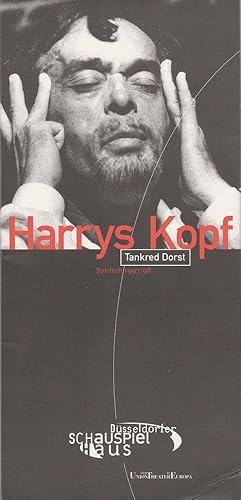
Programmheft Uraufführung Tankred Dorst HARRYS KOPF 17. Oktober 1997 Großes Haus Spielzeit 1997 / 98
Published by Hartmut Kühler, Monheim, 1997 1997
- Softcover
Seller: Programmhefte24 Schauspiel und Musiktheater der letzten 150 Jahre, Görlitz, , GermanyProgrammhefte24 Schauspiel und Musiktheater der letzten 150 Jahre
Contact seller5-star sellerCondition: Used
US$ 20.21
US$ 98.69 shippingShips from Germany to U.S.A.Quantity: 1 available
Condition: siehe Beschreibung. Originalbroschur, Format ca. 9,8 x 20,5 cm, 60 Seiten, mehrere Abbildungen, darunter 2 Szenenfotos. Zustand: gut bis sehr gut, kleiner Knick unten rechts im Deckel und den zwei folgenden Seiten Regie und Bühne: Wilfried Minks. Kostüme: Alissa Kolbusch. Musik: Biber Gullatz. Mitwirkende: Fritz Sched…iwy, Anke Hartwig, Klaus Schreiber, Anke Schubert, Franz Xaver Zach, u. a. ------- Program booklet, premiere. Tankred Dorst, HARRY'S HEAD, Düsseldorfer Schauspielhaus, 1997 - Original softcover, approximately 9.8 x 20.5 cm, 60 pages, several illustrations, including two scene photos. Condition: good to very good, small crease at the bottom right of the cover and the two following pages. - Directed and designed by Wilfried Minks. Costumes by Alissa Kolbusch. Music by Biber Gullatz. Featuring: Fritz Schediwy, Anke Hartwig, Klaus Schreiber, Anke Schubert, Franz Xaver Zach, and others. deu.

- Softcover
Seller: preigu, Osnabrück, Germanypreigu
Contact seller5-star sellerCondition: New
US$ 21.47
US$ 81.27 shippingShips from Germany to U.S.A.Quantity: 5 available
Taschenbuch. Condition: Neu. Towards an Analytic Language | Synchronic and Diachronic Reflections on the Tense System of English | Michael Pieck | Taschenbuch | 28 S. | Deutsch | 2012 | GRIN Verlag | EAN 9783640909254 | Verantwortliche Person für die EU: GRIN Publishing GmbH, Waltherstr. 23, 80337 München, info[at]grin[dot]com |… Anbieter: preigu.

- Softcover
- Print on Demand
Seller: BuchWeltWeit Ludwig Meier e.K., Bergisch Gladbach, , GermanyBuchWeltWeit Ludwig Meier e.K.
Contact seller5-star sellerCondition: New
US$ 21.47
US$ 26.70 shippingShips from Germany to U.S.A.Quantity: 2 available
Taschenbuch. Condition: Neu. This item is printed on demand - it takes 3-4 days longer - Neuware -Seminar paper from the year 2009 in the subject English Language and Literature Studies - Literature, grade: 1,3, University of Cologne (Englisches Seminar), course: Hauptseminar Old English Prose, language: English, abstract: Lives… of saints were a very popular genre in Christian Europe throughout the entire Middle Ages, and their popularity did not cease until the Reformation in the 16th century. Since Late Antiquity two basic concepts of saints' lives had evolved, the passio ('passion') and the vita ('life'). 'The passio was the literary form appropriate for a saint who had been martyred for his/her faith, whereas the vita properly pertained to a confessor (that is, a saint whose impeccable service to God constituted a metaphorical, not real, martyrdom).' (Lapidge 1991: 252)Saints' lives circulated widely in Anglo-Saxon England, most of which were composed in Latin. At the end of the 10th century the monk and author Ælfric of Eynsham translated a collection of forty lives of saints into the Old English vernacular. Together with his Catholic Homilies, they represent the heyday of Old English prose in the late 10th and early 11th century. The overall intention of his Lives of Saints is the same, namely to commemorate a saint on his or her feast day, and to instruct and edify the reader or hearer. The particular lives, however, are treated individually according to the different concepts, the passio and the vita. Two of Ælfric's Lives of Saints, St Edmund's and St Ætheldryth's, represent these two concepts. The former describes a man's life of active participation with a Christian impetus culminating in martyrdom and death, whereas the latter represents a woman's life remote from worldly affairs, which can also be described as a passive life.Ælfric was not just a learned monk and translator but a formidable writer and stylist in his mother tongue. The fact that he had written a book for teaching Latin in Old English leads to the assumption that he must have been familiar with the peculiarities of grammatical constructions in both languages. A comparison between The Life of St Edmund (passio) and the Life of St Æthelthryth (vita), will show that--despite many parallels--he strengthens the individual concepts, male and active vs. female and passive, not only by purely stylistic but also grammatical means. 36 pp. Englisch.
The Joy of Lust? The Depiction and Function of Eroticism in Chaucer's Miller's Tale and Reeve's Tale
- Softcover
- Print on Demand
Seller: Majestic Books, Hounslow, , United KingdomMajestic Books
Contact seller4-star sellerCondition: New
US$ 51.02
US$ 8.73 shippingShips from United Kingdom to U.S.A.Quantity: 4 available
Condition: New. Print on Demand pp. 28.

- Softcover
- Print on Demand
Seller: BuchWeltWeit Ludwig Meier e.K., Bergisch Gladbach, , GermanyBuchWeltWeit Ludwig Meier e.K.
Contact seller5-star sellerCondition: New
US$ 21.47
US$ 26.70 shippingShips from Germany to U.S.A.Quantity: 2 available
Taschenbuch. Condition: Neu. This item is printed on demand - it takes 3-4 days longer - Neuware -Studienarbeit aus dem Jahr 2010 im Fachbereich Englisch - Grammatik, Stil, Arbeitstechnik, einseitig bedruckt, Note: 1,3, Universität zu Köln, Veranstaltung: English Grammar: Synchronic and Diachronic Aspects, Sprache: Deutsch, Abst…ract: The terms synthetic language and analytic language in connection with linguistic typo logy have become commonplaces in contemporary lingusitics. They refer to morphological or rather morpho-syntactic characteristics of languages. Whereas analytic languages have very few affixes (for example, Modern English), synthetic languages have many (for example, Latin, Old English). (O Grady et al. 1997: 334) Using the quantifiers very few and many , this definition by O Grady et al. shows that it might be problematic to speak about synthetic and analytic languages as fixed or closed categories in a structuralist way. They rather denote prototypical categories or general tendencies, as there is hardly any language which entirely belongs to one or the other category. Even a prototypically analytic language like Present-Day English (PDE) has both grammaticalized synthetic elements and tendencies towards new syntheticity, as O Grady et al. or Danchev have shown. In a synthetic language, four lexiacal categories are usually concerned with inflectio n: verbs, nouns, pronouns and adjectives. Since Old English, the earliest stage of the English language, the inflectional system has continuously been reduced, and in PDE most grammatical relations are expressed through analytic constructions. The tense system of Old English consisted of two morphologically marked tenses, the present and the preterite. Futurity could be expressed through futurate constructions employing present tense or, rarely, be supported by a certain set of lexical verbs functioning as auxiliaries without losing their lexical meaning, e.g. willan = to want, or sculan = must. These verbs were, unlike today, fully inflected. ( )This paper will show that the decline of the inflectional system made it quasi necessary to create and strengthen analytic verb forms and finally grammaticalize them. The outcome of this process is the great variety of ways to express temporal relationships and aspects, as we have them in Present-Day English. The fundament of the English language may remain synthetic, however, the construction above is clearly analytic. 28 pp. Deutsch.

- Softcover
- Print on Demand
Seller: buchversandmimpf2000, Emtmannsberg, BAYE, Germanybuchversandmimpf2000
Contact seller5-star sellerCondition: New
US$ 21.47
US$ 69.66 shippingShips from Germany to U.S.A.Quantity: 1 available
Taschenbuch. Condition: Neu. This item is printed on demand - Print on Demand Titel. Neuware -Seminar paper from the year 2009 in the subject English Language and Literature Studies - Literature, grade: 1,3, University of Cologne (Englisches Seminar), course: Hauptseminar Old English Prose, language: English, abstract: Lives of…saints were a very popular genre in Christian Europe throughout the entire Middle Ages, and their popularity did not cease until the Reformation in the 16th century. Since Late Antiquity two basic concepts of saints¿ lives had evolved, the passio (¿passion¿) and the vita (¿life¿). ¿The passio was the literary form appropriate for a saint who had been martyred for his/her faith, whereas the vita properly pertained to a confessor (that is, a saint whose impeccable service to God constituted a metaphorical, not real, martyrdom).¿ (Lapidge 1991: 252)Saints¿ lives circulated widely in Anglo-Saxon England, most of which were composed in Latin. At the end of the 10th century the monk and author Ælfric of Eynsham translated a collection of forty lives of saints into the Old English vernacular. Together with his Catholic Homilies, they represent the heyday of Old English prose in the late 10th and early 11th century. The overall intention of his Lives of Saints is the same, namely to commemorate a saint on his or her feast day, and to instruct and edify the reader or hearer. The particular lives, however, are treated individually according to the different concepts, the passio and the vita. Two of Ælfric¿s Lives of Saints, St Edmund¿s and St Ætheldryth¿s, represent these two concepts. The former describes a man¿s life of active participation with a Christian impetus culminating in martyrdom and death, whereas the latter represents a woman¿s life remote from worldly affairs, which can also be described as a passive life.Ælfric was not just a learned monk and translator but a formidable writer and stylist in his mother tongue. The fact that he had written a book for teaching Latin in Old English leads to the assumption that he must have been familiar with the peculiarities of grammatical constructions in both languages. A comparison between The Life of St Edmund (passio) and the Life of St Æthelthryth (vita), will show that¿¿despite many parallels¿¿he strengthens the individual concepts, male and active vs. female and passive, not only by purely stylistic but also grammatical means.Books on Demand GmbH, Überseering 33, 22297 Hamburg 36 pp. Englisch.


