

Order Total (1 Item Items):
Shipping Destination:

Polyglot Press (6 results)
Skip to main search results
Search filters
Product Type
- All Product Types
- Books (5)
- Magazines & Periodicals (No further results match this refinement)
- Comics (No further results match this refinement)
- Sheet Music (No further results match this refinement)
- Art, Prints & Posters (No further results match this refinement)
- Photographs (No further results match this refinement)
- Maps (No further results match this refinement)
- Manuscripts & Paper Collectibles (1)
Condition Learn more
- New (2)
- As New, Fine or Near Fine (1)
- Very Good or Good (3)
- Fair or Poor (No further results match this refinement)
- As Described (No further results match this refinement)
Binding
Collectible Attributes
- First Edition (No further results match this refinement)
- Signed (No further results match this refinement)
- Dust Jacket (No further results match this refinement)
- Seller-Supplied Images (1)
- Not Print on Demand (4)
Language (2)
Free Shipping
Seller Location
Seller Rating
-

The Role of the Christian Family in the Modern World
Published by St. Paul Editions
Seller: Wonder Book, Frederick, MD, U.S.A.
Seller rating 5 out of 5 stars

Condition: Good. Good condition. (Pope John Paul II, Catholicism) A copy that has been read but remains intact. May contain markings such as bookplates, stamps, limited notes and highlighting, or a few light stains. Bundled media such as CDs, DVDs, floppy disks or access codes may not be included.
-
The Role of the Christian Family in the Modern World
Published by St. Paul Editions
Seller: Wonder Book, Frederick, MD, U.S.A.
Seller rating 5 out of 5 stars
Condition: Very Good. Very Good condition. (Catholic Church, Pope John Paul II, Family) A copy that may have a few cosmetic defects. May also contain light spine creasing or a few markings such as an owner's name, short gifter's inscription or light stamp.
-
SEVEN TYPES OF AMBIGUITY A Monograph for Typophiles
Published by Polyglot Press, Lexington, KY, 1980
Soft cover. Condition: Fine. Sewn stiff brown printed wrappers, large 12mo., (17) pages. One of 50 numbered copies printed on thick creme paper by Arthur Graham at his Polyglot Press and signed by him. Employs seven typefaces, including Civilite and American Uncial. A fine copy in archival mylar. Signed by the Printer.
-
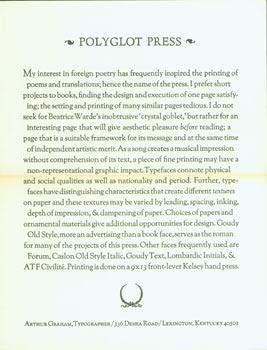
Polyglot Press.
Published by Lexington, Kentucky: Polyglot Press, [2002]., 2002
Seller: Wittenborn Art Books, San Francisco, CA, U.S.A.
Seller rating 5 out of 5 stars
Manuscript / Paper Collectible
Condition: Good. Broadside. Folded Sheet, 9" x 7". Letterpress On Wove. Very Good.
-

US$ 43.62
US$ 49.76 shipping
Ships from United Kingdom to U.S.A.Quantity: 1 available
Add to basketPaperback. Condition: new. Paperback. The "Index of Prohibited Books" is an authoritative historical catalog issued by the Holy See, listing publications deemed heretical or contrary to morality by the Roman Catholic Church. This document represents a significant chapter in the history of censorship and ecclesiastical authority, serving as a primary tool for the regulation of intellectual and spiritual life among the faithful for centuries.The work provides a fascinating look into the theological, scientific, and philosophical boundaries of the past. It features an extensive list of authors and titles-ranging from early reformers to modern thinkers-whose works were considered dangerous to the faith. As a historical record, it offers researchers and students of church history a window into the evolution of Canon Law and the Church's response to the proliferation of the printing press and new ideas.Essential for understanding the intersection of religion, law, and literature, the "Index of Prohibited Books" remains a crucial reference for scholars of Western civilization and the development of institutional control over information.This work has been selected by scholars as being culturally important, and is part of the knowledge base of civilization as we know it. This work was reproduced from the original artifact, and remains as true to the original work as possible. Therefore, you may see the original copyright references, library stamps (as most of these works have been housed in our most important libraries around the world), and other notations in the work.This work is in the public domain in the United States of America, and possibly other nations. Within the United States, you may freely copy and distribute this work, as no entity (individual or corporate) has a copyright on the body of the work.As a reproduction of a historical artifact, this work may contain missing or blurred pages, poor pictures, errant marks, etc. Scholars believe, and we concur, that this work is important enough to be preserved, reproduced, and made generally available to the public. We appreciate your support of the preservation process, and thank you for being an important part of keeping this knowledge alive and relevant. This item is printed on demand. Shipping may be from our UK warehouse or from our Australian or US warehouses, depending on stock availability.
-

US$ 54.01
US$ 49.76 shipping
Ships from United Kingdom to U.S.A.Quantity: 1 available
Add to basketHardcover. Condition: new. Hardcover. The "Index of Prohibited Books" is an authoritative historical catalog issued by the Holy See, listing publications deemed heretical or contrary to morality by the Roman Catholic Church. This document represents a significant chapter in the history of censorship and ecclesiastical authority, serving as a primary tool for the regulation of intellectual and spiritual life among the faithful for centuries.The work provides a fascinating look into the theological, scientific, and philosophical boundaries of the past. It features an extensive list of authors and titles-ranging from early reformers to modern thinkers-whose works were considered dangerous to the faith. As a historical record, it offers researchers and students of church history a window into the evolution of Canon Law and the Church's response to the proliferation of the printing press and new ideas.Essential for understanding the intersection of religion, law, and literature, the "Index of Prohibited Books" remains a crucial reference for scholars of Western civilization and the development of institutional control over information.This work has been selected by scholars as being culturally important, and is part of the knowledge base of civilization as we know it. This work was reproduced from the original artifact, and remains as true to the original work as possible. Therefore, you may see the original copyright references, library stamps (as most of these works have been housed in our most important libraries around the world), and other notations in the work.This work is in the public domain in the United States of America, and possibly other nations. Within the United States, you may freely copy and distribute this work, as no entity (individual or corporate) has a copyright on the body of the work.As a reproduction of a historical artifact, this work may contain missing or blurred pages, poor pictures, errant marks, etc. Scholars believe, and we concur, that this work is important enough to be preserved, reproduced, and made generally available to the public. We appreciate your support of the preservation process, and thank you for being an important part of keeping this knowledge alive and relevant. This item is printed on demand. Shipping may be from our UK warehouse or from our Australian or US warehouses, depending on stock availability.


