

Order Total (1 Item Items):
Shipping Destination:

Pope Giles (9 results)
Skip to main search results
Search filters
Product Type
- All Product Types
- Books (9)
- Magazines & Periodicals (No further results match this refinement)
- Comics (No further results match this refinement)
- Sheet Music (No further results match this refinement)
- Art, Prints & Posters (No further results match this refinement)
- Photographs (No further results match this refinement)
- Maps (No further results match this refinement)
- Manuscripts & Paper Collectibles (No further results match this refinement)
Condition Learn more
- New (1)
- As New, Fine or Near Fine (1)
- Very Good or Good (6)
- Fair or Poor (No further results match this refinement)
- As Described (1)
Binding
Collectible Attributes
- First Edition (2)
- Signed (No further results match this refinement)
- Dust Jacket (1)
- Seller-Supplied Images (1)
- Not Print on Demand (9)
Language (2)
Free Shipping
Seller Location
Seller Rating
-
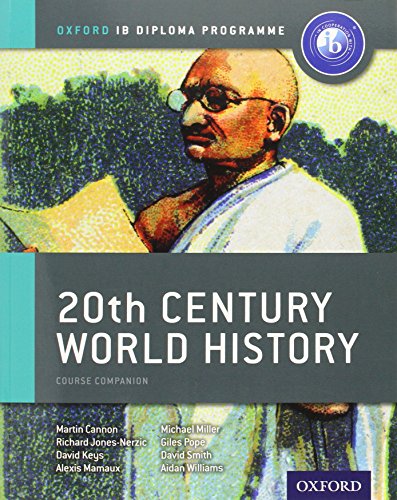
IB 20th Century World History : Oxford IB Diploma Program
Language: English
Published by Oxford University Press, Incorporated, 2012
ISBN 10: 0198389981 ISBN 13: 9780198389989
Condition: Very Good. Pages intact with possible writing/highlighting. Binding strong with minor wear. Dust jackets/supplements may not be included. Stock photo provided. Product includes identifying sticker. Better World Books: Buy Books. Do Good.
-
Ib 20th Century World History: Oxford Ib Diploma Program ; 9780198389989 ; 0198389981
Language: English
Published by Oxford University Press, 2012
ISBN 10: 0198389981 ISBN 13: 9780198389989
Condition: Very Good. Multiple Copies Available - Very Good Condition - May have school stamp and/or student names - May have some cover wear - DOES NOT INCLUDE ANY CDs OR ACCESS CODES IF APPLICABLE.
-
IB 20th Century World History: Oxford IB Diploma Program
Language: English
Published by Oxford University Press, 2012
ISBN 10: 0198389981 ISBN 13: 9780198389989
Paperback. Condition: Very Good. USED VERY GOOD CONDITION MAY HAVE SLIGHT CORNER WEAR - MAY HAVE MINIMAL WRITING - EXPERIENCE AMAZING CUSTOMER SERVICE - WE SHIP DAILY.
-

History: the Origins of the First World War Sources, Skills, Concepts
Published by IBID Press, Victoria, Australia, 2002
Seller: 4 THE WORLD RESOURCE DISTRIBUTORS, Springfield, MO, U.S.A.
Seller rating 5 out of 5 stars

Softcover. Condition: Good. Black marker writing on the bottom edge of the text block and on the title page. ; Cover laminated; International Baccalureate; 4to 11" - 13" tall.
-
IB 20th Century World History: Oxford IB Diploma Program
Language: English
Published by Oxford University Press, 2012
ISBN 10: 0198389981 ISBN 13: 9780198389989
First Edition
Soft cover. Condition: Very Good. 1st Edition. MULTIPLE COPIES AVAILABLE. Shows some minor wear but still in very good condition with many years of productive life remaining. May have a school stamp or bar-code. Ships same or next business day via USPS Media Mail or Canada Post Expedited.
-
Ib 20th Century World History: Oxford Ib Diploma Program ; 9780198389989 ; 0198389981
Language: English
Published by Oxford University Press, 2012
ISBN 10: 0198389981 ISBN 13: 9780198389989
Condition: Fine. Multiple Copies Available - Like New/Mint Condition - DOES NOT INCLUDE ANY CDs OR ACCESS CODES IF APPLICABLE - May have barcode or school stamp.
-
20th Century World History Course Companion: International Baccalaureate Diploma Programme Cannon, Martin; Mamaux, Alexis; Miller, Michael; Pope, Giles; Jones-Nerzic, Richard; Williams, Aiden; Smith, David and Keys, David
Language: English
Published by Oxford University Press, 2009
ISBN 10: 0199152616 ISBN 13: 9780199152612
Condition: New.
-
Glosule super Viaticum
Published by University of Pennsylvania Press, 1990
ISBN 10: 081228142X ISBN 13: 9780812281422
Seller: Powell's Bookstores Chicago, ABAA, Chicago, IL, U.S.A.
Seller rating 5 out of 5 stars
Hardcover. Condition: Very Good. Dust Jacket Condition: Very Good. Annotated. Cloth, dj. Minor shelf wear; light creasing to edges of jacket. Else fine. Internally a bright, clean copy. According to medieval physicians, lovesickness was an illness of mind and body caused by sexual desire and the sight of beauty. The notorious agony of an unhappy lover was treated as an ailment closely related to melancholia and potentially fatal if not treated. In Lovesickness in the Middle Ages, Mary F. Wack uses newly discovered texts and takes a fresh look at primary sources to offer the first comprehensive analysis of the forms and meanings of the lover's malady in medieval culture. She examines its importance in medieval literature and its role in the transformation of courtly love from literary convention to social practice. Drawing extensively from the Viaticum and its commentaries, studied for centuries in medical schools, Wack also addresses wider questions about the cultural construction of illness, the conflict between medicine and Church morality, the relations between lovesickness and gender, and the lover's malady as a form of behavior in late medieval society. The second part of the book contains annotated editions and translations of six important texts on lovesicknessâ"the Viaticum and four commentaries on it. Forty-six black-and-white illustrations provide a striking visual perspective on medieval love and medicine. Lovesickness in the Middle Ages will interest literary scholars and students as well as historians of medicine, sexuality, psychology, and women's studies.
-
The Student's Companion : Or, The Reason of the Laws of England. Shewing, the Principal Reasons and Motives Whereon our Laws and Statutes are Grounded, in the Most Essential and Capital Points, Not Only in Civil But Criminal Cases ; Together With the Law it self. So as to Convey to All Students, and others, the Fundamental Knowledge of the Law, necessary in their Studies.
Published by [London] In the Savoy, Printed by E. and R. Nutt and R. Gosling (Assigns of Edward Sayer, Esq.) for T. Corbett at Addison's Head, 1725., 1725
Seller: Inanna Rare Books Ltd., Skibbereen, CORK, Ireland
Seller rating 5 out of 5 stars
First Edition
First Edition. Small Octavo. [3 unnumbered], 224, [8 unnumbered] pages. Original full leather. Binding in very porr condition but still in its original state. Needs repair. Interior very good + with pre-owner's name in ink on titlepage: "RMA Mainish (?) - 1825"]. Extremely scarce publication. Price reflects condition. Giles Jacob (1686 8 May 1744) was a British legal writer whose works include a well-received law dictionary that became the most popular and widespread law dictionary in the newly independent United States. Jacob was the leading legal writer of his era, according to the Yale Law Library. The literary works of Giles Jacob did not fare as well as his legal ones, and he feuded with the poet Alexander Pope both publicly and in literary form. Pope named Jacob as one of the dunces in his 1728 Dunciad, referring to Jacob as "the blunderbuss of the law". Jacob is remembered well for his legal writing, though not so much for his poetry and plays. Giles was born in Romsey, Hampshire, and was baptized on 22 November 1686. Among eight children, Giles was the only son of Henry and Susannah Jacob. Henry Jacob was a maltster who lived until 1735. Giles Jacob's legal training included employment by Thomas Freke, and then as a secretary to Sir William Blathwayt. Working for Blathwayt, he engaged in litigation and dispensation, probably in manorial courts. Jacob's first book, The Compleat Court-Keeper (1713), gives detailed and practical instructions for how to administer estate matters. He combined this with a chronological summary of statute law, and the combination was financially successful. Jacob always had an interest in contemporary poetry and the literary life, and in 1714 he wrote a farce called Love in a Wood, or, The Country Squire. This play was never produced. He persisted, however, and in 1717 he wrote a satire of Alexander Pope's The Rape of the Lock in the form of The Rape of the Smock. The poem was low and bawdy, and the next year he wrote a serious work titled Tractatus de hermaphroditis about the legal status of intersex people, published by Edmund Curll in 1718 (along with the first English-language publication of Ioannes Henricus Meibomius's A treatise of the use of flogging in venereal affairs). Title page from an 1811 edition of Jacob's The New Law Dictionary. In 1719, two works appeared by Jacob, both very successful. The first was Lex constitutionis, which was a thoroughly researched compendium of statute law, common law, and criminal law, schematized according to which powers of the executive branch of the government were involved. While the work's fame and usefulness were surpassed in a few years, Jacob's book was a well regarded analysis. The same year, he produced the first volume of the Poetical Register, with a second volume in 1720. This work provided biographies of contemporary authors as well as earlier ones. According to the literary editor Stephen Jones: [H]e is generally accurate and faithful, and affords much information to those who have occasion to consult him. It cannot be denied that he possessed very small abilities; but he was fully equal to a task where plodding industry, and not genius, must be deemed the essential qualification. In the Poetical Register, Jacob criticized the play Three Hours After Marriage (1717), which had been written by John Gay with anonymous assistance from John Arbuthnot and Alexander Pope. Jacob wrote that its scenes "trespass[ed] on Female Modesty". He subsequently criticized that play for "obscenity and false Pretence". Jacob had admired Pope, had been on good terms with him, and had submitted the biographical entry of Pope (in the Poetical Register) to Pope himself for correction. Jacob likely did not realize that Three Hours After Marriage had been anonymously co-authored by Pope. In The Dunciad of 1728, Pope pounced: Jacob, the scourge of grammar, mark with awe, Nor less revere him, blunderbuss of law. Pope explained Jacob's offense as follows: "he very grossly and unprovoked abused in that book [the Poetical Register] the author's friend, Mr. Gay". The play Three Hours After Marriage was panned by most critics as obscene, and literary historian Thomas Lounsbury has explained that no one criticized the play "without incurring [from Pope] an enmity that never died out". In 1725, Jacob wrote The Student's Companion and regarded it as his favorite of the books he had written. It was a guide to studying law, with practical tips, reviews, and indexes. In 1729, his most famous work, nine years in the making, appeared: A New Law Dictionary. It combined a dictionary of legal practice with an abridgment of statute law, and it reached its fifth edition by the time of Jacob's death. As late as 1807, "Jacob's Law Dictionary" was still a very profitable copyright. His last work was Every Man his Own Lawyer, which outsold even the law dictionary. It was a self-help book for average citizens who might be involved in litigation. Jacob's legal writings were of a practical and descriptive sort, often compared unfavorably to the analytic and theoretical treatises by authors like William Blackstone. But, according to historian Julia Rudolph, authors like Jacob had a different purpose, in that they "were dealing with the problem of knowledge management or 'information overload,' and in response to this problem the learning of the law was systematized, alphabetized, and organized." Jacob's most successful non-legal writing was of a similarly practical and descriptive sort. Jacob married Jane Dexter in 1733, and they had at least one daughter, also named Jane.[4] He and his family moved to Staines, Middlesex, where he died on 8 May 1744. (Wikipedia).


