
Post Incunable (8 results)

Published by Imp. Ioanne Granion (Jean Granjon). París, 1516 1516
- Hardcover
- First Edition
Seller: FARRÉ Libreria Anticuaria, Barcelona, B, SpainFARRÉ Libreria Anticuaria
Contact seller5-star sellerCondition: Used
US$ 2,999.83
US$ 23.21 shippingShips from Spain to U.S.A.Quantity: 1 available
. 20 cm. [8], CLVII fol. (sign. a8, a-t8-v4). Texto con apostillas marginales. Marca de impresor en portada, capitulares. Enc. en pergamino, cierres. * Rara primera edición de In tertium sententiarum de Jaques Almain (1480-1515). Alumno del teólogo John Major, fue un destacado profesor de teología en la Universidad de París, de…la que fue rector en 1507. Cultivó una gran variedad de géneros en el ámbito del saber académico, aunque sus primeras obras estaban dedicadas a la lógica y la física de Aristóteles. Además de la teología, Almain escribió también sobre política, en concreto acerca del poder papal a partir de la discusión de las opiniones de Guillermo de Ockham. Máximo exponente del conciliarismo, el autor hace una clara distinción entre el poder absoluto y el poder ordenado de Dios. De moral aristotélica, su pensamiento político sugería la necesidad de orden pero dejaba margen para frenar las ambiciones de cualquier gobernante cuya conducta pusiera en peligro la supervivencia de la comunidad. Almain dejó en sus Opuscula (obra póstuma editada en París en 1518) una clara crítica al tratado de Cajetan sobre el papado, pues sostenía que la Iglesia y el Estado son de naturaleza paralela, ambos capaces de actuar contra un líder errante, ya fuera el Papa o el rey. La edición que presentamos fue a cargo de Nicolas Maillard. Biblioteca Nacional de Francia FRBNF 30012484. Books published in France before 1601 in Latin and Languages other than French (ed. Andrew Pettegree y Malcolm Walsby), 52691. B. Moreau, Inventaire chronologique des éditions parisiennes du XVIe siècle, II, 1247.
 More images
Published by Ottaviano Petrucci, Fossombrone 1513
- First Edition
Seller: Phillip J. Pirages Rare Books (ABAA), McMinnville, OR, U.S.A.Phillip J. Pirages Rare Books (ABAA)
Contact seller3-star sellerCondition: Used
US$ 10,400.00
US$ 10.00 shippingShips within U.S.A.Quantity: 1 available
FIRST EDITION. 325 x 210 mm. (12 3/4 x 8 1/4"). [394] leaves. Old (18th century?) stiff vellum (with later endpapers), flat spine (tips neatly reinforced). With metalcut arms of Pope Leo X on verso of title, three full metalcut borders and numerous decorative initials generally attributed to Francesco Griffo, and a full-page woo…dcut of the Crucifixion. Printed in red and black. Occasional ink underlining and marginal notes. Early ownership washed out on title page. Mortimer "Italian" 363; Essling III, 1776; Adams P-504; Sabin 59232.; Brunet IV, 452; EDIT16 CNCE 34292; USTC 847069. A little soiling to vellum, one-inch wormtrail to rear joint, but the binding entirely sound and inoffensive. Quires a-e, k, l, and GG repaired at gutter (with resultant glue stains to some of the leaves), intermittent minor browning, staining, or smudges, other trivial imperfections, but nothing approaching a major defect, and the vast majority of leaves clean and fresh, with remarkably ample margins. The work of two major figures in 16th century book production, this large and attractive publication of a work that helped bring about major calendar reform also includes an early reference to American exploration. Our author, Zeeland-born Paulus de Middelburgo, also known as Paul van Middelburg (1446-1534), was a scientist, astrologer, and physician who in 1494 became bishop of Fossombrone (an ancient town approximately 100 miles east of Florence). By the time of our publication, he had been concerned with calendar reform for some time, with a particular aim of stabilizing the date of Easter. In "De Recta Paschae Celebratione" ("On the Correct Celebration of Easter"), Middelburg proposes that this be accomplished by aligning the civil calendar equinox with the actual astronomical equinox and by dropping one day every 134 years. His arguments were well-respected, and he was invited to present this text at the Fifth Lateran Council (1512-17). Although actual reform was not enacted at or in the immediate aftermath of the Lateran Council, the Lateran discussions helped Aloysius Lilius build the proposal that went on to become the Gregorian Calendar implemented in 1582. Our volume was printed by Ottaviano Petrucci (1466-1539), who was educated in Urbino and printed in Venice and his native Fossombrone, an early printing center, where Geronimo Soncino (also called Hieronymus de Soncino) was issuing books by 1475. Petrucci is best known for his contributions to the printing of musical notation with movable type; he was the first to print polyphonic music, and printed music in larger quantities than any of his contemporaries. In the present (non-musical) publication, the text is accompanied by striking metalcut borders, inhabited with a variety of figures, including mermaids, satyrs, birds, and cherubs, connected with dramatic scrolls of flowers and foliage, each border with a pair of angels or putti flanking a coat of arms. These, the similar metalcut of angels with the arms of Pope Leo X, and the attractive woodcut capitals have been attributed to Francesco Griffo (1450-1518), the typecutter and designer who was responsible for a number of Aldus Manutius' types and who worked with Petrucci in Fossombrone from 1511-13. The dramatic woodcut depicting the crucifixion, probably the work of a different artist, is an arresting scene, particularly given the size of the page and its widespread tumult, including a crowded earthly landscape and a heaven inhabited by three dozen doleful popes. There is an additional historical gem hidden amongst the dense theological and astronomical discussions of the text: on FF4r, Middelburg mentions the voyages of Christopher Columbus and Amerigo Vespucci and the peoples living in the "torrid region" they encountered. This major work is uncommon: USTC finds only six copies in North American institutional collections, and it appears infrequently at auction (we could trace just three copies sold since 1920).
 More images
SUMMA ROSELLE DE CASIBUS CONSCIENTIAE
(POST-INCUNABLE). (BINDINGS - EARLY BLIND-STAMPED). (CANON LAW). TROVAMALA DE SALIS, BAPTISTA
Published by Johann Knobloch, Argentine [Strassburg] 1516
Seller: Phillip J. Pirages Rare Books (ABAA), McMinnville, OR, U.S.A.Phillip J. Pirages Rare Books (ABAA)
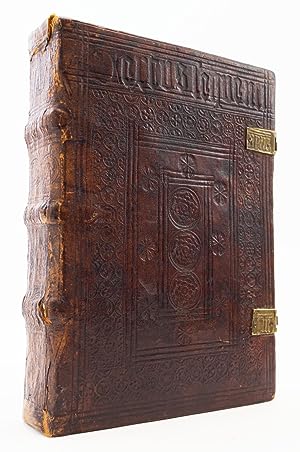
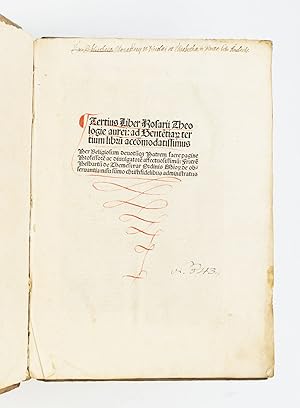
Contact seller3-star seller315 x 210 mm. (12 1/2 x 8 1/4"). 10 p.l., CCLXV leaves (without final blank).Edited by Ottmar Nachtigall. Contemporary German blind-stamped pigskin, covers with several blind-ruled panels, center panel on upper cover with three columns of blind-stamped knotwork (EBDB r000519), framed with a roll of repeating stags (Kyriss Hirsch…-Rolle IV, EBDB r000520), head of front cover stamped with the letters "S rosela," lower cover with a central panel of four ruled X's framed by a roll of flowers with swirling vines, raised bands, head panel lettered in ink, two original brass clasps. Title page with stately wood-engraved border by Hans Baldung Grien depicting Holy Roman Emperor Maximilian I on his throne (Johnson, "German Renaissance Title-Borders," no. 3). Title printed in red and black. Title page with ink stamp of the library of Buxheim Charterhouse. Adams T-1002; VD16 B 308; USTC 694895. For the binding: Kyriss 79, plates 161, 162; EBDB r000519 and r000520, workshop w002121. âPigskin a bit soiled, with a number of marks and quite a few small, round wormholes, but the binding completely sound and in very good shape overall; first half of contents with several small wormholes (though worming in second half quite minor), other trivial imperfections, but the text clean and crisp, and the margins ample. From a renowned monastic library, this is a copy of the first accurate edition of an influential manual on canon law which comes in a binding by a long-lived Augsburg workshop. Composed in 1483 by Franciscan monk Baptista de Salis Trovamala (d. 1496) and first printed in 1484, the alphabetically arranged "Summa" was intended to be a reference guide for students of canon law and for priests hearing confessions. It covers subjects from adultery to property rights, from Abbas (abbot) to Uxor (wives), drawing primarily from the writings of Nicolaus de Ausmo. The incunabular printings of the Summas were plagued with errors, corrected here by Strassburg humanist and professor of Greek Ottmar Nachtigall, who in his introductory poem compares his efforts to the labors of Hercules. Our copy was bound in Augsburg in a workshop said by Kyriss to have flourished from 1482-1532. The binder can be identified by the stag (Kyriss' "Hirsch") roll used to frame the front cover panel. The blind-stamped bindings database of the Staatsbibliothek zu Berlin (EBDB) finds another binding featuring both the knotwork design and the stag roll on an unidentified book (Cultural Object k005529) held by Herzog August Bibliothek in Wolfenbüttel. Our volume was once in the famed library of the Buxheim Charterhouse, the largest Cistercian monastery in Germany, which had extensive manuscript and incunabular holdings, the latter numbering more than 3,000. When the monastery was secularized in 1802, its property and library became the possessions of the Count of Ostein. After his death in 1809, it was inherited by Count Friedrich Waldbott von Bassenheim, whose son's extravagant spending forced the family to sell many of their assets, including the Buxheim library, which went to auction in Munich in 1883. OCLC shows only two locations of our edition of Trovamala's "Summa" in North America, and we could trace just two copies at auction (selling for â 2,784 in 2006 and $2,829 in 2019).
 More images
SOPHOLOGIUM . . . NOVITER AUCTUM ET RECOGNITUM ET VITA EIUSDEM CUM EPISTOLA BERNARDI PRO RE FAMILIARI GUBERNANDA. ET REGULIS JOANNIS GERSONIS DE MODO VIVENDI
(EARLY ILLUSTRATED BOOKS). (POST-INCUNABLE). (BINDINGS - SANGORSKI & SUTCLIFFE). LEGRAND, JACQUES (JACOBUS MAGNI)
Published by Wolfgang Hopyl [for himself and Franciscus Birckmann in London], Paris 1516
Seller: Phillip J. Pirages Rare Books (ABAA), McMinnville, OR, U.S.A.Phillip J. Pirages Rare Books (ABAA)
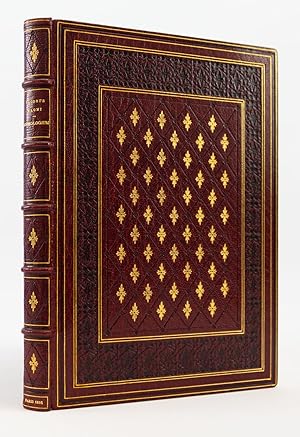
Contact seller3-star seller242 x 168 mm. (9 1/2 x 6 1/2"). 4 p.l. C [100] leaves. HANDSOME MAROON CRUSHED MOROCCO DECORATED IN GILT AND BLIND BY SANGORSKI & SUTCLIFFE (stamp-signed on front turn-in), covers with central panel diapered in blind, the compartments with a gilt Maltese cross, this framed by gilt rules, a wide blind-tooled foliate border enclos…ed by gilt and blind rules, raised bands, spine compartments with gilt Maltese cross within a blind-tooled lozenge, gilt lettering, turn-ins with gilt and blind rules, all edges gilt. In matching morocco-lipped, felt-lined slipcase. Title page with full-page woodcut of the Virgin Mary being crowned Queen of Heaven, final page with Brinkmann's unusual full-page device featuring three scenes: the Virgin and Child enthroned, St. Ursula sheltering the 11,000 virgins under her cloak, and the Martyrdom of the seven Maccabee brothers and their mother (for their refusal to eat pork). Front pastedown with bookplate of the Paolino Gerli Collection at Manhattan College and with fabric library shelf label, verso of title page with library number stamped to tail margin in blue ink. USTC 144650; not in Adams or Mortimer. Text perhaps lightly washed, but still quite fresh, touch of rubbing to front joint, but A LOVELY COPY, with almost no signs of use. This is a rare edition of the French Augustinian's compilation of moral philosophy in elaborately decorated morocco by one of the great English binderies. Composed by Jacques Legrand (d. 1425) in the early 15th century, this work first appeared in print, in Strassburg, around 1468--a publication date sufficiently early to suggest the work's importance. Legrand drew on the writings of a wide variaty of ancient philosophers from Aristotle and Augustine to Avicenna and Averroes, with considerable amounts Scripture thrown in. Very popular in the 15th and 16th centuries, the work is divided into three parts--arts and sciences, vice and virtue, and good manners and personal conduct. Our edition incorporates the "rules for living" of the major theologian Jean Gerson (1363-1429), Chancellor of the University of Paris. It was printed in Paris by Wolfgang Hopyl, who operated a press there between 1489 and 1523. Hopyl was one of several Parisian printers who made books for Franz Birckmann (d. 1530; fl. 1504-30), a publisher and bookseller with offices in Cologne, Antwerp, and London, specializing in liturgical supplied to the English and Dutch. Our copy was bound in a retrospective style by one of the great English workshops to emerge from the Arts & Crafts Movement. After studying under, and then working for, Douglas Cockerell, Francis Sangorski and George Sutcliffe founded their own bindery in 1901 and continued in a successful partnership until 1912. During that year, the firm suffered three major blows: their famously splendid jewelled binding, dubbed the "Great Omar," was lost on the Titanic; a few weeks after this accident, Francis himself drowned; and Francis' brother, Alberto, who had been a central figure in producing the firm's vellum illuminated manuscripts, went over to Riviere. Despite these losses, the firm grew and prospered, employing a staff of 80 by the mid-1920s and becoming perhaps the most successful English bindery of the 20th century. Our copy was owned by American silk manufacturer Paolino Gerli (1890-1982) who donated a number of works from his library to Manhattan College, which had bestowed an honorary degree on him.
 More images
Published by Michael Furter, Basel 1504
Seller: Phillip J. Pirages Rare Books (ABAA), McMinnville, OR, U.S.A.Phillip J. Pirages Rare Books (ABAA)
Contact seller3-star seller220 x 138 mm. (8 x 5 1/2"). CXXII, [10], LXX, [1] leaves. EXCELLENT CONTEMPORARY BLIND-TOOLED CALF, covers panelled in blind, title stamped in gothic letters at head of upper cover, central panel with vertical row of three large rosettes (EBDB tool s013635), this enclosed by a frame with eight carnation stamps (EBDB tool s013643…), then by a roll-tooled frame filled with circles containing flowers, fruit, and stars (EBDB tool r000675; Kyriss 84, Roll 6), lower cover similarly framed, but with central panel divided by diagonal blind rules into four compartments, each containing a large rosette, raised bands, spine panels with one or two floral medallion stamps, upper cover with original brass catches stamped "IVIII," newer clasps and leather straps, probably newer pastedowns, fore edge with the number "75" in ink (subtle repairs to head and tail of spine as well as lower corner on back cover). Title and opening page with decorative woodcut initials, main title and sectional title each with woodcut vignette and full-page woodcut on verso. VD16 T-653; VD16 H-6510; Adams L-1124, L-1123. For the binding: Kyriss 84, Tafel 171, Rolle 6; EinbandDatenbank (EBDB) tools s013635 and r000675, workshop w002075. An ink stain touching text on one leaf and slightly affecting four adjacent leaves, but the vast majority of the contents clean, fresh, and in fine condition. Quarter-inch crack at top of each joint (with leather across the spine consequently becoming a small flap), light signs of wear to leather, hinges mostly open--but the binding entirely sound, with almost no wear at all to the joints. An extremely attractive volume, THE REMARKABLY WELL-PRESERVED BINDING FEATURING FINE, DEEP IMPRESSIONS OF ITS STAMPS. This is a rare early compilation of Medieval liturgical chants in an appealing binding by an Augsburg workshop. Kyriss dubbed this bindery Hirsch-Rolle I for its distinctive deer (i.e., "hirsch") roll tool, and noted it was active 1483-1532. EBDB, the bindings database of the Berlin State Library, has identified 26 bindings in German libraries from this workshop. The wide, attractive floral roll here is most unusual among the binding's wide array of design elements, from flowers and plants to stars, all contained in tightly packed circles that bring bubbles to mind. Our two texts contain "sequences"--words sung between the Gradual and the Gospel on festival occasions--written by, among others, Gregory the Great, the fourth century bishops Hilarius of Poitiers and Ambrose of Milan, and fifth century Latin Christian poet Coelius Sedulius. They were printed by Michael Furter (d. ca. 1516-17) who operated a press in Basel from 1489 into the second decade of the 16th century. He was especially known for the decorative nature of his volumes. Haebler's "Typenrepertorium" counted 12 sets of embellished woodcut initials Furter employed; examples from two of these sets may be seen here, on the title page of the first work and at the opening of the text in both. The woodcut illustrations here are also notable. The title woodcut (Schramm XXII, 1263) on the first work is a depiction of the Magi presenting gifts to the Christ Child and his mother, done early in the career of Albrecht Dürer (1471-1528). It was one of the "Basel Prayer Book Woodcuts," 25 illustrations likely meant for a "Hortulus Animae" Johann Bergmann von Olpe intended to print in 1494 but never issued. A large, striking woodcut depicting the Christ Child at the center of a sunburst, surrounded by medallions with the devices of the four Evangelists, appears on the verso of the title in the first work and on the title page of the second. On the verso of the second title page is a woodcut of the Crucifixion from the "Postilla" by Guillelmus Parisiensis, Basel 1491 (Schramm XXII, 336). This is an especially affecting and detailed scene: Mary Magdalene clings to the foot of the cross, while Jesus looks serenely down at the Virgin Mary, who is collapsing in the arms of another woman as several soldiers jeer. On either side of Christ, the souls of the thieves crucified with him are being taken, one--who had asked to be remembered when Jesus came into his Kingdom--by angels, the other by demons. A banner marked with the SPQR of the Roman Empire flutters in the background. All in all, this is a very pleasing exemplar of post-incunabular book-making.
 More images
Published by Heinrich Gran for Johann Rynmann of Augsburg, Hagenau 1507
- First Edition
Seller: Phillip J. Pirages Rare Books (ABAA), McMinnville, OR, U.S.A.Phillip J. Pirages Rare Books (ABAA)
Contact seller3-star sellerFIRST EDITION. 300 x 205 mm. (11 3/4 x 8 1/8"). [165] leaves (lacking final blank). Double column, 57 lines, gothic type. Contemporary German blind-stamped pigskin over bevelled wooden boards, front cover with frame and central diapered area with round floral and banner stamps, rear boards diapered with stag and acorn stamps, ev…idence of corner and central bosses, since removed, raised bands, ink titling on spine. Capitals struck with red, paragraph marks and three- to seven-line initials hand painted in red. Front pastedown with bookplate of the Abbey of Andechs; early ink ownership inscription of the Abbey on title page. VD16 P1160; USTC 696152. ?Pigskin on front cover a uniform milky brown (corners and center of boards much lighter due to removed bosses), first and last leaves with minor marginal soiling, final quire with a couple of short cuts to head margin of leaves (well away from text), otherwise quite a fine copy--clean, fresh, and bright internally, with excellent margins, and in a scarcely worn, attractive, unsophisticated binding. This is the third volume of a four-part theological encyclopedia by the Hungarian Franciscan scholar Pelbartus of Temesvar, printed in Hagenau between 1503 and 1508. Intended for students, the work is arranged according to the four books of the "Sentences" of Peter Lombard, the standard theological text in the Middle Ages; our third volume covers book III of "Sentences," on Christology. After graduating from the University of Krakow, Pelbartus (1430-1504) joined the Franciscan order and gained renown as preacher, travelling though France, Switzerland, and Germany. He returned to Buda in 1483, to spend the rest of his life teaching and preaching at the abbey there. The "Rosarium" came about as a pedagogical aid based on his experience as an instructor. Pelbartus draws heavily on the Scotist school of thought in this work, quoting from Duns Scotus, Guillaume of Vaurouillon, Peter of Aquila, and Francis of Meyronnes. Our printer Heinrich Gran (d. 1523 or 1524) introduced printing to the town of Hagenau, near Strassburg, around 1489. Between 1497 and 1514, he is known to have printed 27 works (including this one) for Johan Rynmann of Augsburg, considered to be the first non-printing publisher. Preferring to concentrate on sales and distribution, Rynmann hired various pressmen to work for him, publishing almost 200 books but printing none. Gran and Rynmann were the primary suppliers of printed books to Hungary in the late 15th and early 16th century. As the colophon indicates, our volume was sent from its Alsatian press to the Bavarian distributor in Augsburg, and was likely bound in that city. An early ink inscription on the title page notes that this book belonged to the library of the Monastery of Sts. Nicolas and Elisabeth in Andechs, a Benedictine Abbey founded in 1455. The later engraved armorial bookplate of the Abbey on the front pastedown indicates our book resided there for some time, probably until the secularization of the Abbey in 1803. Because the four parts of our first edition of this work were published separately and several years apart, they are rarely found as a complete set. We were able to find just one such copy (bound with another work) in RBH and ABPC, which otherwise listed only a very few stray volumes.
 More images
Published by nelle case d'Aldo Romano e d'Andrea Asolano, Venegia [Venice] 1515
Seller: Phillip J. Pirages Rare Books (ABAA), McMinnville, OR, U.S.A.Phillip J. Pirages Rare Books (ABAA)
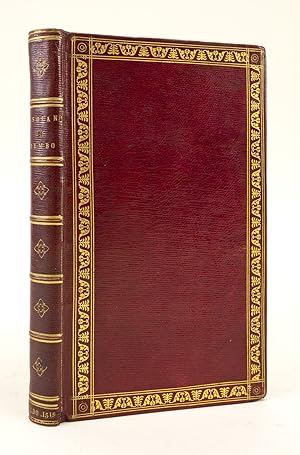
Contact seller3-star sellerSecond Aldine Edition. 170 x 100 mm. (6 3/4 x 3 7/8"). 129, [1] (blank) leaves. Single column, 30 lines, italic type. ATTRACTIVE EARLY 19TH CENTURY RED STRAIGHT-GRAIN MOROCCO, GILT, covers with gilt floral border, bands very slightly raised, compartments with delicate gilt floral motif or gilt lettering, gilt turn-ins, all edges… gilt. With Aldine printer's device on title and final page. Lowry, "World of Aldus Manutius," pp. 155-58; Kallendorf 122; Renouard 1515:5; Adams, B-579; EDIT16 CNCE 4988. For a detailed discussion of the different states of the first Aldine edition, see C. H. Clough, "Pietro Bembo's Gli Asolani of 1505" in Modern Language Notes, vol. 84 (1969), pp. 16-45. âJust a hint of rubbing to joints and extremities, tiny separation at foot of spine, a couple of short, shallow scratches to lower cover, but the very pretty binding extremely well preserved; title a little foxed, an occasional breath of foxing elsewhere, other very trivial imperfections in the text, but A FINE COPY INTERNALLY, the contents uniformly clean and bright. This is an important literary work written by a major Renaissance figure, intended to raise the status of the vernacular back to the exalted levels of Dante, Petrarch, and Boccaccio. Pietro Bembo (1470-1547) was a cardinal, poet, and scholar whose greatest influence was on the development and standardization of the Italian language. Convinced that the vernacular was the equal of Latin as a literary medium, he was able, through the example of his own writings, to rescue Italian from the disordered stylistic eclecticism of his day. The present text is one of his most famous works, a dialogue on Platonic love, reflecting the notions promulgated by humanist philosopher Marsilio Ficino (the dialogue occurs near the court of Caterina Cornaro in Asolo, hence the name "Gli Asolani," or "People of Asolo"). Speaking of the first Aldine edition of 1505, Lowry says it is a "fascinating glimpse of high society, an important literary experiment, a popularisation of Ficino's theories of love, and an edition which commands attention because of the personalities concerned, and because of its connection with political developments in Rome and Ferrara." Early editions of this work are also of interest for Bembo's dedication to Lucrezia Borgia, Duchess of Ferrara, a woman whose romantic alliances included an affair with our author--or at least a notably passionate correspondence (300 years later, Lord Byron would call their missives "the prettiest love letters in the world"). But as Clough notes, this dedication is only present in some copies of the first edition--either it was suppressed for political reasons (possibly owing to Bembo's desire to distance himself from the court of Ferrara), or the text was delivered to Aldus after he had already begun printing the work. However, it appears in all copies of our second Aldine edition, printed a decade later. Of interest for its content, use of language, and position in the world of Renaissance printing and politics, our copy is also desirable for its lovely condition and handsome binding.
 More images
Seller: Herman H. J. Lynge & Søn ILAB-ABF, Copenhagen, , DenmarkHerman H. J. Lynge & Søn ILAB-ABF
Contact seller4-star sellerCondition: Used
US$ 1,918.81
Free ShippingShips from Denmark to U.S.A.Quantity: 1 available
(Colophon:) Basel, Johannes Froben, August 12. 1516. Folio. Bound in a recent half vellum in old style. A very nice and clean copy with one full page woodcut as title page, consisting of one large central illustration depicting a religious gathering of bishops and other holy men, sorrounded 12 smaller illustrations (6 on each si…de of the large one), each depicting a saint. Rubricated initials throughout. 77, (1) ff. (144, (1) pp.). Following saints are treated in this (part of the) work: Andreas, Agnes, Paul, Maria, Phillip, Jacob, Crucis, Johannes the baptist, Maria Magdalene, Laurentius, Bartholomeus, Mattheus, Michael the archengel, Luce. BMC (German), p. 412.


