Order Total (1 Item Items):
Shipping Destination:

Pseudo Eusebius Cremona (2 results)
Skip to main search results
Search filters
Product Type
- All Product Types
- Books (2)
- Magazines & Periodicals (No further results match this refinement)
- Comics (No further results match this refinement)
- Sheet Music (No further results match this refinement)
- Art, Prints & Posters (No further results match this refinement)
- Photographs (No further results match this refinement)
- Maps (No further results match this refinement)
- Manuscripts & Paper Collectibles (No further results match this refinement)
Condition Learn more
- New (No further results match this refinement)
- As New, Fine or Near Fine (No further results match this refinement)
- Very Good or Good (1)
- Fair or Poor (No further results match this refinement)
- As Described (1)
Binding
- All Bindings
- Hardcover (2)
- Softcover (No further results match this refinement)
Collectible Attributes
- First Edition (1)
- Signed (No further results match this refinement)
- Dust Jacket (No further results match this refinement)
- Seller-Supplied Images (2)
- Not Print on Demand (2)
Language (1)
Price
- Any Price
- Under US$ 25 (No further results match this refinement)
- US$ 25 to US$ 50 (No further results match this refinement)
- Over US$ 50
Free Shipping
- Free Shipping to U.S.A. (No further results match this refinement)
Seller Location
Seller Rating
-
[LIFE AND MIRACLES OF ST. JEROME - ONLY ONE COPY IN NORTH AMERICA] La vita, el transito e gli miraracoli [sic!] del beatissimo Sancto Hieronymo Doctore Excellentissimo [The life, passing and miracles of most blessed Saint Hieronymus the Most Excellent Teacher]
Seller: Penka Rare Books and Archives, ILAB, Berlin, Germany
Seller rating 5 out of 5 stars

First Edition
Venice: Guglielmo Fo[n]taneto da Mo[n]ferrato, 1519. Quarto (20.8 × 14.8 cm). Early twentieth-century full parchment; [84] leaves. Title page with a large woodcut portrait of the saint together with the lion (15.5 × 9.8 cm). Text printed in two columns in large type, with decorative woodcut initials, some up to 2.6 × 2.6 cm in size. Boards very lightly distended; first three leaves lightly finger-soiled; faint traces of old red coloration to title; small old bookseller label to front pastedown; still about very good. Early edition of the Italian translation of a volume of hagiographical works about Saint Jerome, printed in large letters and likely the first edition to feature the striking unattributed large-format woodcut portrait of the saint in prayer, with the lion at his side and other customary iconographic attributes. The volume combines the unattributed vita (10 pp.) with three longer epistles about the saint purportedly by his contemporaries, St. Eusebius of Cremona, Saint Augustine of Hippo, and St. Cyril of Jerusalem. This configuration of texts was common; usually titled "Vita et transitus Hieronymi," it circulated in Latin first in manuscript and, from at least 1471, in various printed editions, and was also translated into a range of local languages. The main texts are titled: "La vita de sancto Hieronymo," "La epistola del beato Eusebio la quale mando al beato Damasio Vescovo portuense & a Theodonio senatore di Roma de la morte del beatissimo Hieronymo.," "La epistola del beato Augustino [.] che lui mando al venerabile Cirillo [.] delle magnificentie e laude del glorioso Hieronymo e come sancto Hieronymo apparue a sancto Augustino," and "La epistola del Venerabile Cirillo [.] che mando a sancto Augustino degli miracoli de Sancto Hieronymo." It is now typically assumed that the letters are falsely attributed, but were written much later, possibly after his remains were transferred to the church of Santa Maria Maggiore in Rome in the twelfth century, which led to a vigorous cult of the saint in Italy. If he is known today primarily for his translation of the Bible into Latin and his biblical commentary, these texts establish his record as a devout and prayerful ascetic. The last and longest of the epistles is most interesting in this regard, as it details many visions of Saint Jerome as well as numerous miracles that are said to have occured both before and after his death. In its typography, the edition resembles another edition printed by Augustino de Zani da Portese (Venice, 1511), however, the text has been set anew entirely and the 1511 edition features a different title page, with only a small vignette of the saint. Essling 127. Sander (Le livre à figures italien) 3401. EDIT16 (Edizioni Italiane del XVI Secolo) 37334. As of April 2025, KVK, OCLC show only two copies outside Italy, at Mannheim and Cambridge. We can also trace a copy at the Lessing J. Rosenwald Collection (Library of Congress).
-
Epistola de morte Hieronymi; Epistola ad Cyrillum de magnificentiis Hieronymi; Epistola de miraculis Hieronymi; Vita Sancti Hieronymi; Vita sancti Pauli; illuminated medieval manuscript on parchment
Seller: Les Enluminures (ABAA & ILAB), Chicago, IL, U.S.A.
Seller rating 4 out of 5 stars

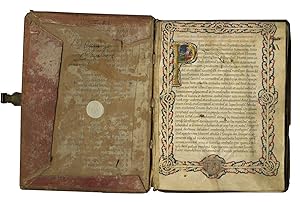
Hardcover. Condition: Good. ILLUMINATED MEDIEVAL MANUSCRIPT IN LATIN ON PARCHMENT, Northern Italy, c. 1440-1470. 203 x 153 mm. 70 folios, complete (collation, i-vii10), remnants of quire and leaf signatures, flourished vertical catchwords, written in a humanist minuscule on 30 long lines (justification, 147-149 x 95-100 mm), horizontal lines ruled very lightly in ink, single vertical bounding lines ruled in lead, prickings remain in top and bottom margins on some leaves, rubrics and paragraph marks in pale red, two-line red or blue initials with contrasting pen flourishes in violet or red, two five-line blue initials, ff. 29v and 35, infilled and on square grounds of elaborate penwork; f. 64v, seven-line polished GOLD INITIAL with white vinestem decoration extending along twenty lines of text and into the upper margin, infilled and edged in deep red and blue with numerous tiny silver dots; f. 1, five-line polished GOLD HISTORIATED INITIAL of St. Jerome, bearded and dressed in red, standing before a Crucifix, with a hilly landscape in the background, on a white vinestem ground, extending into a FULL WHITE VINESTEM BORDER infilled and edged in deep red and blue with tiny silver dots and an erased coat of arms in lower margin, with modern? F.A. BINDING: Early, almost certainly contemporary, reddish-brown leather over wooden boards, flat spine with three slightly raised bands, head and tail bands, clasp and catch fastening, front to back, with brass catch lettered ave, front cover decorated, most likely in the nineteenth century, with an attractive painted border in green, orange, and gray, connecting four brass studs, and the title, De laudibus et miraculis divi Hieronymi, with initials F.C. at the bottom, back pastedown is leaf from a late fourteenth-century Italian copy of Donatuss Latin grammar, front pastedown shows offset script from removed pastedown from a fourteenth-century Italian text in Latin verse. TEXT: This manuscript is a vivid witness to the importance of St. Jerome in fifteenth-century Italy, and includes the foundational texts for his cult: three letters regarding his death, miracles, and titles to glory and veneration and purporting to be written by three contemporaries of St. Jerome (c. 347-420), namely St. Eusebius of Cremona (d. 423), St. Augustine of Hippo (354-430), and Bishop Cyril of Jerusalem (c. 313-386), but probably written in Rome at the end of the thirteenth or beginning of the fourteenth century; a life of St. Jerome by an unknown author, probably writing in Italy in the twelth century; and Jeromes own life of St. Paul the Hermit, written in 374 or 375. These texts were widely disseminated in both Latin and in vernacular translations, and they influenced the work of numerous writers and visual artists. ILLUSTRATION: The iconographical choice in the historiated initial (f. 1) to depict the ascetic Jerome contemplating the Crucifixion dates from c. 1400 in Italy, and can be particularly associated with Hieronymite congregations in Tuscany. PROVENANCE: Copied in Northern Italy in the middle years of the fifteenth century, as suggested by the evidence of the script and decoration; the penwork initials in particular seem to point to Northern Italy. The manuscript almost certainly once included the coat of arms of its original owner in the lower margin of the illuminated border on f. 1. Three sets of initials are inscribed, in three different hands, all possibly initials of owners: within the roundel on f. 1 a modern owner inscribed an outline of a shield in pen and the initials F.A.; inside front cover, white embossed seal, with the initials L.F.; on front cover, as part of the added decoration, F[?]. C[?]. CONDITION: Slight loss of the leather at the back, top of the spine, and over the lower band of the binding; top of the painted border on f. 1 is very slightly trimmed; f. 1 is darkened; and there is some soiling throughout, but overall in very good condition. Full description and photos available (TM 656).
![Seller image for [LIFE AND MIRACLES OF ST. JEROME - ONLY ONE COPY IN NORTH AMERICA] La vita, el transito e gli miraracoli [sic!] del beatissimo Sancto Hieronymo Doctore Excellentissimo [The life, passing and miracles of most blessed Saint Hieronymus the Most Excellent Teacher] for sale by Penka Rare Books and Archives, ILAB](https://pictures.abebooks.com/inventory/md/md32137239984.jpg)