Order Total (1 Item Items):
Shipping Destination:

Pseudo Jerome (8 results)
Skip to main search results
Search filters
Product Type
- All Product Types
- Books (7)
- Magazines & Periodicals (No further results match this refinement)
- Comics (No further results match this refinement)
- Sheet Music (No further results match this refinement)
- Art, Prints & Posters (No further results match this refinement)
- Photographs (No further results match this refinement)
- Maps (No further results match this refinement)
- Manuscripts & Paper Collectibles (1)
Condition Learn more
- New (No further results match this refinement)
- As New, Fine or Near Fine (1)
- Very Good or Good (6)
- Fair or Poor (No further results match this refinement)
- As Described (1)
Binding
Collectible Attributes
- First Edition (1)
- Signed (No further results match this refinement)
- Dust Jacket (2)
- Seller-Supplied Images (5)
- Not Print on Demand (8)
Language (2)
Free Shipping
- Free Shipping to U.S.A. (No further results match this refinement)
Seller Location
Seller Rating
-

Quaestiones on the Book of Samuel (Studia Post Biblica - Supplements to the Journal for the Study of Judaism , No 26)
Seller: Regent College Bookstore, Vancouver, BC, Canada
Seller rating 5 out of 5 stars

Hardcover. Condition: Very Good. No Jacket. Brill, 1975. Blue hardcover, no jacket. 173 pp. Ex-library with the usual. Text block appears unmarked. Binding sound. VERY GOOD+.
-

Quaestiones on the Book of Samuel (Studia Post Biblica - Supplements to the Journal for the Study of Judaism , No 26)
Language: English
Published by Brill Academic Publishers, 1997
ISBN 10: 9004041958 ISBN 13: 9789004041950
Library Binding. Condition: Very Good. VERY GOOD. NO DUST JACKET AS ISSUED? THE INSIDE PAGES ARE CLEAN AND TIGHT.
-
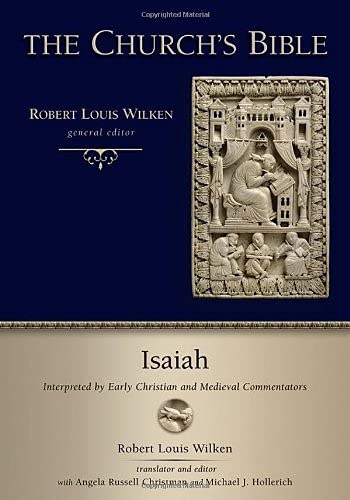
Isaiah: Interpreted by Early Christian and Medieval Commentators
Language: English
Published by William B. Eerdmans Publishing Company, Grand Rapids, Michigan / Cambridge, England, 2007
ISBN 10: 0802825818 ISBN 13: 9780802825810
Seller: Andover Books and Antiquities, Andover, MA, U.S.A.
Seller rating 4 out of 5 stars

Hardcover. Condition: Very good condition. Dust Jacket Condition: Very good. xxviii, 590 pp. The Church's Bible. LCC: 2007010831.
-
US$ 236.32
US$ 33.74 shipping
Ships from United Kingdom to U.S.A.Quantity: 1 available
Add to basketLibrary Binding. Condition: Very Good. Very Good. Dust Jacket may NOT BE INCLUDED.CDs may be missing. SHIPS FROM MULTIPLE LOCATIONS. book.
-
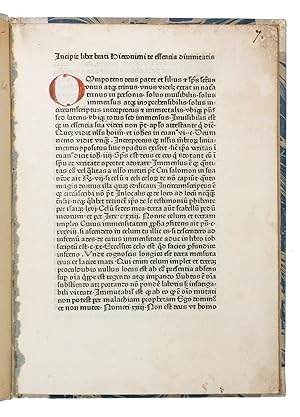
De essentia divinatis.
Published by Günther Zainer,, [Augsburg,, 1468
Seller: Antiquariaat FORUM BV, Houten, Netherlands
Seller rating 5 out of 5 stars
US$ 14,981.84
US$ 29.09 shipping
Ships from Netherlands to U.S.A.Quantity: 1 available
Add to basketThe first and only incunable edition of this theological work, printed by the first printer of Augsburg, Günther Zainer (?-1478). He started his printing career in Augsburg in 1468 and is known to have been one of the printers at the new printing shop in the Augsburg Saint Ulrich and Saint Afra's Abbey. He probably learned the trade from Johannes Mentelin (ca. 1410-1478) in Strasbourg. Zainer's paper, presswork and typefaces are all of high quality and about 80 books are known to have been printed by him.The De essentia divinitatis, the first tract in this collection, was thought to have been written by Saint Jerome, but it is actually the first chapter of Formulae spiritualis intelligentiae by Saint Eucherius of Lyon (ca. 380-ca. 449). In the present edition, this tract is printed together with Aquinas' De articulis fidei; the second tract starts on the leaf on which the first one ends. These works are part of a larger collection of separately published tracts, which includes Imitatio Christi by Thomas à Kempis, Soliloquia by Saint Augustine and Dispositorium moriendi by Johannes Nider. Nearly each tract was sold independently, so every collection differs in composition and number (varying from 1 to 11) of tracts.With the bookplate of Bernd Pattloch mounted on the front pastedown and a manicule in the margin of page [14] of Aquinas's tract and some manuscript annotations in the margins of several leaves. The spine is slightly rubbed, and the blue edges are mostly faded. The gutters of the first and last leaves (excluding the modern endpapers) show remnants of earlier blue paper wrappers. With a water stain in the lower corner throughout, and a water stain in the outer margin in the second half of the work, both without affecting the text. With a repair in the blank foot margin on the final leaf of the text and in the outer margin of the last blank leaf. Overall in good condition.l Goff H-179; GW 12451 II; Hain-Copinger 8589; IDL 2290; ISTC ih00179000; Oates 884; Proctor 1564 (mentions only 6 leaves); cf. Hampden, The life of Thomas Aquinas: A dissertation of the scholastic philosophy of the middle ages, 1848; Saint Eucherius, Formulas for spiritual intelligence (translated by D. P. Curtin). 20th-century quarter vellum with blue and brown marbled paper sides, blue edges, modern brown, blue and red marbled endpapers. With manuscript initials in red throughout, a 4-line initial at the start of the first work, a 3-line initial at the start of the second work, and 2-line initials at the start of new paragraphs. Pages: [11]; [21] [2 blank] pp. Including: AQUINAS, Thomas. De articulis fidei et ecclesiae sacramentis.
-
Dionysii Alex. Et Pomp. Melae Situs Orbis Descriptio, Aethici Cosmographia. C.I. Solini Polyhistor. In Dionysii Poematium Commentariii Eusthathii: Interpretatio Eiusdem Poematii Ad Verbum, Ab Henr. Stephano Scripta: Necnon Annotationes. [DIONYSIUS PERIEGETES (Stephanus, Henricus, Ed.; Eustathius, Comm) [with] POMPONIUS MELA (Oliver, Pedro Juan, Ed.). Situs orbis descriptio. [with] PSEUDO-JEROME (Simmler, Josias, Ed.) Aethici cosmographia [with] SOLINUS, GAIUS JULIUS (Delrio, Martin, Ed.) Polyistor]
Published by Excudebat Henricus Stephanus, 1577
Seller: Symonds Rare Books Ltd, London, United Kingdom
Seller rating 1 out of 5 stars

US$ 4,170.27
US$ 40.49 shipping
Ships from United Kingdom to U.S.A.Quantity: 1 available
Add to basketHardcover. Condition: Fine. Dionysii Alex. Et Pomp. Melae Situs Orbis Descriptio, Aethici Cosmographia. C.I. Solini Polyhistor. In Dionysii Poematium Commentariii Eusthathii: Interpretatio Eiusdem Poematii Ad Verbum, Ab Henr. Stephano Scripta: Necnon Annotationes. [DIONYSIUS PERIEGETES (Stephanus, Henricus, Ed.) [with] POMPONIUS MELA (Oliver, Pedro Juan, Ed.). Situs orbis descriptio. [with] PSEUDO-JEROME (Simmler, Josias, Ed.) Aethici cosmographia [with] SOLINUS, GAIUS JULIUS (Delrio, Martin, Ed.) Polyistor] [Geneva], Excudebat Henricus Stephanus, 1577. £3000 4to, (viii) 158 (xxiv) 47 (i) 152, ¶4 a-v4 ¶4 ¶¶4 ¶4 A-2B4. Greek and Roman letter, a little Italic. Decorated initials, headpieces, Estienne device on title page [Schreiber 18], double- and single-column text alternation. Gloddaeth library bookplate on front pastedown. T-p little soiled, some light age yellowing and thumb marks on margins throughout. Occasional ms. underlining. Bound in early full calf over boards, rebacked, somewhat worn on front covers, red morocco label to spine in compartments. A fine copy. This beautiful edition is a collection of Ancient Greek and Latin texts on geography and cosmography. It includes the famous ethno-geographical description of the world written by the historian Dionysius Periegetes, which was first published by Robert Estienne in 1547, who was the father of Henry, the printer of this edition. This collection includes Pomponius Mela's De situ orbis, the cosmography of Aethicus Ister, and Gaius Julius Solinus's Polyistor, which is a description of the curiosities of the world compiled in Late Antiquity. Except for the geographical parts of Pliny's Historia naturalis, in which Mela is cited as an important authority, the De situ orbis is the only formal treatise on the subject in Classical Latin. This appears here with a commentary by the Spanish humanist Pedro Juan Oliver. The Polyistor is provided with a commentary by the hand of the Jesuit Martin Delrio. The Cosmography, which was issued under the name of Aethicus, its protagonist, is probably the work of a C8th writer, known as Pseudo-Jerome, who was close to the court historiographers of the early Carolingian period. Dionysius Periegetes came from Alexandria and is believed to have written his description at the time of the Roman Emperor Adrian. Renouard, 145; Brunet II, 729; Adams D648; Chaix, 89; Schreiber, Mouson dôra, n°50.
-
Commentary on Psalm 59
Published by Italy, 1150
Seller: Stephen Butler Rare Books & Manuscripts, London, United Kingdom
Seller rating 5 out of 5 stars
Manuscript / Paper Collectible First Edition
US$ 2,085.13
US$ 33.74 shipping
Ships from United Kingdom to U.S.A.Quantity: 1 available
Add to basketNo Binding. Condition: Good. 1st Edition. c.350mm x 260mm Single leaf on vellum. 31 lines in a Carolingian script with red initials. The lack of biting curves in facing letters with a curved stroke in lower register dates this leaf to before 1180. Script to one side only. Repairs, recovered from a binding. Generally good. The text appears to be from the Commentary 59 by Augustine futura ira: per quod non solum peccatores, sed etiam dilecti tui liberantur. Salvum fac dextera tua. Christo tuo, qui est salus nostra. The term "Pseudo-Jerome" refers to authors who have been misidentified as Saint Jerome or who have claimed authorship in a pseudepigraphic manner. In this context, the text was originally attributed to Jerome but is, in fact, by Augustine.
-
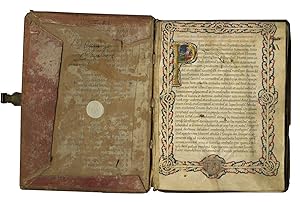
Epistola de morte Hieronymi; Epistola ad Cyrillum de magnificentiis Hieronymi; Epistola de miraculis Hieronymi; Vita Sancti Hieronymi; Vita sancti Pauli; illuminated medieval manuscript on parchment
Seller: Les Enluminures (ABAA & ILAB), Chicago, IL, U.S.A.
Seller rating 4 out of 5 stars
Hardcover. Condition: Good. ILLUMINATED MEDIEVAL MANUSCRIPT IN LATIN ON PARCHMENT, Northern Italy, c. 1440-1470. 203 x 153 mm. 70 folios, complete (collation, i-vii10), remnants of quire and leaf signatures, flourished vertical catchwords, written in a humanist minuscule on 30 long lines (justification, 147-149 x 95-100 mm), horizontal lines ruled very lightly in ink, single vertical bounding lines ruled in lead, prickings remain in top and bottom margins on some leaves, rubrics and paragraph marks in pale red, two-line red or blue initials with contrasting pen flourishes in violet or red, two five-line blue initials, ff. 29v and 35, infilled and on square grounds of elaborate penwork; f. 64v, seven-line polished GOLD INITIAL with white vinestem decoration extending along twenty lines of text and into the upper margin, infilled and edged in deep red and blue with numerous tiny silver dots; f. 1, five-line polished GOLD HISTORIATED INITIAL of St. Jerome, bearded and dressed in red, standing before a Crucifix, with a hilly landscape in the background, on a white vinestem ground, extending into a FULL WHITE VINESTEM BORDER infilled and edged in deep red and blue with tiny silver dots and an erased coat of arms in lower margin, with modern? F.A. BINDING: Early, almost certainly contemporary, reddish-brown leather over wooden boards, flat spine with three slightly raised bands, head and tail bands, clasp and catch fastening, front to back, with brass catch lettered ave, front cover decorated, most likely in the nineteenth century, with an attractive painted border in green, orange, and gray, connecting four brass studs, and the title, De laudibus et miraculis divi Hieronymi, with initials F.C. at the bottom, back pastedown is leaf from a late fourteenth-century Italian copy of Donatuss Latin grammar, front pastedown shows offset script from removed pastedown from a fourteenth-century Italian text in Latin verse. TEXT: This manuscript is a vivid witness to the importance of St. Jerome in fifteenth-century Italy, and includes the foundational texts for his cult: three letters regarding his death, miracles, and titles to glory and veneration and purporting to be written by three contemporaries of St. Jerome (c. 347-420), namely St. Eusebius of Cremona (d. 423), St. Augustine of Hippo (354-430), and Bishop Cyril of Jerusalem (c. 313-386), but probably written in Rome at the end of the thirteenth or beginning of the fourteenth century; a life of St. Jerome by an unknown author, probably writing in Italy in the twelth century; and Jeromes own life of St. Paul the Hermit, written in 374 or 375. These texts were widely disseminated in both Latin and in vernacular translations, and they influenced the work of numerous writers and visual artists. ILLUSTRATION: The iconographical choice in the historiated initial (f. 1) to depict the ascetic Jerome contemplating the Crucifixion dates from c. 1400 in Italy, and can be particularly associated with Hieronymite congregations in Tuscany. PROVENANCE: Copied in Northern Italy in the middle years of the fifteenth century, as suggested by the evidence of the script and decoration; the penwork initials in particular seem to point to Northern Italy. The manuscript almost certainly once included the coat of arms of its original owner in the lower margin of the illuminated border on f. 1. Three sets of initials are inscribed, in three different hands, all possibly initials of owners: within the roundel on f. 1 a modern owner inscribed an outline of a shield in pen and the initials F.A.; inside front cover, white embossed seal, with the initials L.F.; on front cover, as part of the added decoration, F[?]. C[?]. CONDITION: Slight loss of the leather at the back, top of the spine, and over the lower band of the binding; top of the painted border on f. 1 is very slightly trimmed; f. 1 is darkened; and there is some soiling throughout, but overall in very good condition. Full description and photos available (TM 656).


![Seller image for Dionysii Alex. Et Pomp. Melae Situs Orbis Descriptio, Aethici Cosmographia. C.I. Solini Polyhistor. In Dionysii Poematium Commentariii Eusthathii: Interpretatio Eiusdem Poematii Ad Verbum, Ab Henr. Stephano Scripta: Necnon Annotationes. [DIONYSIUS PERIEGETES (Stephanus, Henricus, Ed.; Eustathius, Comm) [with] POMPONIUS MELA (Oliver, Pedro Juan, Ed.). Situs orbis descriptio. [with] PSEUDO-JEROME (Simmler, Josias, Ed.) Aethici cosmographia [with] SOLINUS, GAIUS JULIUS (Delrio, Martin, Ed.) Polyistor] for sale by Symonds Rare Books Ltd](https://pictures.abebooks.com/inventory/md/md22779685888.jpg)