
Ranching (17 results)
- Softcover
Seller: Your Online Bookstore, Houston, TX, U.S.A.Your Online Bookstore
Contact seller5-star sellerCondition: Used - Good
US$ 4.92
Free ShippingShips within U.S.A.Quantity: 1 available
Paperback. Condition: Good. Holmes, Gerald L. (illustrator).
- Softcover
Seller: Orion Tech, Kingwood, TX, U.S.A.Orion Tech
Contact seller5-star sellerCondition: Used - Good
US$ 4.92
Free ShippingShips within U.S.A.Quantity: 1 available
Paperback. Condition: Good. Holmes, Gerald L. (illustrator).
- Softcover
Seller: Orion Tech, Kingwood, TX, U.S.A.Orion Tech
Contact seller5-star sellerCondition: New
US$ 12.88
Free ShippingShips within U.S.A.Quantity: 1 available
paperback. Condition: New. Holmes, Gerald L. (illustrator).
- Softcover
Seller: Your Online Bookstore, Houston, TX, U.S.A.Your Online Bookstore
Contact seller5-star sellerCondition: New
US$ 12.88
Free ShippingShips within U.S.A.Quantity: 1 available
Paperback. Condition: New. Holmes, Gerald L. (illustrator).

Published by National Ranching Heritage Center, Lubbock 2006
- Softcover
- First Edition
Seller: Young & Sons Enterprises, Apache, OK, U.S.A.Young & Sons Enterprises
Contact seller4-star sellerCondition: Used - Near fine
US$ 7.50
US$ 5.50 shippingShips within U.S.A.Quantity: 1 available
Stapled Booklet. Condition: Near Fine. No Jacket. First Edition. Near-fine copy of the 2006 booklet. Light reading/handling.
Published by National Ranching Heritage Center, Lubbock, TX 2003
- Softcover
Seller: Xochi's Bookstore & Gallery, truth or consequences, NM, U.S.A.Xochi's Bookstore & Gallery
Contact seller2-star sellerCondition: Used - Very good
US$ 28.00
US$ 5.00 shippingShips within U.S.A.Quantity: 1 available
Paper Back. Condition: Very Good. No Jacket. 80pp.; SC red w/white (no title on spine); slight rub w/lt.scuff,bk.cover; clean,tight pgs. Exhibit and Gallery guide. illus. Includes M.B. Loyd Firearms Collection & Quanah Parker exhibit.

Published by The American Review of Reviews, New York 1901
Seller: Cosmo Books, Shropshire., United KingdomCosmo Books
Contact seller5-star sellerCondition: Used - Very good
US$ 11.83
US$ 15.71 shippingShips from United Kingdom to U.S.A.Quantity: 1 available
Booklet - Unbound Pages. Condition: Very Good. 16 pages, illustrated. Original articles from the The American Review of Reviews, 1901. Note; Authentic standalone articles, extracted from a larger volume. Not reprints or reproductions, but original works in their own right. Preserved in a modern card cover, prepared for practical…ity - an unassuming but serviceable presentation that favours function over finery. Size: 18 x 24 cms. Category: Review of Reviews; Cosmo Books : 29 years on ABE, 47 years taking care of customers. A bookseller you can rely on.
 More images
Published by Kansas City: Walker Publications, 1955. 1955
- Hardcover
Seller: Joe Maynard, Nashville, TN, U.S.A.Joe Maynard
Contact seller5-star sellerCondition: Used - Very good
US$ 30.00
US$ 7.80 shippingShips within U.S.A.Quantity: 1 available
Hardcover. Condition: Very Good. Association copy with a presentation inscription from Kansas Senator Harry Darby, SIGNED and dated 1950. Octavo, publisher's red cloth lettered in gilt (gilt dulled, minor imperfections with the gluing of the cloth to boards, moderate rubbing and soiling, still about very good).
 More images
- Softcover
Seller: Threescore Years and Ten, Calmar, AB, CanadaThreescore Years and Ten
Contact seller4-star sellerCondition: Used - Fair
US$ 4.37
US$ 26.00 shippingShips from Canada to U.S.A.Quantity: 1 available
Mass Market Paperback. Condition: Fair. Dust Jacket Condition: Good+. 8vo 8" - 9" tall.
Published by Taylor, TX 1984
- Hardcover
- First Edition
- Signed
Seller: bookroom, Livingston, TX, U.S.A.bookroom
Contact seller4-star sellerCondition: Used - Fine
US$ 50.00
US$ 6.00 shippingShips within U.S.A.Quantity: 1 available
Condition: Fine. Second edition first printing hardcover Fine in pictorial boards and fine acetate dust jacket SIGNED BY TED GRAY ON THE FRONT END PAPER. Signed by Author(s).
- Hardcover
Seller: Aragon Books Canada, OTTAWA, ON, CanadaAragon Books Canada
Contact seller3-star sellerCondition: New
US$ 77.00
US$ 23.00 shippingShips from Canada to U.S.A.Quantity: 1 available
Condition: New.
 More images
Published by Firmin-Didot & Co, New York 1892
- Hardcover
- First Edition
Seller: Peruse the Stacks, ABAA, Gig Harbor, WA, U.S.A.Peruse the Stacks, ABAA
Contact seller5-star sellerFirst edition. First American edition, translated from the French by A. J. Herbertson. "The author, a Frenchman, visited the United States in 1890 He Analyzes American civilization and gives the impression of the people and customs encountered on the western ranches and in the western towns and cities." Adams Herd 1959. 4to, 437…pp. Original blind ruled cloth, spine stamped in gilt. Fraying at spine ends, rubbing to edges of boards. Connecticut Agricultural Experiment Station stamps else clean internally and very good.
Published by Hageman & Moore, Photographers, [ca. 1900]., Hamilton, MT: 1900
Seller: Zephyr Used & Rare Books, Vancouver, WA, U.S.A.Zephyr Used & Rare Books
Contact seller5-star sellerOne oblong boudoir-sized albumen photograph, 8 x 5 in., mounted on beige-coloured studio board sized 11 x 6.75 in., w/ photographer's imprint stamped on verso (minor age toning & slight soiling to fore-edges, minor wear & rubbing to corners), still VG bright sharp image. Sheep raising was actually introduced into Montana's Bitte…rroot Valley by Catholic Missionary Father De Smet, and over the 19th-Century often grew in concert with cattle raising, with many ranches maintaining both herds. Following the disastrous Winter of 1886-1887 in which thousands of cattle died off, sheep ranching became the predominant stock shipped into and out of Montana, as they not only handled the Montana Winters well, they cost much less to raise, and wool was a significant commodity. Hageman (1872-1944) had settled in Montana in 1896, and started operating as a photographer in the Bitterroot Valley by 1898, later partnering with Moore (1869-1955) for a short time in a photo studio in 1890, before both went out on their own by 1891, with Hageman operating as photographer until his death, and Moore going first to Missoula, and then Los Angeles.
 More images
Published by Photo Researchers, Inc., New York 1964
Seller: Captain Ahab's Rare Books, ABAA, Stephenson, VA, U.S.A.Captain Ahab's Rare Books, ABAA
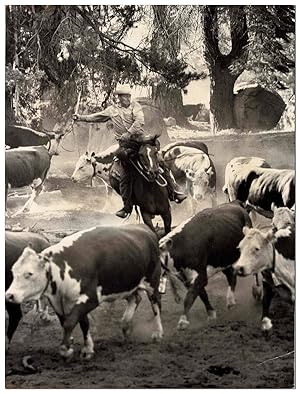
Contact seller4-star sellerOriginal borderless, double-weight silver gelatin photograph, measuring 25.5cm x 34cm (ca.10" x 13 3/8") and mounted on board. Photocopied sheet mounted on verso, with photographer's stamp, Photo Researchers sticker, holograph snipe, and the following note: ".at the Stanley Van Vleck Ranch at Sloughhouse, Calif. SE of Sacramento….". Light wear to extremities, some "spidering" to corners, with a short crease toward lower right corner; Very Good+. Joseph J. "Joe" Munroe (1917-2014) was an Ohio-born photographer and filmmaker who studied with Ansel Adams early on in his career. After serving in the Air Force during World War II, he settled in California, where he developed an interest in agriculture and rural life. "Munroe's camera caught the last days of farmers driving teams of horses and picking cotton by hand. From the 1940s through the 1970s, technology brought dramatic changes to farm life in the United States. There were still families operating small farms with manual labor, but fewer of them. From family-operated farms in the Midwest to the vast fields of California's Central Valley, the joys, challenges, and sheer hard work of rural life are seen in Joe's photographs" (ref.Ohio Memory, Joe Munroe Collection). A rugged, powerful image, capturing a cowboy on horseback rounding up cattle at the Van Vleck Ranch southeast of Sacramento, family-owned since 1856.
 More images
Published by Richard's and others, United States 1960
Seller: Auger Down Books, ABAA/ILAB, Marlboro, VT, U.S.A.Auger Down Books, ABAA/ILAB
Contact seller5-star sellerA photo album belonging to a family in the El Paso area from the 1940s and 1950s, with the latest photo dated to 1960. The album documents rural household life, schooling, and a family trip across the country from Massachusetts to California. The album is highlighted by its shots of rugged ranch life in the Southwest. A photo ca…ptioned "The Prospector" shows an older man in a boilersuit holding a gold pan outside a tent, with a backdrop of prickly pears and yucca. Men in work clothes stand in front of barbed wire fences with posts made of unprocessed logs; ride horses around flat scrubland, sometimes with their children on board; milk cows; and stand outside their trucks (cars and trucks are frequent subjects in the album). Children ride horses; young boys dress up with cowboy hats and feathered headdresses, and young girlsbut not their elderswear blue jeans. Houses are small, single-story, and often surrounded by barbed wire; in contrast with these, however, is a series of shots of several different suburban homes with grassy yards, porches, and picket fences. Not all the rural homestead shots are from Texas, as some include Saguaro cacti, which do not grow in Texas but further west in the Sonoran Desert. These photos, likely from Arizona, include several of a woman and child standing next to a gigantic saguaro specimen, as well as low, flat houses fenced in with wire fences, and miles of scrubland with mountains rising in the background. Other subjects include a high school graduation and a cross-country trip, with identifiable locations including Plymouth and Boston, Massachusetts, and Catalina Island and Knott's Berry Farm in California. School photos of students and teachers from Sierra Blanca from the 195152 school year make up the end of the album, and early photos include formal portraits from Richard's, a photography studio in El Paso, and include several of a man in US Navy uniform. One unusual series is a photo shoot of a young woman and her Underwood typewriter, set up with her books and glasses on a folding table in the driveway. Of interest for its depiction of postwar life and ranching in the rural Southwest. Album and contents overall excellent, with a few photos missing. Album measuring 10 ¼ x 13 inches containing approximately 260 photos; photos generally 3 ½ x 5 ¼ and smaller, with several larger colorized photos. Also includes program from the 1946 Texas Woman's Missionary Union Conference, postcard of the Texas Confederate Museum in Austin, and printed poem. Items glued in, some with manuscript captions.
 More images
- Hardcover
Seller: Max Rambod Inc, Woodland Hills, CA, U.S.A.Max Rambod Inc
Contact seller5-star seller[South America] Gaucho photograph archive documenting cattle work, horsemanship, domestic life, and rural identity in Argentina Chile and Uruguay in the mid twentieth century, with direct evidence of how the older nomadic gaucho tradition had been absorbed into organized ranch labor and national folklore on the pampas. The photo…graphs were taken by and Credited on verso to photojournalist Paul Almásy and distributed through Camera Press, London, The gaucho identity is deeply rooted in their historical role as nomadic horsemen and cattle herders across the South American Pampas, particularly in Argentina and Uruguay. This identity embodies values such as independence, courage, solidarity, and a profound connection to the land. The accompanying one page typed essay, titled The Gaucho Lives On in a Changing World, states that the "old style gaucho" had passed into history while gauchos remained active in Argentina, Uruguay, and Chile, now adjusted to a "more closely organised society," making the archive a concise press constructed account of rural modernization as seen through livestock handling, food preparation, costume, and family life. Archive consists of 22 images, including: 18 Large original silver gelatin press photographs and 3 real photo postcards, and a captioned photo sheet from the original professional photographer explaining the images. The 18 large photographs are approximately 8 x 10 inches. The photographs show gauchos driving cattle across open pasture, working herds inside fenced enclosures, throwing rope among livestock, and managing horses at close range, including one strong action image of men restraining a rearing horse and another of a mounted rider chasing cattle across grassland. Interior scenes broaden the file beyond ranch labor alone: one image shows men seated around an open fire roasting meat for asado, another shows two men from behind on a bench with wide belts and sheathed knives visible at the waist, and another records a family at table in a modest domestic interior with checked cloth, oil lamp, crockery, and cupboard. Costume and self presentation are treated as a parallel theme through a formal portrait of a man in broad hat, neckerchief, decorated belt, and draped textile, a close view of an elaborate silver buckled belt, and a separate photograph of silver horse tack identified on the verso as the kind found throughout South America. Versos carry typed caption slips headed The Gaucho Lives On in a Changing World, repeated Camera Press copyright stamps from Russell Court, Coram Street, London, and additional agency stamps, while the 3 postcards bear printed captions including Argentine Gaucho with Guitar and Gaucho, Argentina. The three Argentine real photo postcards extend the archive backward into an earlier visual phase of gaucho representation, predating the Paul Almásy and Camera Press photographs and preserving a more localized Argentine picture of gaucho dress, horsemanship, and musical performance and as such presenting the shift from national popular iconography to documentary coverage of gaucho labor, domestic life, and modernization. By the twentieth century, the gaucho had already become both a laboring figure within fenced, export driven cattle production and a powerful emblem in Argentine and Uruguayan national culture, a dual status visible here in the movement between working scenes, posed costume studies, and folkloric postcard imagery. Almásy's standing as a widely traveled European photojournalist active from the 1930s onward adds another layer, since the archive also preserves how international press agencies translated South American rural life for metropolitan picture circulation after Camera Press's 1947 founding. Light corner wear, minor creasing, scattered surface abrasions, editorial stamps and pasted caption strips to versos, typed essay sheet fold worn with small tears and losses; overall good condition. Strong material for Latin American studies, labor history.
 More images
Seller: Globus Rare Books & Archives, San Francisco, CA, U.S.A.Globus Rare Books & Archives
Contact seller5-star sellerNone. Condition: None. Octavo Bifolium (ca. 20,5x12,5 cm or 8x5 in). 3 pp. Brown ink on lined wove paper; blind-stamped papermaker's monogram in the left upper corner of the first leaf. Foldmarks, minor stain and tears on the right margins of both leaves affecting a couple of words, but still readable, otherwise a very good lett…er. Penned at the height of the Great Dakota Boom and only two years before the Big Die-Up (the disastrous winter of 1886-1887), the letter documents the activities of one of the most prosperous cattle businesses in the American West in the 1880s. Dakota Territory, soon after its establishment in 1861 and against the backdrop of increased migration to the West, emerged as a center of the range cattle industry. In 1882, when W. Sturgis and G. Goodell founded the Union Cattle Co. in Cheyenne (Wyoming) and located the S&G Ranch in the present-day town of Dewey (Custer County, Dakota Territory), the area became home to one of the most thriving cattle businesses in the American West. "In the flush days of the cattle business the company prospered… and its heard increased to upward of 60,000 head." (Custer County Republican. 26 January 1888. P. 3). "For many years the business proved prosperous, but then came the years in the 80's when severe storms blotted out half the herds… which meant the financial ruin of most of those then engaged in the business." (The Brattleboro Reformer. 21 November 1913. P. 3) This private letter to "Dear Mother" was written by a young cowboy who apparently moved to Dakota Territory from the east during the livestock boom of the 1880s. In the text, the author, a pioneer cattleman of Custer County and a worker of the short-lived "Union Cattle Co." describes in detail his life at the S&G Ranch (the present-day town of Dewey) with thirty-two other cowboys and proudly notes: "the company has about 125,000 head of cattle… the largest cattle outfit" in "this part of the country." Expressing his admiration for the American West, the letter writer comments on the massive wave of migration to the west and urges his friend Edie Trout (possibly from Pennsylvania) to rush to this "country for hemarage… full of men that have come for nothing else but this trouble." In the text, the author also talks about his hard work during one of the biggest spring roundups in Dakota Territory (the roundup gathered over 400,000 head from 20 participating cattle companies), providing notes on his daily regimen ("breakfast…hardly ever later than 5 o'clock"), ration of food (biscuits, killing beef at the roundup), future plans, state of health, etc. The letter was written only two years before the disastrous winter of 1886-1887 threw the "Union Cattle Co." into bankruptcy, leaving dozens of cowboys without work. Overall, an interesting private letter documenting both the flourishing cattle industry of the American West and the massive wave of migration to Dakota Territory. The text of the letter (original spelling and punctuation preserved): " Your very welcome letter received a few days since after going to Cheyenne. I am about 225 miles north of Cheyenne. The Ranch is in Dakota about 3 miles. Custer city Dakota is our nearest town it is about 40 miles from the Ranch. We have bin having very pleasant weather here of late. I am in very good health now. We are going to stand on the Round up the 25 of this month. This company has about 125,000 Head of Cattle they are about the largest: I think they are the largest cattle outfit in this part of the country. I am very sorry I hear that you have been troubled with Rheumatism hope you are all over it before this. I think the best thing that Edie Trout can do is to come west. This is the country for hemarage. This western country is full of men that have come for nothing else but that trouble. When do you expect Uncle Rollin to come East? Has Fannie Winston given up going to school. Is Aunt Ruth going to stay in Fitchburg. We have about 32 men here at the Ranch. I have been away for about.


