Order Total (1 Item Items):
Shipping Destination:

Romantic Movement (4 results)
Skip to main search results
Search filters
Product Type
- All Product Types
- Books (No further results match this refinement)
- Magazines & Periodicals (1)
- Comics (No further results match this refinement)
- Sheet Music (No further results match this refinement)
- Art, Prints & Posters (No further results match this refinement)
- Photographs (No further results match this refinement)
- Maps (No further results match this refinement)
- Manuscripts & Paper Collectibles (3)
Condition Learn more
- New (No further results match this refinement)
- As New, Fine or Near Fine (No further results match this refinement)
- Very Good or Good (1)
- Fair or Poor (No further results match this refinement)
- As Described (3)
Binding
- All Bindings
- Hardcover (No further results match this refinement)
- Softcover (No further results match this refinement)
Collectible Attributes
- First Edition (No further results match this refinement)
- Signed (No further results match this refinement)
- Dust Jacket (No further results match this refinement)
- Seller-Supplied Images (4)
- Not Print on Demand (4)
Language (1)
Free Shipping
- Free Shipping to U.S.A. (No further results match this refinement)
Seller Location
Seller Rating
-
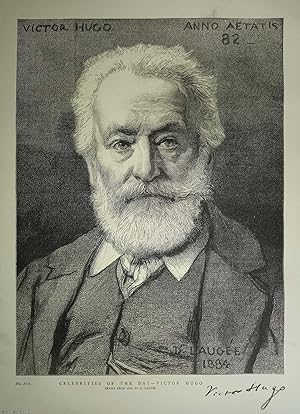
Victor Hugo. A full page woodcut portrait, and a scene from the Lying in State and Funeral of Victor Hugo in Paris. Two original pages from the Graphic Illustrated Weekly Magazine, 1885.
Published by Graphic Illustrated Weekly Newspaper, London, 1885
Magazine / Periodical
US$ 23.46
US$ 15.67 shipping
Ships from United Kingdom to U.S.A.Quantity: 1 available
Add to basketUnframed Print. Condition: Very Good. Woodcut engraving. Note; this is an original item separated from the larger volume, not a reprint or copy. THERE IS MORE THAN ONE PICTURE OF THIS ITEM TO SHOW YOU MORE DETAILS. Size: Page size 30 x 40 cms. Category: Graphic Illustrated Weekly Newspaper; PRINTS : Historic News; Vintage Prints. This item may require more postage than the rates shown for delivery outside the UK. If extra postage is required we will contact you before processing your order and you will be given the details and option to decline the extra cost. Cosmo Books : 29 years on ABE, 47 years taking care of customers. A bookseller you can rely on.
-
Autograph letter signed.
Published by no place, May 14th, 1813, 1813
Seller: Kotte Autographs GmbH, Roßhaupten, Germany
Association Member: ILAB PADA VDA
Seller rating 5 out of 5 stars

Manuscript / Paper Collectible
8vo. 1 p. Double sheet. Written in third person to Mr and Mrs Conell: Ld. Byron presents his compliments to Mr. + Mrs. [] But he will certainly have the pleasure of joining the party in the evening about 20 o'clock.".
-

Letter signed (with initials).
Published by Genoa, 12. VII. 1823., 1823
Seller: Antiquariat INLIBRIS Gilhofer Nfg. GmbH, Vienna, A, Austria
Association Member: ILAB PADA VDA VDAO
Seller rating 5 out of 5 stars
Manuscript / Paper Collectible
4to. ¾ p. on bifolium. With integral address-leaf. The present letter, written in Italian and in the hand of Count Pietro Gamba (the brother of his beloved Teresa Guiccioli), was written while Byron was making his final preparations for his voyage to Greece, where he was to die nine months later "that Greece may still be free". Its addressee is the Greek patriot Giorgio Vitali (1776-1854) at Leghorn, from an ancient Venetian family and the commander of the Ionic vessel "Hercules" that Byron wanted to take. Byron is delaying his departure until July 14, and tells Vitali that by passing through Leghorn they should not drop anchor in order to avoid pointless expense and waste of time. - Byron was to bid farewell to Teresa and board the "Hercules" on 13 July, the day after writing this letter. However, his departure was to be delayed by calms, and then a storm. By some accounts, his mood at this time was despondent, almost fatalistic. During the delay he went on shore again to visit the house outside Genoa that he had shared with Teresa; as her brother recalled: "His conversation was somewhat melancholy on our way to Albaro, he spoke much of his past life, and of uncertainty of the future, 'where', said he, 'shall we be in a year?'" (quoted by Leslie A. Marchand, Byron: A Biography [1957] III, 1089). They eventually set sail from Genoa on the 16th. During the couple of days spent at Leghorn, Byron received a verse-tribute from Goethe and dashed off his famous reply: "I sailed from Genoa some days ago - was driven back by a Gale of Wind - and have since sailed again - and arrived here (Leghorn) this morning to receive on board some Greek passengers for their struggling country" (22 July 1823). They set sail once again on 24 July, and finally reached Cephalonia on 2 August. - Not published in Marchand's edition of Byron's Letters and Journals (1973-1994); small clipping from opening the letter (slightly touching text); overall in fine condition.
-
2 letters signed (as "Noel Byron, Pair d'Angleterre").
Published by Genoa, 1823., 1823
Seller: Antiquariat INLIBRIS Gilhofer Nfg. GmbH, Vienna, A, Austria
Association Member: ILAB PADA VDA VDAO
Seller rating 5 out of 5 stars
Manuscript / Paper Collectible
4to. Altogether (¾+¾ =) 1½ pp. on 4 ff. With integral address leaves. These two evocative letters, written in Italian and in the hand of Count Pietro Gamba (the brother of his beloved Teresa Guiccioli), were written while Byron was making his final preparations for his voyage to Greece, where he was to die nine months later "that Greece may still be free". Their addressee is the Greek patriot Giorgio Vitali (1776-1854) at Leghorn, from an ancient Venetian family and the commander of the Ionic vessel "Hercules" that Byron wanted to take. (I) In the first letter (July 7), Byron is rescheduling his departure to July 12: "[.] Capisco che il momento del forte conflitto è giunto [.]". (II) In the second (July 9), stating that in order not to lose a moment of his time, he has resolved not to make a stop at Leghorn except to take him on board along with an other English gentleman (James Hamilton Browne), and asking Vitali to tell his compatriots to have any despatches and instructions relating to his mission ready for his arrival. - Byron was to bid farewell to Teresa and board the "Hercules" on 13 July. However, his departure was to be delayed by calms, and then a storm. By some accounts, his mood at this time was despondent, almost fatalistic. During the delay he went on shore again to visit the house outside Genoa that he had shared with Teresa; as her brother recalled: "His conversation was somewhat melancholy on our way to Albaro, he spoke much of his past life, and of uncertainty of the future, 'where', said he, 'shall we be in a year?'" (quoted by Leslie A. Marchand, Byron: A Biography [1957] III, 1089). They eventually set sail from Genoa on the 16th. During the couple of days spent at Leghorn, Byron received a verse-tribute from Goethe and dashed off his famous reply: "I sailed from Genoa some days ago - was driven back by a Gale of Wind - and have since sailed again - and arrived here (Leghorn) this morning to receive on board some Greek passengers for their struggling country" (22 July 1823). They set sail once again on 24 July, and finally reached Cephalonia on 2 August. - In fine condition. - Not published in Marchand's edition of Byron's Letters and Journals (1973-1994).