
Rutang (2 results)
 More images
Ancient Chinese Architecture, Vol.2: Buddhist Buildings
Wei Ran; Pan Jingyi [translation from the Chinese]; Ye Rutang [preface]; Lothar Ledderose [preface]
- Hardcover
Seller: killarneybooks, Inagh, CLARE, Irelandkillarneybooks
Contact seller5-star sellerCondition: Used - Near fine
US$ 70.30
US$ 56.78 shippingShips from Ireland to U.S.A.Quantity: 1 available
Hardcover. Condition: Near Fine. Dust Jacket Condition: Good. Large-format cloth hardcover 36 x 26 cm, 195 pages, 157 colour illustrations, pictorial endpapers, NOT ex-library. Weight 2410g. No slipcase. Minor light wear, book is crisp, clean and bright, with unmarked text, free of inscriptions and stamps, firmly bound. Good dus…t jacket (sunned spine, corners and spine ends rubbed white with short creases and edge-nicks). -- Contents: Buddhist Buildings: Photographs [North China; Central China; Western Localities]; Formation and Development of Chinese Buddhism: Explaining Buddhism by Mysticism and Supplementing Mysticism with Buddhism [Initial Spread of Buddhism; Beginnings and the Translation of Scripture; Establishment and Prosperity of the Buddhist Sect; Tibetan Buddhism (Lamaism)]; Founding and Evolution of the Buddhist Monastery in China: From the Establishment of the Baima Temple to the Forest-like Buddhist Monasteries of the Sui and Tang Dynasties [Origin of the Monastery; Structural Evolution of the Chinese Monastery; Transformation and Evolution of the Pagoda; Stone Cave Monastery; Building of the Lamasery]; Artistic Characteristics of Buddhist Architecture in China: The Blending of Western Buddhist Culture and Chinese Innate Culture [Varied Natural Settings Chosen for the Location of the Buddhist Monastery; Treatment of Space in the Buddhist Monastery on Han Territory; Characteristics of the Architectural Art of the Lamasery; Decoration, Artistic Creation, etc.]; Appendices [General Plan and Section of the Nan-Chan Monastery and Restored Elevation and Section of the Great Hall; General Plan and Section of the Foguang Monastery and Front Elevation and Section of the Great Hall; Schematic Drawing of the Beam Structure of the Great Hall in the Foguang Monastery; Elevation and Section of the Mahayana Pavilion in the Puning Monastery; General Plan of the Putuozongsheng Monastery and Plan, Elevation and Section of the Dahong Platform; Drawings of the Great Hall in the Lower Guangsheng Monastery and Its Framework Structure; Illustration of the Principal Features of the Chinese Buddhist Pagoda; A Comparison of the Different Plans of Chinese Buddhist Pagodas; Sketch of Grotto Plan and Comparison with Cave Style Evolution; Plan, Elevation and Section of the Tianlongshan Grotto 16; Imaginary Sketch of the Original State of the 4th Maijishan Grotto; Sketch of Stone-Sculptured Tang Dynasty Buddhist Building and Buddhist Monastery; Dougong Bracket, Inner Lintel and Square Pillar; Glossary]; Notes on the Photographs; Map and Chronology [Map of Distribution of Buddhist Buildings; Tourist Map of Buddhist Buildings in Northern Shanxi; Chronology of Major Events in the History of Chinese Architecture] -- From the end of the Han Dynasty onwards, Buddhism took root in China, spreading and developing over a period of more than 1000 years. The original teachings from India became imbued with native Chinese thought on heaven and man; a foreign religion, therefore, with Chinese modifications. As far as its architecture was concerned, is gradually integrated with that of China, in style hardly differing from that stipulated by central government law. In addition to the wooden or brick and stone temple gate, the main hall and other Buddhist buildings, the Buddhist pagoda or tomb pagoda often took on various forms in the monasteries. Unique forms, including those to be found in the stone cave and the lamasery, are also to be seen, chiefly in Northern China and western localities. To facilitate identification, the monasteries and their location in what is a vast land have roughly been arranged into three regions: Northern China, Central China and the western localities. Not only is their appearance described but the reader is also given an insight into their internal structure, their fittings as well as the exquisitely sculptured statues, all an expression of the dignified beauty of Buddhist architecture.
- Hardcover
- First Edition
Seller: killarneybooks, Inagh, CLARE, Irelandkillarneybooks
Contact seller5-star sellerCondition: Used - Very good
US$ 153.00
US$ 56.78 shippingShips from Ireland to U.S.A.Quantity: 1 available
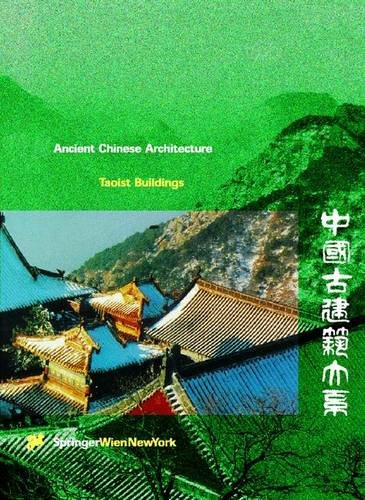
Hardcover. Condition: Very Good. Dust Jacket Condition: Fine. 1st Edition. Large-format cloth hardcover, 38 x 28 cm, housed in the original cardboard box. 183 pages, copiously illustrated, pictorial endpapers, NOT ex-library. English edition, translated from the Chinese. Weight 2.5kg. A beautiful book with little wear, clean and… bright throughout with unmarked text, free of inscriptions and stamps, firmly bound. In a crisp untorn dust jacket. The cardboard box shows short rips, handling and dusty marks, creases and scratches. Instead of a traditional slipcase, the publisher issued a hinged box resembling a pizza box, with the title and ISBN printed along the "spine." -- This volume is part of a comprehensive ten-part English-language series on historical Chinese built environments, originally compiled by the Chinese Academy of Architecture. Focused exclusively on Taoist religious structures, the text examines how indigenous philosophical principles - such as harmony with the natural world, the balance of yin and yang, and traditional geomancy - are physically manifested in building design. The book documents significant temples, monasteries, and shrines across China, including remote complexes integrated into sacred mountain landscapes like Mount Wudang and Mount Qingcheng. Through a combination of extensive color photography, detailed architectural elevations, cross-sections, and traditional floor plans, the author analyzes the spatial organisation and structural evolution of these sites from antiquity through the Qing dynasty. An introductory preface is provided by Lothar Ledderose, a prominent German art historian and recipient of the Balzan Prize, who contextualises these structural achievements within broader East Asian art history. The work is a visual and historical record for architects, art historians, and preservationists studying the exact structural methods used to align religious architecture with the natural topography.

