
Ruysch: First Edition (8 results)
 More images
Published by The Hague, 1955-56. 1955
- Hardcover
- First Edition
Seller: Librarium of The Hague, The Hague, NetherlandsLibrarium of The Hague
Contact seller5-star sellerCondition: Used
US$ 29.30
US$ 39.83 shippingShips from Netherlands to U.S.A.Quantity: 1 available
Hardcover. 1st Edition. Six volumes in one. Paginated consecutively. Square royal octavo. Pp. 522. Profusely illustrated. Numerous tipped-in plates. HARDCOVER, bound in the original publisher's decorative full cloth, gilt lettering to cover and spine. In a very good condition. ~ FIRST EDITION. 010-01. ~ ~ NOTE: THE PRICE OF THIS… BOOK IS CURRENTLY REDUCED! ~ ~ (illustrator).
 More images
Published by Apud Janssoniow Aesbergios 1726
- Softcover
- First Edition
Seller: Librairie Le Feu Follet, Paris, FranceLibrairie Le Feu Follet
Contact seller5-star sellerAssociation member: ILAB
Condition: Used
US$ 337.57
US$ 34.14 shippingShips from France to U.S.A.Quantity: 1 available
couverture souple. Apud Janssoniow Aesbergios | Amstelodami (Amsterdam) 1726 | 19 x 23.50 cm | broché | Edition originale. Broché, sous papier velin lie de vin XXe. Frederik Ruysch (1638-1731) est un médecin et un anatomiste néerlandais, tour à tour chirurgien, professeur auprès des sages-femme, médecin légiste et professeur de…botanique. Trait amusant son cabinet de curiosités (composé de pièces anatomiques) est acquis par Pierre le Grand (1672-1725) pour la somme de 30 000 florins. Ses oeuvres paraîtront en 1734 à Amsterdam (5 Vol. in 4). Ex libris Docteur A. Beauvois. | [ENGLISH DESCRIPTION FOLLOWS] First edition. In original wrappers, under twentieth-century wine-colored laid paper. Frederik Ruysch (1638-1731) was a Dutch physician and anatomist, successively surgeon, professor to midwives, forensic physician and professor of botany. An amusing detail: his cabinet of curiosities (composed of anatomical specimens) was acquired by Peter the Great (1672-1725) for the sum of 30,000 florins. His works would be published in 1734 in Amsterdam (5 vols. in 4to). Bookplate of Dr. A. Beauvois. * (4) 200pp. (1pl.).

Published by Leiden, P. van der Aa. 1722
- Hardcover
- First Edition
Seller: Universitätsbuchhandlung Herta Hold GmbH, Berlin, GermanyUniversitätsbuchhandlung Herta Hold GmbH
Contact seller4-star sellerCondition: Used
US$ 562.62
US$ 34.14 shippingShips from Germany to U.S.A.Quantity: 1 available
4°. Titelvignette, 2 Textkupfer, (1 Bl.), 81 S. Pappband der Zeit mit Rückenschild und Rückenvergoldung (wenig berieben). Umlaufender Rotschnitt. Vorsatz und Titel beidseitig gestempelt. S.1-6 mit Wasserrand an Kopf- und Außensteg. Stellenweise geringfügig fleckig, einzelne Seiten leicht gebräunt, sonst in sehr schöner Erhaltung…. Erste Ausgabe. - Wellcome IV, 600; Heirs of Hippocrates 625 (Ausgabe Amsterdam 1733); DSB XII, 39-42; Lindeboom 339 (Boerhaave). - Dokumentiert den Gelehrtenstreit zwischen den namhaften holländischen Medizinern Ruysch und Boerhaave im ersten Drittel des 18. Jahrhunderts. Ruysch wandte sich gegen Malpighi "who had taught that the glands are seperate and anatomically bounded formations in the body, with the purpose of secretion. Ruysch, who was famous for his preparations made by injections of conservating liquids, cherished the idea that the glands were not anatomically distinct formations but only vascular differentiations as he did not see them in his preparates. Boerhaave takes it up pro Malpighi, and makes the suggestion that Ruysch injected his conservating liquids into the vessels, e. g. of the liver, under such heavy pressure that the glands were pressed away. So he thinks that Ruysch is a victim of his own method. Ruysch answered in an epistle, afterwards printed together with that of Boerhaave" (Lindeboom). Sprache: Deutsch.
 More images
Published by Johannis Jacobi Schipperi, Amsterdam 1657
- Hardcover
- First Edition
Seller: Arader Books, New York, NY, U.S.A.Arader Books
Contact seller5-star sellerCondition: Used - Very good
US$ 5,125.00
Free ShippingShips within U.S.A.Quantity: 1 available
Hardcover. Condition: Very Good. First. Historiæ naturalis: folio in 4s (14 13/16" x 9 1/4", 375mm x 236mm): full collation available upon request. 30 leaves, pp. 1-2 3-58 [2] (index, instructions for the binder). With 20 copperplate engravings. Bound in quarter blue cloth over pebbled red buckram. On the spine, date, author, an…d title gilt to black lettering piece. Excerpted and bound to stand alone from Historiae Naturalis de Quadrupetibus. de Piscibus et Cetis. .de Exanguibus Aquaticis; .de Avibus.; de Insectis. de Serpentibus. Lettering piece lifting away from the spine. Light spotting to the margins of the leaves. XXc ink stamp of Richard I. Johnson to the recto of the flyleaf and title-leaf. Theatri universalis animalium: folio in 4s (14 5/8" x 9 1/8", 370mm x 233mm): full collation available upon request. 32 leaves, pp. [2] (title, blank) 1-2 3-58 [2] (index, instructions for the binder). With 20 copperplate engravings. Bound in quarter green buckram over grey card. On the spine, date, author, and title gilt to spine. Excerpted and bound to stand alone from Hendrik Ruysch's Theatrum universale omnium animalium piscium, avium, quadrupedum, exanguium, aquaticorum, insectorum, et angium [sic]. Light soiling to the boards. Deep but even toning to the text leaves and plates. Occasional paper flaws, primarily at the margins and edges. XXc ink stamp of Richard I. Johnson to the recto of the title-leaf. The first installment of Polish-Scottish physician John Jonston's (1603-1675) Historiæ naturalis was released in 1650 and by the time the series reached its conclusion in 1657, it was already recognized as a standard reference of encyclopedic zoology. Jonston spent his childhood in Poland before completing his education at Cambridge, where he studied botany and medicine. He was a devoted disciple of Ulisse Aldrovandi (1522-1605), whose work he heavily drew from when drafting his own (he is chiefly referred to as a a skilled "compiler" by bibliographers). Matthaeus Merian the younger executed the vast majority of the copperplate engravings, which would be extensively reprinted and copied by fellow engravers for the next century. Hendrik Ruysch's (1663-1727) 1718 edition is one such copy. A fellow physician, Ruysch updated and revised Jonston's work for an XVIIIc audience. Ruysch was the son of the renowned Dutch anatomist, Frederik Ruysch, and had unbridled access to his father's internationally famous collection of medical curiosities, which housed countless preserved specimens and became a tourist attraction for those visiting Amsterdam. The father-son duo had significantly advanced preservation techniques, so much so that when Tsar Peter the Great paid a visit, he was so moved by the sight of an embalmed young boy that he fell to his knees and kissed him. The Tsar later purchased the entire collection and relocated it to St. Petersburg, where it remains to this day. The present examples are both book IV of the series, chronicling marine invertebrates. Other installations would focus on fish, quadrupeds, birds, and insects, and serpents, but these men of science would occasionally feature mythical creatures alongside the observable ones (some of which no doubt seemed equally improbable to XVII and XVIIIc Europeans). In conversation with one another, the Jonston and Ruysch editions dictate a century of pre-Linnaean attempts to meaningfully classify the natural world; the volumes illustrate both the triumphs and follies of Baroque scientific inquiry that Systema Naturæ would build upon and concretize, issuing in the Enlightenment. Richard I. Johnson (1925-2020) was a long time Research Associate at Harvard's Museum of Comparative Zoology, having started as a volunteer while still in high school. He published his first scientific article at the age of 16, beginning his life as a gentleman scholar. Though never conferred a doctorate, Johnson produced more than 50 papers on malacology and was widely recognized as a scholarly authority. Over six decades, Johnson assembled.
 More images
Language: Latin
Published by H. en Weduwe T. Boom, Amsterdam 1691
- Hardcover
- First Edition
Seller: Milestones of Science Books, Ritterhude, GermanyMilestones of Science Books
Contact seller5-star sellerCondition: Used - Very good
US$ 2,227.05
US$ 51.21 shippingShips from Germany to U.S.A.Quantity: 1 available
Hardcover. Condition: Very Good. 1st Edition. Observationum Anatomico-Chirurgicarum Centuria Accedit Catalogus Rariorum, quae in Museo Ruyschiano asservantur., two parts in one. Amsterdam: H. en Weduwe T. Boom, 1691, 4to. (233 x 183 mm), [16], 138, [2] pp.; [4], 3-120 pp., first title-page printed in red and black, woodcut devic…e on both titles, 46 engr. plates (including two folding) and some woodcuts in text, ink library stamps to titles and plates, occasional fraying to edges of some plates, contemp. vellum, spine lettered in manuscript. ---- DSB XIII, pp. 40-41; Wellcome IV, p. 597; Osler 3868; Waller 8337; Krivatsy 10071; Hirsch-H. IV, 934. - First edition. The first part containing 100 anatomicial and surgical observations by Ruysch, and the second part containing the first descriptive account of his famous anatomical museum. Displayed in several rented houses in Amsterdam, the museum was a major attraction for foreign visitors. In 1717, Ruysch sold his collection to Peter the Great for 30,000 guilders. In this text of practical observations in medicine and surgery, Ruysch presents the results of one hundred studies and illustrates many of them with excellent engravings, many of which are undoubtedly enhanced by his injection techniques (H.o.H. 613).
 More images
Published by Bernardinus Venetus de Vitalibus, Rome 1508
- First Edition
- Map
Seller: Arader Books, New York, NY, U.S.A.Arader Books
Contact seller5-star sellerCondition: Used - Very good
US$ 575,000.00
Free ShippingShips within U.S.A.Quantity: 1 available
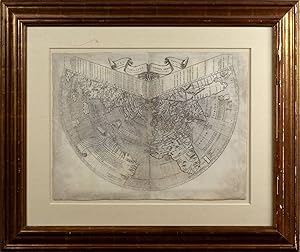
No binding. Condition: Very good. First. THE EARLIEST OBTAINABLE DEPICTION OF THE NEW WORLD [Rome: Bernardinus Venetus de Vitalibus, 1508.] First edition, Shirley state 5/McGuirk 3-C. Two sheets joined (sheet: 17 1/16" x 22 3/4", 433mm x 578mm; framed: 30" x 35 1/2". Engraved conical-projection map. Float-matted with a window ve…rso, demonstrating the water-mark of the left-hand sheet (a crossbow within a circle). The edges uneven (untrimmed, i.e., deckled?) with some small areas of infill, not touching the image. Rubbing along the sheets' join, with some filled losses at the head and tail, not touching the image. A little soiled at the peripheries, including a faint ink-splatter at lower-left. As exploration pushed European knowledge of the world east and south, cartographers built on the framework of Ptolemy (Claudius Ptolemaeus), a second-century philosopher living in Roman Alexandria in Egypt. In the Greek tradition (Ptolemy wrote in Greek, which was the administrative language of the Roman Empire in the Eastern Mediterranean), philosophy -- the love of wisdom -- bridged what we now divide into the humanities and the sciences; he was a mathematician, natural scientist and geographer-astronomer. No manuscripts of the ?????????? ???????? (Geographical Guidance) survive from before the XIIIc, but some XIIIc examples survive with maps that bear some relation to those Ptolemy himself drew. Thus, with the exception of some excavated carved maps, Ptolemy is the source for ancient cartography as well as its culmination. The discovery of the New World in the late XVc -- Columbus assumed he had found the East Indies because of Ptolemy's calculations and assertions about longitude -- provoked a crisis in the understanding of the disposition of the globe; the Ptolemaic skeleton was showing signs of fracture. It is against this background that Johannes Ruysch (Johan(n) Ruijsch, ca. 1460-1533) made his coniform (cone or fan-shaped) projection. Ruysch was a profoundly cosmopolitan figure; he was Flemish or German or Netherlandish by birth, lived in Cologne, Rome, England and finally Portugal. From England, it is claimed, he himself sailed west as far as the American coast; thus he is the first mapmaker to have traveled to America. Due, perhaps, to his first-hand knowledge of the contradictions entailed by a New World adjoining Ptolemy's, Ruysch was visionary in his solutions. (The title translates to "a more universal illustration of the known world made out of new observations;" the comparative makes clear Ruysch's competitiveness.) Newfoundland adjoins Tibet. Japan (Zipangu) is identified with Spagnola (modern Haiti and the Dominican Republic), although Ruysch is fairly agnostic in his reasoning. In other ways, however, his map is cutting-edge in its modelling of Asia --here the triangular form of India appears for the first time -- and the Caribbean, largely drawing on Portuguese sources. The map's date is sometimes given as 1507, and indeed it does appear in some examples of the 1507 Rome edition of Ptolemy (colophon 8 September 1507); the vast majority, however, appear in 1508 editions, which have the addition of a commentary of Marcus of Benevento (Marcus Beneventanus) based on the findings depicted in this map. The tacit suggestion of most bibliographies is that the map was not completed until very late 1507 or early 1508, and its inclusion in 1507 editions is the work of owners rather than the publisher. Although the 1506 map of Contarini/Rosselli and the 1507 Waldseemüller are earlier (excluding manuscript maps), each survives in a single example. The Ruysch map is thus the earliest obtainable depiction of the New World. McGuirk's 1989 census counted 64 examples, of which 14 were in private collections (plus one on the market in 1986). He also determines that about two-thirds of the maps examined were Shirley's state 5 (his 3-C). McGuirk estimates that 100 examples of the map survive, of which perhaps 25 are in private hands. The present example was acquired from the Cl.
 More images
Published by Bernardinus Venetus de Vitalibus, Rome 1508
- First Edition
- Map
Seller: Arader Books, New York, NY, U.S.A.Arader Books
Contact seller5-star sellerCondition: Used - Very good
US$ 485,000.00
Free ShippingShips within U.S.A.Quantity: 1 available
No binding. Condition: Very good. First. THE EARLIEST OBTAINABLE DEPICTION OF THE NEW WORLD. [Rome: Bernardinus Venetus de Vitalibus, 1508.] First edition, Shirley state 5/McGuirk 3-C. Two sheets joined (sheet: 17 7/16" x 22 3/4", 443mm x 578mm; framed: 35 9/16" x 30"). Engraved conical-projection map. Float-matted with a window… verso, demonstrating water-marks (crossed arrows). Trimmed at the edges, with about an inch added and loss supplied in facsimile. Some losses at the join, filled in facsimile. A little toning in patches. As exploration pushed European knowledge of the world east and south, cartographers built on the framework of Ptolemy (Claudius Ptolemaeus), a second-century philosopher living in Roman Alexandria in Egypt. In the Greek tradition (Ptolemy wrote in Greek, which was the administrative language of the Roman Empire in the Eastern Mediterranean), philosophy -- the love of wisdom -- bridged what we now divide into the humanities and the sciences; he was a mathematician, natural scientist and geographer-astronomer. No manuscripts of the ?????????? ???????? (Geographical Guidance) survive from before the XIIIc, but some XIIIc examples survive with maps that bear some relation to those Ptolemy himself drew. Thus, with the exception of some excavated carved maps, Ptolemy is the source for ancient cartography as well as its culmination. The discovery of the New World in the late XVc -- Columbus assumed he had found the East Indies because of Ptolemy's calculations and assertions about longitude -- provoked a crisis in the understanding of the disposition of the globe; the Ptolemeian skeleton was showing signs of fracture. It is against this background that Johannes Ruysch (Johan(n) Ruijsch, ca. 1460-1533) made his coniform (cone or fan-shaped) projection. Ruysch was a profoundly cosmopolitan figure; he was Flemish or German or Netherlandish by birth, lived in Cologne, Rome, England and finally Portugal. From England, it is claimed, he himself sailed west as far as the American coast; thus he is the first mapmaker to have traveled to America. Due, perhaps, to his first-hand knowledge of the contradictions entailed by a New World adjoining Ptolemy's, Ruysch was visionary in his solutions. (The title translates to "a more universal illustration of the known world made out of new observations;" the comparative makes clear Ruysch's competitiveness.) Newfoundland adjoins Tibet. Japan (Zipangu) is identified with Spagnola (modern Haiti and the Dominican Republic), although Ruysch is fairly agnostic in his reasoning. In other ways, however, his map is cutting-edge in its modelling of Asia --here the triangular form of India appears for the first time -- and the Caribbean, largely drawing on Portuguese sources. The map's date is sometimes given as 1507, and indeed it does appear in some examples of the 1507 Rome edition of Ptolemy (colophon 8 September 1507); the vast majority, however, appear in 1508 editions, which have the addition of a commentary of Marcus of Benevento (Marcus Beneventanus) based on the findings depicted in this map. The tacit suggestion of most bibliographies is that the map was not completed until very late 1507 or early 1508, and its inclusion in 1507 editions is the work of owners rather than the publisher. Although the 1506 map of Contarini/Rosselli and the 1507 Waldseemüller are earlier (excluding manuscript maps), each survives in a single example. The Ruysch map is thus the earliest obtainable depiction of the New World. McGuirk's 1989 census counted 64 examples, of which 14 were in private collections (plus one on the market in 1986). The present example was purchased from a private collector in 2008. McGuirk, Donald L. "Ruysch World Map: Census and Commentary." Imago Mundi 41 (1989) 133-141. Peerlings, R.H.J., F. Laurentius and J. van den Bovenkamp. "The Watermarks in the Rome Editions of Ptolemy's Cosmography and More." Quaerendo 47 (2017) 307-327. Burden 3 (p. xxiii); Harrisse 56; Sabin 66476 (Ptolemy); Shirley 25.
 More images
- First Edition
Seller: Antiquariaat Schierenberg, Amsterdam, NetherlandsAntiquariaat Schierenberg
Contact seller4-star sellerCondition: Used
US$ 1,640.98
US$ 56.90 shippingShips from Netherlands to U.S.A.Quantity: 1 available
Amsterdam, Johannes Wolters, 1701. Very large single leaf (41.3 x 36.1 cm). = This spectacular, finely engraved "Wunderkammer" plate depicts items from the collection of natural history objects by the Dutch medical doctor and zoologist Frederik Ruysch (1638-1731). Published in his Thesaurus Anatomicus or Anatomisch Cabinet [Anat…omical Thesaurus]. Shown are five human juvenile skeletons (four standing) on a pedestal, surrounded by several other parts of the human anatomy. First issue of this unusually large anatomical-philosophical plate. It was engraved by C. Huijberts, "ad vivum sculpsit". Plate engraved "Thes 3, Tab I". Central to Ruysch's work are the bizarre, but anatomically correct illustrations of foetuses and anatomical preparations. "Ruysch drew on his art not only for strict medical science but also for flights and fancy. He often made up preparations in a rather romantic, dramatic way. He prepared the corpse of a child as if it were still alive so that Peter the Great was inclined to kiss it. A hydrocephalid child was prepared, seated on a cushion and with a placenta in its hands. Ruysch displayed these preparations . and this 'cabinet' became a major attraction for foreign visitors. . In 1715 he announced the sale of his collection but no buyers presented themselves before 1717 when Peter the Great bought it for 30,000 guilders" (DSB). This is Neerd Taf. 83, however, printed before the Neerd numbering (i.e., first edition). Very weak folds. A few skilful, marginal repairs, but in all an excellent, clean copy. Nissen ZBI, 3541.


