

Order Total (1 Item Items):
Shipping Destination:

Ryan Noppen Douglas Dildy (14 results)
Skip to main search results
Search filters
Product Type
- All Product Types
- Books (14)
- Magazines & Periodicals (No further results match this refinement)
- Comics (No further results match this refinement)
- Sheet Music (No further results match this refinement)
- Art, Prints & Posters (No further results match this refinement)
- Photographs (No further results match this refinement)
- Maps (No further results match this refinement)
- Manuscripts & Paper Collectibles (No further results match this refinement)
Condition Learn more
- New (11)
- As New, Fine or Near Fine (No further results match this refinement)
- Very Good or Good (2)
- Fair or Poor (No further results match this refinement)
- As Described (1)
Binding
- All Bindings
- Hardcover (No further results match this refinement)
- Softcover (14)
Collectible Attributes
- First Edition (No further results match this refinement)
- Signed (No further results match this refinement)
- Dust Jacket (No further results match this refinement)
- Seller-Supplied Images (6)
- Not Print on Demand (14)
Language (1)
Price
- Any Price
- Under US$ 25
- US$ 25 to US$ 50
- Over US$ 50 (No further results match this refinement)
Free Shipping
Seller Location
Seller Rating
-

German and Italian Aircraft Carriers of World War II (New Vanguard, 306)
Book 300 of 328: New VanguardSeller: Used Book Company, Egg Harbor Township, NJ, U.S.A.
Seller rating 4 out of 5 stars

Condition: like_new. Wright, Paul (illustrator). Shows very minimal signs of wear and previous use. Can include notes highlighting. A portion of your purchase benefits nonprofits! - Note: Edition & format may differ from what is shown in stock photo & item details. May not include supplementary material such as toys, access code, dvds, etc.
-

paperback. Condition: Good. Wright, Paul (illustrator). Connecting readers with great books since 1972! Used textbooks may not include companion materials such as access codes, etc. May have some wear or writing/highlighting. We ship orders daily and Customer Service is our top priority!
-

German and Italian Aircraft Carriers of World War II
Book 300 of 328: New VanguardLanguage: English
Published by Bloomsbury Publishing PLC, GB, 2022
ISBN 10: 1472846761 ISBN 13: 9781472846761
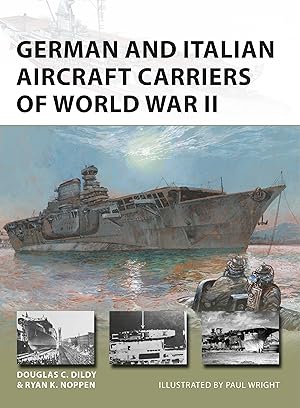
Paperback. Condition: New. Wright, Paul (illustrator). This fully illustrated study details Germany and Italy's failed development of World War II aircraft carriers, and the naval aviation ships that the two Axis powers sent into action in their place.The quest for a modern aircraft carrier was the ultimate symbol of the Axis powers' challenge to Allied naval might, but fully-fledged carriers proved either too difficult, expensive or politically unpopular for either to make operational. After the Anglo-German Naval Agreement of 1935, Hitler publicly stated his intention to build an aircraft carrier, the Graf Zeppelin, which was launched in 1938. A year later, the ambitious fleet-expansion Z-Plan, was unveiled with two additional aircraft carriers earmarked for production . However, by the beginning of World War II, Graf Zeppelin was not yet completed and work was halted. Further aircraft carrier designs and conversion projects such as the ocean liner Europa and heavy cruiser Seydlitz were considered but, in January 1943, all construction work on surface vessels ceased and naval resources were diverted to the U-boat Campaign.This book explains not only the history of Germany's famous Graf Zeppelin fleet carrier and German carrier conversion projects but also Italy's belated attempt to convert two of her ocean liners into carriers. It considers the role of naval aviation in the two countries' rearmament programmes and describes how ultimately it was only Italian seaplane carriers and German ocean-going, catapult-equipped flying boat carriers that both Axis powers did eventually send into combat.
-

German and Italian Aircraft Carriers of World War II
Book 300 of 328: New VanguardLanguage: English
Published by Bloomsbury Publishing PLC, GB, 2022
ISBN 10: 1472846761 ISBN 13: 9781472846761
Seller: Rarewaves.com USA, London, LONDO, United Kingdom
Seller rating 5 out of 5 stars

US$ 18.42
Free Shipping
Ships from United Kingdom to U.S.A.Quantity: Over 20 available
Add to basketPaperback. Condition: New. Wright, Paul (illustrator). This fully illustrated study details Germany and Italy's failed development of World War II aircraft carriers, and the naval aviation ships that the two Axis powers sent into action in their place.The quest for a modern aircraft carrier was the ultimate symbol of the Axis powers' challenge to Allied naval might, but fully-fledged carriers proved either too difficult, expensive or politically unpopular for either to make operational. After the Anglo-German Naval Agreement of 1935, Hitler publicly stated his intention to build an aircraft carrier, the Graf Zeppelin, which was launched in 1938. A year later, the ambitious fleet-expansion Z-Plan, was unveiled with two additional aircraft carriers earmarked for production . However, by the beginning of World War II, Graf Zeppelin was not yet completed and work was halted. Further aircraft carrier designs and conversion projects such as the ocean liner Europa and heavy cruiser Seydlitz were considered but, in January 1943, all construction work on surface vessels ceased and naval resources were diverted to the U-boat Campaign.This book explains not only the history of Germany's famous Graf Zeppelin fleet carrier and German carrier conversion projects but also Italy's belated attempt to convert two of her ocean liners into carriers. It considers the role of naval aviation in the two countries' rearmament programmes and describes how ultimately it was only Italian seaplane carriers and German ocean-going, catapult-equipped flying boat carriers that both Axis powers did eventually send into combat.
-
Condition: New. Wright, Paul (illustrator).
-
German and Italian Aircraft Carriers of World War II: And Italian and German Carrier Development 191943
Book 300 of 328: New VanguardUS$ 16.75
US$ 13.53 shipping
Ships from United Kingdom to U.S.A.Quantity: 2 available
Add to basketPaperback. Condition: Brand New. Wright, Paul (illustrator). 48 pages. 9.50x7.00x0.25 inches. In Stock.
-
German and Italian Aircraft Carriers of World War II (New Vanguard, 306)
Book 300 of 328: New VanguardSeller: Ria Christie Collections, Uxbridge, United Kingdom
Seller rating 5 out of 5 stars
US$ 17.20
US$ 16.21 shipping
Ships from United Kingdom to U.S.A.Quantity: 2 available
Add to basketCondition: New. Wright, Paul (illustrator). In.
-
German and Italian Aircraft Carriers of World War II: And Italian and German Carrier Development 1919-43: 306 (New Vanguard)
Book 300 of 328: New VanguardUS$ 13.26
US$ 20.96 shipping
Ships from United Kingdom to U.S.A.Quantity: 20 available
Add to basketpaperback. Condition: New. Wright, Paul (illustrator).
-
German and Italian Aircraft Carriers of World War II: And Italian and German Carrier Development 1919-43: 306 (New Vanguard)
Book 300 of 328: New VanguardUS$ 13.80
US$ 20.96 shipping
Ships from United Kingdom to U.S.A.Quantity: 2 available
Add to basketpaperback. Condition: New. Wright, Paul (illustrator).
-
Condition: New. Wright, Paul (illustrator).
-
Condition: Very good. Wright, Paul (illustrator).
-

German and Italian Aircraft Carriers of World War II
Book 300 of 328: New VanguardLanguage: English
Published by Bloomsbury Publishing PLC, GB, 2022
ISBN 10: 1472846761 ISBN 13: 9781472846761
Paperback. Condition: New. Wright, Paul (illustrator). This fully illustrated study details Germany and Italy's failed development of World War II aircraft carriers, and the naval aviation ships that the two Axis powers sent into action in their place.The quest for a modern aircraft carrier was the ultimate symbol of the Axis powers' challenge to Allied naval might, but fully-fledged carriers proved either too difficult, expensive or politically unpopular for either to make operational. After the Anglo-German Naval Agreement of 1935, Hitler publicly stated his intention to build an aircraft carrier, the Graf Zeppelin, which was launched in 1938. A year later, the ambitious fleet-expansion Z-Plan, was unveiled with two additional aircraft carriers earmarked for production . However, by the beginning of World War II, Graf Zeppelin was not yet completed and work was halted. Further aircraft carrier designs and conversion projects such as the ocean liner Europa and heavy cruiser Seydlitz were considered but, in January 1943, all construction work on surface vessels ceased and naval resources were diverted to the U-boat Campaign.This book explains not only the history of Germany's famous Graf Zeppelin fleet carrier and German carrier conversion projects but also Italy's belated attempt to convert two of her ocean liners into carriers. It considers the role of naval aviation in the two countries' rearmament programmes and describes how ultimately it was only Italian seaplane carriers and German ocean-going, catapult-equipped flying boat carriers that both Axis powers did eventually send into combat.
-
Condition: New. Wright, Paul (illustrator). Über den AutorrnrnRyan K. Noppen, Douglas C. DildyInhaltsverzeichnisINTRODUCTION GERMANYGerman seaplane carriers, 1914-1918 German aircraft carrier project SMS Ausonia, 1918 Flush-deck airc.
-

German and Italian Aircraft Carriers of World War II
Book 300 of 328: New VanguardLanguage: English
Published by Bloomsbury Publishing PLC, GB, 2022
ISBN 10: 1472846761 ISBN 13: 9781472846761
US$ 16.71
US$ 87.95 shipping
Ships from United Kingdom to U.S.A.Quantity: Over 20 available
Add to basketPaperback. Condition: New. Wright, Paul (illustrator). This fully illustrated study details Germany and Italy's failed development of World War II aircraft carriers, and the naval aviation ships that the two Axis powers sent into action in their place.The quest for a modern aircraft carrier was the ultimate symbol of the Axis powers' challenge to Allied naval might, but fully-fledged carriers proved either too difficult, expensive or politically unpopular for either to make operational. After the Anglo-German Naval Agreement of 1935, Hitler publicly stated his intention to build an aircraft carrier, the Graf Zeppelin, which was launched in 1938. A year later, the ambitious fleet-expansion Z-Plan, was unveiled with two additional aircraft carriers earmarked for production . However, by the beginning of World War II, Graf Zeppelin was not yet completed and work was halted. Further aircraft carrier designs and conversion projects such as the ocean liner Europa and heavy cruiser Seydlitz were considered but, in January 1943, all construction work on surface vessels ceased and naval resources were diverted to the U-boat Campaign.This book explains not only the history of Germany's famous Graf Zeppelin fleet carrier and German carrier conversion projects but also Italy's belated attempt to convert two of her ocean liners into carriers. It considers the role of naval aviation in the two countries' rearmament programmes and describes how ultimately it was only Italian seaplane carriers and German ocean-going, catapult-equipped flying boat carriers that both Axis powers did eventually send into combat.

