Order Total (1 Item Items):
Shipping Destination:

Salinger J D, Signed (20 results)
Skip to main search results
Search filters
Product Type
- All Product Types
- Books (17)
- Magazines & Periodicals (No further results match this refinement)
- Comics (No further results match this refinement)
- Sheet Music (No further results match this refinement)
- Art, Prints & Posters (No further results match this refinement)
- Photographs (No further results match this refinement)
- Maps (No further results match this refinement)
- Manuscripts & Paper Collectibles (3)
Condition Learn more
- New (No further results match this refinement)
- As New, Fine or Near Fine (5)
- Very Good or Good (1)
- Fair or Poor (No further results match this refinement)
- As Described (14)
Binding
Collectible Attributes
Language (2)
Price
- Any Price
- Under US$ 25 (No further results match this refinement)
- US$ 25 to US$ 50 (No further results match this refinement)
- Over US$ 50
Free Shipping
Seller Location
Seller Rating
-
The Catcher in the Rye
Language: English
Published by Little, Brown and Company, Boston, 1951
First Edition Signed
Hardcover. Condition: Fine. Dust Jacket Condition: Fine. 1st Edition. First Edition, First Printing with the words "FIRST EDITION" printed on the copyright page. Later editions do not state "First Edition" on the copyright page. This copy is SIGNED by J.D. Salinger on a sales receipt for four books that he bought from the Dartmouth Bookstore in Hanover, NH on August 22, 2001. The bookstore was near his home. This ORIGINAL dustjacket is rich in color with minor wear to the spine. The book is bound in the publisher's cloth and is in excellent condition with minor wear to the spine and edges. The binding is tight with NO cocking or leaning and the pages are clean. There is NO writing, marks or bookplates in the book. A wonderful copy SIGNED by the author with a Letter of Authenticity examined by PSA/DNA on February 27, 2020. Includes a photograph of J.D. Salinger. Signed by Author(s).
-
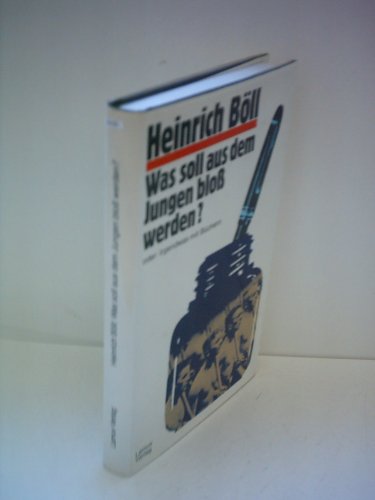
Hebt den Dachbalken hoch, Zimmerleute& Seymour wird vorgestellt - signiert von Böll
Published by Kiepenheuer & Witsch, 1965
ISBN 10: 3921521319 ISBN 13: 9783921521311
Signed
Original-Leinen. Condition: Gut. Dust Jacket Condition: Gut. deutschsprachige Erstausgabe. auf Vorsatz signiert von dem deutschen Schriftsteller und Nobelpreisträger Heinrich Böll ( 1917-85) leichte Gebrauchsspuren. signed by author . Size: 8°. Vom Autor signiert. Buch.
-
THE CATCHER IN THE RYE. Custom Collector's 'Sculpted' Clamshell Case. [Collector's Custom Clamshell case only - Not a book and "no book" included]
Published by Little, Brown & Co.[1951, Book Date], Boston, 1951
Seller: TBCL The Book Collector's Library, Montreal, QC, Canada
Association Member: IOBA
Seller rating 5 out of 5 stars

First Edition Signed
No Binding. Condition: Not A Book. Dust Jacket Condition: Clamshell As New. 1st Edition. 1st Edition. No Binding. Custom Clamshell Case. Excellent Custom Fitted Modern Collector's Clamshell Bookcase [Not A Book] HAND-CRAFTED by our conservation team, each box is Gilt-stamped at the spine, & features a blind embossed [sculpted] red prancing horse design, raised on the upper cover inspired by the first edition DJ's graphics & is finished inside & out in Red & Black Nuba®, a fine, supple & durable covering with a neutral ph that has the feel of velvety soft Italian Nubuck® leather. This clamshell is perfectly sized to accommodate your first edition. A Terrific Collector's Custom Case for an important Book. TBCL Web Site photo/link available for more than 100 generally in-stock titles. Custom Craft available. Book definitely NOT included. CUSTOM CASES available for FRANNY, RAISE HIGH & NINE STORIES. The text can be altered to add "signed" or other special requests. *Also available in Black if requested.
-

Raise High the Roof Beam, Carpenters and Seymour: An Introduction.
Published by Little, Brown and Company, Boston, 1963
First Edition Signed
First edition of this classic collection of two novellas by the author of The Catcher in the Rye. Octavo, original cloth. Presentation copy, signed by the author on the front free endpaper, "with best wishes J.D. Salinger." The recipient was a neighbor and friendly with the author in Cornish, New Hampshire. Very good with dampstaining in a very good price-clipped dust jacket. Housed in a custom half morocco clamshell box by the Harcourt Bindery. Books signed by Salinger are rare, this title exceptionally so and in our experience the most difficult to encounter signed as this was his final published book as he had already withdrawn from publicity. "Raise High the Roof Beam, Carpenters is written with a dazzling, almost showy, technical brilliance. Its dialogue is expert, its satirical comedy amusing, its style fluid and graceful. There can be no question that J. D. Salinger is a finished literary craftsman" (Orville Prescott, The New York Times).
-
'The Catcher in the Rye', US first edition in first state dust jacket, together with an original signed Salinger letter
Published by Little, Brown and Company, 1951
First Edition Signed
US$ 27,656.20
US$ 37.59 shipping
Ships from United Kingdom to U.S.A.Quantity: 1 available
Add to basketHardcover. Condition: Near Fine. Dust Jacket Condition: Near Fine. 1st Edition. Jerome David Salinger (1951) The Catcher in the Rye , US first edition, first printing, published by Little, Brown and Company. Together with an original Salinger letter, signed by him. First issue dust jacket fullfilling all three first issue points: 1) Salinger s photograph appearing slightly cropped on the rear panel; 2) the photograph portrait is credited to Lotte Jacobi; and 3) the $ and 3 of the price is positioned directly above the shoulder of the R. The letter: typed letter signed in full as J.D. Salinger , written to his copy editor John E. Woodman at Little, Brown and Company. Measuring 8.5 inch x 11 inch; on one leaf of watermarked Corrasable Bond paper, R.D. 2, Windsor, VT, dated October 14, 1962. Within, the author acknowledges receipt of page proofs for Raise High the Roof Beam, Carpenters and Seymour: An Introduction . Accompanied by the original transmittal envelope bearing philatelic markings and letter-opened at left. Featuring expected letter folds to typed leaf, with minor creasing throughout. Together with a photocopy of Woodman s original letter to Salinger dated four days earlier describing the proofs as remarkably clean , and praising its contents. Raise High the Roof Beam, Carpenters and Seymour: an Introduction , was the final book-length work of fiction published in Salinger s lifetime. It is comprised of two novellas set seventeen years apart, and are both concerned with Seymour Glass, the eldest son of Salinger s fictional Glass family. Originally published in the New Yorker in 1955 and 1959, the two stories were reprinted as an anthology by Little, Brown and Company in 1963, just months ahead of the present correspondence. Condition of the book: a near fine copy and very close to fine for the harshest of judges. There are no previous owners inscriptions, no stamps, no bookplates. No bumps to the boards, no lean. The lettering on the spine is NOT rubbed out and clearly legible. Endpapers clean. The dust jacket is in amazing condition and one of the best we have ever seen. Crucially, this is in the original state with NO restorations whatsoever. It is not price clipped, clean with no tears, no chips, no rubbing. Light browning to spine commensurate with age and no fading of the red colour. A beautiful copy. The Catcher in the Rye needs no introduction. Being read in schools, it is one of the landmark novels of 20th century American fiction with global sales exceeding one million copies anually. It has defined and captured the timeless mood of teenage existential angst and that is why the novel has retained its fascination to young readers around the globe to date. First and Fine. Signed by Author(s).
-
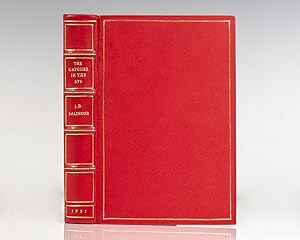
First edition of the author's classic first book. Octavo, bound in full morocco by the Harcourt Bindery with gilt titles and tooling to the spine in five compartments within raised bands, gilt ruling to the front and rear panels, gilt stamped signature to the front panel, gilt ruled inner dentelles stamp-signed by the Harcourt Bindery, marbled endpapers, all edges gilt. In fine condition. An exceptional presentation. Since his debut in 1951 as The Catcher In the Rye, Holden Caulfield has been synonymous with "cynical adolescent." Holden narrates the story of a couple of days in his sixteen-year-old life, just after he's been expelled from prep school, in a slang that sounds edgy even today and keeps this novel on banned book lists. It begins, "If you really want to hear about it, the first thing you'll probably want to know is where I was born and what my lousy childhood was like, and how my parents were occupied and all before they had me, and all that David Copperfield kind of crap, but I don't feel like going into it, if you want to know the truth. In the first place, that stuff bores me, and in the second place, my parents would have about two hemorrhages apiece if I told anything pretty personal about them.".
-
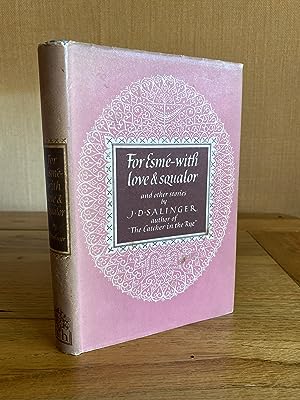
For Esme - with Love and Squalor and Other Stories
Published by Hamish Hamilton, London, 1953
Seller: James M Pickard, ABA, ILAB, PBFA., LEICESTER, United Kingdom
Association Member: ABA ILAB PBFA
Seller rating 5 out of 5 stars
Signed
US$ 1,624.80
US$ 30.88 shipping
Ships from United Kingdom to U.S.A.Quantity: 1 available
Add to basketHard Cover. Dust Jacket Condition: Dust Jacket. (London: Hamish Hamilton Second Impression 1953). Originally published in 1953 this is the second impression from the same year. INSCRIBED BY VIVIEN LEIGH TO JAMES "JIMMIE" GROUT. Publisher's blue boards with gilt lettering to the spine. A VG (or slightly better) copy in a near VG dustwrapper priced 10s 6d net to the inside flap (as called for). The dustwrapper has a few marks, small edge nicks and some spine dulling. With a SUPERB FULL-PAGE INSCRIPTION TO THE FRONT FREE END-PAPER FROM THE ACTRESS VIVIEN LEIGH TO FELLOW ACTOR JAMES GROUT (MOST FAMOUS FOR HIS LONG-STANDING ROLE AS CHIEF-SUPERINTENDENT STRANGE IN INSPECTOR MORSE). Vivien Leigh played one season in Stratford in 1955, and James Grout (1927-2012) acted with Leigh (and her husband Laurence Olivier) in Macbeth at the Shakespeare Memorial Theatre in June of that year. The play was directed by Glen Byam Shaw with Anthony Hopkins as Musical Director. The inscription reads 'For Jimmie - I hope you love this as much as I do - it comes with very much love. Many thankyous for all the happiness of this season at Stratford - Vivien 1955'. The choice of a Salinger title as a gift is interesting, as it is known that Salinger had dinner with Leigh and Olivier when in the UK in 1951. Photographs/scans available upon request. Signed by Author.
-
THE CATCHER IN THE RYE. Signed
Published by Little, Brown & Company, Boston, 1952
Seller: TBCL The Book Collector's Library, Montreal, QC, Canada
Association Member: IOBA
Seller rating 5 out of 5 stars
First Edition Signed
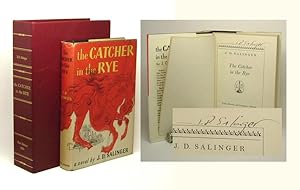
Hardcover. Dust Jacket Included. First Edition. First Edition. Hardcover. Signed by Author. Salinger, J.D. THE CATCHER IN THE RYE. Signed. Boston: Little Brown, 1952. A fine SIGNED copy of the March, 1952 reprint of the first edition. [The first issue was July, 1951]. 8vo., 277pp., black cloth, gilt. Salinger's remarkable first book, neatly signed in black fountain pen at the top of the title page. An excellent example of Salinger's elusive signature - The binding is fine; the dustwrapper very good or better with the $3.00 price present & nine reviews on the back panel replacing Salinger's photo after the first few early printings at his insistence. Custom clamshell case in very fine condition. The probable High Spot in Modern American Lit collecting, "The Catcher In The Rye is undoubtedly a 20th-century classic. It struck a popular note, particularly with young readers, who strongly identified with Holden Caulfield and his yearning for lost innocence. Salinger's novel was, and continues to be, a phenomenal success" (Parker, 300). "This novel is a key-work of the nineteen-fifties in that the theme of youthful rebellion is first adumbrated in it, though the hero, Holden Caulfield, is more a gentle voice of protest, unprevailing in the noise, than a militant world-changer. The Catcher in the Rye was a symptom of a need, after a ghastly war and during a ghastly pseudo-peace, for the young to raise a voice of protest against the failures of the adult world. The young used many voices-anger, contempt, self-pity-but the quietest, that of a decent perplexed American adolescent, proved the most telling" (Anthony Burgess, 99 Novels , 53-4). Signed by Author.
-
[SERBIAN ARTIST BOOK - ONE OF 15 COPIES] Perfektan dan za banana-ribe [A Perfect Day for Bananafish]
Seller: Penka Rare Books and Archives, ILAB, Berlin, Germany
Seller rating 5 out of 5 stars
Signed
Belgrade: self-published, 1980. Oblong quarto (26.4 × 24.3 cm). Original gray letterpress-printed wrappers; [13] leaves of thick stock. With six original acquatint engravings by Gordana Leskovac, under tissue gards. Spine sun-tanned; else very good. Serbian edition of Salinger's "Bananafish", with six original etchings by Gordana Leskovac. The book was printed in 1980 as graduate work at the Book graphic Atelier of Faculty of Applied Arts at Belgrade University (Serbia, Yugoslavia) in the class of late professor and famous Serbian book and graphic artist Bogdan Jovana Kr?ic (1932-2009). This is no. 4 of 15 printed copies, signed by the artist to the colophon. From the estate of Kr?ic, with his own bookplate As of March 2024, not in KVK, OCLC.
-
J.D. Salinger Signed Contract for 'Catcher in the Rye' Translation and Publication Rights into Norwegian
Published by Roslyn Targ Literary Agency, Inc, 1974
Signed
Unknown. Condition: Near Fine. This contract between reclusive author J.D. Salinger and Norwegian publisher J.W. Cappelens Forlag was executed April 29, 1974. Signed by Salinger, it is 2 pages printed and typed on both sides of a single 8.5 x 14 inch leaf. The last three clauses reflect Salinger's insistence on control over the appearance and presentation of his work, prohibiting the publisher from using reviews or any text not by author on the book, nor use his photograph either on the book or in its promotion, and that the cover and jacket must receive the author's approval (which he would refuse if an illustration was employed). In a custom wood frame (20 x 19 inches) with 3-window archival matte, with portrait and printed quote from the text. Upon buyer request, this may be shipped unframed.
-
Typed Letter, signed "Jerry" to Edith Oliver at the New Yorker Magazine
Published by Windsor, Vermont, 1960
Seller: Argosy Book Store, ABAA, ILAB, New York, NY, U.S.A.
Seller rating 5 out of 5 stars
Signed
unbound. Condition: fine. 7 lines, on his usual plain yellow paper, enclosing a polaroid photograph of his children. June 8, [1960]. In the original mailing envelope, dated Windsor, Vermont. "Here's the picture you was kind enough to express interest in. The streaks mean I have a dirty roller.Peggy is not wearing braces; she's biting her lower lip.".
-
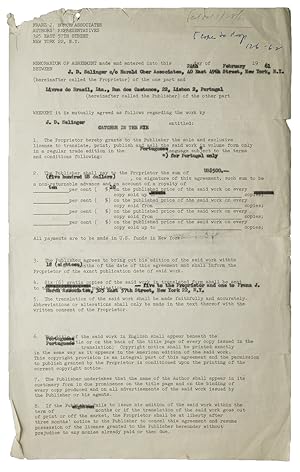
Contract signed ("J.D. Salinger"), granting Portuguese-language publishing rights for The Catcher in the Rye to Livros do Brasil (Lisbon)
Published by New York, 1961
Seller: James Cummins Bookseller, ABAA, New York, NY, U.S.A.
Seller rating 5 out of 5 stars
Signed
2 pp recto and verso, printed contract completed in type carbon, countersigned by publisher's representative and two witness, a few ink and pencil annotations. Folio. A signed copy of the contract for the Portuguese-language rights of The Catcher in the Rye, made between Salinger and the Lisbon publisher Livros do Brasil, ten years after the book's original publication. Rights are granted for publication in Portugal only, and do not extend to Brazil. The Portuguese edition was published under the title Uma Agulha no Palheiro (A Needle in the Haystack), in a translation by João Palma-Ferreira. A Brazilian edition appeared in 1965 under the title O Apanhador no Campo de Centeio (The Catcher in the Rye), which differed substantially from the Lisbon edition. Single sheet standard printed contract of Franz J. Horch Associates, Author's Representatives. Old folds, wear at upper left margin, a few tiny edge tears 2 pp recto and verso, printed contract completed in type carbon, countersigned by publisher's representative and two witness, a few ink and pencil annotations. Folio. Signed.
-
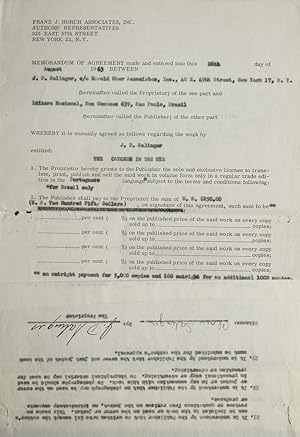
Contract signed ("J.D. Salinger"), granting Portuguese-language publishing rights for The Catcher in the Rye to Editora Nacional (São Paulo)
Published by New York, 1963
Seller: James Cummins Bookseller, ABAA, New York, NY, U.S.A.
Seller rating 5 out of 5 stars
Signed
2 pp recto and verso, printed contract completed in type carbon, with stapled quarter sheet addendum bearing ink signatures of Salinger and Claire Salinger (as witness). Folio. A signed copy of the contract for the Portuguese-language rights of The Catcher in the Rye, made between Salinger and the Brazilian publisher Editora Nacional, twelve years after the book's original publication. Rights are granted for Brazilian publication only, and do not extend to Portugal or the rest of Europe. The final three provisions on the contract, which appear as a stapled addendum, testify to Salinger legendary control over his image, stipulating that "no reviews or quotations from reviews" and "no introductory comments or prefaces" be used on the jacket; that "no photograph may be used on the cover or jacket or in any connection with this book," and that "no biographical material may be used for promotion or advertising"; and finally that "the cover and dust jacket of the book must be submitted for the author's approval." The contract is signed by Claire Salinger, the author's second wife, as witness. The Brazilian edition appeared in 1965 under the title O Apanhador no Campo de Centeio (The Catcher in the Rye), in a joint translation by Álvaro Alencar, Antônio Rocha e Jório Dauster. This differed substantially from the edition brought out in Portugal under the title Uma Agulha no Palheiro (A Needle in the Haystack). Single sheet standard printed contract of Franz J. Horch Associates, Author's Representatives. Old folds, a few small pinholes 2 pp recto and verso, printed contract completed in type carbon, with stapled quarter sheet addendum bearing ink signatures of Salinger and Claire Salinger (as witness). Folio. Signed.
-
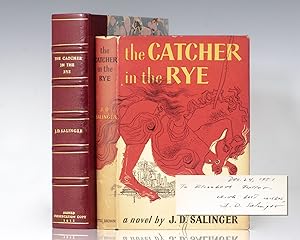
Early printing, printed in the year of publication of the author's classic novel. Presentation copy, inscribed by the author in the year of publication on the front free endpaper, "December 24, 1951 To Elizabeth Fueller- with best wishes J.D. Salinger." Salinger's signature is scarce and signed examples of The Catcher in the Rye are rare. Very good in a very good supplied dust jacket. Jacket design by Michael Mitchell. Photograph of Salinger by Lotte Jacobi. Housed in a custom half morocco clamshell box made by the Harcourt Bindery. Exceptionally scarce, most rare and desirable inscribed and in the year of publication. Since his debut in 1951 as The Catcher In the Rye, Holden Caulfield has been synonymous with "cynical adolescent." Holden narrates the story of a couple of days in his sixteen-year-old life, just after he's been expelled from prep school, in a slang that sounds edgy even today and keeps this novel on banned book lists. It begins,"If you really want to hear about it, the first thing you'll probably want to know is where I was born and what my lousy childhood was like, and how my parents were occupied and all before they had me, and all that David Copperfield kind of crap, but I don't feel like going into it, if you want to know the truth. In the first place, that stuff bores me, and in the second place, my parents would have about two hemorrhages apiece if I told anything pretty personal about them.".
-
Two typed letters, signed "xx JDS" and "JDS", to poet Celia Bland, 17 May and 26 August 1985
Published by Windsor, VT, 1985
Seller: James Cummins Bookseller, ABAA, New York, NY, U.S.A.
Seller rating 5 out of 5 stars
Signed
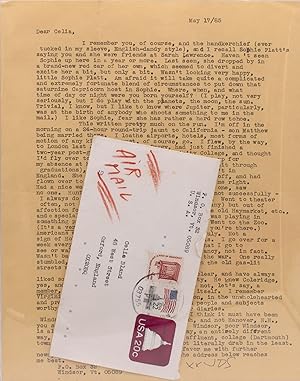
3 pages (279 x 216 and 216 x 140 mm) on yellow typing paper, signed, addressed to Celia Bland in Oxford, England, and Northeast Harbor, Maine. 4to. J. D. Salinger first met poet Celia Bland when she was an undergraduate at Sarah Lawrence College with a friend who lived near Salinger in New Hampshire. "Where, when, and what time of day or night were you born .? (I play, not very seriously, but I do play with the planets, the moon, the sun. Trivial, I know, but I like to know where Jupiter, particularly, was at the birth of anybody who shoots something to me in the mail.)" In the 1970s Salinger wrote a story about an astrologer, and his research made him into an enthusiast who drew up the charts of his family and friends. Salinger goes on to say he is traveling shortly to attend his son Matthew's wedding. "I loathe airports, hotels, most forms motion of any kind." He then relates a misadventure in trying to visit his daughter Peggy in England, only to discover she had gone to the U.S. for a few days: "Had a nice week in London alone anyway. Phoned no one, saw no one. Hunted down some out-of-print books, but not successfully - I always do better, best, in Boston on old books. Went to theater often, not out of love for the Theater (haven't any) but out of affection for the physical theater in London - the old Haymarket, etc., and especially the tiny theater where Leo McKern was playing in something pretty awful. Walked, bus'd, taxi'd. Went to Zoo. Not a sign of Holmes, anywhere, but then there never is. I go over for a week every couple of years or so, but most of what I go to see or walk past existed solely in fiction or fancy, not in fact. Wasn't bad at all, though, in blackouts during the war. One really stumbled, bumped into things, but really, as in the old gas-lit streets when the fog rolled in." Turning to literature, Salinger muses on Hazlitt: "He's sharp, clear, and have always liked something about his personal unpopularity. He knew Coleridge, yes, and probably the Wordsworths, but he was not, let's say, a member, and I find that rather commending in itself. I remember Virginia Woolf wrote about him with admiration, in the unwholehearted and practical way she bestowed admiration on people and subjects worthy of grist for her essays or letters or diaries." Slawenski says that Salinger had intended to visit a number of people in London, but "spent the week alone in his London hotel room," an account disputed by this letter to Bland. By 1985 his mail had become an ordeal for him, and lack of a response to letters from close friends like E. Michael Mitchell, were excused, when they were at all, by his commitment to his work, his "assignment." He describes something similar to Bland, whom he nevertheless found time to write. As he explains in the second letter: "The truth be told, I am, at least as far as I'm able or permitted by the people who send out bills, making a stab at withdrawing from the mails entirely. Have even considered printing a small announcement to that effect in some publication that everybody reads, like Woodman of the World or The Canadian Needlewoman. It's mainly that I'm seated here at work most of the day and a fair part of the night, and then another couple of hours just trying to reduce the little pile of unanswered letters, bills, etc., and have decided to leave off for a year or two." Celia Bland is a poet and the Associate Director of the Bard Institute for Writing and Thinking. Cf. Slawenski, J.D. Salinger, A Life, 2010, p. 384-8 Light horizontal and vertical folds. Typed envelopes. Housed in a half blue morocco clamshell case 3 pages (279 x 216 and 216 x 140 mm) on yellow typing paper, signed, addressed to Celia Bland in Oxford, England, and Northeast Harbor, Maine. 4to. Signed.
-
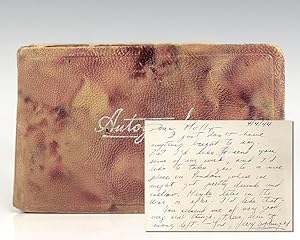
Scarce autograph note signed by J.D. Salinger on April 4, 1944, two months and two days before he saw combat at Utah Beach on D-Day. One page from an oblong octavo autograph album bound in full leather, the note is dated 4/4/44 and reads, "Dear Molly - I just don't have anything bright to say. But I'd like to send you some of my work, and I'd like to take you to a nice place in London where we might get pretty drunk and mellow. Maybe later in The War or after. I'd like that. You remind me of very real things. There aren't many left. - Love, Jerry Salinger." The recipient, Molly Bocock was stationed at the School for Military Intelligence in Smedley's Hydro, Matlock, Derbyshire where she befriended a number of American servicemen training at the school, including Salinger, then a young writer who had submitted several short stories to The New Yorker, all of which were rejected with the exception of his Manhattan-set story, Slight Rebellion off Madison, about a disaffected teenager named Holden Caulfield with "pre-war jitters". Salinger was drafted into the army in the spring of 1942, several months after the United States entered World War II, where he saw combat with the 12th Infantry Regiment, 4th Infantry Division. He was present at Utah Beach on D-Day, in the Battle of the Bulge, and the Battle of Hürtgen Forest. During the campaign from Normandy into Germany, Salinger arranged to meet with Ernest Hemingway, who was then working as a war correspondent in Paris. The meeting had a profound effect on Salinger and the development of his writing style; Hemingway was impressed by what Salinger shared with him of his early writing and the two corresponded frequently throughout the war. Salinger was later assigned to the 4th Counter Intelligence Corps in which he used his proficiency in French and German to interrogate prisoners of war and later witnessed the liberation of one of the Dachau Concentration Camps. Salinger continued to write and submit stories to the New Yorker throughout his wartime years, which would have a lasting effect on his life and writing. It was not until 1952 that Salinger's first, and best-known, work The Catcher in the Rye was published to mixed initial reactions. The autograph album includes several additional signatures and inscriptions from American servicemen training at the School for Military Intelligence as well as a number of signatures from guests at the Cumberland Hotel, including the signature of Beverley Nichols. Laid in is a newspaper clipping from the March 5, 1968 issue of the Evening Standard featuring a book review of Salinger's Raise High the Roofbeam, Carpenters and Seymour, An Introduction by Richard Lister. An exceptional note, signed by Salinger at a pivotal time in his life, before the wartime experiences that would plague him later in life and contribute to his withdrawal from society. Best-known for his novel The Catcher in the Rye, American author J.D. Salinger published several short stories and five books throughout his lifetime. In a contributor's note Salinger gave to Harper's Magazine in 1946, he wrote: "I almost always write about very young people," a statement that has been referred to as his credo. Adolescents are featured or appear in all of Salinger's work, from his first published short story, "The Young Folks" (1940), to The Catcher in the Rye and his Glass family stories. In 1961, the critic Alfred Kazin explained that Salinger's choice of teenagers as a subject matter was one reason for his appeal to young readers, but another was "a consciousness [among youths] that he speaks for them and virtually to them, in a language that is peculiarly honest and their own, with a vision of things that capture their most secret judgments of the world." For this reason, Norman Mailer once remarked that Salinger was "the greatest mind ever to stay in prep school.".
-

Franny and Zooey
Publication Date: 1961
Seller: Bauman Rare Books, Philadelphia, PA, U.S.A.
Association Member: ABAA ILAB PBFA
Seller rating 4 out of 5 stars

First Edition Signed
First Edition. "SALINGER, J.D. Franny and Zooey. Boston: Little, Brown, (1961). Octavo, original gray cloth, original dust jacket. Housed in a custom chemise and clamshell box. $150,000.First edition of Salinger's third book, presentation/association copy, inscribed by him to his close friend Lillian Ross, staff writer at the New Yorker, "To Lillian, with love and great and special pleasure. Jerry Cornish, N.H. 7/29/61." Inscribed copies of Salinger's books are notoriously rare, and the close association this copy has with Salinger makes it particularly desirable.Salinger planned a series of stories on Franny, Zooey and the Glass family. "I've been waiting for them most of my life," he wrote, "and I think I have fairly decent, monomaniacal plans to finish them with due care and all-available skill." "Franny" originally appeared in The New Yorker in 1955; "Zooey" followed two years later. To John Updike, "Salinger's conviction that our inner lives greatly matter peculiarly qualifies him to sing of an America where, for most of us, there seems little to do but to feel" (New York Times). Stated "First Edition" on copyright page. Salinger met Lillian Ross through New Yorker editor William Shawn, to whom Salinger dedicated Franny and Zooey. Out of Shawn's faith in Salinger's workShawn would publish 13 Salinger stories between 1946 and 1965grew a great and close friendship, one Shawn shared with Ross in 1957 when she sought to send Salinger a letter in praise of "Zooey." The two traded fan lettersher letter on "Zooey" led to Salinger's on her Hemingway profileinaugurating a friendship that lasted through many publications by each author, occasional dinners and family visits, and many epistolary exchanges for decades on topics literary, professional and personal. In 1965, Salinger wrote a 3-page legal affidavit supporting Ross' efforts to adopt a child; both Salinger and Shawn were co-godfathers to Erik, the son she adopted. In her memoir Here But Not Here, Ross writes of her working life and love life with Shawn: "When it comes to writing, along with what Bill taught me, I've learned the most from Salinger. He's one of the best we've ever had." She noted that "Of all the scores of writers Bill dealt with over the years, including some that were old friends, only Salinger would go out of his way to be helpful to Bill without asking for anything in return.Ross wrote to Salinger to thank him for this inscribed copy: "I've been carrying the book all over town with me since it arrived this morning. It's perfect, naturally, inside and out The jacket looks terrificthere's no way of talking about it; it's too good. What you say on it should hold a lot of people up for a long time, even if 'distinguished' fellows here and there try to put a little carbon monoxide back into the fresh air. I cherish the inscription. In fact, things are looking up all over, it makes it seem, now that the book is here. I'm going to read it backwards. Thank you and bless you and Love, Lillian." Stated "First Edition" on copyright page. Bixby A4a. Starosciak A40. Bruccoli & Clark I:315.Book and jacket with very mild toning to extremities, jacket with a bit of soiling to rear panel. Near-fine condition.". Signed.
-
J.D. Salinger Exceptional Typed Letter Signed on His Personal Beliefs of Truth, Friendship, and Discussing the Boarding School That Inspired Catcher in the Rye" "I went to an awful, fourth-class boarding school. it couldn't have been worse, but it was full of misfits, kids that didn't fit in "
Publication Date: 1972
Seller: Max Rambod Inc, Woodland Hills, CA, U.S.A.
Association Member: ABAA ILAB PADA
Seller rating 5 out of 5 stars
Manuscript / Paper Collectible Signed
[Literature] Salinger, J.D. American author of Catcher in the Rye. Typed letter signed from Salinger to his friend Eileen Paddison. January 25, 1972. One page, typed on Salinger's characteristic goldenrod paper, signed boldly in ink at the foot: "Love to you, Eileen - Jerry." A letter chronicling friendship between Salinger and Paddison, in which Salinger relates to their "sameness", and provides personal insight on subjectivity and "truth". Salinger would characterize the relationship between himself and Eileen in 1975 as one between "a brother or sister, or some kind of close blood relative anyway", one born of warmth and mentorship which mirrored the sibling bond of Holden and Phoebe Caulfield and Franny and Zooey Glass. A deeply personal letter from J.D. Salinger to Eileen Paddison, written just weeks after their correspondence began in late 1971. At this point Paddison was a young college student and aspiring writer who had approached Salinger about Zen, Taoism, and the spiritual questions embedded in Franny and Zooey, themes that had become central to his private life. This January 1972 letter is one of the earliest to survive from their remarkable epistolary friendship. Exceptionally, Salinger closes this letter with "Love to you," a warmth he very rarely expressed in writing and almost never in letters to non-family. Its presence here, so soon after their acquaintance, testifies to the immediate and unusual closeness he felt toward Paddison. The letter features Salinger's characteristic blend of humor, candor, private philosophy, and autobiographical detail. Reflecting on the "sameness" between himself and Eileen, a theme that would only deepen over their years of correspondence, he writes: "Oh, God, life is full of some pretty funny stuff off and on. And there are moments, I have a notion, when there are echoes of sameness between us, maybe having to do with our matching awkward 'background'. Who do little kids who are self-described "best friends" do?.a form of narcissism, in a real sense, but more complicated than that." He discusses Taoist and Zen inflections in his thinking through an anthropological lens, mentioning beauty standards in other nations, he questions "Is there any possibility of "truth" in this world when vantage points and reasoning powers depend so heavily on conditioning, heredity, culture, language, geography, etc.? Almost none." The sense of epistemological skepticism, of truth mediated through perception, echoes the teachings of Taoist thinkers such as Chuang-tzu, whose relativistic parables informed Salinger's later spiritual worldview. Salinger's reflections on academia in this January 1972 letter reveal how quickly he perceived in Eileen Paddison a biographical and emotional mirror, grounded in their shared experience of feeling like outliers within educational institutions rather than beneficiaries of them, and this recognition is inseparable from the imaginative terrain of The Catcher in the Rye. His recollection-"I went to an awful, fourth-class boarding school. it couldn't have been worse, but it was full of misfits, kids that didn't fit in anywhere"-closely parallels Holden Caulfield's scathing assessments of Pencey Prep, where hypocrisy, cruelty, and emotional vacancy define the school environment and leave Holden drifting between expulsion and psychic collapse. Salinger's own progression from a series of unhappy boarding schools to the Valley Forge Military Academy, with its emphasis on regimentation, surveillance, and obedience, provided the experiential core for Holden's alienation: the sense that schools function less as places of moral development than as systems designed to enforce conformity and punish sensitivity. In the letter, Salinger's observation that "If one's going to be away at school or in prison or in the Army, it's only fair that a few congenial types be around" echoes Holden's repeated longing for authentic human connection amid institutional emptiness-whether in hi. Signed.
-
Typed Letter Signed.
Publication Date: 1977
Seller: Moroccobound Fine Books, IOBA, Lewis Center, OH, U.S.A.
Association Member: IOBA
Seller rating 5 out of 5 stars
Manuscript / Paper Collectible Signed
No Binding. Condition: Fine. Typed letter signed "JDS" and dated December 4, 1977, measuring 8.5 x 11 inches. With original mailing envelope postmarked White River Junction, VT (where Salinger got his mail). Here the reclusive author declines an interview. Signed by Author(s).
-
![Seller image for J.D. Salinger on His Guiding Philosophy: "It's a tremendously tall order, an undertaking seemingly more beautiful and more real in the mind's eye than in actual practice [.] The taoist feat is to know at all times that there is nothing that isn't shit-- but also, and more difficult, nothing that is." for sale by Max Rambod Inc](https://pictures.abebooks.com/inventory/md/md31237506942.jpg)
J.D. Salinger on His Guiding Philosophy: "It's a tremendously tall order, an undertaking seemingly more beautiful and more real in the mind's eye than in actual practice [.] The taoist feat is to know at all times that there is nothing that isn't shit-- but also, and more difficult, nothing that is."
Publication Date: 1972
Seller: Max Rambod Inc, Woodland Hills, CA, U.S.A.
Association Member: ABAA ILAB PADA
Seller rating 5 out of 5 stars
Manuscript / Paper Collectible Signed
Salinger, J.D. American author of Catcher in the Rye. Typed letter signed "JDS". 1972. Written during his extended correspondence with Eileen Paddison, this two-page letter offers sustained reflection on Taoist philosophy as a lived discipline rather than abstract doctrine. Salinger frames himself as "a cluttered man.writer, parent, chauffeur, cook, snow-remover," grounding spiritual inquiry within daily life. Typed letter signed "JDS".February 24, 1972, two pages. Addressed to to Eileen Paddison, a close friend and aspiring writer who maintained a correspondence with Salinger over 10 years. An archive revealing the Taoist philosophical underpinnings of Saliner's iconic critique of the American bourgeois life-style. In 1977, Gerald Rosen authored an entire book on the Zen and Buddhism influence on Salinger work, Zen in the Art of J. D. Salinger, analyzing Buddhism concepts and phrasing in The Catcher in the Rye, Franny & Zooey, and also his other short stories. In these letters, Salinger goes into detail about exactly what it is in Taoist practice he finds so compelling. American Author J.D. Salinger built his canon with novels starring hungry young truth-seekers, dissatisfied with the materialism and soullessness of upper middle-class American life. He was intensely averse to the fame that met his work, refusing to do the usual press-circuit. Therefore, it's personal letters like these which can give us a window into the philosophy behind famous works like Catcher in the Rye, Nine Stories, and Franny and Zooey. Salinger begins the 1972 letter by imploring Eileen to "See me as I am, a cluttered man-- writer, parent, chauffeur, cook, snow-remover, unreliable letter writer" and states further that "If I'm to be liked, at all, I think I'm best liked only slightly or intermittently." Another descriptor for that list: Taoist. Salinger's intense devotion to honesty and truth, and his extreme aversion to anything "phony", made the neutral balance of Taoism something aspirational and extremely challenging: "You say you certainly haven't been living Taoism. You know, of course, that it's no easy way to live. Probably Lao-tse and Chaang-tse themselves were better at writing about it than living it." Salinger craved the kind of relief from artifice that Taoist belief promises, but doubted it could really be experienced: "It's a tremendously tall order, an undertaking seemingly more beautiful and more real in the mind's eye than in actual practice. The task, I think, is to stay close to Taoism in affection, if not in practice, at all times, for life. It's possible, probably, that an effort should be made to screen most of the things that happen to oneself through Taoist thought. I know that I usually fall into a kind of unhappiness, depression, If I let my complicated daily life alienate me too far from Taoist values and non-values." Finally, Salinger writes about what it is exactly in taoism that's so compelling and so difficult for him; namely, relief from the need to evaluate what's authentic or not, but to simply live inherently free of pretentiousness or falsity: The taoist feat is to know at all times that there is nothing that isn't shit-- but also, and more difficult, nothing that is. To hold those mutually eliminating realities in the head at the same time, and yet not (by some small miracle that is no miracle at all) allow them to eliminate each other." These ideas are rooted deeply in Salinger's personal life as well as his writing. In an earlier letter from 1971, Salinger writes that there is "probably no richer or better stuff in all of Eastern philosophy" than taoism. His scholarship is obvious here-- he mentions a preferred translation by Legge, calling it "the very heart of Zen Buddhism [.] "what marvelous things, thoughts, all of them" and admits that though "there's something wrong in sticking to one subject for too long [.] the Tao itself, though, is the kind of subject that stands outside thinking and non-thinking, and. Signed.


![Seller image for THE CATCHER IN THE RYE. Custom Collector's 'Sculpted' Clamshell Case. [Collector's Custom Clamshell case only - Not a book and "no book" included] for sale by TBCL The Book Collector's Library](https://pictures.abebooks.com/inventory/md/md22814719059.jpg)


![Seller image for [SERBIAN ARTIST BOOK - ONE OF 15 COPIES] Perfektan dan za banana-ribe [A Perfect Day for Bananafish] for sale by Penka Rare Books and Archives, ILAB](https://pictures.abebooks.com/inventory/md/md31820685785.jpg)