
Salmasius C (11 results)
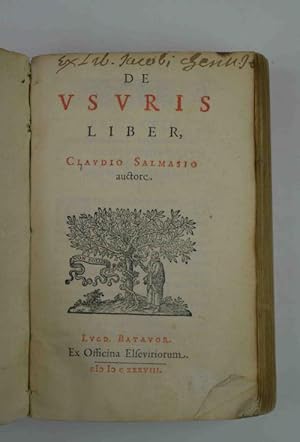 More images
Published by ex Officina Elseviriorum,, Lugd. Batav., 1638
- Hardcover
Seller: Studio Bibliografico Benacense, riva del garda, TN, ItalyStudio Bibliografico Benacense
Contact seller5-star sellerCondition: Used
US$ 605.99
US$ 50.07 shippingShips from Italy to U.S.A.Quantity: 1 available
hardcover. Condition: Buono (Good). Cm. 15,5, pp. (56) 686 (72) + 1 cb. Frontespizio in rosso e nero con marchio tipografico inciso. Leg. coeva in perg. molle e titoli ms. al dorso. Una piccola mancanza alla base del dorso e qualche traccia d'uso, ma bell'esemplare, genuino e marginoso. Edizione originale, non comune, di questo…trattato il cui fine è giustificare la legittimità del prestito sottomesso ad interesse. Cfr. Kress 536; Einaudi 5085 e Willems 471. Book.
 More images
Epitome altera Historiae Romanae
FLORUS L. Annaeus. CL. SALMASIUS. addidit Lucium AMPELIUM. E cod. M. S. nunquam antehac editum.
Published by Lugd. Batav. Apud I. Elzevirium. 1657
- Hardcover
Seller: H. PICARD ET FILS, depuis 1902, PARIS, , FranceH. PICARD ET FILS, depuis 1902
Contact seller5-star sellerCondition: Used - Fine
US$ 937.70
US$ 34.14 shippingShips from France to U.S.A.Quantity: 1 available
Couverture rigide. Condition: Tràs bon. In-8 (13 x 8 cm), frontispice, 3 ff. 336 pp., 8 pp. index, reliuredu XIXe sià cle maroquin bleu-marine, dos ornà de filets, encadrements de filets et dentelles sur les plats, les coupes et intà rieurs, tranches dorà es. Ex-libris "de Boigne". Exemplaire en bel à tat.

Published by s.n.,, Sumptibus regiis, 1649
Seller: Studio Bibliografico Benacense, riva del garda, TN, ItalyStudio Bibliografico Benacense
Contact seller5-star sellerCondition: Used
US$ 167.61
US$ 50.07 shippingShips from Italy to U.S.A.Quantity: 1 available
Cm. 12,5, pp. 468. Leg. coeva in perg. con titoli ms. al dorso. Restauro al frontespizio che non interessa il testo, qualche sottolineatura, peraltro esemplare ben conservato. Opera del Salmasio (1588-1653) scritta su richiesta esplicita di Carlo II allo scopo d'approntare un'apologia del padre Carlo I. Ne scaturirono violente p…olemiche che portarono ad una forte risposta di John Milton cui fece seguito un'ulteriore presa di posizione del Salmasio. Lo scontro dialettico suscitò notevole interesse tanto che Voltaire ne parla nel Secolo di Luigi XIV. Contraffazione della seconda edizione elzeviriana che vide la luce contemporaneamente all'originale in folio. Cfr., per l'originale elzeviriano, Willems, 658.
- Hardcover
- Signed
Seller: A. Gerits & Son b.v., Diemen, , NetherlandsA. Gerits & Son b.v.
Contact seller5-star sellerCondition: Used
US$ 527.46
US$ 19.91 shippingShips from Netherlands to U.S.A.Quantity: 1 available
No place, Sumptibus regiis, (Leyde, Bonaventura et Abraham Elzevier) 1649. (2), 720 pp. 12mo. 19th-century calf, gilt floral ornaments on sides, spine gilt with gilt lettering, gilt inside dentelles, all edges gilt, binding signed at foot of spine: Bozerian jeune. Lalanne, Dictionnaire Historique de la France, vol. ii, p. 1637;…Willems 658; Graesse, Tresor des Livres Rares et Precieux, vi, 249; not in BMSTC, French Books 1601-1700. One of various editions published in the year as its original publication in folio which was also published by the Elzeviers, and often reprinted. This is the work by which Salmasius is best remembered. It does not appear by whose influence he was induced to undertake the Defensio Regia, but Charles II defrayed the expense of printing, and presented the author with £ 100. The work provoked the famous reply by Milton Pro populo Anglicano defensio, contre Claudii anonymi, alias Salmasii, defensionem regiam. 'Claude Saumaise (1588-1658), l'un des plus célèbres érudits et critiques du XVIIe siècle. Il embrassa le protestantisme, alla s'établir à Leyde (1631), où il succéda comme professeur à Joseph Scaliger. Appelé en Suède par Christine, près de laquelle il séjourna un an, il retourna en Hollande. Sa réputation était immense parmi ses contemporains .' (Lalanne, op.cit). - Very nice copy in a binding by Bozerian the Younger.
 More images
Published by London (Londoni), Typis Tho. Roycroft, Impensis Jo. Martin (etc.), 1660. 1660
Seller: Antiquariaat Fragmenta Selecta, AMSTERDAM, , NetherlandsAntiquariaat Fragmenta Selecta
Contact seller5-star sellerCondition: Used
US$ 615.37
US$ 27.31 shippingShips from Netherlands to U.S.A.Quantity: 1 available
12mo. (IV),304,(4 blank) p. Contemporary calf. 16 cm (Ref: ESTC Citation No. R203484; Wing (2nd ed.) S736; Ebert 14095) (Details: Double blind fillet on back and boards. Red shield with gilt lettering in the second 'compartment') (Condition: Binding scuffed(Photographs on request) . Head of the spine damaged. First pastedown det…ached, pastedown at the end removed) (Note: The English Civil War (1642-1651) was a series of armed conflicts between Parliamentarians and Royalists, who supported King Charles I. The war ended with a Parliamentarian victory in 1651. The climax of the Civil War was the trial and execution of King Charles I on January 30, 1649. The monarchy was replaced with a Republic form of government, first the Commonwealth of England (1649-1653), and then the Protectorate under the rule of the dictator Oliver Cromwell, who died in 1658, and his son (1653-1659). Charles II, son of Charles I, went in exile. Cromwell's death in 1658 resulted in a political crisis, which led to the restoration of the monarchy, when the English Parliament resolved to invite the son of Charles I to return. He was proclaimed King in May 1660. § In November 1649, 10 months after the beheading of Charles I, the French classical scholar Claudius Salmasius (Claude Saumaise, 1588-1653), who was professor at the University of Leiden, published at the request of the 19 years old king in exile Charles II a 'Defensio Regia pro Carolo I' (In defence of King Charles I). On the title page Charles II is called 'heredem et successorem legitimum'. It was brought on the market anonymously, and 'sumptibus regiis', by Elsevier at Leiden. The exiled King paid for the printing and rewarded Salmasius with £ 100. It is a defence of absolute monarchy and a fierce condemnation of the English Parliamentary system. § The 'Defensio Regia pro Carolo I' came as a bombshell and provoked in 1651 a scathing reply from the English poet and polemist John Milton, 'Pro Populo Anglicano Defensio' (A Defense of the People of England). Milton, who was appointed under Cromwell 'Secretary for Foreign Tongues' in 1649, was responsible for the Republic's foreign correspondence in Latin, but it was also his task to produce propaganda for the new regime. Milton was ordered by the Council of State to write the 'Defence of the English People', to establish its legitimacy. In this work full of learned vituperation, Milton alludes to Salmasius' effeminacy, comparing him with the Greek mythological Hermaphrodite Salmacis, and he also attacks his wife, Anne Mercier, who wore, that was true, the trousers. The pure Latin prose and the evident learning made Milton's name in Europe. The English philosopher Thomas Hobbes, a contemporary, observes concerning both 'Defences': 'They are very good Latin both, and hardly to be judged which is better; and both very ill reasoning, hardly to be judged which is worse; like two declamations 'pro' and 'con', made for exercise only in a rhetoric school by one and the same man'. (Hobbes, Behemoth, Dialogue IV) Hobbes' opinion of this learned controversy is devastating: 'Where Europe thought it had witnessed the sharpest possible contest of principle between an opponent of regicide on one side and a defender of it on the other, Hobbes saw unwitting collusion between twin offpspring of the Reformation. (.) Nor is the remark about the excellence of their Latin offered in mitigation. On the contrary, it is intended to aggravate their offence. (.) Milton and Salmasius are condemned for exhibiting the (.) lethal combination of attributes: eloquence and ill reasoning'. (M. Dzelzainis, 'Milton's classical republicanism' in 'Milton and Republicanism', Cambridge 1995, p. 7) § Salmasius prepared a reply (responsio) to Milton, but he did not live to finish it. It was published posthumously by his son at Dijon in 1660, a few months after the restoriation of Charles II, and reissued at London in September of the same year) (Collation: A-N12 (leaves N11 & N12 blank)) (Pho.
 More images
Published by Leiden (Lugduni Batavorum), Ex typographia Adriani Wyngaerden, 1656. 1656
Seller: Antiquariaat Fragmenta Selecta, AMSTERDAM, , NetherlandsAntiquariaat Fragmenta Selecta
Contact seller5-star sellerCondition: Used
US$ 761.88
US$ 27.31 shippingShips from Netherlands to U.S.A.Quantity: 1 available
4to. (VIII),72;294,(2 privilegium); 67,(3); 77,(3 blank) p. Overlapping vellum 24 cm (Ref: STCN ppn 840276850; Brunet 6,18777; Ebert 20119; Graesse 6/1,249) (Details: Nice and clean copy. Woodcut printer's device on the title, depicting a man who tries to clime a tree, the motto reads: 'Ardua quae pulchra', a variant of the well…known Platonic Adagium of Erasmus 'Difficiliora quae pulchra'. (Adagia 1012,II,I,12) Beautiful engraved portrait of Salmasius, executed and engraved by J. Tangena and I. Snijderhoef. Woodcut initials. At the end of p. 294 has been pasted a slip with 15 lines of corrigenda) (Condition: Vellum age-toned. Back soiled) (Note: The French scholar Claude de Saumaise, latinized Claudius Salmasius, 1588-1653, was a prolific author, and he distinguished himself in his editions as a textual critic and erudite commentator. He was easy to get along with, but murderous on paper. In 1623 he was appointed as the successor of Scaliger at the University of Leiden, a city he was going to hate. When his Leiden colleague Daniel Heinsius, 1580-1655, published his 'Sacrae Exercitationes ad Novum Testamentum' in 1639, Salmasius saw an opportunity to take 'revenge on the man he viewed as the leader of the coterie opposing him at Leiden'. (P.R. Sellin, 'Daniel Heinsius and Stuart England', Leiden/Oxford 1968, p. 43) In the preface of his 'De Modo Usurarum' of 1639 Salmasius ridiculed Heinsius' description of the 'koinê' as 'lingua Hellenistica'. A flurry of polemics followed. In this quarrel the printer Maire sided with Salmasius in his attempts to destroy Heinsius' integrity. (Idem, p. 47) The next step in the ongoing quarrel between Daniel Heinsius, once the favourite of Scaliger, and Salmasius, came in 1643, when Salmasius attacked Heinsius anonymously in his 'Funus linguae Hellenisticae'. And with a still fiercer attack in 'De Hellenistica commentarius, controversiam de lingua Hellenistica decidens', published in the same year, 1643, Salmasius mounted a full-scale assault on Heinsius' position on the 'koinê'. In it Salmasius contended that the language of the Greek Scriptures was not a separate dialect, but the ordinary Greek of his time. (Sandys, A History of Classical Scholarhip, N.Y., 1964, volume 2, 284/86) § The letters of Salmasius were collected and edited by the young promising Dutch student theology Anthony Clement (Antonius Clementius), 1533-1657. (NNBW 1,606/07, and his article in encyclopedievanzeeland.nl) The collection, consisting of 125 letters written before 1638, opens with a biographic eulogy and a bibliography of Salmasius of 72 pages. The recipients of the letters are amongst others Johannes Beverovicius, Johannes Dallaeus, Jacobus Golius, J.F. Gronovius, H. Grotius, I.F. Peireskius, P. Puteanus, and I.G. Vossius. At the end of the 125th letter (p. 294) the editor announces a second volume of letters, till 1640. The project was however delayed, he tells, due to the sudden departure to Germany of the publisher Wyngaerden. Nothing came of it, owing to the premature death of the editor. § The editor added after letter 125 two long treatises disguised as letters: Salmasius' 'Epistola de regionibus et ecclesiis suburbicariis', first published in 1619; and 'Claudii Salmasii ad Aegidium Menagium epistola, super Herode infanticida V.C. Tragoedia, et censura Balsacii'. This second letter is of interest concerning Salmasius controversy with Heinsius. It was first published in Paris in 1644, and is a polemic against Daniel Heinsius', biblical tragedy 'Herodes infanticida' (the Massacre of the Innocents), a tragedy that he published in Leiden in 1632. This tragedy was attacked in 1636 by the French polemicist, poet and literary theoretician J.-L. Guez de Balzac; and in 1642 a French minister, Jean de Croï, published a reaction on Balzac's fierce attack in defence of Heinsius. Which reaction lead to a long letter, written by a raging Salmasius, to the French poet and classical scholar Gilles Ménage (Aegidius Menagius).
 More images
Published by Leiden (Lugduni Batavorum), Ex officina Ioannis Maire, 1643. 1643
Seller: Antiquariaat Fragmenta Selecta, AMSTERDAM, , NetherlandsAntiquariaat Fragmenta Selecta
Contact seller5-star sellerCondition: Used
US$ 732.58
US$ 27.31 shippingShips from Netherlands to U.S.A.Quantity: 1 available
8vo. 390,(1 corrigenda),(1 blank) p. Vellum. 8vo. 16.5 cm. (Ref: Breugelmans 1643:10; Graesse 6,249; Berghman 704; Rahir 1920; Ebert 20118; Brunet 6, no. 10665; cf. Willems 558) (Details: 5 thongs laced through the joints. Woodcut printer's mark of Maire on the title, depicting a farmer who stamps a shovel into the ground; above… his head the motto 'fac et spera'. Page 1-280: Funus Linguae Hellenisticae, page 281-390: Ossilegium Hellenisticae) (Condition: Vellum age-toned. One gathering foxed) (Note: The French scholar Claude de Saumaise, latinized Claudius Salmasius, 1588-1653, was a prolific author, and he distinguished himself in his editions as a textual critic and erudite commentator. He was easy to get along with, but haughty and murderous on paper. In 1623 he was appointed as the successor of Scaliger at the University of Leiden, a city he was going to hate. This Funus linguae Hellenisticae of 1643 is a stage in the ongoing quarrel between the Leyden professors Daniel Heinsius, once the favourite of Scaliger, and Salmasius. When Heinsius published his Sacrae Exercitationes ad Novum Testamentum in 1639 Salmasius saw an opportunity to take 'revenge on the man he viewed as the leader of the coterie opposing him at Leiden'. (P.R. Sellin, 'Daniel Heinsius and Stuart England', Leiden/Oxford 1968, p. 43) In the preface of his De Modo Usurarum of 1639 he ridiculed Heinsius' description of the koinê as 'lingua Hellenistica'. A flurry of polemics followed. In this quarrel the printer Maire sided with Salmasius in his attempts to destroy Heinsius' integrity. (Sellin p. 47) With his De lingua Hellenistica et origine ac dialectis graecae linguae of 1643 Salmasius mounted a full-scale assault on Heinsius position on the koinê, followed in the same year by a still fiercer attack, De Hellenistica commentarius, controversiam de linguae hellenistica decidens and this anonymously published attack on his colleague, the Funus Linguae Hellenisticae. In it Salmasius contended that the language of the Greek Scriptures was not a separate dialect, but the ordinary Greek of his time. (Sandys, A History of Classical Scholarhip, N.Y., 1964, volume 2, 284/86) Concerning the De Hellenistica commentarius, which was published by Elzevier, and the Funus Linguae Latinae, both written by Salmasius, we quote part of an excellent note of Willems, p. 138, no. 558: 'On appelait Hellénistes les Juifs dispersés parmi les Grecs, surtout ceux qui habitaient Alexandrie et parlaient habituellement le grec. Partant de là, certains savants, à l'exemple de Daniel Heinsius, dans son Aristarchus sacer s'étaient crus autorisés désigner sous le nom d'hellénistique le langage, mêlé d'expressions et de tours de phrases hébraïques, qui était usité parmi ces mêmes Juifs, et dans lequel sont écrits la version des Septante et le Nouveau Testament. Saumaise, qui trouvait l'expression impropre, composa ce gros volume (De Hellenistica commentarius) contre ceux qu'il appelle les Hellénisticaires, et notamment contre Daniel Heinsius, quoique celui-ci ne soit pas nominativement désigné. Il n'en resta pas là; car dès la même année il donna encore le Funus linguae hellenisticae, suivi de l'Ossilegium hellenisticae, Lugd. Bat., J. Maire, 1643. L'auteur a beau jeu pour démontrer que le terme d'hellénistique est inconnu à toute l'antiquité, que cette langue ne constitue pas à proprement parler un dialecte spécial, qu'il n'y a en grec que quatre dialectes, ou cinq si l'on y comprend la langue commune , &c. A cet égard son livre est plein de vues nouvelles et ingénieuses, dont les grammairiens ont fait leur profit. Mais le fait que les livres saints sont écrits en un idiome dont les mots sont grecs et la phrase hébraïque, n'en subsiste pas moins, et Saumaise en convient. (.) Quoi qu'il en soit, le mot qui échauffait si fort la bile de Saumaise a fait fortune, car les récents linguistes Matthiae, Kühner &c n'ont pas fait difficulté de l'admettre') (Provenance: On the front pastedown in pencil.
Seller: Antiquariaat Brinkman, since 1954 / ILAB, Amsterdam, , NetherlandsAntiquariaat Brinkman, since 1954 / ILAB
Contact seller4-star sellerCondition: Used
US$ 337.57
US$ 22.53 shippingShips from Netherlands to U.S.A.Quantity: 1 available
London [=Utrecht], W. Dugard, 165? [=1651]. 12mo. 468-[xx],244 pp. Laced case vellum with turned edges. (hinges very slightly splitting; ex libris on paste-down; title-page Salmasius repaired; small stain on title-page; small tear in one leaf; ; a few pages slightly browned in the margins; a few underlinings in Milton) Ad 1: Cla…ude de Saumaise wrote this work at the request of the banished king Charles II. Madan 6 (one of the four editions printed in 1649). STCN. 213746115 (two copies of this edition: British Library and Vasteras stadsbibliotek). Ad 2: Poem against Salmasius Defense of King Charles I, stylised after the Roman satyrist Persius. (Milton, The complete poems, 2004. Read online). Madan b.4. Although in the past generally considered to be the first edition, this is in fact a continental reprint by Ackersdijck and Zijll at Utrecht (published before 25 March 1651). (F.F. Madan, A revised bibliography of Salmasius's Defensio regia and Milton's Pro populo Anglicano defensio, in: The Library 1954). STCN.83230915X (three copies of this issue: Amsterdam University Library, Royal Library Netherlands; British Library).
Seller: A. Gerits & Son b.v., Diemen, , NetherlandsA. Gerits & Son b.v.
Contact seller5-star sellerCondition: Used
US$ 351.64
US$ 19.91 shippingShips from Netherlands to U.S.A.Quantity: 1 available
Rothomagi, apud Ioannem Berthelin, Ioannemm Viret, Ioannem Du Bosc & Jacobum Besogne, 1650. (24), 681, (1, blank) pp. 12mo. Contemporary supple vellum, title handwritten on spine. Lalanne, Dictionnaire Historique de la France, vol. ii, p. 1637; this edition not in BMSTC, French Books 1601-1700. Originally published in 1649, and…often reprinted. The work provoked the famous reply by Milton 'Pro populo Anglicano defensio, contre Claudii anonymi, alias Salmasii, defensionem regiam'. Where Salmasius defended Charles II, Milton defended the right of the people to try and execute an unjust king. 'Claude Saumaise (1588-1658), l'un des plus célèbres érudits et critiques du XVIIe siècle. Il embrassa le protestantisme, alla s'établir à Leyde (1631), où il succéda comme professeur à Joseph Scaliger. Appelé en Suède par Christine, près de laquelle il séjourna un an, il retourna en Hollande. Sa réputation était immense parmi ses contemporains.' (Lalanne, op.cit.) - Handwritten annotations on first and last blanks.
Seller: Antiquariaat Brinkman, since 1954 / ILAB, Amsterdam, , NetherlandsAntiquariaat Brinkman, since 1954 / ILAB
Contact seller4-star sellerCondition: Used
US$ 773.61
US$ 22.53 shippingShips from Netherlands to U.S.A.Quantity: 1 available
Leiden, Adrianus Wyngaerden, 1656. 4to. (22,3x18cm). [viii],lxxii,294,[1 privilegium,1 blank].[2],77.67,[1] pp. W.portrait of Salmasius (by I.Suijderhoef) and woodcut printer's device. Full calf. (rubbed, front hinge splitting, marginal waterstain in last part; old stickers on spine; at bottom of title-page tipped in printed str…ip: "Cum privilegio") Poems by C.Barlaeus on the portrait of Salmasius and laudatory poem by R.Hofferus. Provenance: bookplates of the Cathedral Library of Ely (one: bequest by bishop Symon Patrick). Edited with a (64 p.) biographical introduction by Anthony Clement from Zierikzee (1620-1657). Contains i.a. 5 letters to Jan van Beverwyck, 46 letters to Gronovius, 18 to Grotius, 12 to Puteanus, 18 to Vossius. All published.
Seller: Antiquariaat Brinkman, since 1954 / ILAB, Amsterdam, , NetherlandsAntiquariaat Brinkman, since 1954 / ILAB
Contact seller4-star sellerCondition: Used
US$ 914.26
US$ 22.53 shippingShips from Netherlands to U.S.A.Quantity: 1 available
Utrecht, Joh. van de Water et al., 1689. Folio. [44], [vi],63,943,157,[1] & [1],27,259,20 pp. With 3 titlepages and title vignettes, some woodcut illustrations in the text. Contemporary blind-stamped vellum (printed by Ernestus Voskuyl; Schweiger II/961; Brunet V/93: "ouvrage estimé". Binding very damaged, front hinge split thro…ughout, spine loosening, some marginal waterstaining, small tear in one page).


