
Schaefer Henri (11 results)
 More images
On Va Faire Sauter Paris : [They're going to blow up Paris]
Suquet, Henri; edited for American schools by Helen Scott Miller and Alice V H Schaefer
Published by Harcourt, Brace and Company, New York 1938
- Hardcover
Seller: Mike's Library LLC, Plymouth, PA, U.S.A.Mike's Library LLC
Contact seller5-star sellerCondition: Used - Very good
US$ 29.95
Free ShippingShips within U.S.A.Quantity: 1 available
Hardcover. Condition: Very Good-. No Dust Jacket. Light cock, light tone, otherwise light wear. Solid hardcover.; French language, with English language Preface, explanation of French Lycee, and translations in Vocabulaire in rear. "On va faire sauter Paris isa an amusing tale of modern school life in France for the second-year…of high schol French. . they find their physics professor dying a mysterious death. Before he dies he is able to tell them that an unscrupulous enemy is trying to steal his notes on a secret process which is powerful enought to blow up the entire city of Paris. From this point the story moves rapidly; in the end the boys outwit the villain." - Preface. Fun French schoolboy mystery used to enliven French language class. ; v, (1), 200 pages. Illustrated by Pru Herric illustrations (illustrator).

Language: German
Published by Edition Nautilus GmbH; Deutsche Erstausgabe Edition (3. März 2016) 2016
- Softcover
Seller: Rarewaves.com USA, London, LONDO, United KingdomRarewaves.com USA
Contact seller5-star sellerCondition: New
US$ 32.78
Free ShippingShips from United Kingdom to U.S.A.Quantity: 3 available
Paperback. Condition: New.
 More images
Published by Adolphe Delahays 1858
- Hardcover
Seller: Librairie FAUGUET, Marseille, FranceLibrairie FAUGUET
Contact seller5-star sellerCondition: Used - Near fine
US$ 59.41
US$ 10.38 shippingShips from France to U.S.A.Quantity: 1 available
Couverture rigide. Condition: Bon. In-8 (265x175 mm) demi basane rouge, titre doré sur dos lisse orné de filets dorés. 662 pages. Histoire de Portugal depuis sa séparation de la Castille jusqu'à nos jours. Traduit de l'Allemand par Soulange-Bodin. Avec une Note sur la chronique inédite de la conquête de Guinée donnée par le Vico…mte de Santarem. Introduction. Des anciennes limites du Portugal. Depuis l'origine de l'état portugais jusqu'à l'extinction de la ligne légitime de la Maison de Bourgogne ou depuis de gouvernement du Comte Henrique jusqu'à la mort du roi Ferdinando. Depuis l'extinction de la branche légitime de Bourgogne jusqu'à la clôture du Moyen-Âge ou depuis la mort du roi Fernando jusqu'à la fin de Joao II.

- Softcover
Seller: moluna, Greven, , Germanymoluna
Contact seller5-star sellerCondition: New
US$ 23.76
US$ 56.51 shippingShips from Germany to U.S.A.Quantity: Over 20 available
Condition: New.

- Hardcover
Seller: Librería La Candela, Murcia, MU, SpainLibrería La Candela
Contact seller5-star sellerCondition: Used
US$ 38.02
US$ 46.14 shippingShips from Spain to U.S.A.Quantity: 1 available
.- París. 1858. Adolphe Delahays. 4º. 2 h-662 p-5 h. Holandesa piel nueva, nervios, hierros. . . .
Published by Imprimerie de Plon Fréres, Paris 1845
- Hardcover
Seller: Librería Litoral, Barcelona, B, SpainLibrería Litoral
Contact seller5-star sellerCondition: Used - Very good
US$ 78.42
US$ 100.47 shippingShips from Spain to U.S.A.Quantity: 1 available
Condition: Buen estado. First Edition.1ª. Ed. Frances Pág: 662+table 25x16 Portugal/Historia D-363 Holandesa piel (Lomo piel) y cartone de epoca. texto a dos columnas. Moteado.
Published by Trad. del Alemán al Francés por Henri Soulange-Bodin. Imp. Plon Frères. Paris, 1845 1845
Seller: FARRÉ Libreria Anticuaria, Barcelona, B, SpainFARRÉ Libreria Anticuaria
Contact seller5-star sellerCondition: Used
US$ 83.17
US$ 23.07 shippingShips from Spain to U.S.A.Quantity: 1 available
. 26 cm. 2 h., 662 pág., 5 h. Texto a dos columnas. Enc. en media piel, nervios, tejuelo. Ligera señal de óxido. Historia y política. Historia de Portugal.
Published by Paris, imprimerie Plon frères, 1845, in-4 demi-basane noire richement ornée (dos romantique), 662 pp + tables, imprimé sur 2 colonnes. 1845
Seller: LE SERPENT QUI PENSE, PRECHAC, FranceLE SERPENT QUI PENSE
Contact seller4-star sellerCondition: Used
US$ 71.29
US$ 46.14 shippingShips from France to U.S.A.Quantity: 1 available
Frottements sur la couverture (coiffes), rares rousseurs, quelques cahiers un peu défraichis, sinon bon état général.
Published by Garnier fréres, Paris 1858
Seller: Librería José Porrúa Turanzas S.A., Madrid, M, SpainLibrería José Porrúa Turanzas S.A.
Contact seller5-star sellerCondition: Used
US$ 178.22
US$ 32.30 shippingShips from Spain to U.S.A.Quantity: 1 available
Paris, Gernier fréres, 1858. En 4º (260 x 167)mm. Texto a dos columnas separadas por medianil tipográfico. (4), 662, 10 pp., la última blanca. Encuadernación de la época en holandesa piel, letrería dorada en la lomera. Segunda edición francesa, la primera editada en 1845. La mayoría del libro lo compone la historia de los reyes…de Portugal desde el siglo XI al siglo XV con el reinado de Alfonso V. Al fin una breve historia de Portugal, desde Juan II hasta comienzos del siglo XIX, excluyendo los reyes españoles que reinaron en Portugal. Buen ejemplar, ligero óxido ocasional en los márgenes. 260x167mm. (10¼x6½").
Published by Imprimerie de Plon Fréres 1846
Seller: LIBROS EL CID CAMPEADOR, Santiago de Chile, , ChileLIBROS EL CID CAMPEADOR
Contact seller5-star sellerCondition: Used
US$ 427.72
US$ 35.00 shippingShips from Chile to U.S.A.Quantity: 1 available
(TK32) - 662 páginas - Mapa - Traduit de L allemand par Henri Soulange-Bodin - Hojas presentan marcas de óxido - Encuadernado en medio cuero - Lomo y puntas gastadas - Buen estado. leatherbound.
 More images
Seller: Rob Zanger Rare Books LLC, Middletown, NY, U.S.A.Rob Zanger Rare Books LLC
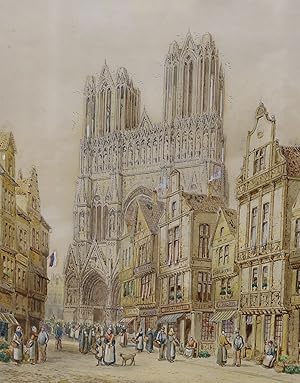
Contact seller5-star sellerWatercolor and gouache on cream wove paper, 17 3/4 x 13 7/8 inches (450 x 340 mm). Signed and titled in watercolor in the lower right image area. Small circular pea-sized damp stain in the top center image area (visible in the area of the sky), and some additional small spots of unobtrusive foxing in the upper left sheet area. O…therwise in very good condition with fresh colors and intricate brushwork. Henri Schäfer attended l'Ecole National de Beaux-Arts, and is well known for his Victorian era European city and town views, especially his French and Belgian cathedral landscapes. Schäfer's work is often conflated with that of British artist Henry Thomas Schafer, who was active in the same regions at the same time. In addition, both artists are considered to belong to the School of Samuel Prout. Biographical distinctions may be found in Christopher Wood's 1971 reference, The Dictionary of Victorian Painters, published by the Antique Collectors Club, London. One observation that can be made in regard to Schäfer's work is the joy the artist conveyed in capturing the daily activities of townsfolk, who are often seen milling around within a composition. Keen observation will show that many of the figures in Schäfer's work, although not part of the immediate focal point, are looking directly at the viewer, as if caught for a instant while staring into the lens of a faraway camera. This can be seen clearly in this particular painting, and is a detail that forms an intimate an engaging human relationship with the viewer. These small portraits complement the complexity and grandiosity of the architecture looming above with something endearing and tender.


