
Selenus (16 results)

Published by Kunstberg c Leipzig 1972 1690
- Hardcover
Seller: Tony Peterson, Littlehampton, , United KingdomTony Peterson
Contact seller5-star sellerCondition: Used
US$ 16.62
US$ 24.21 shippingShips from United Kingdom to U.S.A.Quantity: 1 available
Facsimile reprint. Small hardback, VG. 83pp. Frontispiece, folding plate. I cannot locate the original work in LN or Van der Linde. I have found this book listed in Kieler Schachkatalog, no.2319.
 More images
- Softcover
- Print on Demand
Seller: Forgotten Books, London, United KingdomForgotten Books
Contact seller4-star sellerCondition: New
US$ 20.86
Free ShippingShips from United Kingdom to U.S.A.Quantity: Over 20 available
Paperback. Condition: New. Print on Demand. This book presents a rich and detailed examination of chess techniques, game strategy, and positional analysis through a collection of 156 historical games. The author, a renowned 16th-century player and theorist, provides insights into the game's evolution, offering crucial lessons fo…r both novice and experienced players alike. The games presented in this volume are not mere recreations of past matches but rather serve as invaluable case studies, illustrating fundamental principles and tactics that continue to shape the game today. By delving into these historical encounters, readers gain a deeper understanding of chess strategy and the nuances of positional play, enhancing their ability to anticipate moves, evaluate positions, and ultimately improve their gameplay. This book is a reproduction of an important historical work, digitally reconstructed using state-of-the-art technology to preserve the original format. In rare cases, an imperfection in the original, such as a blemish or missing page, may be replicated in the book. print-on-demand item.
- Hardcover
Seller: Der Buchecker, Koeln, GermanyDer Buchecker
Contact seller5-star sellerCondition: Used - Very good
US$ 11.94
US$ 46.41 shippingShips from Germany to U.S.A.Quantity: 1 available
geb. Condition: Gut. 83 S. : Ill. ; 19 cm Exemplar mit Gebrauchsspuren (das kann heißen: das Buch KANN normale Leseverformung wie Knicke am Buchrücken, oder leichte Nachdunklung o. ä. haben oder auch, obwohl unbeschädigt, als Mängelexemplar gekennzeichnet sein, ferner können auch Notizen oder Unterstreichungen im Text vorhanden…sein. Alles dies zählt zur Kategorie des GUT ERHALTENEN). In jedem Falle aber dem Preis und der Zustandsnote entsprechend GUT ERHALTEN. und ACHTUNG: Die Covers können vom abgebildeten Cover und die Auflagen können von den genannten abweichen AUSSER bei meinen eigenen Bildern (die mit den aufrechtstehenden Büchern vor schwarzem Hintergrund, wie auf einer Bühne) MEINE EIGENEN BILDER SIND MASSGEBEND FÜR AUFLAGE, AUSGABE UND COVER w-002c-0423 KEIN VERSANDKOSTENRABATT !!! Sprache: Deutsch Gewicht in Gramm: 450 Fotomechan. Neudr. [d. Ausg.] Frankfurt, ca 1690.
- Hardcover
Seller: Antiquariat Biebusch, Lilienthal, GermanyAntiquariat Biebusch
Contact seller5-star sellerCondition: Used - Very good
US$ 16.85
US$ 69.62 shippingShips from Germany to U.S.A.Quantity: 1 available
Leinen. Condition: Gut. 83 S.: Ill.; 19 cm Zustand: Leinen ohne Schutzumschlag, gering fleckig, Papier gebräunt, Reprint, Frakturschrift --- Inhalt: über Schack, mit einer ausklappbaren Tafel NUß1-6 ISBN: 9783858830289 Sprache: Deutsch Gewicht in Gramm: 200 Fotomechan. Neudr. [d. Ausg.] Frankfurt, ca 1690.

- Hardcover
Seller: Rhönantiquariat GmbH, Hofbieber, , GermanyRhönantiquariat GmbH
Contact seller2-star sellerCondition: Used
US$ 81.27
US$ 46.41 shippingShips from Germany to U.S.A.Quantity: 1 available
4°. Kunstleder. 495 S. mit Abb. Ränder leicht gebräunt, ansonsten sehr gut erhalten. Sprache: Deutsch Gewicht in Gramm: 3100.
Das Schach- oder König-Spiel. [.] In vier unterschiedene Bücher, mit besonderm fleiß, gründ- und ordentlich abgefasset. Auch mit dienlichen Kupfer-Stichen gezieret [.] Diesem ist zu ende, angefüget, ein sehr altes Spiel, genandt, Rythmo-Machia.
Selenus, Gustavus (i.e., August II, Duke of Brunswick-Lüneburg).
Published by Leipzig, (Lorenz Kober for Henning Grosse the Younger, 1616-)1617. 1617
- Hardcover
- First Edition
Seller: Antiquariat INLIBRIS Gilhofer Nfg. GmbH, Vienna, A, AustriaAntiquariat INLIBRIS Gilhofer Nfg. GmbH
Contact seller5-star sellerCondition: Used
US$ 21,512.73
US$ 34.81 shippingShips from Austria to U.S.A.Quantity: 1 available
Folio (194 x 303 mm). (30), 495, (3) pp., party interleaved. Five parts in one volume. General title, first divisional title and title of the fifth part (Rythmomachia) within engraved borders, three remaining divisional titles within woodcut borders. With a folding engraved plate by Jacob van der Heyden, two full-page plates of…rithmomachy positions, and a double-page letterpress table. Numerous engraved diagrams (some full-page) and illustrations of chessmen in the text, woodcut head- and tailpieces, and woodcut initials. Early 19th century English calf, covers diced and blindstamped within gilt rules, spine gilt, edges gilt. First edition, second issue, of the first German instruction book for chess players, a title reissue of the 1616 printing with only the date on the general title altered. - The book adapts and reorganises earlier continental material, including an Italian tradition ultimately dependent on Ruy López, while preserving valuable evidence for the laws and practices of chess current in the German lands. Duke Augustus devotes notable attention to Courier chess, the medieval variant long popular in German-speaking regions, and cites its survival at Ströbeck near Halberstadt alongside other local forms of the game. The fifth and final part describes the number-game Rithmomachy, translated (as stated on its separate title) from Francesco Barozzi's Venetian treatise of 1572, and positioned here as a learned adjunct to the art of play. - The illustrative programme is unusually rich for the genre, culminating in the folding engraved plate of the young Duke winning at chess: a discreet emblem of princely erudition and the bookish court culture that also produced the great Wolfenbüttel library. - Some early underlining and marginal markings in ink. Light browning due to paper quality, half-title and title slightly spotted and dust-soiled, occasional spotting elsewhere. Binding slightly rubbed and rebacked preserving spine (small loss made good at foot). - 1. "Peter Peterse[n]", ownership inscription (shaved at fore-edge) dated 1714 at foot of general title. - 2. Royal Library, Berlin (18th century circular stamp on verso of title-page and circular red sale stamp). - 3. Jacob Henry Sarratt (1772-1819), presentation inscription on front flyleaf to his pupil William Lewis, dated November 1816. - 4. William Lewis (1787-1870), with extensive chess notation and notes on inserted leaves. - 5. J. W. Rimington-Wilson (1822-77), ownership inscription and note; Sotheby's, 28 Feb. 1928, lot 437, to Quaritch (against Maggs). - 6. Bernard Quaritch, Cat. 428 (1929), no. 1322. - VD 17, 39:125792Z. Faber du Faur 422a. Van der Linde I, 349. Van der Linde, Das erste Jartausend der Schachlitteratur (1881), no. 2937. Schmid, Literatur des Schachspiels, p. 116-118. Zollinger, Bibliographie der Spielbücher, 68. Ann E. Moyer, The Philosophers' Game. Rithmomachia in Medieval and Renaissance Europe (Ann Arbor, 2001), p. 120. Hausmann & Kapp 83.
Published by Printed for J. Ebers, London 1817
- Hardcover
Seller: Stony Hill Books, Madison, WI, U.S.A.Stony Hill Books
Contact seller5-star sellerCondition: Used - Very good
US$ 2,450.00
US$ 5.50 shippingShips within U.S.A.Quantity: 1 available
Hardcover. Condition: Very Good. Two volumes each with separate title page, bound together; xxi + 233, 240 pages; bound in half leather over marbled paper-covered boards, red leather spine label lettered in gilt; rubs at all edges and joints, front hinge cracked but holding; light age toning and foxing to endpapers and first and… last couple pages only, internally quite clean and bright, text block sound and tight and unmarked.
Das Schach- oder König-Spiel von Gustavo Seleno, In vier unterschiedene Bücher, mit besonderm Fleiß, gründlich und ordentlich abgefasset. Auch mit dienlichen Kupfern gezieret: Desgleichen vorhin nicht ausgangen. .
SELENUS, Gustavus i.e. Augustus II, Duke of Braunschweig-Lüneburg
Published by Lipsiae, Gedruckt durch Lorentz Kober. Bey Henning . 1616
- Hardcover
Seller: Cobnar Books, Deal, , United KingdomCobnar Books
Contact seller4-star sellerCondition: Used
US$ 2,867.66
US$ 28.49 shippingShips from United Kingdom to U.S.A.Quantity: 1 available
Folio in 4s. Collates A-3H4, 3I6, 3K-3P4. Lacks the engraved title and preliminary matter before p.1 (A1) which is the part title to Book I. The printed text ends at p.490 (3P4). The missing leaves are all supplied in 18th century German manuscript. Five engraved part titles, including that to Rythmomachia. Many engravings in th…e text, some full page. Lacks the folding plate. Contemporary vellum with the title inked on the spine. Wormed at the foot of both boards and some loss of vellum at the foot of the spine. Paper unformly toned with a few water stains. Pinholes of worm to lower margins of signatures A & B, not touching the text. Despite its defects a usable copy of the first book on chess in German.
Published by (Excriptum typis & impensis Johannis & Henrici Fratrum: Lunaeburgensium) 1624
- Hardcover
Seller: John K King Used & Rare Books, Detroit, MI, U.S.A.John K King Used & Rare Books
Contact seller5-star sellerEngraved title; charts including three folding charts and one folding plate of music, 11.5 x 7.5, bound in 19th century (?) gilt decorated boards, 491 pp, covers worn with hinges starting, extremities bumped and fraying, old bookplate (Ex-Bibliothec Zschuckiana), pp toned, some minor foredge wear else an exceptionally nice and u…sable volume. A much sought-after volume, the cipher illustrated on page 140 was used by Thomas Bokenham to solve the cipher on the statue of Shakespeare in Westminster Abbey (proving that Bacon authored Shakespeare's plays). Even the title page allegorical illustrations in this book are alleged to prove Bacon's authorship. A must-have for anyone with an interest in cryptography! One of the most important titles to have passed through our hands in a long time. (Gustavus Selenus is the pseudonym of Augustus the Younger, Duke of Brunswick-Luneburg.).
- Hardcover
Seller: BOUQUINIST, München, BY, GermanyBOUQUINIST
Contact seller5-star sellerCondition: Used - Very good
US$ 89.64
US$ 92.83 shippingShips from Germany to U.S.A.Quantity: 1 available
Condition: Gut. Nachdruck der Ausgabe Leipzig 1616. XIV, [30], 495 (5) Seiten mit zahlreichen Illustrationen und graphischen Darstellungen. 30,1 x 21,7 cm. Guter Zustand. - August der Jüngere (* 10. April 1579 in Dannenberg, Fürstentum Lüneburg; 17. September 1666 in Wolfenbüttel) Herzog zu Braunschweig-Lüneburg, Fürst von Braun…schweig-Wolfenbüttel, regierte von 1635 bis zu seinem Tode 1666 und galt als einer der gelehrtesten Fürsten seiner Zeit. Aufgrund seines immensen Interesses an Handschriften und Büchern entfaltete er eine intensive Sammeltätigkeit und schuf damit in Wolfenbüttel die für seine Zeit größte Bibliothek Europas, die Herzog August Bibliothek. . Kulturelle Leistungen: August setzte sich sehr für die Entwicklung der deutschen Sprache als Literatursprache ein. Im Gegensatz zu vielen Gebildeten seiner Zeit war er stolz darauf, seine Werke in seiner Muttersprache verfasst zu haben. Er interessierte sich außerdem für Geheimlehren und Alchimie und stand lange Jahre in brieflicher Verbindung mit Johann Valentin Andreae, dem vermutlichen Gründer der Rosenkreuzer. Im Februar 1632 traf Herzog August auf dem Halberstädter Kreistag Fürst Ludwig I. von Anhalt-Köthen. Dieser nahm das Treffen zum Anlass, den Fürsten in die Fruchtbringende Gesellschaft aufzunehmen, eine lose Vereinigung von adligen und bürgerlichen Gebildeten mit dem Ziel, Deutsch zu einer einheitlichen Hochsprache in Orthographie und Grammatik zu entwickeln. Als Mitglied der Fruchtbringenden Gesellschaft wurde Herzog August der Gesellschaftsname der Befreiende verliehen. Als Devise wurde ihm vom Schlage und als Emblem Gamanderle zugewiesen. Im Köthener Gesellschaftsbuch ist Herzog August unter der Nr. 227 zu finden. Dort wurde auch das Reimgesetz vermerkt, mit welchem er sich für die Aufnahme bedankte: Gamanderley befreyt vom schlag, hilfft das man meidet Das Zipperlein, so macht das schmertzen mancher leidet, Befreyend heiß ich drumb vom Schlag: Es muß darzu gesucht sein ins gemein vor Vnserm leib die ruh, Den lastern aber thut sich die Seel vnterwerffen, Doch hat die Tugend hie sich sehen laßen dörffen, Die macht aus Knechten herrn, die spricht die Fürsten frey Von so viel vnd so lang geübter Tyranney. Im Rahmen dieser Bestrebungen stellte er den jungen Gelehrten Justus Georg Schottelius (16121676) als wissenschaftlichen Mitarbeiter und Prinzenerzieher ein, der vielen heute als Vater der deutschen Grammatik gilt. Durch seine Leistungen wurde Wolfenbüttel das Zentrum der deutschen Sprachforschung, ein Treffpunkt von Schriftstellern und Wissenschaftlern. Dazu hat sicherlich auch Augusts Bibliothek, die damals als die größte in Europa galt, wesentlich beigetragen. Zum Ende des 17. Jahrhunderts wurden in Deutschland erstmals mehr Bücher auf Deutsch als auf Latein gedruckt. Unter dem Pseudonym Gustavus Selenus veröffentlichte er im Jahr 1616 das erste deutschsprachige Schachlehrbuch, Das Schach- oder Königspiel (In vier unterschiedene Bücher mit besonderem fleiss gründ- und ordentlich abgefasset) und im Jahr 1624 das 500-seitige Werk Cryptomenytices et Cryptographiae libri IX, das zu seiner Zeit als Standardwerk für Kryptologie und Kryptographie galt. Vier Jahre nach seinem Regierungsantritt wurde 1648 der Westfälische Friede geschlossen, und bis zu seinem Tode im Jahre 1666 führte August keinen Krieg. Hingegen entwickelte er Wolfenbüttel getreu seinem Wahlspruch Alles mit Bedacht zu einem geistigen und kulturellen Zentrum, das nach ganz Europa ausstrahlte. Seine Bibliothek, die er als Fürst und Herzog mit den ihm zur Verfügung stehenden Mitteln systematisch ausbaute, wurde zur größten Sammlung von Handschriften und gedruckten Büchern des Kontinents. Heute ist die Herzog August Bibliothek eine bedeutende Bibliothek und Forschungsstätte mit besonderem Schwerpunkt auf dem Spätmittelalter und der frühen Neuzeit. . Aus: wikipedia-August_II._(Braunschweig-Wolfenbüttel) Sprache: Deutsch Gewicht in Gramm: 2001 Blaues Kunstleder mit goldgeprägten Rücken- und Deckeltiteln und Schutzumschlag.
Published by Zch., Olms 1978. 1978
Seller: Antiquariat Burgverlag, Wien, , AustriaAntiquariat Burgverlag
Contact seller5-star sellerCondition: Used
US$ 101.59
US$ 75.42 shippingShips from Austria to U.S.A.Quantity: 1 available
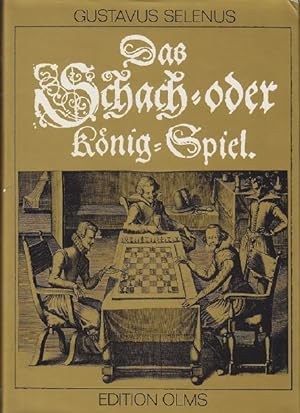
Faksimile d. Ausg.. Lpz., 1616. 4°. XIV, 15 Bll., 495 S. Mit zahlr. Abb. OKunstldr. m. Goldpräg., OU. Mit Schuber. In gutem Zustand. - (Tschaturanga. Darstellungen und Quellen zur Geschichte des Schachspiels, hrsg. v. Viktor Kortschnoi u. Klaus Lindörfer, Bd. 1) Gewicht in Gramm: 2000.
Published by (Lüneburg, Johann & Heinrich Stern [for the author]), 1624. 1624
Seller: Antiquariat INLIBRIS Gilhofer Nfg. GmbH, Vienna, A, AustriaAntiquariat INLIBRIS Gilhofer Nfg. GmbH
Contact seller5-star sellerCondition: Used
US$ 29,878.79
US$ 34.81 shippingShips from Austria to U.S.A.Quantity: 1 available
Folio (190 x 300 mm). (36), 493, (1) pp., final blank leaf. Title-page set within an elaborately engraved pictorial border. With full-page engraving by Lucas Kilian (on p. 341), half-page engraving by Wolfgang Kilian (on p. 384), and an engraved illustration in the text (on p. 492); a large folding table; numerous woodcut or let…terpress diagrams, tables, and musical scores in the text. Woodcut printer's device to colophon; woodcut and typographical head- and tailpieces, woodcut decorated initials. Bound in 18th century French red morocco with gilt fillets and the fine large gilt arms Jérôme Phélypeaux, count of Pontchartain and Maurepas, to both covers; sewn on 6 supports with raised spine bands, gilt spine title, compartments outlined with gilt fillets. Leading edges gilt; gilt inner dentelle; all edges gilt over marbling. Marbled endpapers. First and only edition of one of the most renowned works on cryptography written by Augustus II, Duke of Brunswick-Lüneburg (1579-1666), founder of the Herzog August Library in Wolfenbüttel. Dedicated to Emperor Ferdinand II and printed in Lüneburg at the author's expense by the brothers Johann and Heinrich Stern, this book is a comprehensive survey of various cryptographic techniques and methods of code-breaking, comprising for example steganography (the hiding of a message in a larger text) and encryption in musical scores. It is profusely illustrated with tables and schemes of alphabets and ciphers encoded in numerous variations, occasionally including signs of the zodiac. The text, divided into nine books, is partly based on the famous "Steganographia" of the German Benedictine abbot Johannes Trithemius (1462-1516), which was first published in Frankfurt in 1606. The third book contains the unfinished part of Trithemius's enigmatic text, whose the secret code was deciphered only late in the 20th century. - The intriguing engraved title border is generally regarded as the first pictorial clue in the controversial Baconian theory of Shakespearean authorship, which contends that the English philosopher and statesman Francis Bacon (1561-1626) was the true author of the plays written by William Shakespeare. One scene suggests Francis Bacon handing over a text to a man holding a spear (meaning Shakespeare), and another suggests Augustus II holding the "Cap of maintenance" above the head of Francis Bacon writing at his desk. Some authors believe this work to be a cryptographic twin to Bacon's "De dignitate et augmentis scientiarum" and Shakespeare's First Folio, both published in 1623. - Augustus II, born as the seventh child of Henry III, Duke of Brunswick-Dannenberg (1533-98), studied at the Universities of Rostock, Tübingen, and Strasbourg. After his Grand Tour of Italy, France, the Netherlands and England, he settled in 1604 in his residence in Hitzacker, continuing his studies for the next three decades. Under his pseudonym Gustavus Selenus he wrote an influential book on chess, "Das Schach- oder Königsspiel" (first published in Leipzig in 1616). He was one of the most learned men of his time and maintained a correspondence with the German theologian Johannes Valentinus Andreae (1586-1654), one of the founders of the Rosicrucian movement at the beginning of the 17th century. - Slightly browned throughout due to paper stock; three oversized leaves (pp. 185-190) folded in. A few small white paint spots to upper cover of the binding, otherwise in excellent condition. - From the library of the great French bibliophile Paul Girardot de Prefond (1722 - ca. 1785) with his engraved armorial bookplate mounted on the first flyleaf. Girardot de Préfond assembled two successive libraries: he sold his first one in 1757 to create a new, more carefully curated collection. This second library, distinguished by volumes beautifully bound by Padeloup, Boyet, and Derome, was later sold in its entirety, under pressure from creditors, to Count Justin MacCarthy Reagh. Books from the first collection usually bear Girardot de Préfond's name in gilt, and more often his armorial bookplate on one of the endpapers. Several examples later entered collections so renowned as those of the Duke de La Vallière, Gaignat, and Nodier (cf. Brunet, Manuel du libraire II, 553f.; Esprit des livres). The 1757 catalogue (Catalogue des livres du cabinet de M. G D P, Guillaume-François de Bure le jeune, p. 74) does not record a price for this specific book; however, during a later sale held from 20 February to 17 March 1800 at one of the Silvestre halls, Rue des Bons-Enfants, this copy from Girardot's library was offered as Lot 1277 (Gustavus Selenus (Augustus, Duke of Brunswick), Cryptomenytices et Cryptographiae, libri IX. Lüneburg, 1624, folio, illustrated, in red morocco, ex libris Girardot de Préfond), listed on p. 133 and priced at 4 livres/francs. - VD 17, 23:285820R. Caillet 10114 ("manque à la Bibliothèque nationale"). BM-STC German A1047. Galland, p. 166f. Shulman, p. 10. Wellcome 545. USTC 2135578. Folger II, p. 84. Faber du Faur 124. Graesse VI, 344. Brunet V, 270 ("Ouvrage curieux"). Not in Jantz.
 More images
Published by Johann & Heinrich Stern, Lüneberg 1624
- First Edition
Seller: SOPHIA RARE BOOKS, Koebenhavn V, , DenmarkSOPHIA RARE BOOKS
Contact seller4-star sellerCondition: Used
US$ 25,000.00
Free ShippingShips from Denmark to U.S.A.Quantity: 1 available
First edition. ONE OF THE MOST SPLENDID BOOKS ON CRYPTOGRAPHY. First edition, rare, of this encyclopaedic account of the science of cryptography as it was then practiced. It presents a comprehensive survey of encryption and code-breaking methods, including examples of substitution ciphers, musical ciphers, steganography (the emb…edding of secret messages in a larger text), graphical encryption in images, and other techniques, with chapters on everything from simple inverted and transposed alphabet codes to accounts of cryptography in music and the visual arts. "In 1624, August II, Duke of Braunschweig-Lüneburg (afterwards Hanover) in Germany, issued Cryptomenytices et Cryptographiae libri IX under the pseudonym Gustavus Selenus. This was a play on his name, Gustavus being an anagram (with the interchangable u and v of the time) of Augustus, and Selene, the Greek goddess of the moon, which is 'luna' in Latin, standing for Lüneburg. The duke, who was cousin to the grandfather of George I of England, is probably the highest-ranking author of a book on cryptology. He prefaced the almost 500 small-folio pages of his volume with 17 pages of tributes from his courtiers ('As, what night in dusty cloak conceals, bright Cynthia soon with torch full-flaming shows, / So, too, Gustavus now, Selenus called, uncovers things that time has long in shadow held')" (Kahn, The Codebreakers, p. 154). Duke August, a "Wunder unter den Fürsten" (miracle among princes), was one of the most learned men of his time and founder of the Wolfenbüttel library, where some 180,000 volumes and numerous manuscripts were assembled during his lifetime. At the same time he was the owner and curator of one of the largest cryptological collections of the 17th century. Duke August exchanged coded messages with Johann Valentin Andreae, mystic, utopian writer and the supposed 'founder' of Rosicrucianism. Basing his work on Trithemius' uncompleted Steganographia, August here presents hundreds of cryptographic systems. The folding table at the beginning is a synoptic diagram of all systems of encryptions contained in the book. "However, it is not this schema but rather the title page that has attracted the most interest in this volume; several scholars have claimed that hidden within the engravings is the key to discovering the real author of the Shakespeare plays. Theories as to the identity of the 'true' author of the Shakespeare corpus have long been a part of the study of the poems and plays and have often been expressed by well-respected scholars of Elizabethan literature, especially during the early decades of the 20th century" (;/a>). "A good indicator of the state of cryptology in Germany in the first quarter of the century is the 496-page compendium on secret communication that Duke August the Younger of Brunswick-Ltineburg (1579-1666) published in 1624. The young prince, who originally had no hopes of ruling the duchy, devoted his early life to scholarly pursuits, wrote a book on chess in 1616, and in the 1590s laid the foundation to what in 1666 had become one of the largest collections of books and manuscripts of his day. In 1624, he published Cryptomenytices et Cryptographiae Libri IX, which was issued under the pseudonym of Gustavus Selenus. It began as a defence and explication of the two works of Trithemius and ended up being the earliest manual of cryptology. With almost two hundred pertinent primary books and manuscripts in his possession, Duke August made use of just about all the authors and analysed the entire body of cryptologic material from ancient times to the 1621 plagiarism of Vigenère's Traicté . "The Wolfenbtittel duke included the first and second editions of the earliest major cryptologic treatise written in German, Daniel Schwenter's Steganologia & Steganographia, both editions published under the pseudonym of Resene Gibronte Runeclus Hanedi in the 1610s. Schwenter, a professor of mathematics and Oriental languages at the Altdorf (Nuremberg) Academy, deemed it advisable not to reveal his authorship. He drew heavily on Italian source materials, in particular on Porta; his books focus on optical and acoustic telegraphs and even on telepathy and list various ways of communication by means of sympathetic inks. The two editions included in the Cryptomenytices and a later third one are well structured but do not add much new cryptologic matter. "For well over half a century, Duke August's encyclopedic compendium served as a cryptologic reference in the German area and beyond. Apart from the (mostly) successful elucidation of Books I and II of Trithemius' Steganographia, its primary value lay in the presentation of cryptologic source materials that simply were not accessible to most individuals, . including the 1593 Scotographia by Abram(o) Colorni. This 'Jew of Mantua', as he called himself, was in the service of the Hapsburg emperor Rudolph II at Prague, and his elaborate polyalphabetic substitution systems appealed to Duke August so much that no other author except Trithemius occupies more space in his compendium" (Strasser, pp. 297-298). The full-page engraving on p. 341 is a kind of visual summary of the work. "Selenus uses this illustration as a cumulative exercise for the student who has just worked through numerous examples of ciphers. In a kind of final exam, readers are challenged to notice the sheer volume of ciphers that could possibly be before them in a work of art or, even, out in the world in an everyday landscape. The Duke's subject is 'complete,' he notes, in the scope of a single scheme, expressing the key and the hidden principle of a great cryptographic device . "The illustration stresses the existence of ciphers in nature. The inhabitants of this image are surrounded by ciphers (and are also ciphers themselves). From the top to the bottom, readers see birds with wings and feet outspread in shapes that indicate meaning; fruits positioned in a tree that may align with an alphabetic key; windows in distant.
Seller: Antiquariat BehnkeBuch, Neu Kaliß, , GermanyAntiquariat BehnkeBuch
Contact seller5-star sellerCondition: Used
US$ 11.95
US$ 116.03 shippingShips from Germany to U.S.A.Quantity: 1 available
19*11 cm. OLeinenband. 83 S. : Ill. Guter Zustand mit lediglich leichten Gebrauchsspuren. L16-4 ISBN 3858830283 Wichtiger Hinweis: Aufgrund der EPR-Regelung zur Zeit KEIN Versand in EU-Länder. Due to EPR, there is currently no delivery to EU-countries. Sprache: Deutsch Gewicht in Gramm: 300 Fotomechan. Neudr. [d. Ausg.] Frankfur…t, ca 1690.
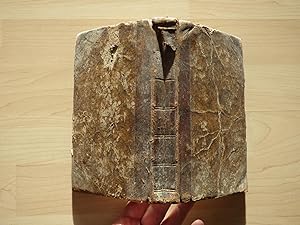
Seller: Cassiodor Antiquariat, Gauting, , GermanyCassiodor Antiquariat
Contact seller5-star sellerCondition: Used
US$ 956.12
US$ 52.22 shippingShips from Germany to U.S.A.Quantity: 1 available
Die Schachspielkunst nach den Regeln und Musterspielen des Gustavus Selenus, Phildor, G. Greco Calabrois, Stamma und des Pariser Clubs; in einer für die Erleichterung des Selbstunterrichts bequemen Anordnung und Bezeichnungsart entworfen von Johann Friedrich Wilhelm Koch. Mit einem Anhange, enthaltend: Thöldens Damenspielmuster.… Georg Christian Keil, Magdeburg 1801. 8°, Halbledereinband, Abb.-Blatt und Titelei und XV unpag. Seiten und 408 Seiten und ein Blatt. Titelei mit Besitzervermerk, Abb. vorne fast lose, fleckig, Rücken mit Läsur, Einband fleckig und berieben und gestaucht, vord. Vorsatz fehlt, Deckel hinten innen mit Skizzen und Besitzervermerk der Zeit, wenige Seiten mit Randläsur, partiell falzig, sonst gut. Das Buch wurde ehedem ausgiebig studiert.
 More images
- Hardcover
- Print on Demand
Seller: Gyan Books Pvt. Ltd., Delhi, , IndiaGyan Books Pvt. Ltd.
Contact seller5-star sellerCondition: New
US$ 44.36
Free ShippingShips from India to U.S.A.Quantity: Over 20 available
Leather Bound. Condition: New. Language: English. {Size: 14.60 x 22.86 cms} Presenting an Exquisite Leather-Bound Edition, expertly crafted with Original Natural Leather that gracefully adorns the spine and corners. The allure continues with Golden Leaf Printing that adds a touch of elegance, while Hand Embossing on the rounded…spine lends an artistic flair. This masterpiece has been meticulously reprinted in 2013, utilizing the invaluable guidance of the original edition published many years ago . The contents of this book are presented in classic black and white. Its durability is ensured through a meticulous sewing binding technique, enhancing its longevity. Imprinted on top-tier quality paper. A team of professionals has expertly processed each page, delicately preserving its content without alteration. Due to the vintage nature of these books, every page has been manually restored for legibility. However, in certain instances, occasional blurriness, missing segments, or faint black spots might persist. We sincerely hope for your understanding of the challenges we faced with these books. Recognizing their significance for readers seeking insight into our historical treasure, we've diligently restored and reissued them. Our intention is to offer this valuable resource once again. We eagerly await your feedback, hoping that you'll find it appealing and will generously share your thoughts and recommendations. Lang: - English, Pages:- 639, Print on Demand. If it is a multi-volume set, then it is only a single volume. We are specialised in Customisation of books, if you wish to opt different color leather binding, you may contact us. This service is chargeable. Product Disclaimer: Kindly be informed that, owing to the inherent nature of leather as a natural material, minor discolorations or textural variations may be perceptible. Explore the FOLIO EDITION (12x19 Inches): Available Upon Request. 639.


