Order Total (1 Item Items):
Shipping Destination:

Signed Article (5 results)
Skip to main search results
Search filters
Product Type
- All Product Types
- Books (4)
- Magazines & Periodicals (1)
- Comics (No further results match this refinement)
- Sheet Music (No further results match this refinement)
- Art, Prints & Posters (No further results match this refinement)
- Photographs (No further results match this refinement)
- Maps (No further results match this refinement)
- Manuscripts & Paper Collectibles (No further results match this refinement)
Condition Learn more
- New (1)
- As New, Fine or Near Fine (1)
- Very Good or Good (2)
- Fair or Poor (No further results match this refinement)
- As Described (1)
Binding
Collectible Attributes
Language (1)
Price
- Any Price
- Under US$ 25 (No further results match this refinement)
- US$ 25 to US$ 50
- Over US$ 50
Free Shipping
- Free Shipping to U.S.A. (No further results match this refinement)
Seller Location
Seller Rating
-
Wallace Stegner On His Own Terms. an article in STANFORD Magazine, Spring, 1989.
Published by 1989., 1989
Magazine / Periodical First Edition Signed
Soft cover. Condition: Very Good. No Jacket. 1st Edition. Article about Wallace Stegner in Stanford Magazine, Spring 1989. Signed by Stegner, on the bottom of page 25. Spot to bottom edge of one page. Very good. See photos. Inscribed by Author(s).
-

The Victorian Newsletter - includes Wilde's Gracious Enclosures - A Brief Tour (SIGNED COPY)
Published by The Victorian Newsletter Kentucky University Spring 1997, No. 91, 1997
First Edition Signed
US$ 48.49
US$ 28.24 shipping
Ships from United Kingdom to U.S.A.Quantity: 1 available
Add to basketSOFTCOVER. Condition: New. 1st Edition. A4 size card covered journal. Noon gives an interesting angle on Wilde's appreciation of social and class distinctions and barriers. Signed by Noon on title page . [CONDITION: NEW unread copy ] . __To see more of our Literary monographs, biographies etc type DbbLBIOG in the Keywords search box . . We always ship in STRONG PROTECTIVE CARD PARCELS.
-

Ballad of Reading Gaol, The ( with small newspaper article by Press Staff Artist Roger Skipp reproduction of one of John Vasso Illustrations On the Sale of Keats Love Letters & drawing of Vasso )
Published by E. P. Dutton & Co
Seller: Bluff Park Rare Books, LONG BEACH, CA, U.S.A.
Association Member: IOBA
Seller rating 4 out of 5 stars

First Edition Signed
Hard Cover. No Jacket. Hard Cover. No Jacket. Signed by Illustrator. HBNODJ, 1928, 1st edition,Black cloth & decorated greyblue Paper Boards decorated Gold Gilt, Cover rub, Scuff & Wear Primarily Extremities, Small Tears top Spine, NF-/VG, NODJ, , Interior Nice, Tight Basically Clean with light edge stain some pgs & slightly darkened pgs & few small margin tears & tiny or small external pg chips, 124 pgs. Signed by Illustrator.
-
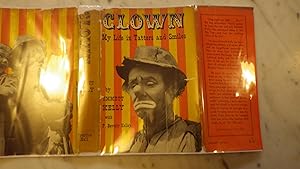
Clown: My Life in Tatters and Smiles , SIGNED BY EMMETT & Beverly KELLY, with few pgs with color Photo Painting from Readers Digest article by John Culhane , Emmett one of the world's greatest Clowns
Published by Prentice-Hall, Inc., New York, 1954
Seller: Bluff Park Rare Books, LONG BEACH, CA, U.S.A.
Association Member: IOBA
Seller rating 4 out of 5 stars
First Edition Signed
Hardcover. Condition: Very Good. Dust Jacket Condition: Very Good. Decorations by ALICIA FIENE (illustrator). 1st Edition. Decorations by ALICIA FIENE , endpapers of Circus Line ,Original price of $3.95 printed on dust jacket front flap. illustrated with B/W photos,HBDJ, NF-/VG-, March 1954, 1st edition, 2ND printing stated ., Dust Jacket has clips and Mended tears to front and spine held together in several locations with Interior tape. Cover shows ageing and browning. Interior clean and tight. 271 pages. Second printing. Pricing of $3.95 found on bottom of front dj panel. Tanning to spine CVR Orange Boards with Yellow cloth spine Titled in black, Book Condition: NF. Dust Jacket Condition: VG-. dustJacket has small corner/ heel chips, closed tears now protected with paper backed polyester film. Size: 8vo , DJ Protected Clear Mylar, Tiny chips Tears creases DJ Extremities, , 271 PGS, Lite Soil Top spine DJ, Orange Baords with Yellow cloth spine Titled in black, ,Emmett one of the world's greatest clowns, creator of " weary willie ", the mournful CIRCUS tramp in a tattered business suit., Signed by Author(s).
-
Autograph Manuscript from "Autobiography: Making of a New Yorker"; Together with Three ALS to His Editor
Published by [New York Times Magazine], [New York], 1952
Seller: The First Edition Rare Books, LLC, Cincinnati, OH, U.S.A.
Association Member: ABAA ILAB IOBA MWABA
Seller rating 5 out of 5 stars

Signed
Paper. Condition: Near fine. Handwritten by John Steinbeck, parts two and three of his three-part article for The New York Times Magazine titled, "Autobiography: Making of a New Yorker." Together with three autograph letters signed by Steinbeck to NYTM editor Seymour Peck, and o (illustrator). Handwritten Manuscript. In total, this collection includes 12 legal page leaves, written in pencil by Steinbeck on rectos only, and one typed letter from his editor. All in near fine condition, with faint toning to edges and small paperclip indentations. (Goldstone & Payne C90, article) With an 11-page typed transcription of the drafts and letters, bound in chronological order of appearance. Housed in a custom brown cloth clamshell case, title printed on paper label affixed to spine. (Provenance: Christie's 1986; Christie's 1999) John Steinbeck's article "Autobiography: Making of a New Yorker," begins in Part One (not included here) with his first unhappy (and short-lived) experience in New York City in 1925, at the age of 23. Part Two, handwritten here, details his second "assault on New York" in the fall of 1935, in which he begrudgingly transforms from a "Country Boy" into a true "New Yorker." At first, Steinbeck writes: "It is so strange to look back. I was going to live in New York but I was going to avoid it." Near the end of the installment, his anecdotes change. He writes: "Everything fell into place. I saw every face I passed. It was beautiful - but most important - I was part of it, I was no longer a stranger." In the final section, handwritten here, Steinbeck describes the broad dichotomy of the city, and romanticizes city life. He writes: "New York is an ugly city, a dirty city. Its climate is a scandal, its politics are used to frighten children, its traffic is madness, its competition is murderous. But. once you have lived in New York and it has become your home - no place else is good enough. All of everything is concentrated here, population, theatre, art, painting, publishing, importing, business, murder, mugging, luxury, poverty. It is all of everything." The correspondence between Steinbeck and NYTM editor Seymour Peck primarily discusses deadlines for the article drafts. In the first letter, Steinbeck tells Peck of his plans for the three-part article. Peck responds on November 26, 1952, asking for all writing to be completed by December 24, 1952. The second letter is inserted at the end of Part Two, informing Peck that Part Three will be along shortly. The third letter, dated December 17, 1952, accompanies Part Three, in which Steinbeck says the article "isn't very good, but it is heart-felt." A truly exceptional collection of autobiographical writings from a classic American author. Despite his reputation as a Californian, John Steinbeck spent nearly half his life living in New York City. In 1925, he left Stanford University without a degree and moved to the city for roughly one year. He returned to New York with his then-girlfriend Gwen, living for a while in Sneden's Landing. They stayed in New York until the birth of his first son, Thom, and the publication of Cannery Row (1945). He later returned to the East Coast with his third wife, Elaine, and bought a home in Sag Harbor in 1955. Steinbeck remained in New York City until his death in 1968. Signed.