Order Total (1 Item Items):
Shipping Destination:

Sinclair Meurice (4 results)
Skip to main search results
Search filters
Product Type
- All Product Types
- Books (4)
- Magazines & Periodicals (No further results match this refinement)
- Comics (No further results match this refinement)
- Sheet Music (No further results match this refinement)
- Art, Prints & Posters (No further results match this refinement)
- Photographs (No further results match this refinement)
- Maps (No further results match this refinement)
- Manuscripts & Paper Collectibles (No further results match this refinement)
Condition Learn more
- New (No further results match this refinement)
- As New, Fine or Near Fine (No further results match this refinement)
- Very Good or Good (4)
- Fair or Poor (No further results match this refinement)
- As Described (No further results match this refinement)
Binding
- All Bindings
- Hardcover (4)
- Softcover (No further results match this refinement)
Collectible Attributes
- First Edition (2)
- Signed (1)
- Dust Jacket (No further results match this refinement)
- Seller-Supplied Images (2)
- Not Print on Demand (4)
Language (1)
Price
- Any Price
- Under US$ 25 (No further results match this refinement)
- US$ 25 to US$ 50
- Over US$ 50
Free Shipping
- Free Shipping to U.S.A. (No further results match this refinement)
Seller Location
Seller Rating
-

The Thomas Splint and its Modifications
Published by Oxford Medical Publications, 1927
Seller: James Cummings, Bookseller, Signal Mountain, TN, U.S.A.
Seller rating 4 out of 5 stars

First Edition
Hardcover. Condition: Very Good. First Edition.
-
The Thomas Splint and Its Modifications in the Treatment of Fractures
Published by Oxford Medical Publications
Seller: Phatpocket Limited, Waltham Abbey, HERTS, United Kingdom
Seller rating 5 out of 5 stars

US$ 34.39
US$ 14.22 shipping
Ships from United Kingdom to U.S.A.Quantity: 1 available
Add to basketCondition: Good. 1927 Original publisher's cloth binding.Small paper sticker to front board. text is unmarked. Your purchase helps support Sri Lankan Children's Charity 'The Rainbow Centre'. Ex-library, so some stamps and wear, but in good overall condition. Our donations to The Rainbow Centre have helped provide an education and a safe haven to hundreds of children who live in appalling conditions.
-
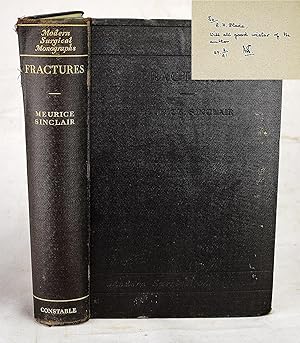
Fractures, Modern Surgical Monographs
Published by Constable And Company Ltd, London, 1931
Seller: Lola's Antiques & Olde Books, Traverse City, MI, U.S.A.
Seller rating 5 out of 5 stars
First Edition
Hardcover. Condition: Good. 1st Edition. 1931 Ex-Library Book In Brown Cloth Bound Hardboards In Good Condition. Fraying On Top And Bottom And Along Front Edge Of Spine, Corners Of Boards Slightly Worn And Toed, Library Sticker On Top Of Front Cover And Inside Of Front Board, Card Pocket On Inside Of Back Board And Dust On Top Of Pages. Otherwise A Clean Tight Copy. This Is From The Archibald Church Library, Northwestern University Medical School. 550 Pages With 337 X-Ray Photographs, Photographs And Diagrams Size: 8vo - over 7" - 9" tall. Ex-Library.
-
Fractures, (Modern Surgical Monographs)
Published by Constable and Company Ltd, 1931
Seller: Sequitur Books, Boonsboro, MD, U.S.A.
Association Member: IOBA
Seller rating 5 out of 5 stars
Signed
Hardcover. Condition: Good. Inscribed to Edward Fox Slade by Meurice Sinclair on front end page. Bound in publisher's black cloth. Gilt lettering. Hardcover. Shelf wear. Large tear to spine. Edges bumped. Bookplate of Slade on verso. Related ephemera include: Correspondence between Sinclair and Slade. xxxiv, 550 p., ill., 22 cm. "Major Meurice Sinclair was a Regular Army Medical Officer who revolutionized the management and treatment of gunshot fractures during the First World War, particularly those of the femur which carried the highest mortality. Not only did his methods reduce mortality but they increased the ease of nursing and hence the comfort of the wounded to a marked degree. His system of traction on the Thomas splint, in suspension, gained general acceptance such that he gave lectures and demonstrations to the medical officers of the allied forces, for which he was thrice mentioned in dispatches and subsequently appointed CMG. Central to his method was the concentration of the fracture cases within certain hospitals to standardize and improve their management. This he was able to achieve through the good offices of Sir Almroth Wright who was Consultant Physician to the British Expeditionary Force. His methods reduced the death rate in open fractures of the femur from 80 % generally, to 7.3 % in his own hospital. He left a legacy that bore fruit both in the treatment of civilian fractures after the war but also in the second war of 1939âââ‰â¬Å"1945." - Injury Journal. Signed.