Order Total (1 Item Items):
Shipping Destination:

Smith Margit (5 results)
Skip to main search results
Search filters
Product Type
- All Product Types
- Books (5)
- Magazines & Periodicals (No further results match this refinement)
- Comics (No further results match this refinement)
- Sheet Music (No further results match this refinement)
- Art, Prints & Posters (No further results match this refinement)
- Photographs (No further results match this refinement)
- Maps (No further results match this refinement)
- Manuscripts & Paper Collectibles (No further results match this refinement)
Condition Learn more
- New (1)
- As New, Fine or Near Fine (1)
- Very Good or Good (No further results match this refinement)
- Fair or Poor (No further results match this refinement)
- As Described (3)
Binding
Collectible Attributes
- First Edition (2)
- Signed (No further results match this refinement)
- Dust Jacket (4)
- Seller-Supplied Images (4)
- Not Print on Demand (5)
Language (2)
Price
- Any Price
- Under US$ 25 (No further results match this refinement)
- US$ 25 to US$ 50
- Over US$ 50
Free Shipping
- Free Shipping to U.S.A. (No further results match this refinement)
Seller Location
Seller Rating
-
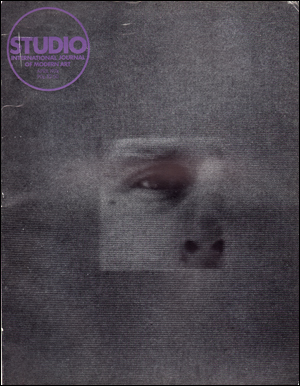
Studio International Journal of Modern Art, Vol. 187, No. 965 (April 1974)
Published by Studio International London, United Kingdom, 1974
Seller: Specific Object / David Platzker, New York, NY, U.S.A.
Seller rating 5 out of 5 stars

196 pp.; 30.8 x 24 cm.; glue bound; black-and-white & color; edition size unknown; unsigned and unnumbered; offset-printed; April 1974 issue of Studio International with cover specially designed for this issue by Klaus Rinke. Edited by Peter Townsend. Contents include: "Art and industry: a systematic approach," by Bernard Smith; "Correspondence;" "On Mounds," by James Davis; "Memories of passing: a note on Richard Long," by R.H. Fuchs; "Phenomenology of a time-space system," by Evelyn Weiss; "Georges Vantongerloo: mathematics, nature and art," by Margit Staber; "Sage of machine wit," by Howard E. Wooden; "Malevich and 'the fourth dimension,'" by Susan Compton and "Review." Good. Light curling of spine edge, rubbing of cover edges, scratching of covers, and finger oil staining on verso from handling. 3.7 cm. dog-ear to top left corner of verso. 5.7 cm. of writing in pencil on first page. Bumping of top right corner of contents. Contents otherwise clean and unmarked. Due to large size and weight additional shipping charges will be required for international orders.
-
MEDIEVAL GIRDLE BOOK.|THE
Language: English
Published by Oak Knoll Press, New Castle, Delaware, 2017
ISBN 10: 1584563680 ISBN 13: 9781584563686
Seller: Oak Knoll Books, ABAA, ILAB, NEW CASTLE, DE, U.S.A.
Association Member: ABAA ILAB MBS
Seller rating 5 out of 5 stars
hardcover, dust jacket. 7.375 x 10.5 inches. hardcover, dust jacket. 384 pages. "The Medieval Girdle Book provides rich information about this iconic binding structure and inspiration to those binders (teachers and students alike) who are seeking to replicate the structure and keep alive this branch of book history." - Peter D. Verheyen, PBSA "I highly recommend this book for its wealth of information; a single read-through will not be enough. It is a favorite upon my bookshelves, well-referenced and well loved." - Leah Humenuck, News in Conservation "Margit Smith's book is both timely and welcome." - Nicholas Pickwoad, The Library "In this lavishly illustrated study, Margit J. Smith. has written the definitive account of the 'girdle book', a small, portable volume designed for quick access and consultation." - Eve Houghton, TLS "Smith provides a comprehensive study of the bindings of the twenty-six known surviving examples of the girdle book. It is to be hoped Smith's survey may serve to bring to light yet further examples of the type." - Pamela Robinson, The Book Collector Between the 14th and 16th centuries a little-known book format, now called the girdle book, was used throughout various European countries. The girdle book is distinguished by a cover that extends beyond the limits of the book itself and may end in a knot, hook or ring, or may be left ungathered. By this extension the book was hung from the belt with its head down, so when swung up it could be read without detaching it from the belt. Today there are only twenty-six known examples identified and documented in collections worldwide. In The Medieval Girdle Book, the author provides a comprehensive look at these extremely rare books. A study of this scope, which contributes significantly to the information available has been lacking until now and makes this the first thorough treatment of all so far known girdle books. The author has examined each book in detail, documented its historical context, provenance, owner(s) or institutions associated with it, and described each from the bookbinder's perspective, including the materials and processes of their construction. Contrary to previous assumptions that only clerics and the religious used girdle books, The Medieval Girdle Book shows they also contain legal, medical, and philosophical contents. This book is illustrated with more than 290 color photographs taken by the author or reproduced from contemporary works of art to show their use during the Middle Ages. Margit Smith is a librarian and hand bookbinder. She retired in 2010 from the Helen K. and James S. Copley Library at the University of San Diego, CA, after nearly twenty years as Head of Cataloging and Preservation.
-

Structure in Art and in Science:
Published by George Braziller, New York, New York, 1965
Seller: Andover Books and Antiquities, Andover, MA, U.S.A.
Seller rating 4 out of 5 stars

Hardcover. Dust Jacket Condition: Good. vii, 189 pp. Vision + Value Series. LCC: 6510807 Very good condition; very light yellowing on edges of papers.
-

Structure In Art And In Science
Language: English
Published by George Braziller, New York, 1965
Seller: Arroyo Seco Books, Pasadena, Member IOBA, Pasadena, CA, U.S.A.
Association Member: IOBA
Seller rating 4 out of 5 stars
First Edition
Hardcover. Condition: Fine. Dust Jacket Condition: Near Fine. B/W Illustrations (illustrator). First Edition. Vii, 189 Pp. White Cloth. First Printing (No Additional Printing Noted). Fine In Very Near Fine Dust Jacket Priced $12.50, Browning On And Around The Spine Panel.
-

The Medieval Girdle Book
Published by Oak Knoll Press, 2017
Seller: Structure, Verses, Agency Books, Spray, OR, U.S.A.
Seller rating 5 out of 5 stars
First Edition
Hardcover. Condition: New. Dust Jacket Condition: New. First Edition. I am proud to consider the author, Margit Smith, a librarian and hand bookbinder who retired in 2010 from the Helen K. and James S. Copley Library at the University of San Diego, a personal friend. I've saved a signed copy of this, my favorite title in my The Art of the Book section. Bound in an Imperial octavo hardcover format, with a brilliant, illustrated dust jacket and that is augmented with nearly 300 color photographs. Brand-new, still in shrink-wrap, neither shelf- nor edge-worn, neither sunned nor marked as a remainder. In Medieval Europe, ?girdle?-books were all of that and more. From the looks of their exterior, girdle-books weren?t obviously books, but clergymen and noblemen wore them, aristocrats and commoners, men and women alike. Some looked like little leather-bound ghosts hanging upside-down. Text was written in ink on hand-made paper and illustrated or, following the manufacture of type-font and invention of the printing press, printed finely. Their spines were sewn with thread or twine or sinews into a large piece of soft animal skin so that the surrounding ?cloak? could be folded over and fastened with buckles or laces or clasped and embellished in ?humaniform,? that is, little polished figures etched to resemble humans. Some girdle-books featured brass corner pieces, embroidery, awl punctures, or family crests. Girdle-books were worn folded over a rope or leather belt. They were ?tied? with a ?Turk?s head? knot at top. They hung down so far that, when worn properly, they slapped against the thighs of their wearers. Swung upwards easily, a girdle-book could be opened and read from, say, from a Book of Hours or a New Testament commentary. A copy of Boethius?s De Consolatione Philosophiae (The Consolations of Philosophy) sits in Yale University?s Beineke Library, a sort of Holy Grail of viewing for bibliopoles. Of the 26 exemplars of that title that were ever printed - a sixth-century manuscript printed in the 15th century ? that one is the sole survivor in Christendom. Margit Smith?s fascinating survey, The Medieval Girdle Book, dives deeply into the world of Medieval readership and girdle-book display. Girdle-books hanging down the fronts and sides of men and women are depicted in Medieval art, too. For women, a girdle-book enabled hands-free carrying of a precious item thus safe from rain, mud, and grubby thumbs. Girdle-books also revealed social station and literacy, religious faith and fame; Saints George and Jerome were painted wearing them while slaying demons. Printed books and that were bound with leather and other materials spelled the end of the girdle-book. Fewer than two dozen Medieval girdle-books have survived in their original binding. Cheaper printing costs made it easier to replicate instead of copying texts. Because of its physical nature and the moral-philosophical or frankly religious texts they contained, girdle-books mimicked corpses, implied souls and resembled human beings. Girdle-books bound together a ?text? that could be read and interpreted almost endlessly. 384 pp. and complete with notes, bibliography and index.Member, I.O.B.A., C.B.A., and adherent to the highest ethical standards. Additional postage may be required for oversize or especially heavy volumes, and for sets.