
Soviet Propaganda (9 results)

Published by Press Group, Etc., Moscow 1968
- Softcover
- First Edition
Seller: David Gaines, Eureka, CA, U.S.A.David Gaines
Contact seller5-star sellerCondition: Used - Very good
US$ 11.00
US$ 6.70 shippingShips within U.S.A.Quantity: 1 available
Paperback. Condition: Very Good. No Jacket. First. Very good in paper, b&w photos and unsigned articles in volume oddly Samizdat-like in appearance, tell the Soviet invaders' side of the story of the tanks quashing Prague Spring 1968. Swastikas appeared on the streets again, peace-loving people were asked for fraternal aid and t…hey could not turn down such a touching request. 168p., two dozen photos. Vintage Soviet propaganda of the sleazier variety. Size: 12mo - over 6¾" - 7¾" tall. Various(propaganda photos) (illustrator).

Language: English
Published by Published by Sovinformburo, Press Department of the Soviet Union, London 1942
- Softcover
- First Edition
- Periodical
Seller: blograrebooks, Oswestry, SHROP, United Kingdomblograrebooks
Contact seller2-star sellerCondition: Used - Very good
US$ 34.11
US$ 29.28 shippingShips from United Kingdom to U.S.A.Quantity: 1 available
Soft cover. Condition: Very Good. No Jacket. 1st Edition, Illustrated Edition. Soviet War News Weekly - 1942 - Issues 24 , 25 , 32 & 39 RARE papers Hitler WW2.
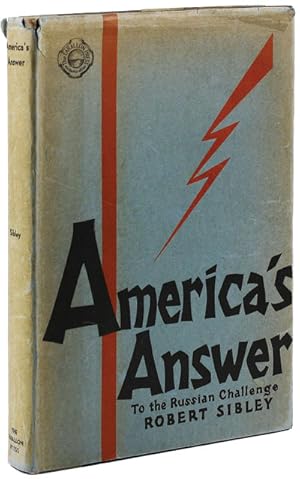
Published by Farallon Press, San Francisco 1931
- Signed
Seller: Lorne Bair Rare Books, ABAA, Winchester, VA, U.S.A.Lorne Bair Rare Books, ABAA
Contact seller5-star sellerdj. First, Limited Edition. Number 91 of an unspecified limitation. Hand-numbered and signed by the author on copyright page. Large octavo (25cm); original gilt-blocked cloth; dustjacket; 171pp; illus. Brief ownership inscription to front endpaper, else a tight, fine copy. In the original dustjacket, toned on spine and margins w…ith a few short closed tears to extremities, Very Good. The author, a hydroelectric engineer, presents the results of his first-hand survey of Soviet electrification projects in 1930. He concludes that Individualism has and will continue to trump Collectivism on the path to progress. Well-illustrated with halftones and three mounted color plates (reproducing Soviet poster designs); two maps. Signed.

[Joseph Stalin, communist dictator of the Soviet Union.] Printed propaganda: handbill in English, translating text by 'J. STALIN' exhorting his followers to do 'as Lenin taught us'.
Joseph Stalin, communist dictator of the Soviet Union [Lenin; Rabochaya Gazeta, Moscow; Communist Party of Great Britain; propaganda]
Published by No date or place. English s? Translated from letter sent by Stalin in 1925 to the Rabochaya Gazeta Worker's Newspaper Moscow 1920
Seller: Richard M. Ford Ltd, London, , United KingdomRichard M. Ford Ltd
Contact seller5-star sellerCondition: Used
US$ 163.73
US$ 5.96 shippingShips from United Kingdom to U.S.A.Quantity: 1 available
The parallel which Bertrand Russell showed between Marxism and Christianity is apparent in this piece of quasi-religious propaganda, which presumably emanates from the Communist Party of Great Britain. It is printed in red on one side of a 20 x 29 cm piece of shiny paper, scarcely thicker than tracing paper. Lightly aged, and wi…th creasing and wear to extremities. The text, which translates part of a letter sent by Stalin to the Rabochaya Gazeta on the first anniversary of Stalin's death, reads as follows: 'Remember, love and study Lenin, our teacher and leader. / Fight and vanquish the enemies, internal and foreign - as Lenin taught us. / Build the new life, the new existence, the new culture - as Lenin taught us. / Never refuse to do the little things, for from little things are built the big things - this is one of Lenin's important behests. / J. STALIN'. See Image.
- Softcover
Seller: Ursus Rare Books, New York, NY, U.S.A.Ursus Rare Books
Contact seller4-star sellerSOVIET PROPAGANDA DESIGN. Za oboronu SSSR [For Defence of the USSR]. 48 pp., illustrated with 32 full page plates printed in red and black. Small folio, 275 x 200 mm., bound in publisher's wrappers illustrated by Czech artist P. Skala. Moscow: Izdatel'stvo AKHRR: Shkola FZU pri 1-i Obraztsovoi tipografii, 1928. A remarkable coll…ection of Soviet imagery intended as instruction for decorating workers' clubs, reading huts and use during rallies. The illustrations include fully decorated interiors, concepts for 'hands-on' attractions such as a 'rayok' or Russian peep show, shooting galleries, and quiz shows. Most of the imagery is in the constructivist style, but also includes numerous caricatures of western fat cats, fascists, and even a Ku Klux Klan member, which would have been inspiration for costume design. Rare, OCLC finds just one copy at the Bibliotheque Nationale de France. The leaves with illustrations have an even toning from the printing process, else a fine copy with the errata slip and unusually printed on fine thick paper.
- Hardcover
Seller: Ursus Rare Books, New York, NY, U.S.A.Ursus Rare Books
Contact seller4-star sellerSOVIET PROPAGANDA. L'novodstvo, khlopkovodstvo i sakharnaya svekla: Tsvetnye tablitsy. [Cultivation of Flax, Cotton, and Sugar Beet: Colorful Tables.] 4, 25, 34 ills. Oblong folio, 335 x 240 mm., in original cloth portfolio. N.p.: Izd. Narkomzema (1940). A handsome piece of unintentional book illustration. While the illustration…s are largely botanical in nature, the overall effect is more of an illustrated book than a tedious tome extolling Soviet agricultural prowess. Extremely rare with no listing on OCLC.

Nacisticke Nemecko bude dobite v najkratom case - tak sa rozhodli Stalin, Roosevelt a Churchill na krymskej konferencii.
1945 Soviet World War II Anti-Nazi Germany Propaganda Poster in Slovakian
- Signed
- Map
Seller: Geographicus Rare Antique Maps, Brooklyn, NY, U.S.A.Geographicus Rare Antique Maps
Contact seller4-star sellerVery good. Mounted on heavy linen. Size 33.5 x 23.25 Inches. This is a powerful 1945 Slovak-language Soviet World War II propaganda poster heralding the achievements of the Yalta Conference and the Allies' agreement to continue the fight until Germany was defeated. The evocative image set against a bright yellow background featu…res three fists (representing the United States, the United Kingdom, and the Soviet Union) punching a dejected and depressed Hitler. A Nazi swastika is breaking apart in the background. The text reads, 'Nácistické Nemecko bude dobité v najkratom ?ase - tak sa rozhodli Stalin, Roosevelt a Churchill na krymskej konferencii' ('Nazi Germany will be conquered in the shortest possible time - this is what Stalin, Roosevelt, and Churchill decided at the Crimean conference'). The Yalta Conference The Yalta Conference was a meeting between U.S. President Franklin D. Roosevelt, U.K. Prime Minister Winston Churchill, and Soviet General Secretary Joseph Stalin. It occurred at Yalta in Crimea and was held February 4 - 11, 1945. The participants discussed how to shape postwar Europe and declared an intention of self-determination for liberated Europe. Slovakia during World War II On March 14, 1939, an independent Slovakia was declared, emerging out of Hitler's invasion of Czechoslovakia. Slovakia was led by Jozef Tiso, a Catholic priest, and signed a friendship agreement with Nazi Germany. Slovakians fought in the German Army on the Eastern Front for the entirety of the war. In 1944, the Slovak National Uprising broke out and lasted from August 29, 1944, until late October. This forced Nazi Germany to send troops needed on the Eastern Front to secure Slovakia. The Soviet Red Army slowly liberated Slovakia in the spring of 1945 and entered Bratislava in early April, ending collaborationist independent Slovakia. After the end of the war, Czechoslovakia was reestablished. Publication History and Census This poster was published in 1945 by the Soviet government. This is the only known surviving example of the 1945 edition in Slovakian. We are aware of 2 surviving examples of a 1944 Russian language edition, which are held by the Vabamu Museum of Occupations and Freedom in Tallinn, Estonia, and the Boris Yeltsin Presidential Library in St. Petersburg. Signed by Author(s).

. / This service record is a glory to our dear army but at the end of this list there is a space, that can be filled.
1965 Abramov and Dobrovolsky Cold War Soviet Propaganda Broadside
- Map
Seller: Geographicus Rare Antique Maps, Brooklyn, NY, U.S.A.Geographicus Rare Antique Maps
Contact seller4-star sellerGood. Wear along edges. Closed margin tears professionally repaired on verso. Small areas of infill to margins. Closed tear extending two (2) inches in printed area below soldier's face professionally repaired on verso. Size 35.5 x 26.5 Inches. This is a 1965 Mark Abramov and Victor Dobrovolsky Cold War Era Soviet propaganda pos…ter touting the Soviet military achievement. A Soviet soldier, embracing a ballistic missile, unfurls the army 'service record'. The 'service record' takes the form of a scorecard, with commanding generals and leaders of Russia's enemies skewered on bayonets. Most of whom wear pained expressions, and some are easily recognizable, including Kaiser Wilhelm II, Franklin Roosevelt, Winston Churchill, and Hitler, among more stereotypically racist representations of Japanese, Turkish, and Persian potentates. The poster is intended to promote Soviet nationalism and confidence in face of growing anti-Soviet sentiment. The Cold War The Cold War was a geopolitical conflict between the United States and the Soviet Union, and their respective allies, the Western Bloc and the Eastern Bloc, which began following World War II (1939 - 1945). The Cold War is generally considered to have begun with the 1947 Truman Doctrine and ended with the 1991 dissolution of the Soviet Union. During the course of the conflict, both the United States and the Soviet Union developed powerful nuclear arsenals. While there was always a threat of nuclear war, the apocalyptic cost of such an exchange kept both sides from engaging in direct warfare. Instead, with no large-scale engagement, the Cold War was fought through various proxy wars, espionage, propaganda campaigns, embargos, and psychological warfare. Each superpower supported major regional conflicts centered around an ideological and geopolitical struggle for global influence. Publication History and Census This poster was created by Mark Abramov and Victor Dobrovolsky and published by the Military Publishing House of the USSR Ministry of Defense in Moscow in 1965. Per text in the bottom margin, the poster had a circulation of 40,000 copies. We have been unable to locate any cataloged examples in institutional collections and have uncovered only a handful of instances where this poster appeared on the private market.

Les camps de concentration en Union Sovietique. 'Jamais ca en France'. Votez Socialiste S.F.I.O.
1951 French Socialist Party Propaganda Map of the Gulags in the Soviet Union
- Map
Seller: Geographicus Rare Antique Maps, Brooklyn, NY, U.S.A.Geographicus Rare Antique Maps
Contact seller4-star sellerVery good. Mounted on heavy linen. Size 23 x 30 Inches. This is a c. 1951 Section française de l'Internationale ouvrière (French Section of the Workers' International) campaign propaganda poster of the Gulag labor and prison camp network in the Soviet Union. The map depicts the Soviet Union from the Baltic Sea to the Bering Stra…it, highlighting in red the location and extent of the Soviet Russian forced labor camps. The Soviet hammer and sickle mark locally administered camps, while the red dots mark camps under centralized control. The lighter red shades broader forced labor regions. An Anti-Soviet Propaganda Map Perhaps the most widely circulated piece of anti-Soviet Cold War-era propaganda, this is not the first iteration of a Western map of the Gulag network. That work is credited to Polish soldiers Sylvester Mora and Pierre Zwierniak, who created a map to accompany their 1945 book Sprawiedliwo?? Sowiecka [Soviet Justice]. The present map goes far beyond Mora and Zwierniak's work. Influenced by Mora and Zwierniak, a committee of the AFL-CIO (backed by the CIA) commissioned Don Levine, a Russian-American journalist, to create a map that detailed the Gulag network with much more precision. Levine's final product (the central map presented here) first appeared in the September 17, 1951, issue of TIME . Subsequent, separately issued posters were published later, and the central map was distributed around the world. Per the P.J. Mode Collection of Persuasive Cartography at Cornell University, 'thousands of copies were distributed in Latin America (in Spanish) and in Europe (in German, French, and other languages).' Publication History and Census This map was published c. 1951 by the Section française de l'Internationale ouvrière. It is not cataloged in OCLC and is not part of the P.J. Mode Collection at Cornell. We have found only a handful of other instances when it appeared on the private market.


