Order Total (1 Item Items):
Shipping Destination:

Stanley Kubricks Clockwork Orange (2 results)
Skip to main search results
Search filters
Product Type
- All Product Types
- Books (No further results match this refinement)
- Magazines & Periodicals (No further results match this refinement)
- Comics (No further results match this refinement)
- Sheet Music (No further results match this refinement)
- Art, Prints & Posters (No further results match this refinement)
- Photographs (2)
- Maps (No further results match this refinement)
- Manuscripts & Paper Collectibles (No further results match this refinement)
Condition Learn more
- New (No further results match this refinement)
- As New, Fine or Near Fine (No further results match this refinement)
- Very Good or Good (No further results match this refinement)
- Fair or Poor (No further results match this refinement)
- As Described (2)
Binding
- All Bindings
- Hardcover (No further results match this refinement)
- Softcover (No further results match this refinement)
Collectible Attributes
- First Edition (No further results match this refinement)
- Signed (No further results match this refinement)
- Dust Jacket (No further results match this refinement)
- Seller-Supplied Images (2)
- Not Print on Demand (2)
Language (1)
Price
- Any Price
- Under US$ 25 (No further results match this refinement)
- US$ 25 to US$ 50 (No further results match this refinement)
- Over US$ 50
Free Shipping
- Free Shipping to U.S.A. (No further results match this refinement)
Seller Location
Seller Rating
-
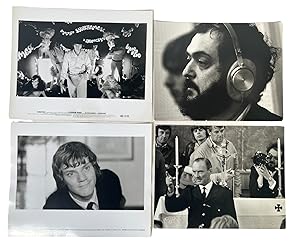
Stanley Kubrick's A Clockwork Orange 1971 Original Vintage Photo Archive
Publication Date: 1971
Seller: Max Rambod Inc, Woodland Hills, CA, U.S.A.
Association Member: ABAA ILAB PADA
Seller rating 5 out of 5 stars

Photograph
[Film] Stanley Kubrick's A Clockwork Orange. Archive of 4 Original Vintage silver gelatin photographs used as lobby cards in movie theaters. Warner Bros., 1971. All about 8" x 10" in glossy black and white. A Clockwork Orange is a dystopian crime film based on the novel by Anthony Burgess. It follows a social delinquent named Alex and shows violent images to comment on psychiatry, juvenile delinquency and other social, political and economic subjects in a near-future Britain. The film received polarized reviews for its graphic depictions of violence, and was cited as having inspired copycat acts of violence. As a result, the film was removed from British cinemas and was banned in several countries. It was nominated for four Academy Awards including Best Picture in 1972 and is listed on the British Institute's list of the world's greatest films. Several photos feature action shots of Malcolm McDowell as Alex, including one from the iconic opening at the Korova Milkbar. Several others are behind the scenes shots of Stanley Kubrick directing. Two feature production credits along with the date and Warner Bros. logo in the lower white margin. One has an addition caption pasted on the verso: "Alex (MALCOLM McDOWELL) agrees to have his prison sentence commuted to the experimental Ludovico Conditioning Technique" with additional production credits. All in very good condition.
-
Violence, State Control, and Youth Culture in Stanley Kubrick's A Clockwork Orange, 1971
Publication Date: 1971
Seller: Max Rambod Inc, Woodland Hills, CA, U.S.A.
Association Member: ABAA ILAB PADA
Seller rating 5 out of 5 stars
Photograph
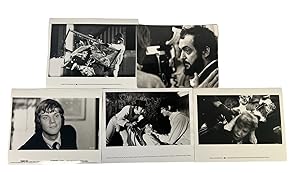
Kubrick, Stanley. A Clockwork Orange (1971) examined state authority, behavioral conditioning, and youth violence within a near-future Britain shaped by social instability and cultural anxiety. Adapted from Anthony Burgess's novel, the film follows a juvenile offender subjected to experimental psychological treatment, presenting explicit depictions of violence alongside institutional attempts at control. Its polarized reception, including withdrawal from exhibition in the United Kingdom and bans in multiple countries, situates the work within debates over censorship, media influence, and the limits of representation. Nominations for four Academy Awards, including Best Picture, further positioned the film within critical and institutional recognition despite ongoing controversy. Stanley Kubrick's A Clockwork Orange. Burbank: Warner Bros., 1971. Archive of 5 original vintage silver gelatin photographic lobby stills. Glossy black-and-white prints measuring approximately 8 x 10 inches. The images include staged scenes featuring Malcolm McDowell as Alex, depicted in his recognizable costume of bowler hat and white attire, often in confrontational or performative poses that emphasize the film's stylized violence and theatrical composition. Several stills present group scenes of youth gangs and moments of physical aggression, while one photograph captures Stanley Kubrick directing on set, providing production context. Most prints retain lower margins with production credits, date, and studio insignia, consistent with their use as theatrical display materials. Produced during a period of heightened concern over crime, youth culture, and state intervention, A Clockwork Orange contributed to broader cultural discourse on free will, punishment, and media effects. Its continued inclusion in critical rankings of major films underscores its lasting interpretive significance. Light handling wear with minor edge wear; overall very good condition. A cohesive group of exhibition stills associated with one of Kubrick's most debated works.