
Sunqua (6 results)
 More images
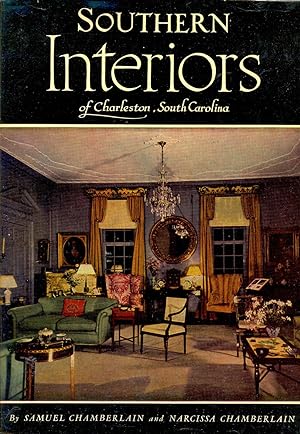
Southern interiors of Charleston, South Carolina [List of Houses Illustrated -- Meeting Street -- Church Street -- Legare Street -- Tradd Street -- Along the Bay Shore -- North of Broad Street -- Neighboring Plantations -- Porch of St. John's Lutheran Church]
Chamberlain, Samuel, 1895-1975. ; Chamberlain, Narcissa G. ; Chamblerain, Narcisse [art, John Berridge, John Audubon, Sunqua, James Montgomery Flagg, John Trumbull, Thomas Sully, Irving Wiles, Etienne Ret, Selinger, Jeremiah Theus, James Earle, Charles Durand, Jarvis, Edward Savage, John Ramage, Benjamin West,
Published by New York : Hastings House, Publishers, 1956 1956
- Hardcover
- First Edition
Seller: Joseph Valles - Books, Stockbridge, GA, U.S.A.Joseph Valles - Books
Contact seller5-star sellerCondition: Used - Fine
US$ 130.00
US$ 16.95 shippingShips within U.S.A.Quantity: 1 available
Hardcover. Condition: Fine. Dust Jacket Condition: Fine. 1st Edition. 172 p. (chiefly illus.) 32 cm. ; LCCN: 56-12014 ; LC: NA7238.C3; Dewey: 729/.24/09757915; 747 ; OCLC: 1871460 ; 314 photographs of Charleston homes and near-by plantations. ; dark red cloth in full color photographic dustjacket ; editied by Narcisse Chamblerla…in ; Contents: List of Houses Illustrated -- Meeting Street -- Church Street -- Legare Street -- Tradd Street -- Along the Bay Shore -- North of Broad Street -- Neighboring Plantations -- Porch of St. John's Lutheran Church ; Featured are The Colonel William Rhett House, The Gaillard-Bennett House, The William Gibbs House, The Nathaniel Russell House, Colonel John Stuart House, Garden of the William Hendricks Buildings, Gateway to St. Michael's Churchyard, The Pirate's House - Church Street, The Spire of St. Philip's Church, John Ashe House, Ashley Hall, Colonel Othniel Beale House, Governor Thomas Bennett House, Daniel Bourget House, Miles Brewton House, Dock Street Theatre, Drayton Hall, John Edwards house, Charles Elliott House, William Elliott House, George Eveleigh House, Thimothy Ford House, Gibbs-Blackwood House, Halidon Hill Plantation, Heyward-Washington House, William Holmes House, Daniel Huger House, Inglis' Arch House, Thomas Legare House, Joseph Manigault House, Medway Plantation, Middleton Place, Jacob Motte House, Mulberry Plantation, Colonel Charles Pinckney House, Judge Robert Pringle House, Robert William Roper House, Thomas Rose House, Seabrook House, Simmons-Edward House, Josiah Smith House, William Mason Smith House, Humphrey Sommers House, Sword Gate House, General William Washington House, Mrs, Jane Weightman's House, Joseph Winthrop House ; very clean copy ; FINE/FINE. Book.
 More images
Published by SunQua Studio, Canton 1830
- Hardcover
Seller: Antipodean Books, Maps & Prints, ABAA, Garrison, NY, U.S.A.Antipodean Books, Maps & Prints, ABAA
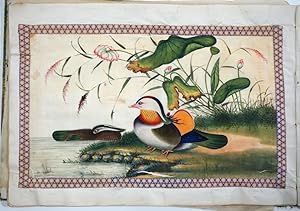
Contact seller3-star sellerSilk covered boards. The 12 bird images are full page, finely done with grass, rocks and flowers with shrubs or trees. Unusually, the half page images are mounted on the verso of the sheets of bird images. The half page images include collections of shells (4); women playing musical instruments (8); men sitting, a scribe, man sm…oking, butcher, melon, fish and vegetable sellers, and a few of the punishment images. Oblong 4to, 8 1/4 x 13 1/4". Leaves mounted with to paper leaves with an unusual paper border with a purple circle pattern on pale background paper. Chinese style binding, opening from the back of the album. Bound in a green, gold, blue and red silk woven in a daisy pattern, which sometimes appears with a Sunqua stamp. Without background painting. The first image with some cracking but not affecting the characters, some slight browning. Most in very good condition.
 More images
Published by SunQua, Canton 1870
- Hardcover
Seller: Antipodean Books, Maps & Prints, ABAA, Garrison, NY, U.S.A.Antipodean Books, Maps & Prints, ABAA
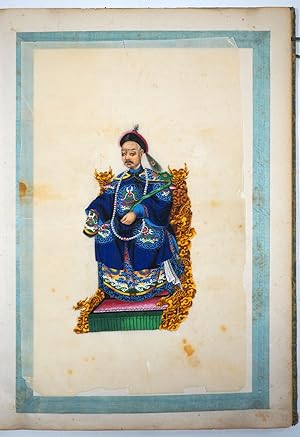
Contact seller4-star sellerSilk covered boards. Condition: Otherwise very good condition. This album bears the red stamp of Sunqua, with border & stars. The nobility include the Emperor and Empress, who are followed by the nobility, men and their women. The painting is particularly fine, with intricate robes and portraits. The National Library of Australi…a in their collection holds a similar but later rendition of this album where they identify the individual paintings. Small folio silk patterned album (14 x 10 1/4") complete with the original silk ties. The green silk is decorated in daisy & vine floral pattern, which is typical of many SunQua albums. Leaves mounted with pale turquoise silk ribbon to paper leaves, with some images floating and no longer within the borders. There are some cracks in the pith paintings, none however affecting the image themselves. Western binding, opening from the right, lightly rubbed on corners & foredge, very good overall.
 More images
- Softcover
- Manuscript
Seller: Bruce Marshall Rare Books, Cheltenham, , United KingdomBruce Marshall Rare Books
Contact seller5-star sellerCondition: Used - Very good
US$ 10,363.68
US$ 5.50 shippingShips from United Kingdom to U.S.A.Quantity: 1 available
Soft cover. Condition: Very Good. [c 1840], Oblong 4to,(310 x 240mm), Original Decorated Silk Binding, Sunqua Label to Endpaper, Twelve leaves with Seventy-Two Watercolours of Exotic Shells on Pith Paper within Blue Silk Borders. Sunqua was one of the most important of the Chinese artists producing pictures and drawings for the…European market. He worked and established studios in both Macao and Canton and is more commonly known for his large oil pictures of the shipping and trade into these great Chinese ports.Pith seems not to have been adopted for painting until about 1820. Some European museums claim that their paintings on pith (often erroneously called "rice paper" or "mulberry pith") come from the end of the eighteenth century but there do not seem to be any dateable examples that are so early. There is a record of the Kaiser Franz of Austria buying some albums from an English Consul-General Watts in 1826. We know of an Italian Count who visited Canton in 1828 and had over 350 paintings on pith in his baggage when he died in Ambon two years later. In the British Library there is a scrap-book containing six pith paintings and a journal entry by a serving British officer who sent them home from India in 1829. These examples and contemporary accounts by visitors to Canton suggest that there was a flourishing trade in pith paintings by the early 1830s. Pith presumably came into use for painting to satisfy the increasing demand for small, inexpensive and easily transported souvenirs, following the massive growth in the China Trade in the first quarter of the nineteenth century. Paintings in oils, on board and canvas were costly and difficult to carry home. Earlier and more prestigious export water-colours had often been on a larger scale and painted on fine Chinese paper or on paper imported from Europe. They may have suited the sea-captains and informed the aristocracy but for the hoi polloy they were too expensive. The albums of pith paintings (and later the little glass-fronted boxes) were inexpensive, light, easy to pack and gave the pictures some protection on the long voyage home. Because many were sold in albums and hence protected from the light, they retain their bright colours to this day. Because of the nature of pith and its cellular structure, the gouache used by the Chinese sat on the surface and produced a bright and even sparkling effect. Very fine detail could be achieved but pith did not lend itself to the flat wash of colour favoured for European watercolours. Developed to appeal to the "foreign barbarian" visitors to China, paintings on pith were produced by artisans rather than by the intellectual elite and they were therefore not accepted as Chinese art. Though there is evidence in these paintings of Western influence - derived in part from the presence of European paint Carl Crossman in his book The Decorative Arts of the China Trade gives an excellent list of export painters with a note of those known to have painted on pith. These include Tingqua, Sunqua and Youqua. From 1757 until 1842 Canton was the only Chinese port open to trade with the west and it is no surprise that of the eight studios identified by Crossman as producing works on pith, six were in Canton. The whereabouts of one was unknown and the eighth was that of Chou Pai Chuen who was exceptional on two counts, firstly because he was a talented artist still painting on pith at the end of the nineteenth century and secondly because his studio was in Peking. It seems that the 1830s and 1840s may have been the heyday of pith painting. The international trading bases, the waterfront 'factories' on the 'Hongs' in Canton, where they were produced, were partially burnt during the First Opium War (1839-41) and totally destroyed in a fire of 1856. The foreign trading companies then moved to Honan and subsequently put up splendid new offices on reclaimed land at Shamian Island.
 More images
Published by [Guangzhou (Canton), 1849
Seller: ASHER Rare Books, t Goy Houten, NetherlandsASHER Rare Books
Contact seller5-star sellerCondition: Used
US$ 10,148.69
US$ 28.98 shippingShips from Netherlands to U.S.A.Quantity: 1 available
Album with twelve beautifully executed Chinese pith paintings, which show the emperor, the empress, and three court officials. The artworks have a consistent style and were clearly all made by the same artist and produced as a series. They are quite large, as the leaves are close to the maximum size that pith paper could be prod…uced in (ca. 30 x 20 cm). The figures, and especially their clothes, have been painted with incredible detail. Due to the fact that the paintings have been mounted in an album, they have kept their vibrant colours, as well as their characteristic three-dimensional quality and velvety texture.Chinese artists seem to have begun making coloured gouache drawings on pith paper in the 1820s, but the genre flourished after China's defeat in the First Opium War (1839-1842) opened the country to foreign trade. Most were produced in the port city Guangzhou (Canton province), where the leading artists Sunqua (fl. 1830-1870) and Tingqua, also known as Guam Lianchang (ca. 1809-1870 or soon after) established their studios. They mixed Chinese and Western styles and catered largely to the new export market. Although six other studios have been identified, Sunqua and Tingqua's studios certainly produced a large percentage of the better quality work. Unfortunately, since pith-paper drawings were rarely signed, few can be attributed to an artist or studio based on documentary evidence. They are most easily identified by a label that is sometimes mounted on the front pastedown of the albums, but is not present here. However, floral silk brocade bindings were apparently typical for Sunqua's studio. We have found other albums with the exact same binding that did come with the Sunqua label. As such, the present paintings can tentatively be attributed to Sunqua's studio. The present album was acquired by Danish Consul Ferdinand Wolff (1814-1893) in 1850. Wolff worked in Manila from 1837 to 1849 and brought the album to Denmark on his way back home.With a Danish annotation ("Hjembragt af Konsul Ferdinand Wolff i 1850" [= Brought home by Consul Ferdinand Wolff in 1850]) on the front pastedown. The corners of the boards are somewhat scuffed, with a vertical tear in the silk at the foot of the spine, the ties have likely been replaced. Most leaves are slightly creased and chipped in the lower margin, all pith paper leaves have small tears and holes around the edges, but never touching the painted image, the work is very lightly foxed throughout. Otherwise in very good condition.l Cf. Williams, I., "Views from the West", in: Arts of Asia XXXI (2001), pp. 140-149; Williams, I., "Painters on pith", in: Arts of Asia XXXIII (2003), pp. 56-66. Contemporary green silk brocade with a floral pattern, pink closing ties. Gouache and gold on pith paper (ca. 26.5 x 17.5 cm), each drawing is mounted by its corners in an album of mulberry-bark(?) paper (ca. 34 x 24 cm) and framed with a light blue silk ribbon. Pages: [12] ll.
 More images
- Hardcover
- Print on Demand
Seller: Gyan Books Pvt. Ltd., Delhi, , IndiaGyan Books Pvt. Ltd.
Contact seller5-star sellerCondition: New
US$ 38.12
Free ShippingShips from India to U.S.A.Quantity: Over 20 available
Leather Bound. Condition: New. Presenting an Exquisite Leather-Bound Edition, expertly crafted with Original Natural Leather that gracefully adorns the spine and corners. The allure continues with Golden Leaf Printing that adds a touch of elegance, while Hand Embossing on the rounded spine lends an artistic flair. This masterpie…ce has been meticulously reprinted in 2025, utilizing the invaluable guidance of the original edition published many years ago in 1800. The contents of this book are presented in classic black and white. Its durability is ensured through a meticulous sewing binding technique, enhancing its longevity. Imprinted on top-tier quality paper. A team of professionals has expertly processed each page, delicately preserving its content without alteration. Due to the vintage nature of these books, every page has been manually restored for legibility. However, in certain instances, occasional blurriness, missing segments, or faint black spots might persist. We sincerely hope for your understanding of the challenges we faced with these books. Recognizing their significance for readers seeking insight into our historical treasure, we've diligently restored and reissued them. Our intention is to offer this valuable resource once again. We eagerly await your feedback, hoping that you'll find it appealing and will generously share your thoughts and recommendations. Pages:- 96, Print on Demand. If it is a multi-volume set, then it is only a single volume. We are specialised in Customisation of books, if you wish to opt different color leather binding, you may contact us. This service is chargeable. Product Disclaimer: Kindly be informed that, owing to the inherent nature of leather as a natural material, minor discolorations or textural variations may be perceptible. Explore the FOLIO EDITION (12x19 Inches): Available Upon Request. 96 96.


