

Order Total (1 Item Items):
Shipping Destination:

Swiss Physicist (5 results)
Skip to main search results
Search filters
Product Type
- All Product Types
- Books (No further results match this refinement)
- Magazines & Periodicals (No further results match this refinement)
- Comics (No further results match this refinement)
- Sheet Music (No further results match this refinement)
- Art, Prints & Posters (No further results match this refinement)
- Photographs (No further results match this refinement)
- Maps (No further results match this refinement)
- Manuscripts & Paper Collectibles (5)
Condition Learn more
- New (No further results match this refinement)
- As New, Fine or Near Fine (1)
- Very Good or Good (No further results match this refinement)
- Fair or Poor (No further results match this refinement)
- As Described (4)
Binding
- All Bindings
- Hardcover (No further results match this refinement)
- Softcover (No further results match this refinement)
Collectible Attributes
- First Edition (No further results match this refinement)
- Signed (3)
- Dust Jacket (No further results match this refinement)
- Seller-Supplied Images (4)
- Not Print on Demand (5)
Language (2)
Price
- Any Price
- Under US$ 25 (No further results match this refinement)
- US$ 25 to US$ 50
- Over US$ 50
Free Shipping
- Free Shipping to U.S.A. (No further results match this refinement)
Seller Location
Seller Rating
-

Autogrammkarte (mit aufgezogenem Illustriertenbild), eigenhändig signiert (dito : Grosses Foto (ca. 13 x 18 cm), eigenhändig signiert Euro 65,-).
-

Heinrich Rohrer (1933-2013) - Signed photo - 2004
Language: French
Publication Date: 2004
Manuscript / Paper Collectible Signed
Pas de couverture. Condition: Bon. Authentic photo signed in 2004. Size : 15x11 cm. Condition : see scans please. Certificate of Authenticity and lifetime guarantee. Signé par l'auteur.
-
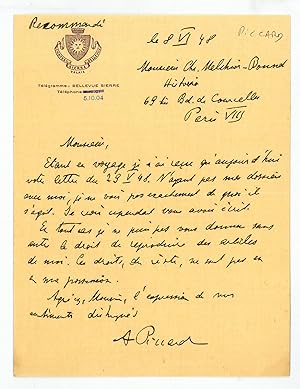
Autograph letter signed.
Published by Sierre (Valais), 8. VI. 1948., 1948
Seller: Antiquariat INLIBRIS Gilhofer Nfg. GmbH, Vienna, A, Austria
Association Member: ILAB PADA VDA VDAO
Seller rating 5 out of 5 stars

Manuscript / Paper Collectible
8vo. 1 p. on bifolium. With autograph envelope. To the historian, journalist, and publicist Christian Melchior-Bonnet (1904-95), informing him that he cannot authorize the republication some of his articles as he is not the rights holder: "Étant en voyage je n'ai reçu qu'aujourd'hui votre lettre du 29 V 48. N'ayant pas mes dossiers avec moi, je ne vois pas exactement de quoi il s'agit. Je crois cependant vous avoir écrit. En tout cas je ne puis pas vous donner sans autres le droit de reproduire des articles de moi. Les droits, du reste, ne sont pas en ma possession [.]". - On stationery with printed letterhead.
-
2 autograph postcards signed ("Pauli").
Published by Goettingen, 15 and 17 Dec. [1921]., 1921
Seller: Antiquariat INLIBRIS Gilhofer Nfg. GmbH, Vienna, A, Austria
Association Member: ILAB PADA VDA VDAO
Seller rating 5 out of 5 stars
Manuscript / Paper Collectible
Altogether 2 pages. Each with autogr. address. 8vo. Two autograph postcards addressed to the German mathematician Gustav Herglotz, the first stating that he looks forward to seeing Herglotz next week in Leipzig, and discussing his scientific questions; the second thanking Herglotz for his postcard, and arranging when to meet him at his house in Leipzig. - In mint condition.
-

ALS. ("W. Pauli").
Published by N.p., November 17, 1949, 1949
Seller: Kotte Autographs GmbH, Roßhaupten, Germany
Association Member: ILAB PADA VDA
Seller rating 5 out of 5 stars
Manuscript / Paper Collectible Signed
2pp. 4to. To the eminent American physicist Joaquin M. Luttinger (1923-1997)."Dear Luttinger, Jost told me about your letter on food questions and radical solutions and mass [?] production in quantum electrodynamics. Only dealing with your spiritual starvation I have to put you a question today, as I want to hear the official answer of the 'Dysonists' [likely a reference to Freeman Dyson]:There is a difference of a factor in the definition of the vacuum-polarization a) Pauli-Villars and b) Feynmann or Jost-Luttinger (all in the e2-approximation). [There follow formulas for a) and b) plus an additional explanation]Neither raised this question here in a discussion (shame on you and Jost, that you did not mention it to me earlier!)This is not due to any computational error, but it is a question of the interpretation of non-observable results (as the self ). Therefore I think it of some interest. The result b) is always obtained if the S-matrix of real scattering process is computed (in contrast to additional currents).I hope to be received by you with enlightening remarks about it. (It is also interesting in this connection that Shafroth does not obtain any charge-renormalization in the Compton-effect). The problem to prove [formula] is still open. In my last letter to you and Jost (I am looking forward with great hopes to the continuation of your 'symbiosis') I was to[o] quick in the discussion of the subtraction of the vacuum contribution in the e2-approximation one obtains for god knows now [?] [formulas plus Luttinger's annotations]Shafroth proved (with help of formulas contained in his doctor-thesis) that the numerators are equal, so that one can immediately the result is negative. But it was not possible for us to guess the correct generalization of this to higher approximations in [Greek symbol].Jost wants to resume this problem when he arrives in December.I leave on Tuesday and will arrive according to schedule on November 29th in New York with Mrs. Pauli. It was great fun to telephone with Oppe [J. Robert Oppenheimer?]. His voice sounded as if he had lost a couple of bets. (As the Washington administration made me miss the boat on Nov. 10th).So I'll see you soon and meanwhile all good wishesFromYoursW. Pauli[There follows a 17-line note in German signed Roby(?)]"The author of a classic text on relativity theory, Pauli received his doctorate in 1922. He soon began work on the Zeeman effect, and within two years had both proposed a new quantum number for electrons and formulated his now-famous "exclusion principle. the crowning conclusion to the old quantum theory," also known as the Pauli Principle, and for which he was awarded the 1945 Nobel Prize in Physics, after being nominated by Albert Einstein, (DSB). Pauli's contributions to quantum physics are difficult to overstate. He postulated the existence of the neutrino, formulated the Pauli matrices and proposed spin theory, one of two forms of angular momentum of elementary particles. Pauli is well known for postulating many of his ideas in letters rather than in published academic works, being unconcerned with getting credit for his theories. He was also known as the "conscience of physics," holding his colleagues and their ideas morally and ethically accountable.After earning his PhD in physics from MIT in 1947, Luttinger was awarded a National Research Council Fellowship for 1948-1949. As such "Luttinger took advantage of a Swiss-American exchange fellowship to become the first American postdoc in Wolfgang Pauli's group at the Swiss Federal Institute of Technology in Zurich after World War II. There, he demonstrated his brilliance in contributions to the just-developed renormalized quantum electrodynamics. Especially noteworthy is his 1948 calculation of the anomalous magnetic moment of the electron, carried out independently of and approximately simultaneously with the calculation by Julian Schwinger," (Joaquin M. Luttinger's obituary in Journal of Statistic.


