
Thirteenth Amendment (3 results)

Published by Press of Bradstreet & Son, [New York 1865
Seller: David M. Lesser, ABAA, Woodbridge, CT, U.S.A.David M. Lesser, ABAA
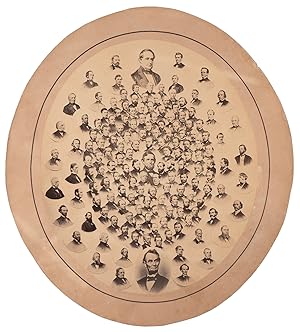
Contact seller5-star sellerOval albumen print, 18" x 20." Photomontage of the Senators and Congressmen who voted for adoption of the Thirteenth Amendment to the Constitution. At the top is Hannibal Hamlin, Schuyler Colfax in the middle, President Lincoln at the bottom. An early owner has written in pencil, in the lower margin, "Congress that voted out sla…very." The image is clear, with blank margins exhibiting light chipping and wear. Included with the photograph is a later print titled "Anti-Slavery Constitutional Amendment Picture," which lists the names of the Representatives and Senators in numerical order corresponding to their positions in the photomontage. The "Key" is a broadside 11" x 13-3/8." It names each person in numerical order corresponding to their positions in the photomontage. Light wear, toning, spotted at the bottom margin, repairs affecting a few words. This image was available as early as August 1865, and became popular as "The Great National Picture" and the "Anti-Slavery Constitutional Amendment Picture.".
 More images
Published by Powell and Co, New York 1865
Seller: James Cummins Bookseller, ABAA, New York, NY, U.S.A.James Cummins Bookseller, ABAA
Contact seller5-star sellerSingle oval silver albumen photomontage, 10 x 8 3/4 inches, mounted on a larger sheet with tinted background, 13 1/2 x 10 1/2 inches overall. The sign 11x14 inches. A photographic montage featuring portraits (mostly from Mathew Brady's studio) of Lincoln, Vice President Hamlin, and the 157 senators and congressmen who voted to p…ass the Thirteenth Amendment, abolishing slavery. The man in the center of the montage is Schuyler Colfax, the journalist and representative from Indiana who became Vice President under Andrew Johnson. This photomontage became quite popular at the time, and was also printed in a much smaller stereocard format measuring about three by two and a half inches. An identification key to the figures in this photograph was printed separately. An uncommon contemporary tribute to the men who finally brought an end to slavery in the United States, with copies at Cornell, the Morgan, National Portrait Gallery, Gilder Lehrman Institute, University of Rochester, and Henry Ford Museum. The creator of this montage, George May Powell, was a man of diverse talents and influence. He served as founder of the Evangelical Press Association and Oriental Topographical Corps (where he led an expedition through Egypt and North Africa to create educational maps of Palestine and the Holy Land for school children), was president of the National Forest Council and Intensive Agricultural Society, and ran unsuccessfully for congress on the Prohibition ticket. He was also a long-time supporter of President Lincoln and worked in the Treasury Department during the Civil War. The accompanying point-of-sale broadside for this "Great National Picture" scarce if not unique. Very minor soiling and staining Single oval silver albumen photomontage, 10 x 8 3/4 inches, mounted on a larger sheet with tinted background, 13 1/2 x 10 1/2 inches overall. The sign 11x14 inches.
Published by New York, N.Y. 1865
Seller: Seth Kaller Inc., White Plains, NY, U.S.A.Seth Kaller Inc.
Contact seller5-star sellerCondition: Used - Very good
US$ 2,200.00
US$ 3.00 shippingShips within U.S.A.Quantity: 1 available
No binding. Condition: Very Good. Photomontage of the Congressional supporters of the Thirteenth Amendment, which ended slavery in the United States. Composite oval albumen photograph, 13 3/4 x 16 in., credited in negative, on the original mount, 18 1/8 x 20 1/4 in. New York: G. M. Powell and Co., 1865. Manuscript annotation on…verso: George May Powell / Great National Picture / Photograph of Members of United States House of Representatives and the Senate who voted Aye on Resolution to amend the Constitution of the United States so as to prohibit slavery. Passed Senate April 1864. Passed House of Representatives January 1866 [1865]. Abraham Lincoln " president. "Neither slavery nor involuntary servitude.shall exist within the United States." This intriguing composite photograph depicts the Senators and Congressmen who voted in favor of the Thirteenth Amendment to the U.S. Constitution, as well as President Abraham Lincoln (bottom center) and Vice President Hannibal Hamlin (top center). In the center is Speaker of the House Schuyler Colfax of Indiana, surrounded by individual images of members of the House of Representatives. In two outer ovals appear individual images of the Senators who voted for the Amendment.When the Amendment passed Congress, Schuyler Colfax signed the amendment as Speaker of the House, and Vice President Hannibal Hamlin signed it as the President of the Senate. Colfax considered February 1, 1865, the day he signed the House resolution, the happiest day of his life. Although he did not need to do so, President Abraham Lincoln added his approval and signature on February 1, making it the only successful amendment signed by a U.S. President.This composite photograph was available as early as August 1865, when Powell was advertising for male and female "canvassers" to sell it, promising earnings as high as $125 to $200 per month. It became very popular as "The Great National Picture" and the "Anti-Slavery Constitutional Amendment Picture." Hailed by The Liberator as "a triumph of art," the editors insisted that it "should be framed by every loyal family."[1]This composite photograph was still offered for sale at the National Fair in Washington, D.C. in June 1866. A local newspaper declared, "The likenesses are excellent, and as the picture is patented and not for sale at other places of resort in this city, it would be wise for all interested in it to avail themselves of this opportunity to secure a great national historical picture, interesting not for the present only but also for all time." A Massachusetts newspaper praised it a few months later as "an elegant parlor ornament."[2]Historical BackgroundAs the culmination of wartime measures against slavery, the Thirteenth Amendment completed the destruction of slavery in the United States. Passed by the U.S. Senate in April 1864, it did not pass the House of Representatives until January 31, 1865, by a lame-duck session of the 38th Congress before many members gave up their seats to new members in March 1865. Fearing that his Emancipation Proclamation might not withstand a legal challenge, President Abraham Lincoln urged the House to pass the amendment in his December 6, 1864, annual message, and he lobbied several members directly to support the measure. On January 31, 1865, the amendment passed the House by a vote of 119 to 56, with 8 members abstaining, meeting the required two-thirds majority by only two votes. Speaker of House Colfax announced, "The constitutional majority of two thirds having voted in the affirmative, the Joint Resolution is passed." After Colfax's announcement, "a moment of silence succeeded, and then, from floor and galleries, burst a simultaneous shout of joy and triumph, spontaneous, irrepressible and uncontrollable, swelling and prolonged in one vast volume of reverberating thunder." Secretary of State William H. Seward forwarded this amendment to the states on February 1. Eighteen states ratified the amendment in Fe. (See website for full description). Photograph.


