
Thomson Ramsay J (5 results)

Language: English
Published by South Africa: Central News Agency, Ltd, 1950
- Hardcover
Seller: Chapter 1, Johannesburg, GAU, South AfricaChapter 1
Contact seller5-star sellerCondition: Used - Very good
US$ 18.00
US$ 28.60 shippingShips from South Africa to U.S.A.Quantity: 1 available
Hardcover. Condition: Very Good. No Jacket. Reprint . Heavy book may require extra postage unless posted within South Africa. Reprint, 1950. Publication of 460 pages. The boards are a little shelf rubbed. Internally the pages are clean and complete. The binding is excellent. GK. Our orders are shipped using tracked courier deliv…ery services.
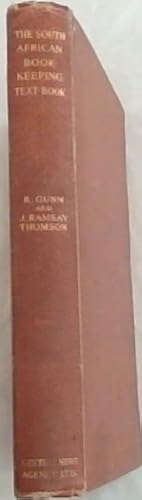
Published by South Africa: Central News Agency, Ltd, 1935
- Hardcover
- First Edition
Seller: Chapter 1, Johannesburg, GAU, South AfricaChapter 1
Contact seller5-star sellerCondition: Used - Very good
US$ 18.00
US$ 28.60 shippingShips from South Africa to U.S.A.Quantity: 1 available
Hardcover. Condition: Very Good. No Jacket. First Edition. Name of the previous owner. There is gilt on the spine of the book. The boards are a little shelf rubbed. The cloth on the spine of the book is slightly frayed. There are minor pencil annotations within the book, the text is bright and clear. The binding is excellent. GK…. Our orders are shipped using tracked courier delivery services.

Published by Central News Agency, Johannesburg, 1946
- Hardcover
Seller: Snookerybooks, Philippolis, South AfricaSnookerybooks
Contact seller5-star sellerCondition: Used - Good
US$ 20.00
US$ 28.60 shippingShips from South Africa to U.S.A.Quantity: 1 available
Hardcover. Condition: Good. 6th ed. Ex-lib with usual trappings. 464pp. with very occasional small pencil marks. A few pages towards the back creased at the top corner. Spine edges rubbed and corners bumped.
 More images
Published by Jonathan Cape, London 1931, 1931
- Hardcover
- First Edition
Seller: ROBIN SUMMERS BOOKS LTD, Aldeburgh, United KingdomROBIN SUMMERS BOOKS LTD
Contact seller5-star sellerCondition: Used - Very good
US$ 82.53
US$ 38.73 shippingShips from United Kingdom to U.S.A.Quantity: 1 available
Condition: Very Good. First edition thus. Hardback. Original green cloth slightly marked and faded, otherwise a sound, very good copy. No dust jacket. Bookplate of the Countess of Warwick to pastedown. New edition with Introduction.
 More images
FREDERICK GARDNER COTTRELL | 46 SIGNED LETTERS FROM 1911-1941 [34 TLS, 12 ALS] FROM SEVERAL FIGURES OF NOTE, INCLUDING THOMAS EDISON, WOODROW WILSON, ALEXANDER GRAHAM BELL, HERBERT HOOVER, NITOBE INAZ?, AND MORE
Cottrell, Frederick Gardner; Bell, Alexander Graham; Edison, Thomas; Thomson, Joseph John; Ramsay, William; Hoover, Herbert; Wilson, Woodrow; Compton, Karl T.; Ogden, C. K. [Charles Kay]; Cecil, Robert; Nitobe, Inaz?; Robertson, Thorburn Brailsford; Dern, George Henry; Jefferies, E. A. W.; Sproul, Robert G.; Wallace, Henry C.; Pinchot, Gifford; Hutchings, W. W.; Hale, George E.; Jardine, W. M. [William Marion]; Claude, Georges; Norris, George W.; Smith, George Otis; Van de Graaff, R. J. [Robert]; Doherty, Henry L.; Conti, Piero Ginori; Stevenson, Adlai E.; Bush, Vannevar; Acheson, Dean G.; Hammond, John Hays; Baruch, Bernard M.; Eastman, George; Boving, J. O. [Jens Orten]; Korzybski, Alfred
Published by 1911-1941, 1911
- Hardcover
- Signed
Seller: Second Story Books, ABAA, Rockville, MD, U.S.A.Second Story Books, ABAA
Contact seller4-star seller46 signed letters [34 TLS, 12 ALS] comprising decades of correspondence between Frederick Gardner Cottrell and various notable figures of his day in U.S. politics, the international science community, and academia. All letters are housed in new archival mylar sleeves. Cottrell was a notable chemist, inventor, and philanthropist,… best known today for his invention of the electrostatic precipitator - one of the first inventions to combat air pollution - and his founding of the Research Corporation for Science Advancement, which used the revenue from the electrostatic precipitator to fund further scientific research, and continues to do so today. While best remembered for these feats, Cottrell had a long and influential career both in the U.S. Federal Government and as a science consultant. He was well known nationally and internationally - in industry, in government, and in academia - for his support of and contributions to new ideas and new talent within the scientific community. The letters, which span from 1901-1941, track Cottrell over the course of 40 years, and evidence the many relationships he had over that period with some of the most influential people of the time. These include a letter of introduction from Alexander Graham Bell, a discussion of chemistry with Thomas Edison, replies from two Nobel Prize winning scientists - the discoverer of the noble gasses, William Ramsay, and discoverer of the electron, J. J. Thomson - to Cottrell's request to study in their labs, and exchanges with two presidents, Herbert Hoover and Woodrow Wilson. Other letters show his personal interactions with leading scientists of his day (Robert J. Van de Graaff, Georges Claude, George E. Hale) and heads of industry (Henry L. Doherty, Ivy Lee), and track the path of his career through his time as the director of the Bureau of Mines; to chairman of the Division of Chemistry and Chemical Technology on the National Research Council; to head of the U.S. Department of Agriculture's Fixed Nitrogen Research Lab, and beyond. These letters, the vast majority of which were sent by these notable figures to Cottrell, evidence his expertise, the depth and breadth of his professional interests, and his eagerness to collaborate and share research and ideas, coming together to trace the life of a man whose work was and continues to be consequential to the advancement of science as a whole. Shelved case 1. CONTENTS: 1-Page TLS from inventor of the telephone Alexander Graham Bell to a Mr. Fish, dated December 20, 1911, introducing Cottrell to him. In Very Good condition. In this letter, Bell is writing in his capacity as Regent of the Smithsonian Institution. On 1331 Connecticut Avenue letterhead. Faintly creased, with mild wrinkling along the edges. Signed in black ink by Bell: "Alexander Graham Bell". 1-page TLS from inventor of the light bulb Thomas Edison to Cottrell dated January 13, 1925, discussing the unexpected results of a past chemistry experiment of his in relation to the generation of ammonia. In Very Good condition. TLS is on Edison's personal letterhead ("From the Laboratory of Thomas A. Edison"). Lightly age toned, with some wrinkling and small closed tears along the top edge. Faintly creased from past folding. Signed by Edison in black ink: "Thos. A. Edison". Includes a lightly soiled 1-page facsimile of Cottrell's reply. 2-page ALS from Nobel Prize winning physicist Joseph John Thomson to an unnamed recipient, likely Cottrell, dated July 6, 1901, discussing the possibility of Cottrell coming to study at Thomson's lab. In Very Good condition. In 1901, Cottrell would have been studying in Europe at the University of Berlin, seeking to study in the laboratory of an accomplished scientist. Thomson was already a figure of some renown for his 1897 discovery of the electron, which represented the first identification of a subatomic particle, and would be awarded the 1906 Nobel Prize in Physics in recognition of his work. ALS is on Cavendish Laborat. Signed.


