Order Total (1 Item Items):
Shipping Destination:

Tintin Comic Drawing (3 results)
Skip to main search results
Search filters
Product Type
- All Product Types
- Books (1)
- Magazines & Periodicals (No further results match this refinement)
- Comics (No further results match this refinement)
- Sheet Music (No further results match this refinement)
- Art, Prints & Posters (2)
- Photographs (No further results match this refinement)
- Maps (No further results match this refinement)
- Manuscripts & Paper Collectibles (No further results match this refinement)
Condition Learn more
- New (No further results match this refinement)
- As New, Fine or Near Fine (No further results match this refinement)
- Very Good or Good (No further results match this refinement)
- Fair or Poor (No further results match this refinement)
- As Described (3)
Binding
- All Bindings
- Hardcover (No further results match this refinement)
- Softcover (No further results match this refinement)
Collectible Attributes
- First Edition (No further results match this refinement)
- Signed (No further results match this refinement)
- Dust Jacket (No further results match this refinement)
- Seller-Supplied Images (3)
- Not Print on Demand (3)
Language (1)
Price
- Any Price
- Under US$ 25 (No further results match this refinement)
- US$ 25 to US$ 50 (No further results match this refinement)
- Over US$ 50
Free Shipping
- Free Shipping to U.S.A. (No further results match this refinement)
Seller Location
Seller Rating
-
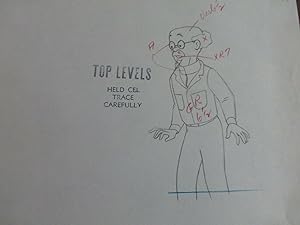
Graphic Art and Animation Process Hergé Professor Calculus Model Drawing from Tintin Studio Production 1959
Publication Date: 1959
Seller: Max Rambod Inc, Woodland Hills, CA, U.S.A.
Association Member: ABAA ILAB PADA
Seller rating 5 out of 5 stars

Art / Print / Poster
Hergé (Georges Remi). Original animation production drawing of Professor Calculus from the Tintin series, circa 1959 to early 1960s, documents the adaptation of a central scientific character into early television animation during a period of heightened public interest in technological innovation and space exploration. Produced at Belvision Studios under the supervision of Hergé and collaborators including Ray Goossens and Greg, the drawing reflects the translation of the professor figure-known in French as Tryphon Tournesol-into a standardized animated form. As the inventor of key narrative technologies such as the lunar rocket in Destination Moon, the character embodies mid-twentieth-century cultural fascination with science and invention. The drawing supports research into animation history, comic-to-screen adaptation, and representations of scientific expertise in popular media. Hergé (Georges Remi). Original animation production drawing of Professor Calculus. Belvision Studios, circa 1959 to early 1960s. Pencil and red grease pencil on studio animation sheet measuring approximately 12" x 10.5", with the figure drawing approximately 3" to 5". The image depicts Professor Calculus in work overalls, rendered in graphite with red pencil corrections and production annotations. A stamped instruction at the top reads "Held cels - trace carefully," consistent with cel animation workflow. Additional notations include "P1" at the lower right, indicating character reference, and a production code "T12 / 34," corresponding to studio filing and sequencing practices. The sheet represents an original working element used in the frame-by-frame construction of animated sequences. Created during the first wave of Tintin television adaptations, initiated in 1959 and broadcast internationally beginning in the early 1960s, the drawing reflects the expansion of European comic characters into global media circulation, including distribution in North America and the United Kingdom. The inclusion of Professor Calculus as a central figure in these adaptations underscores the narrative emphasis on scientific invention during the era, particularly in stories connected to space exploration. Surviving production drawings from this process provide material evidence of animation techniques, including model standardization, iterative correction, and cross-studio collaboration involving European and American production teams. Light handling wear; annotations clear and legible; overall in very good condition.
-
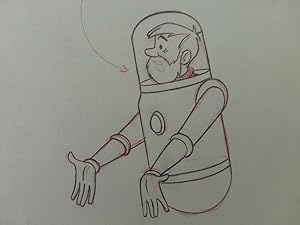
European Comics and Animation History Tintin Captain Haddock Production Drawing Belvision Studios 1959 to 1964 Space Adaptation
Publication Date: 1959
Seller: Max Rambod Inc, Woodland Hills, CA, U.S.A.
Association Member: ABAA ILAB PADA
Seller rating 5 out of 5 stars
Art / Print / Poster
Hergé (Georges Remi). Original animation production drawing of Captain Haddock from Explorers on the Moon, circa 1959 to early 1960s, documents the translation of a major European comic character into televised animation during the early Cold War period of scientific and cultural interest in space exploration. Produced at Belvision Studios under the supervision of Hergé and collaborators including Ray Goossens and Greg, the drawing reflects the application of the ligne claire style within a studio system that standardized character design for animated sequences. The material supports research into mid-twentieth-century animation practices, the international expansion of Tintin as a media property, and the visual culture of early space-themed storytelling. Hergé (Georges Remi). Original animation production drawing of Captain Haddock. Belvision Studios, circa 1959 to early 1960s. Pencil and red grease pencil on studio animation sheet measuring approximately 12" x 10.5", with the drawing itself approximately 3" to 5". The image depicts Captain Haddock in a space suit with a glass helmet, rendered in graphite with red pencil corrections and contour adjustments. Handwritten production notations appear on the sheet, including a stamped instruction reading "Held cels - trace carefully," consistent with animation workflow and cel transfer processes. The drawing represents an original working element used in the production of animated episodes adapting the Tintin lunar narrative. Created during the first television adaptations of Tintin, which began production in 1959 and were broadcast internationally beginning in the early 1960s, the drawing reflects the broader movement of European comics into global media circulation, including distribution across North America and the United Kingdom. The lunar storyline, developed in Destination Moon and Explorers on the Moon, aligned with contemporary public interest in space travel prior to human lunar landing, situating the animation within wider Cold War scientific imagination. Surviving production drawings from this process provide direct evidence of the labor and technical procedures behind early television animation. Light handling wear; annotations clear; overall in very good condition.
-
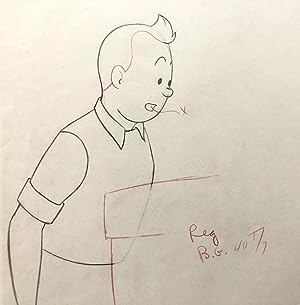
Animation History Hergé Tintin Original Production Drawing 1959 Belvision Studio Artwork for Early Television Adaptation
Publication Date: 1959
Seller: Max Rambod Inc, Woodland Hills, CA, U.S.A.
Association Member: ABAA ILAB PADA
Seller rating 5 out of 5 stars
Hergé. Original animation production drawing, 1959, created for the early animated adaptation of The Adventures of Tintin, documenting mid twentieth century European animation practices and the translation of comic characters into television format. Produced under the supervision of Hergé and within the Belvision studio system, the drawing reflects the development of animated serial production following a 1959 agreement with American producer Larry Harmon. The work contributes to research on comics to screen adaptation, studio animation processes, and the international circulation of European characters through broadcast media in the early television era. Hergé. The Adventures of Tintin. Belvision Studios, 1959. Original pencil production drawing on animation paper depicting Tintin in a head and upper torso composition. The sheet includes handwritten production notations in red and black pencil, indicating its function within the animation workflow. Such drawings were created as part of the sequential process used to produce animated episodes and were not intended for public distribution, serving instead as internal studio materials. The scale of the figure is larger than many comparable production drawings, offering a detailed rendering of the character's facial expression and posture. Produced at the outset of Tintin's animated adaptations, which aired internationally beginning in the early 1960s on networks including the BBC and North American television, this drawing situates itself within the expansion of television animation and the global dissemination of European graphic narratives. The collaboration between Belvision and American producers reflects broader patterns of transatlantic media exchange during this period. Original production drawings provide primary evidence of animation techniques, including character modeling and frame development, and are often preserved only in limited numbers due to their utilitarian use. Light handling wear with clear image and annotations; overall very good. A well preserved example of early Tintin animation production material.