
Tintype (24 results)

Language: English
Published by University of Iowa, Iowa City 1992
- Softcover
- First Edition
Seller: Clayton Fine Books, Shepherdstown, WV, U.S.A.Clayton Fine Books
Contact seller4-star sellerCondition: Used - Near fine
US$ 25.00
US$ 6.00 shippingShips within U.S.A.Quantity: 1 available
Soft cover. Condition: Near Fine. First Edition. Near fine in original wrappers. Back cover: A late 1850s tintype of Walt Whitman? (illustrator).
Seller: Xerxes Fine and Rare Books and Documents, Glen Head, NY, U.S.A.Xerxes Fine and Rare Books and Documents
Contact seller5-star sellerCondition: Used - Very good
US$ 29.00
US$ 5.95 shippingShips within U.S.A.Quantity: 1 available
Condition: VG. Tintype is 2-1/2 x 3 inches and framed under glass in oval copper matting with copper frame all around. Likely once was housed in wooden clamcase (clamcase now missing.) VG. Very nice strong image of young woman in a Spanish mantilla-type headpiece with very wide ribbon ties, her hands clasped serenely in her lap.… Ephemera.
Seller: Xerxes Fine and Rare Books and Documents, Glen Head, NY, U.S.A.Xerxes Fine and Rare Books and Documents
Contact seller5-star sellerCondition: Used - Very good
US$ 29.00
US$ 5.95 shippingShips within U.S.A.Quantity: 1 available
Condition: VG. Tintype is 2-1/2 x 3 inches and framed under glass in oval copper matting with copper frame all around. Held in bottom half of wooden clamshell (top half missing.) Nice strong image. Hair parted in middle with corsetted waist, broach at neckline where wide white collar buttoned. VG. ephemera.
- First Edition
Seller: Xerxes Fine and Rare Books and Documents, Glen Head, NY, U.S.A.Xerxes Fine and Rare Books and Documents
Contact seller5-star sellerCondition: Used - Very good
US$ 50.00
US$ 5.95 shippingShips within U.S.A.Quantity: 1 available
Condition: VG. Original tintype photograph of woman aged about 15 years, from chest up, described on verso as "Mother, about 1874". First edition. Tintype housed in original white paper sleeve 2-1/3 x 3-3/4 inches. Printed on verso is information about the photographer: "Chas. Leach, successor to Leach & Edkins' Celebrated Galle…ry 159 Baltimore Street, between Calvert & Light S's. Baltimore, MD." Light red rouging of Mother's cheek. VG.
- First Edition
Seller: Xerxes Fine and Rare Books and Documents, Glen Head, NY, U.S.A.Xerxes Fine and Rare Books and Documents
Contact seller5-star sellerCondition: Used - Good
US$ 60.00
US$ 5.95 shippingShips within U.S.A.Quantity: 1 available
Condition: Good. Original tintype photograph of man aged about 30 years, from waist up wearing what looks like a train conductor's cap ? On verso in ink is written: Haverhill, June 13, 1868. First edition. Tintype housed in original white paper sleeve 2-1/2 x 3-7/8 inches. Sleeve is lightly toned. Faint horizontal bend in tintyp…e . Cheeks hand-rouged. Good plus.
 More images
- Hardcover
- Photo
Seller: Max Rambod Inc, Woodland Hills, CA, U.S.A.Max Rambod Inc
Contact seller5-star seller19 century Tintype photograph of African American gentleman wearing a bowler hat. 2.5" x 3.5." Housed in brown leather booklet. Close-up black & white photograph of a young African American man in a white shirt and an overcoat and boler hat; he looks directly at the camera and appears rather forlorn. Corners snipped from when it… was placed in an album, very good condition.
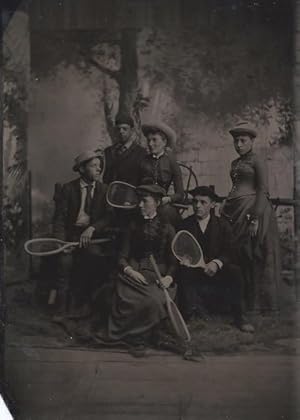
Published by E. L. Merrow late-19th century, Bethlehem, NH
Seller: Sanctuary Books, A.B.A.A., New York, NY, U.S.A.Sanctuary Books, A.B.A.A.
Contact seller5-star sellerCondition: Used - Near fine
US$ 300.00
US$ 5.00 shippingShips within U.S.A.Quantity: 1 available
Ephemera. Condition: Near Fine. Tintype (88 x 130 mm) group portrait of 3 men and 3 women, in a photography studio, 4 of them holding tennis rackets. Tintype is in excellent condition, out of (but sold with) its original mount, which reveals it to be the work of E. L. Merrow of Bethlehem, New Hampshire. (Mount is water-damaged a…nd a bit chipped.).

- Hardcover
- Photo
Seller: Max Rambod Inc, Woodland Hills, CA, U.S.A.Max Rambod Inc
Contact seller5-star seller19 century tintype photograph of dapper African American man. 2.5" x 4." Close up photoportrait of a young African American man dressed in a three-piece suit. A white ribbon is pinned to his lapel. He gazes at the camera with a solemn, relaxed expression. Photograph is bordered by a white embossed oval paper mat. Very good contr…ast and condition.

- Hardcover
- Photo
Seller: Max Rambod Inc, Woodland Hills, CA, U.S.A.Max Rambod Inc
Contact seller5-star seller19 century set of 2 tintype photographs of an African American man and woman. Each measure 1.5" x 1" One is a close-up photograph of a young man wearing a fancy three piece suit, high collar shirt with tie and a cloth hat. The chain of a pocketwatch drapes from behind the lapel of his coat. He looks confidently at the camera, we…aring a dignified and serious expression. The other is a close-up photograph of a woman, probably his wife. She wears an elegant puffy-sleeved gown with a high collar that appears to be made of velvet. Her feminine brimless cap has a feather on it, and she has pinned a brooch to her chest. She, too, gazes confidently and directly at the camera. However, she smiles slightly, a playful look in her eye. Very interesting set of small gem tintype photos. Both in very good condition.
- First Edition
Seller: Xerxes Fine and Rare Books and Documents, Glen Head, NY, U.S.A.Xerxes Fine and Rare Books and Documents
Contact seller5-star sellerCondition: Used - Good
US$ 95.00
US$ 5.95 shippingShips within U.S.A.Quantity: 1 available
Condition: Good. Original tintype photograph of man aged about 30 years, from chest up, described on verso as "David Miller." c. 1875. First edition. Tintype housed in original white paper sleeve 2-1/4 x 3-3/4 inches. Name "David Miller" is written in pencil on verso. Printed on verso is information about the photographer: H. W.… Piffar's Photography Gallery __ & 93 Broadway, Brooklyn." Good.
ORIGINAL TINTYPE PHOTOGRAPH OF CIVIL WAR UNION SOLDIER HENRY D DALTON WEARING A UNION ARMY HAT 1861
Dalton, Henry D. or possibly G H Achley ? (original tintype photograph portrait)
Seller: Xerxes Fine and Rare Books and Documents, Glen Head, NY, U.S.A.Xerxes Fine and Rare Books and Documents
Contact seller5-star sellerCondition: Used - Fine
US$ 200.00
US$ 5.95 shippingShips within U.S.A.Quantity: 1 available
Condition: Fine. Original photograph (appears to be a tintype) of a man we assume to be Henry D. Dalton as there is a tightly folded-up piece of very old paper underneath the image which reads: "1861 Nov 27. Albany Barracks. Rec'd of G Achley $100 in cash I promise to pay as soon as i receive my pay from w. Barber, signed Henry…D Dalton" below this in a different hand is written "Received G H Achley." (all mss is in pencil) The tintype shows a seated man with lightly rouged cheeks wearing some type of uniform hat. Man appears to be about 25 years old. Image surrounded by original fancy copper oval frame. Housed in bottom half of its original old wooden clamshell box. Tintype is Fine; frame is Fine; wooden box holding tintype is lacking top half with metal clasp present.
- Photo
Seller: Max Rambod Inc, Woodland Hills, CA, U.S.A.Max Rambod Inc
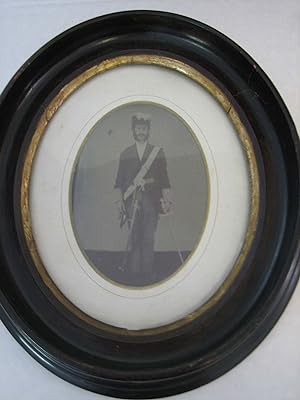
Contact seller5-star sellerA large Civil War 3/4 plate tintype, measures 5" x 7", of a Navy chaplain in full uniform with his sword pulled out of his rapier and in his hand. He has his dress uniform chapeaux with feathers on his head and a white sash with a chaplain medal in the center. There are crosses on his cuffs, sash and belt buckle. A clean image w…ith some minor cracking to the emulation barely noticeable. In an oval matte and original oval wood frame.

- Photo
Seller: Max Rambod Inc, Woodland Hills, CA, U.S.A.Max Rambod Inc
Contact seller5-star sellerTintype showing Mexican woman's seated portrait. Circa 19th century. Measures 2.5" x 3.5". Image shows a seated Mexican woman wrapped in traditional Aztec patterned sarape blanket. Her expression is stoic and her gaze intense. Her hair is pulled back with a ringlet peaking from her left, a common hairstyle in the mid 1800s. Tint…ypes, original photographic images printed on thin sheets of metal coated with a dark lacquer or enamel, were invented in 1855 and popularized through the 1870s when they were replaced by new technology in albumen prints. This photo was taken within only a couple decades of Mexico receiving their independence. In 1811, women made up a third of the identified labor force and were oftentimes single and head of the household, even through their major contributions to Mexican society, they were still not recognized in the 1811 census. Photography was one of the few ways to recognize a woman's personhood at a time they were unfairly represented. Top corners of photo clipped. Overall very good condition.
- Photo
Seller: Max Rambod Inc, Woodland Hills, CA, U.S.A.Max Rambod Inc
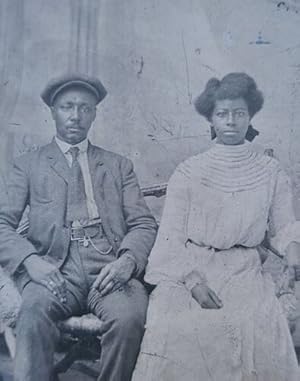
Contact seller5-star seller19th century Tintype photograph of handsome African American couple. 2.5" x 3.5." An African American man and woman sit beside one another on a loveseat. The man wears a suit and tie and a flat cap; the chain of his small pocketwatch can be seen draping from his sportcoat. The young woman wears a high-collared white gown with a…tiered hemline. Her hair is tied back with a black ribbon tied in a bow. They appear relaxed, yet very serious. The man leans back slightly with his hands in his lap; the two seem to be very natural in their formal dress. Very good condition.
- Photo
Seller: Max Rambod Inc, Woodland Hills, CA, U.S.A.Max Rambod Inc
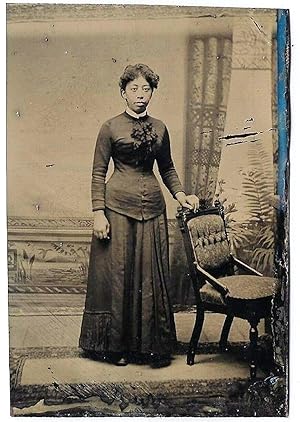
Contact seller5-star seller19th century Tintype photograph of lovely young African American woman. Size 3.5" x 2.5." A young woman wearing a fashionable two-piece gown stands upright. Her dress has a high collar, with intricate ruffles along the bodice. She rests one hand on the back of a cushioned chair and looks directly in the camera. The room or studi…o background behind her appears ornate, with indoor plants, thick brocade curtains, and a hand painted mural on the wall. Very good contrast and condition.

- Photo
Seller: Max Rambod Inc, Woodland Hills, CA, U.S.A.Max Rambod Inc
Contact seller5-star seller19th century tintype photograph of African American man with goatee. Measures 4" x 2.5." Sitting photo portrait of an African American gentleman wearing a fasionable vest and sportcoat. Despite his fine clothing, he appears tired and worn; perhaps he has endured a difficult life. He is seated and rests his hands in his lap, gazi…ng directly at the camera. Photograph has three small scratches, otherwise in very good condition.
- Photo
Seller: Max Rambod Inc, Woodland Hills, CA, U.S.A.Max Rambod Inc
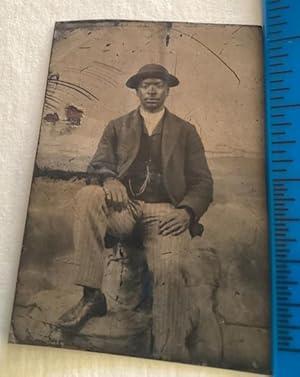
Contact seller5-star seller19th century Tintype Photograph of African American man wearing pinstripe pants and cap. Circa late 1800s. Measures at 1 1/2" x 2 14". The emancipation of slaves and the 13th amendment in 1865 coincided with tintypes' popularity. This image portrays the recently found freedom of African Americans in the post-Civil War era, and s…ome of the subjects of these photographs may have born into slavery. This photo captures a young African American man dressed in a blazer wearing a cap, pinstripe pants, and a vest sporting a pocket watch with a chain visible on his vest. Tintypes were still affordable to the less wealthy in the post-Civil War era which contributed to their popularity. This tintype has a few light scratches on side and above of subject, overall in very good condition.

- Photo
Seller: Max Rambod Inc, Woodland Hills, CA, U.S.A.Max Rambod Inc
Contact seller5-star sellerPhotographer unknown, Rodman cannon tintype photograph, circa 1860s, documents one of the most important classes of heavy artillery used by the United States during the Civil War and in nineteenth-century coastal defense. The image supports research into Union ordnance technology, military engineering, and the visual culture of…large-scale artillery deployment. Rodman guns, developed under the direction of ordnance officer Thomas J. Rodman, marked a major expansion in American heavy weapons design, and photographs of these guns preserve direct evidence of how such artillery was presented, maintained, and understood in relation to the men who worked around it. Half plate tintype photograph, image approximately 4.5 x 7 inches, showing three men posed on and beside a large Rodman cannon mounted on a wheeled rail-supported carriage. The gun's immense barrel dominates the composition, with its pronounced rounded breech and upper vent area clearly visible. The carriage rests on a circular rail track designed to allow the piece to be traversed for aiming, a system associated with fortified coastal positions and heavy defensive artillery. One man stands beside the carriage while two others are seated or leaning along its structure, their bodies providing a clear sense of the cannon's scale. Their caps and work clothing suggest artillery personnel or laborers engaged with the weapon and its mounting rather than a purely studio portrait setting. Rodman guns were introduced in the 1850s and became central to American heavy ordnance during the Civil War, especially in siege and harbor defense contexts where large-caliber smoothbore cannon were required to fire explosive shells against ships and fixed fortifications. This photograph is valuable not only for the weapon itself but for the relationship it establishes between industrial-scale artillery and the human figures tasked with operating it. The image records mid-nineteenth-century military technology in a direct and legible form, with the rail carriage and posed attendants making the engineering purpose immediately visible. Minor surface wear and edge rounding consistent with nineteenth-century tintypes; overall good condition. A strong documentary image of Civil War era heavy artillery and the material scale of Union ordnance production.

- Photo
Seller: Max Rambod Inc, Woodland Hills, CA, U.S.A.Max Rambod Inc
Contact seller5-star seller19th century tintype photograph of African American man in full case. Size 3.5" x 4." A young African American man wears a suit, bowtie, buttoned vest, pocket watch hanging from his trousers, and a cap common of the era. Beside him is a homemade artisanal hay drying rack built from branches; he rests an elbow on the top of it, p…ossibly proud of his creation. On one hand, he wears a glove; the other hand is bare, holding the spare glove. Tintype is housed in a case, fully separated at hinges. Floral metallic copper-colored mat. Very clear image in good to very good condition.
- Photo
Seller: Max Rambod Inc, Woodland Hills, CA, U.S.A.Max Rambod Inc
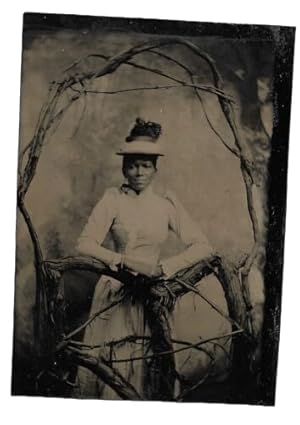
Contact seller5-star sellerTintype Photograph of a beautifully dressed African American woman. 19th century. Measures 2.5 x 3.5". This Image shows an African American woman in white Victorian style dress and hat, hands clasped before her on the heart-shaped ledge of a huppah fashioned from branches as part of the studio set. A natural scene painted on a s…creen is just visible as her backdrop. Tintypes, original photographic images printed on thin sheets of metal coated with a dark lacquer or enamel, were invented in 1855 and popularized through the 1860s when they were replaced by CDV's. These portraits come from a time just after emancipation when African Americans were creating new lives for themselves. Photography was one way to commemorate freedom and memorialize prosperity, the formerly impossible made possible. Image is remarkably crisp and details clear. Slight wear to top edge. Overall very good condition.
- Photo
Seller: Max Rambod Inc, Woodland Hills, CA, U.S.A.Max Rambod Inc
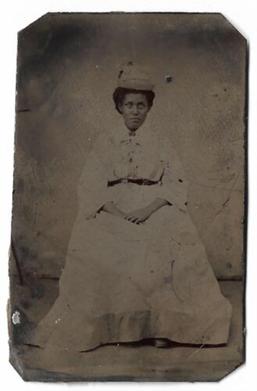
Contact seller5-star sellerTintype photograph of an African American woman, 19th century, documenting personal portraiture and self-presentation in the decades following emancipation, with direct relevance to the study of Black identity, social mobility, and visual culture in Reconstruction-era America. The sitter is shown in formal Victorian dress, weari…ng a full white gown and hat, with hands clasped in her lap, adopting a composed and deliberate pose consistent with studio portrait conventions of the period. Such images formed part of a broader practice in which African Americans used photography to assert dignity, stability, and participation in social norms that had been denied under slavery, creating visual records of family, status, and self-definition during a period of transition and reconstitution of community life. Tintype photograph measuring approximately 2.5 x 3.5 inches, produced using a photographic process introduced in the mid-nineteenth century in which images were created on thin metal sheets coated with dark lacquer. The portrait presents the subject seated against a neutral backdrop, her attire and posture carefully arranged to emphasize refinement and composure, with the details of her dress and hat clearly visible above the folds of her skirt. Corners clipped, with tissue paper attached to the verso and a small chip not affecting the image; overall very good condition. A clear and well-preserved example of nineteenth-century African American portrait photography, reflecting the use of the medium in documenting personal identity and social presence after emancipation.
- Photo
Seller: Max Rambod Inc, Woodland Hills, CA, U.S.A.Max Rambod Inc
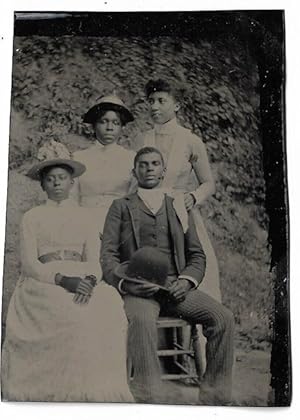
Contact seller5-star sellerTintype photograph of an African American family group, 19th century, documenting family structure, dress, and self-presentation in the decades following emancipation, with direct relevance to the study of Black domestic life and identity formation in Reconstruction-era America. The image presents a seated man in a three-piece s…uit with a bowler hat resting on his lap, flanked by women in Victorian dress, including one seated beside him in a high-collared white gown with gloves and hat, and two standing figures positioned behind, one resting a hand on his shoulder. The arrangement and attire reflect formal studio conventions and convey participation in prevailing social norms of respectability and family cohesion during a period when African Americans were establishing independent households and public identities after the abolition of slavery. Tintype photograph measuring approximately 2.5 x 3.5 inches, produced using a mid-nineteenth-century photographic process in which images were created on thin sheets of metal coated with a dark lacquer. The composition features four figures posed in a structured arrangement, with attention to clothing, posture, and gesture emphasizing familial relationships and visual balance within the frame. Glue stain to verso; otherwise light wear consistent with age; overall very good condition. A clear and well-composed example of nineteenth-century African American family portraiture, preserving evidence of social aspiration and domestic identity in the post-emancipation United States.

Seller: James Cummins Bookseller, ABAA, New York, NY, U.S.A.James Cummins Bookseller, ABAA
Contact seller5-star sellerHalf plate tintype. 5-1/4 x 4 inches. A young girl poses with her large doll in front of a painted backdrop. Provenance: Abraham Stransky Gilt and white paper window mount, wood frame Half plate tintype. 5-1/4 x 4 inches.
- Photo
Seller: Max Rambod Inc, Woodland Hills, CA, U.S.A.Max Rambod Inc
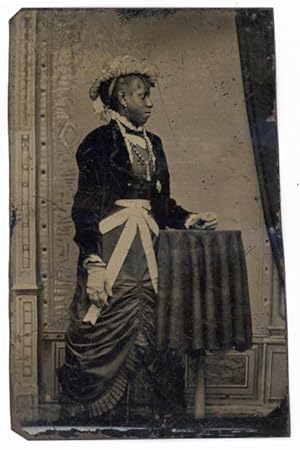
Contact seller5-star sellerTintype portrait of African American woman, circa late 1860s, documents Black female self-presentation during the Reconstruction era following the abolition of slavery in 1865. The image places the sitter within the early years of legal freedom for formerly enslaved people, when photography became an accessible medium for record…ing identity, status, and personal dignity. Tintypes, widely adopted in the mid-nineteenth century due to their affordability and durability, enabled broader participation in studio portraiture, including among African American communities newly navigating public life after emancipation. The sitter's formal pose and composed presentation align with established studio conventions used to assert respectability and social standing in a period of rapid social transition. Tintype photograph measuring approximately 3 3/16 x 2 inches. The image depicts a standing African American woman dressed in a pleated Victorian gown with visible fringe, paired with a fitted outer garment secured with a brooch. She wears white gloves, a structured white hat, and jewelry including earrings and a necklace. The composition presents the figure full-length, emphasizing dress and posture. The tonal qualities are consistent with period tintype production, with a darkened background and controlled studio lighting. Following the ratification of the Thirteenth Amendment, African American portraiture expanded significantly as photography offered a means to construct and preserve individual identity outside of enslavement. Clothing and adornment in such images provide evidence of how Black women engaged with prevailing standards of dress and respectability, often using fashion to signal autonomy and social mobility. This photograph contributes to the visual record of Reconstruction-era Black life by documenting material culture, personal presentation, and participation in photographic practices during a foundational period in American history. Minor wear with slight clipping to corners; overall very good condition.


