
Trollopes (5 results)
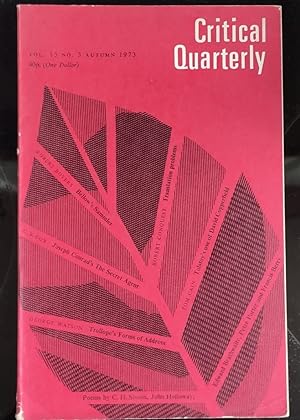
Critical Quarterly, Volume 15, Number 3, Autumn 1973 / Agent': The Irresponsible Piano" / George Watson "Trollope's Form of Address" / Tom Cain "Tolstoy's use of David Copperfield" / Edward Brathwaite - 2 poems / Robert Boyers "Nature and Social Reality in Bellow's Sammler" / Robert Conquest "Done into English: A Simple Exercise"
C B Cox and A E Dyson (Editors) / Agent': The Irresponsible Piano" / George Watson "Trollope's Form of Address" / Tom Cain "Tolstoy's use of David Copperfield" / Edward Brathwaite - 2 poems / Robert Boyers "Nature and Social Reality in Bellow's Sammler" / Robert Conquest "Done into English: A Simple Exercise"
Published by Manchester University Press 1973
- Softcover
- Periodical
Seller: Shore Books, London, United KingdomShore Books
Contact seller5-star sellerCondition: Used - Very good
US$ 6.36
US$ 14.76 shippingShips from United Kingdom to U.S.A.Quantity: 1 available
Soft cover. Condition: Very Good. 92 pages. C B Cox "Joseph Conrad's ' The Secret Agent': The Irresponsible Piano" / George Watson "Trollope's Form of Address" / Tom Cain "Tolstoy's use of David Copperfield" / Edward Brathwaite - 2 poems / Robert Boyers "Nature and Social Reality in Bellow's Sammler" / Robert Conquest "Done into… English: A Simple Exercise".

Published by Trollope & Sons (London) Limited. 1964
- Softcover
- First Edition
Seller: Roe and Moore, London, , United KingdomRoe and Moore
Contact seller4-star sellerCondition: Used - Very good
US$ 24.87
US$ 15.43 shippingShips from United Kingdom to U.S.A.Quantity: 1 available
Soft cover. Condition: Very Good. 1st Edition. 12mo. Original card covers. Introduction, 40 item catalogue, short biographies. ins Beutlch, Bicat, Brunsdon, Coutu, Dickson, Markson, Sorel and Thornton.

The Dean's Little Daughter
Author of "A Fellow of Trinity" and "Trollope's Dilemma"; Cooper, A W (illustrated)
Published by Society for Promoting Christian Knowledge (SPCK), London (undated)
- Hardcover
- First Edition
Seller: CURIO, Cleethorpes, North East Lincolnshire, United KingdomCURIO
Contact seller5-star sellerCondition: Used - Very good
US$ 89.81
US$ 40.24 shippingShips from United Kingdom to U.S.A.Quantity: 1 available
Hardcover. Condition: Very Good. No Jacket. 1st Edition. Undated c1896. Hardback copy in grey cloth pictorial boards with gold gilt lettering to spine, no dustjacket as issued. 158pp + 8pp book catalogue to rear. B/w frontispiece with tissue, b/w plates throughout, patterned endpapers. Not library copy, neat ink inscription date…d 1896 to reverse ffep. (7/2).

Published by Letter from Rochester Kent ; 28 September Note from St. Margarets; 20 April 1877 1872
- Manuscript
Seller: Richard M. Ford Ltd, London, , United KingdomRichard M. Ford Ltd
Contact seller5-star sellerCondition: Used
US$ 207.25
US$ 6.04 shippingShips from United Kingdom to U.S.A.Quantity: 1 available
Both items in fair condition, aged and worn. ONE: ALS. 28 September 1872. 4pp., 12mo. Bifolium. He is 'taking somewhat of a liberty', but having heard 'that you are parting with one of your Clerks', says 'a word in favour of a person in whom for many reasons I take a great interest, & of whom you & your Brothers may know somethi…ng. | I mean Mr. Prothero for many years an Inmate of my House, & an Assistant Master in the School'. Prothero was 'for some years a Clerk in the County Court', but 'is obliged from paucity of business to leave it, & is now out of employment'. He praises him as 'a most respectable, & trustworthy man, in whom you might place the most implicit confidence. He writes an admirable hand, & his experience in the County Court would I should think fit him for the work of a Solicitors Orffice'. He has a wife and three children. TWO: ANS. 20 April 1877. 1p., 12mo. He thanks him for his 'friendly communication', and hopes to 'have the pleasure of meeting some members of the Corporation as proposed on Monday next'. The beginning of Raymond Postgate's review in the Spectator (31 August 1961) of Ralph Arnold's book sums up the story of 'The Whiston Matter': 'In the year 1842 the Reverend Robert Whiston was appointed by the Dean and Chapter to be headmaster of Rochester Cathedral grammar school, which had been so badly run by the previous headmaster that only one pupil was left in it. He brought with him his own private pupils and his brother-in-law as assistant master; he was successful and popular and the school was ' quickly full again. The dean and chapter were pleased with him. They soon ceased to be. Whiston investigated the affairs of the cathedral and discovered that the statutes were being broken on a large scale. [] The chapter had pocketed the proceeds of these malversations, and he wrote to it requiring it to reform, and using fairly peremptory terms. But they would notthey were by now very rich. [] When Whiston published the facts about Rochester and other cathedrals in a pamphlet it was not very surprising that they dismissed him. [] The story of his subsequent fight and victory against the cathedral reads like an excerpt from Trollope or Dickens; it was in fact used by both of them as raw material.'.
Published by Rochester Kent ; 16 June 1854
- Manuscript
Seller: Richard M. Ford Ltd, London, , United KingdomRichard M. Ford Ltd
Contact seller5-star sellerCondition: Used
US$ 248.70
US$ 6.04 shippingShips from United Kingdom to U.S.A.Quantity: 1 available
3pp., 4to. Bifolium. In fair condition, aged and worn. Docketed: 'Application of the Revd. Robt. Whiston to make Dock & use Creek'. Written in a hurried hand. Begins: 'Gentlemen, | I have received a Notice from the Town Clerk, informing me that I have acted illegally, & infringed upon your Rights by endorsing & converting into a… Dock, without your License, a portion of a Creek of the River Medway described in this Notice | Permit me then to assure you that in doing so, I acted without any knowledge that I was committing an illegal action, & I now beg to express my regret for having done so, in any way or to any extent.' He assures them that he is 'desirous of doing whatever may be right & proper in the matter', and asks them to grant him a license, for which he will be happy to pay a 'reasonable amount'. He hopes concludes 'in the hope that you will not compel me to close an establishment which furnishes some employment in & contributes somewhat to the trade of the City'. The beginning of Raymond Postgate's review in the Spectator (31 August 1961) of Ralph Arnold's book sums up the story of 'The Whiston Matter': 'In the year 1842 the Reverend Robert Whiston was appointed by the Dean and Chapter to be headmaster of Rochester Cathedral grammar school, which had been so badly run by the previous headmaster that only one pupil was left in it. He brought with him his own private pupils and his brother-in-law as assistant master; he was successful and popular and the school was ' quickly full again. The dean and chapter were pleased with him. They soon ceased to be. Whiston investigated the affairs of the cathedral and discovered that the statutes were being broken on a large scale. [] The chapter had pocketed the proceeds of these malversations, and he wrote to it requiring it to reform, and using fairly peremptory terms. But they would notthey were by now very rich. [] When Whiston published the facts about Rochester and other cathedrals in a pamphlet it was not very surprising that they dismissed him. [] The story of his subsequent light and victory against the cathedral reads like an excerpt from Trollope or Dickens; it was in fact used by both of them as raw material.'.


