

Order Total (1 Item Items):
Shipping Destination:

Tulley Michael (14 results)
Skip to main search results
Search filters
Product Type
- All Product Types
- Books (14)
- Magazines & Periodicals (No further results match this refinement)
- Comics (No further results match this refinement)
- Sheet Music (No further results match this refinement)
- Art, Prints & Posters (No further results match this refinement)
- Photographs (No further results match this refinement)
- Maps (No further results match this refinement)
- Manuscripts & Paper Collectibles (No further results match this refinement)
Condition Learn more
- New (12)
- As New, Fine or Near Fine (No further results match this refinement)
- Very Good or Good (1)
- Fair or Poor (1)
- As Described (No further results match this refinement)
Binding
- All Bindings
- Hardcover (No further results match this refinement)
- Softcover (14)
Collectible Attributes
- First Edition (No further results match this refinement)
- Signed (No further results match this refinement)
- Dust Jacket (No further results match this refinement)
- Seller-Supplied Images (5)
- Not Print on Demand (14)
Language (1)
Price
- Any Price
- Under US$ 25 (No further results match this refinement)
- US$ 25 to US$ 50 (No further results match this refinement)
- Over US$ 50
Free Shipping
Seller Location
Seller Rating
-
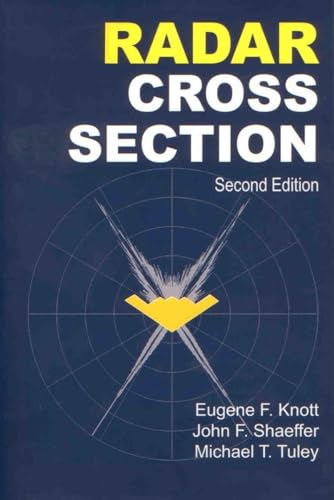
Radar Cross Section (Radar, Sonar and Navigation)
Language: English
Published by Scitech Publishing (edition 2), 2004
ISBN 10: 1891121251 ISBN 13: 9781891121258
Paperback. Condition: Fair. 2. The item might be beaten up but readable. May contain markings or highlighting, as well as stains, bent corners, or any other major defect, but the text is not obscured in any way.
-
Paperback. Condition: Very Good. No Jacket. Former library book; May have limited writing in cover pages. Pages are unmarked. ~ ThriftBooks: Read More, Spend Less.
-

Radar Cross Section
Language: English
Published by SciTech Publishing Inc, US, 2004
ISBN 10: 1891121251 ISBN 13: 9781891121258
Paperback. Condition: New. 2nd. Radar cross section (RCS) is a comparison of two radar signal strengths. One is the strength of the radar beam sweeping over a target, the other is the strength of the reflected echo sensed by the receiver. This book shows how the RCS gauge can be predicted for theoretical objects and how it can be measured for real targets. Predicting RCS is not easy, even for simple objects like spheres or cylinders, but this book explains the two exact forms of theory so well that even a novice will understand enough to make close predictions. Weapons systems developers are keenly interested in reducing the RCS of their platforms. The two most practical ways to reduce RCS are shaping and absorption. This book explains both in great detail, especially in the design, evaluation, and selection of radar absorbers. There is also great detail on the design and employment of indoor and outdoor test ranges for scale models or for full-scale targets (such as aircraft). In essence, this book covers everything you need to know about RCS, from what it is, how to predict and measure, and how to test targets (indoors and out), and how to beat it.
-
Condition: New.
-
Radar Cross Section (Radar, Sonar and Navigation)
Seller: Ria Christie Collections, Uxbridge, United Kingdom
Seller rating 5 out of 5 stars

US$ 139.40
US$ 16.22 shipping
Ships from United Kingdom to U.S.A.Quantity: 4 available
Add to basketCondition: New. In.
-
Radar Cross Section (Scitech Radar and Defense) (Radar, Sonar and Navigation)
Language: English
Published by SciTech Publishing Inc 2004-07-15, 2004
ISBN 10: 1891121251 ISBN 13: 9781891121258
US$ 132.97
US$ 20.97 shipping
Ships from United Kingdom to U.S.A.Quantity: 4 available
Add to basketPaperback. Condition: New.
-
Radar Cross Section
Language: English
Published by SciTech Publishing, Incorporated, 2004
ISBN 10: 1891121251 ISBN 13: 9781891121258
US$ 147.75
US$ 8.80 shipping
Ships from United Kingdom to U.S.A.Quantity: 3 available
Add to basketCondition: New. pp. xiv + 611 Illus.
-
Radar Cross Section
Language: English
Published by SciTech Publishing, Incorporated, 2004
ISBN 10: 1891121251 ISBN 13: 9781891121258
Condition: New. pp. xiv + 611 2nd Edition.
-

Radar Cross Section
Language: English
Published by SciTech Publishing Inc, US, 2004
ISBN 10: 1891121251 ISBN 13: 9781891121258
Seller: Rarewaves.com USA, London, LONDO, United Kingdom
Seller rating 5 out of 5 stars
Paperback. Condition: New. 2nd. Radar cross section (RCS) is a comparison of two radar signal strengths. One is the strength of the radar beam sweeping over a target, the other is the strength of the reflected echo sensed by the receiver. This book shows how the RCS gauge can be predicted for theoretical objects and how it can be measured for real targets. Predicting RCS is not easy, even for simple objects like spheres or cylinders, but this book explains the two exact forms of theory so well that even a novice will understand enough to make close predictions. Weapons systems developers are keenly interested in reducing the RCS of their platforms. The two most practical ways to reduce RCS are shaping and absorption. This book explains both in great detail, especially in the design, evaluation, and selection of radar absorbers. There is also great detail on the design and employment of indoor and outdoor test ranges for scale models or for full-scale targets (such as aircraft). In essence, this book covers everything you need to know about RCS, from what it is, how to predict and measure, and how to test targets (indoors and out), and how to beat it.
-
Radar Cross Section
Language: English
Published by SciTech Publishing, Incorporated, 2004
ISBN 10: 1891121251 ISBN 13: 9781891121258
Condition: New. pp. xiv + 611.
-
Paperback. Condition: New. In shrink wrap. Looks like an interesting title!
-

Radar Cross Section
Language: English
Published by SciTech Publishing Inc, US, 2004
ISBN 10: 1891121251 ISBN 13: 9781891121258
Paperback. Condition: New. 2nd. Radar cross section (RCS) is a comparison of two radar signal strengths. One is the strength of the radar beam sweeping over a target, the other is the strength of the reflected echo sensed by the receiver. This book shows how the RCS gauge can be predicted for theoretical objects and how it can be measured for real targets. Predicting RCS is not easy, even for simple objects like spheres or cylinders, but this book explains the two exact forms of theory so well that even a novice will understand enough to make close predictions. Weapons systems developers are keenly interested in reducing the RCS of their platforms. The two most practical ways to reduce RCS are shaping and absorption. This book explains both in great detail, especially in the design, evaluation, and selection of radar absorbers. There is also great detail on the design and employment of indoor and outdoor test ranges for scale models or for full-scale targets (such as aircraft). In essence, this book covers everything you need to know about RCS, from what it is, how to predict and measure, and how to test targets (indoors and out), and how to beat it.
-

Condition: New. Über den AutorrnrnEugene F. Knott received his MS in Electrical Engineering from the University of Michigan in 1966. He spent 16 years at the University of Michigan Radiation Laboratory conducting RCS measurements of lab models and devel.
-

Radar Cross Section
Language: English
Published by SciTech Publishing Inc, US, 2004
ISBN 10: 1891121251 ISBN 13: 9781891121258
US$ 173.58
US$ 88.01 shipping
Ships from United Kingdom to U.S.A.Quantity: 2 available
Add to basketPaperback. Condition: New. 2nd. Radar cross section (RCS) is a comparison of two radar signal strengths. One is the strength of the radar beam sweeping over a target, the other is the strength of the reflected echo sensed by the receiver. This book shows how the RCS gauge can be predicted for theoretical objects and how it can be measured for real targets. Predicting RCS is not easy, even for simple objects like spheres or cylinders, but this book explains the two exact forms of theory so well that even a novice will understand enough to make close predictions. Weapons systems developers are keenly interested in reducing the RCS of their platforms. The two most practical ways to reduce RCS are shaping and absorption. This book explains both in great detail, especially in the design, evaluation, and selection of radar absorbers. There is also great detail on the design and employment of indoor and outdoor test ranges for scale models or for full-scale targets (such as aircraft). In essence, this book covers everything you need to know about RCS, from what it is, how to predict and measure, and how to test targets (indoors and out), and how to beat it.

