
Turkish School (1 results)
Seller: Rob Zanger Rare Books LLC, Middletown, NY, U.S.A.Rob Zanger Rare Books LLC
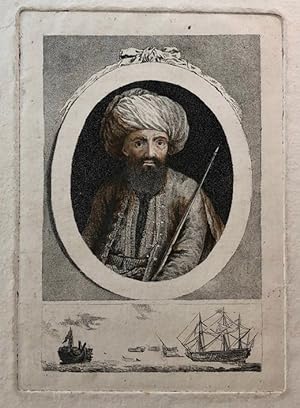
Contact seller5-star sellerSteel engraving with hand coloring in brown ink on thick handmade laid paper. 150 x 104 mm; 6 x 4 1/8 inches, full margins. Scattered light staining, age tone, light tone and light foxing. Appointed as Admiral of the Ottoman Navy in 1769, by 1770 Mandalzade Husamaddin Pasha had risen to the rank of High Admiral. On the heels of…the longest period of peace with Europe (1747-1768), the first Russo-Turkish was raging, and despite the fact that Husamaddin had inherited a weak and depleted Navy, he was able to command his ships into a series of victories by capitalizing on Russia's deep financial strain. The forward progression wouldn't last long. Despite the fact that the Russian Navy had been, in a lot of ways, inferior to the Ottoman Navy, and the Turkish forces had shorter supply lines, and the ability to levy troops from their vassel state, the Crimean Khanate, the Russian Navy eventually opted to employ British officers to resolve their shortcomings. In addition, relentless Russian destabilization of the area, and brute action to undermine the government eventually destroyed the effectiveness of the Ottoman Navy. In 1774 the Ottoman Empire ceded two key seaports to Russia, Azov and Kerch, allowing the Russian Navy and merchant fleet direct access to the Black Sea. This war comprised but a small part of the continuous process of expansion of the Russian Empire, which continued to bleed southwards and eastwards throughout the 18th and 19th centuries.
