
Utagawa Kunitoshi (4 results)

Published by [Illegible] Meiji 31 [1898]., ??. [Tokyo]. 1898
Seller: Asia Bookroom ANZAAB/ILAB, Canberra, ACT, AustraliaAsia Bookroom ANZAAB/ILAB
Contact seller5-star sellerCondition: Used
US$ 216.13
US$ 21.25 shippingShips from Australia to U.S.A.Quantity: 1 available
Brightly coloured woodblock print, 35 x 25cm, evenly browned as usual for these types of prints, a very good copy. This beautiful wood block print depicts 42 flowering pot plants each in their own panel. Omocha-e [Japanese toy prints] such as this, were used as educational toys for children and they often featured various aspect…s of nature and society. These prints were designed so that children could cut the panels out to play with. This omocha-e shows a wide variety of flowering plants, including the camelia, morning glory and plum. The artist, Utagawa Kunitoshi (1847-1899) was an Ukiyo-e artist in Meiji period who is better known for depicting the drastically changing Japanese society of the Meiji Period.
 More images
- Softcover
Seller: Jonathan A. Hill, Bookseller Inc., New York, NY, U.S.A.Jonathan A. Hill, Bookseller Inc.
Contact seller5-star seller27 double-page & 14 single-page brush & ink detailed drawings. 35 folding leaves. 12mo (185 x 130 mm.), orig. wrappers, orig. stitching. [Japan]: [late Edo or early Meiji]. A unique manuscript of underdrawings for ukiyo-e prints by an artist from one of the most prominent lineages active in the genre. While ukiyo-e are most famo…us in the form of colored prints from the "floating world" of Edo's pleasure quarters and kabuki theaters, the originators of the genre's designs were not printers or engravers, but painters. "The skillful use of brush and ink to render an image was central to the ukiyo-e artist's task. These illustrator-designers were trained as painters. The brush was their primary tool, its practice the foundation for their art.for most their first images appeared as book illustrations" (Davis, p. 15). Indeed, our manuscript appears to contain illustrations intended for a printed book by a famous artist. Kunitoshi was a student of Utagawa Kunisada ???? (Sandaime Utagawa Toyokuni ???????, or Toyokuni III, 1786-1865) and Utagawa Kunitsugu ???? (1800-61). Ukiyo-e were often produced by "artistic lineages": "these 'schools' were established by a lead artist with an atelier of students and followers working in the same mode. The position of head of the school was usually handed down from father to artist sons, to sons-in-law, or to designated heirs. Apprentices usually entered the master's atelier between the age of ten and early teens, and if they were found to be worthy practitioners of the master's style, they would be adopted into the family and given its lineage name" (Davis, pp. 43-44). The author of our manuscript would have entered the Utagawa lineage in this way. The Utagawa lineage was "one of the [ukiyo-e] genre's most productive and profitable through to the modern era." The Utagawa "transformed the ukiyo-e genre, producing some of its most iconic images" (Davis, p. 88). One page in our manuscript contains a legend stating, "Drawings by Toyokuni, created by Sant? Ky?den" ????????? The title on the upper wrapper of the manuscript is indeed also "Sant? bunko," referring to the same person. Sant? Ky?den (1761-1816) was a visual artist, writer, and businessman. We have been unable to determine which story by Ky?den is being illustrated here. It does not appear to be one set in the ninth century, however, as another pair of pages show men with muskets a much later invention surrounding a man reclining on a futon. Our manuscript contains many striking images, including yokai (??) and y?rei ?? Very fine copy, preserved in a chitsu. ? Julie Nelson Davis, Picturing the Floating World: Ukiyo-e in Context (Hawai'i: 2021).
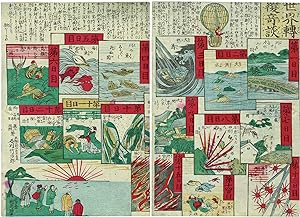
Published by Tokyo: Ishikawa Takejiro, October, Meiji 14 [1881] 1881
- First Edition
- Art Print
Seller: Kagerou Bunko (ABAJ, ILAB), Tokyo, , JapanKagerou Bunko (ABAJ, ILAB)
Contact seller2-star sellerCondition: Used - Very good
US$ 805.00
US$ 35.50 shippingShips from Japan to U.S.A.Quantity: 1 available
No Binding. Condition: Very Good. 1st Edition. On August 13, 1881, an article titled "La Fin du Monde" was printed in the French language newspaper "L'Echo du Japon", published in Yokohama. The article reported on a prediction that the world would end on November 15th of the same year. In response to the article, Japanese newspa…pers also reported on an attempt by an old man in Lincolnshire, England, to ride a hot air balloon to escape the end of the world. This nishiki-e diptych, which depicts the twelve days leading up to the collapse of the world, fueled people's anxiety while also attracting interest in hot air balloons. Diptych, complete. Trimmed, with very minor wormhole repairs, otherwise very good. Each print measures 34.6 x 24 cm. Text in Japanese.
 More images
Seller: Richard Neylon, St Marys, TAS, AustraliaRichard Neylon
Contact seller4-star sellerCondition: Used - Very good
US$ 216.13
US$ 31.00 shippingShips from Australia to U.S.A.Quantity: 1 available
Condition: very good. Tokyo, Shimizu Kahei 1881 (Meiji 14). 38x26cm colour woodcut (a bit rumpled). A useful birds-eye view of the second national industrial exhibition, held in Ueno Park in 1881. It, despite hard times, quadrupled in size and almost doubled the attendance of the first, 1877, exhibition. Centre stage is the cloc…k tower by Kaneda Ichibei.


