

Order Total (1 Item Items):
Shipping Destination:

Vardanega Gregorio (4 results)
Skip to main search results
Search filters
Product Type
- All Product Types
- Books (2)
- Magazines & Periodicals (2)
- Comics (No further results match this refinement)
- Sheet Music (No further results match this refinement)
- Art, Prints & Posters (No further results match this refinement)
- Photographs (No further results match this refinement)
- Maps (No further results match this refinement)
- Manuscripts & Paper Collectibles (No further results match this refinement)
Condition Learn more
- New (No further results match this refinement)
- As New, Fine or Near Fine (2)
- Very Good or Good (2)
- Fair or Poor (No further results match this refinement)
- As Described (No further results match this refinement)
Binding
- All Bindings
- Hardcover (No further results match this refinement)
- Softcover (4)
Collectible Attributes
- First Edition (2)
- Signed (No further results match this refinement)
- Dust Jacket (No further results match this refinement)
- Seller-Supplied Images (4)
- Not Print on Demand (4)
Language (1)
Price
- Any Price
- Under US$ 25 (No further results match this refinement)
- US$ 25 to US$ 50 (No further results match this refinement)
- Over US$ 50
Free Shipping
- Free Shipping to U.S.A. (No further results match this refinement)
Seller Location
Seller Rating
-
Original photograph of 'Monde de Transparences 1960, Plexiglas avec Lumières Coloées, Glode au centre en mouvement, illuminé et coloré'.
Published by Self-published., Paris, 1965
First Edition
US$ 89.39
US$ 15.35 shipping
Ships from United Kingdom to U.S.A.Quantity: 1 available
Add to basketPaperback. Condition: Very Good. First edition. Original photograph of Vardanega's 'Monde de Transparences 1960, Plexiglas avec Lumières Coloées, Glode au centre en mouvement, illuminé et coloré'. Thumbed. 235x180mm. From the collection of P.M.T. Sheldon-Williams, the writer, editor and critic.
-
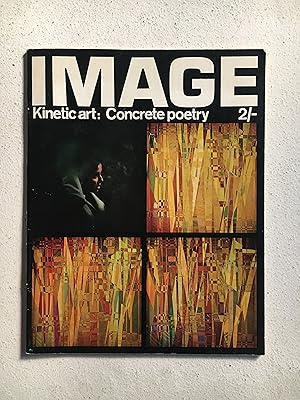
Image - Kinetic Art: Concrete Poetry
Published by Kingsland Prospect Press, 1964
Magazine / Periodical First Edition
Soft cover. Condition: Very Good. 1st Edition. Superb copy of a well done and thorough magazine on kinetic art and concrete poetry. One page dog-eared else excellent with slightest handling and shelfwear.
-
Image - Kinetic Art: Concrete Poetry
Published by Kingsland Prospect Press Ltd., London, 1964
Seller: William Allen Word & Image, London, United Kingdom
Seller rating 5 out of 5 stars

US$ 137.53
US$ 28.71 shipping
Ships from United Kingdom to U.S.A.Quantity: 1 available
Add to basketPaperback. Condition: Near fine. Book. 265 x 210 mm, 64 pp. in printed stapled wraps. Front cover image ('Portrait of Andree Dantu by Richard Hardwick: three phases of a Dantu polaroid light mobile') in colour, contents illustrated with both colour and b/w images. Three issues of Image (usually a 'careers' magazine for young graduates) were effectively taken over by important Cambridge academics of the day, all with a specific interest in concrete poetry and kinetic art: Philip Steadman, Stephen Bann and Reg Gadney. The issues of Image dedicated to kinetic and concrete poetry were particularly noteworthy for their commitment to translation and reprinting 'lost' texts, an imaginative use of layout and photography, and enlightening academic essays on their given subjects. This particular issue is entirely dedicated to kinetic art and concrete poetry (as the title suggests), and the editorial (which is idiosyncratically placed in the middle of the publication) reads: 'This issue of IMAGE is largely devoted to Kinetic Art: art, that is, incorporating real movement as opposed to the painted or static illusion of movement.' It is illustrated with a photograph of the editors and contributors - Stephen Bann, Reg Gadney, Frank Popper, Phil Steadman and Citroen - strolling through Paris. The issue features an essay by the concrete poetry specialist Stephen Bann, entitled 'Communication and Structure in Concrete Poetry', which comes with a reprinted letter from Ian Hamilton Finlay to Pierre Garnier, dated September 17th 1963. Translated by Bann are extracts from 'Manifesto for a new poetry, visual and phonic' by the concrete poet Pierre Garnier: 'The word is an element. / The word is a material. / The word is an object.' Also included in this section is a manifesto by Eugen Gomringer, entitled 'from line to consideration', and translated by Mike Weaver. It was 'first printed in augenblick no 2 agis verlag baden-baden 1954'. Works by Augusto de Campos, Ronaldo Azeredo, Decio Pignatari and Haraldo de Campos are also reprinted here. The second academic essay featured is a text by Mike Weaver entitled 'Concrete and Kinetic: the poem as Functional Object', which is illustrated with reproduced typestracts by Dom Sylvester Houedard. Also featured is a text by the editor Philip Steadman, entitled 'Colour Music and the Art of Lumia, and an essay by Reg Gadney entitled 'An Introduction: Kinetic Art', which is illustrated with images of works by Alexander Calder and Alexander Schoffer's Chronus sculptures. There are artist profiles of Frank Malina (by Reg Gadney); Gregoria Vardanega (by Stephen Bann); Martha Boto (by R.G); J-M. Cruxent (by S.B); Andree Dantu (by R.G); Knud Hvidberg and William Soya (by R.G); Nino Calos (by R.G). Condition: near fine (contents fine minor rubbing to covers).
-

Arte Nuevo Boletin de la Asociacion Arte Nuevo
Published by Buenos Aires Cabrera Rey, 1956
Magazine / Periodical
Encuadernación de tapa blanda. Condition: Muy bien. In-8. #2 1956, #4 1957. Two of only six issues of the journal published between 1956 and 1958. The New Art Association was formed at the request of Carmelo Arden Quin and was a group made up of non-figurative artists who met to disseminate, through publications, exhibitions and conferences, the manifestations of this trend. This group held Salons that functioned without the intervention of admission juries, which had the support of Aldo Pellegrini. Washington Pereyra T5,p69. WasHol.


