Order Total (1 Item Items):
Shipping Destination:

Vilips Pavils (5 results)
Skip to main search results
Search filters
Product Type
- All Product Types
- Books (5)
- Magazines & Periodicals (No further results match this refinement)
- Comics (No further results match this refinement)
- Sheet Music (No further results match this refinement)
- Art, Prints & Posters (No further results match this refinement)
- Photographs (No further results match this refinement)
- Maps (No further results match this refinement)
- Manuscripts & Paper Collectibles (No further results match this refinement)
Condition Learn more
- New (No further results match this refinement)
- As New, Fine or Near Fine (2)
- Very Good or Good (2)
- Fair or Poor (No further results match this refinement)
- As Described (1)
Binding
- All Bindings
- Hardcover (No further results match this refinement)
- Softcover (5)
Collectible Attributes
- First Edition (5)
- Signed (No further results match this refinement)
- Dust Jacket (No further results match this refinement)
- Seller-Supplied Images (5)
- Not Print on Demand (5)
Language (2)
Price
- Any Price
- Under US$ 25 (No further results match this refinement)
- US$ 25 to US$ 50 (No further results match this refinement)
- Over US$ 50
Free Shipping
- Free Shipping to U.S.A. (No further results match this refinement)
Seller Location
Seller Rating
-
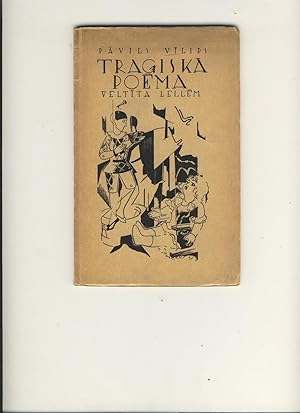
Tragiska poema. Veltita lellem.
Published by Riga: the author, 1929
Seller: Michael Fagan Fine Art & Rare Books, Newton, MA, U.S.A.
Seller rating 5 out of 5 stars

First Edition
Soft cover. Condition: Very Good. 1st Edition. Octavo, wrappers, 46pp, with 6 drawings and vignettes by Sigismunds Vidbergs. A collection of poems by Vilips (1901-1979), enjoyed some celebrity and readership as a leading modernist in the Riga avant-garde. The poetic texts and Vidbergs' images lean to the erotic. This is a fine result of a collaborative publication, probably too racy for the censors of the day and thus self-published. Uncommon, found in three North American libraries. This copy very good with former library stamps, none on illustrated pages, but priced accordingly.
-

Romantika Autobusa. Dzeju Cikls
Published by Izdevnieciba Tagadne, Riga, 1930
Seller: Földvári Books, Budapest, Hungary
Seller rating 5 out of 5 stars
First Edition
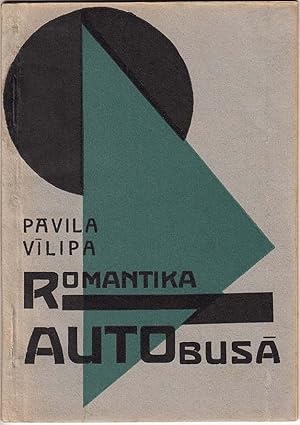
Cover designed by Eriks Kalis. (illustrator). First edition. Cover designed by Eriks Kalis. First edition. In publisher's illustrated grey wrappers, printed in green and black. 48, (8) p. Striking constructivist cover by Eriks Kalis. Eriks Kalis (19041939) was a Latvian graphic designer and scenographer, member of the avant-garde Riga Artist Group. "Kalis's covers demonstrate his indebtedness to the most rigorous abstraction, first developed by Malevich and then embraced by Lissitzky and a host of central and eastern European disciples of Malevich's Suprematism and Russian Constructivism. The modern romance conducted in the urban bus is intimated by the penetration of the green triangle into the red sphere, an abstract format famously employed by Lissitzky in a revolutionary poster from a decade before." (Davis, 2007) Pavils Vilips (19011979) was a Latvian poet, essayist, and translator. In the 1920s he was a member of the Latvian Expressionist group of writers focusing on the aspects of contemporary urban life. His present book, Romantika Autobusa is a remarkable example of this movement. Bibl.: Davis, R. H. - Kasinec E.: Graphic Modernism from the Baltic to the Balkans, 19101935. The New York Public Library, New York 2007. p. 42. . Author's name on the cover, and occasional notes and marks in the text in pencil. Moderate tanning to the cover at the extremities. Small damage to the spine at the tail and the head. Pages somewhat yellowed due to ageing. Overall in fine condition. In publisher's illustrated grey wrappers, printed in green and black.
-
Poema par Annu Lazdu un melno runci (The Poem about Anna Lazda and Black Thread)
Published by K/S. Avanti, Riga, 1932
First Edition
Soft cover. Condition: Near Fine. 1st Edition. Latvian language. Enlarged format. Octavo 20 x 24 cm. Weight 180 g. Wrappers, [76] pp., incl. [4] illustration plates. The book is in Near Fine condition without any visible defects, losses, remarks and stains. Soft creases across cover corners and along cover fore-edge, some color fading to the cover edges; internally two light small stains on the single sheet. Latvian avant-garde poet Pavils Vilips (1901-1979) was identified literally with the Expressionists and politically with the Social Democrats. He collaborated with the left press and was close to the leftist "Trauksme" (Alarm) group, which members were focused on the aspects of contemporary urban life and social contradictions. All the above listed impacts are reflected in the current fourth collection of poems. Using the sharp contrasts of expressionism, author depicts suburbs and port areas, factories and working-class dwellings, beggars and the poor. His ideas are connected with industrialisation of the world and a working-class state. Poet's work brilliantly complemented by artist's illustrations. Four amazing full-page linocut plates portray scenes of urban life. Karlis Bus' (1912-1987) Latvian modernist painter, graphic artist and illustrator. Since 1931 participated in exhibitions. Was member of Zala Varna (Green Crow) art society and Rigas makslinieku grupa (Riga Artists' Group).
-
Romantika autobusa : dzeju cikls (Romantic of the Bus : Cycle of Poems)
Published by Tagadne, Riga, 1930
First Edition
Soft cover. Condition: Near Fine. 1st Edition. Latvian language. Octavo 11 x 16 cm. Weight 40 g. Wrappers, 48 [4] pp. The book is in Near Fine condition without any visible defects, losses, remarks and stains. Book cover shows minor foxing and very slight soiling to the spine edge; internally few occasional foxing spots. Current book can be considered as one of the best examples of leftist Avant-Garde in Latvian literature. Author's third cycle of poems was published in 1930, while he was close to the leftist "Trauksme" (Alarm) group of young poets influenced by Futurism and Constructivism. Members of the group were focused on the aspects of contemporary urban life and social contradictions, and current book of poems became a remarkable example of this movement. In order to reveal a new reality author, using the sharp contrasts of expressionism, depicted the city in his verses. He turned to suburbs and port areas, factories and working-class dwellings, favourite images were the beggars and the poor. In the poems dominates sad and pessimistic mood, skepticism and bravado, motives of loneliness and human alienation. Pavils Vilips (1901-1979) social-democratic Latvian poet, essayist and translator, collaborated with leading periodical editions, published about 15 poetry collections, also plays and prose writings. Book's cover is an amazing example of Constructivism created by Latvian and Soviet Avant-Garde graphic artist, devoted Communist Ernest Kalis (1904-1939), who is best known for avant-garde book and periodic designs, and producing of political posters. Was a Member of the Presidency of the Association of Artists of Revolutionary Russia. Participated in the revolutionary movement, and was repressed in 1937.
-
Soft cover. Condition: Very Good. Ernests Kalis (illustrator). 1st Edition. Cover designed by Ernests Kalis. (illustrator). First edition. Cover designed by Eriks Kalis. First edition. 56, (8) p. Striking constructivist cover by Ernests Kalis. Ernests Kalis (1904-1939) was a Latvian graphic designer and scenographer, member of the avant-garde Riga Artist Group. "Kalis's covers demonstrate his indebtedness to the most rigorous abstraction, first developed by Malevich and then embraced by Lissitzky and a host of central and eastern European disciples of Malevich's Suprematism and Russian Constructivism." (Davis, 2007) Pavils Vilips (1901-1979) was a Latvian poet, essayist, and translator. In the 1920s he was a member of the Latvian Expressionist group of writers focusing on the aspects of contemporary urban life. His present book, 21 DZEJA is a remarkable example of this movement. Bibl.: Davis, R. H. - Kasinec E.: Graphic Modernism from the Baltic to the Balkans, 1910-1935. The New York Public Library, New York 2007. p. 42. . Moderate tanning to the cover at the extremities. Small damage to the spine at the tail and the head. Pages somewhat yellowed due to ageing. Overall in fine condition.