
Whaling Scroll (2 results)
 More images
Seller: Jonathan A. Hill, Bookseller Inc., New York, NY, U.S.A.Jonathan A. Hill, Bookseller Inc.
Contact seller5-star sellerCondition: Used
US$ 41,475.00
US$ 20.00 shippingShips within U.S.A.Quantity: 1 available
Scroll (273 x 13,760 mm.). At end (in trans.): "All the images are of the whaling at TaijiApril 1857, Tennojiya Shinsuke owned." A remarkable, long, and vividly rendered whaling scroll, from Wakayama Prefecture, depicting the whaling activities in unusual detail, of the famous town of Taiji and its bay ("Taiji ura"), the site of… the annual dolphin slaughter, featured in the 2009 Oscar-winning documentary The Cove. Taiji has long been known as a whaling town, and its history is essentially the history of whaling in Japan. In the 17th century, whalers of the town developed a series of more sophisticated whaling techniques, including the group hunting system (1606), a handheld harpoon, and the whaling net technique (1675). The scroll begins with a quite detailed history of whaling in Japan, written in a very legible hand, describing the above-mentioned new methods of whaling, with dates of introduction. There is information on when certain species of whales pass by during the year, signaling systems, other technical aspects of whaling, etc. The first images depict six species of whales found off the coast of Taiji: Semi kujira (North Pacific right whale), Zato kujira (humpback whale), Nagasu kujira (fin whale), Katsuo kujira (Bryde's whale), Koku kujira (gray whale), and Makko kujira (sperm whale). Each of the dramatically and richly painted whales have notes regarding their most notable identifying features. The next scene takes place at Taiji: it shows the captured Semi kujira whales being winched onto shore and the highly specialized butchering of the carcasses. The slaughter area is fenced off and there are observation decks for government officials to review the work. We see a cross-section of the whale and the various products rendered from it in various stages of dismemberment: skin, flesh, bone, intestines, fins, penis, all displayed in large piles. Spectators stand to the side, watching the work. A shrine is depicted in the background. This scene has been heightened with metallic pigments. All the harpoons in this scroll are depicted with metallic pigments. Following this is a scene of the different kinds of boats entering the greater bay, towing a whale. The scenes of the houses on shore reveal what a prosperous community it once was. The subsequent scene depicts the specialized boats going out to sea, passing two elevated signal posts ("Kajitorizaki" & "Shomyozaki"), which receive news of whales in the distance and sends signals by a flag system. Smoke is rising, a signal to the boats. One of the boats is a "tool" boat containing special harpoons to kill the whale after it had been entangled in a net. Other boats are "net" boats, each of which requires 81 sailors; they are seen spreading out the net. There are other boats seko bune which guide the whale into the net. Another vessel is fast-moving messenger boat giving directions to the others. In the following two scenes, the sky and ocean are very beautifully depicted with delicate gradations of colors. The whale (a humpback) is shown caught in the net, writhing and fighting for its freedom, desperately spouting water. The enormous motion of the whale has caused the water to turn white with foam, which is very expressively painted on the scroll, with almost a 3-D, Jackson Pollock, splashed effect. A young whaler is seen climbing on the whale, to stab it in the nose. The whalers all have special tasks to fulfill, and the scroll provides the names of each special function. The next scene shows whalers catching a North Pacific right whale just off the Mikisaki peninsula. Following this, we are on shore again, at the enormous supply storage compound. The first scene shows government observers at the security gate of the compound with men shown mending and storing the whaling nets. The workers wear different head gear and colors of clothes, denoting their jobs and ranks. One room has bundles of poles for harpoons. The next building shows men making boat paddles, black.
 More images
Seller: Jonathan A. Hill, Bookseller Inc., New York, NY, U.S.A.Jonathan A. Hill, Bookseller Inc.
Contact seller5-star sellerCondition: Used
US$ 24,750.00
US$ 20.00 shippingShips within U.S.A.Quantity: 1 available
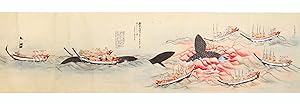
Scroll (360 x 9290 mm.). N.p.: late-Edo? Our scroll, while it reveals no definitive place or date, was clearly produced in the early 19th century; it is uncommonly long and richly illustrated. In a series of distinct scenes, we see all the stages of whale hunting and processing. Each scene is a "beehive of activity." The first s…cene depicts the boats sent out for the hunt, including boats for harpooners, a large boat carrying an enormous net, and pursuit boats. The following scene shows an enormous whale we see only his head and tail chased by pursuit boats, which are directing the whale in the direction of an enormous net now spread out in the sea. The whale is spouting and has caused the water to become extremely turbulent. The next scene shows the sailors spreading out the net in the middle of the ocean. This is followed by a scene showing the trapped whale surrounded by harpooners (on boats) who have hurled their harpoons into the whale's flesh. In the following scene, with many harpoons in the whale, the ocean water has turned red with blood. Next, we see the boats towing the whale to shore. We then see the whale hauled onto the beach and being butchered. There is much use of red pigment in this image. The beach area is tightly secured, and we see butchers cutting up the fat and flesh while others are carrying these products into the secured processing buildings. Government officials are observing. We also see a thief, who has tried to steal some flesh, being beaten. The next scene shows the interior of the factory, with an assembly line of workers cutting up large pieces of fat with knives (the knives are painted in silver), so they can be placed in barrels and carried to the caldrons in order to render oil. We also see a storage area where the meat of the whale is stored. There are two balconies where government officials sit, examining the factory floor. There are workers measuring the meat on a scale and accountants keeping inventory using an abacus. Now we move on to the factory room where the whale bones are processed. We see two men using a very large saw cutting up the rib bone and a row of women cutting the bones into smaller pieces. A man is beating a drum to give the women a working rhythm. All the sharp tools axes, saws, and knives are painted in silver. We also see several workers pounding bone into powder. Our final scene shows the factory room where the sinews of the whale are being trimmed and hung to dry. Again, all the knives are painted with silver. In very good condition, preserved in a wooden box.

