

Order Total (1 Item Items):
Shipping Destination:

Woolf Samuel Johnson (7 results)
Skip to main search results
Search filters
Product Type
- All Product Types
- Books (6)
- Magazines & Periodicals (No further results match this refinement)
- Comics (No further results match this refinement)
- Sheet Music (No further results match this refinement)
- Art, Prints & Posters (No further results match this refinement)
- Photographs (No further results match this refinement)
- Maps (No further results match this refinement)
- Manuscripts & Paper Collectibles (1)
Condition Learn more
- New (No further results match this refinement)
- As New, Fine or Near Fine (1)
- Very Good or Good (3)
- Fair or Poor (No further results match this refinement)
- As Described (3)
Binding
- All Bindings
- Hardcover (4)
- Softcover (No further results match this refinement)
Collectible Attributes
- First Edition (1)
- Signed (1)
- Dust Jacket (No further results match this refinement)
- Seller-Supplied Images (5)
- Not Print on Demand (7)
Language (2)
Free Shipping
Seller Location
Seller Rating
-

Drawn from life,
Published by Whittlesey house, 1932
Seller: Books From California, Simi Valley, CA, U.S.A.
Seller rating 4 out of 5 stars

Hardcover. Condition: Good. mild amount of wear along the edges of the cover of the book (creasing, scuff marks).
-
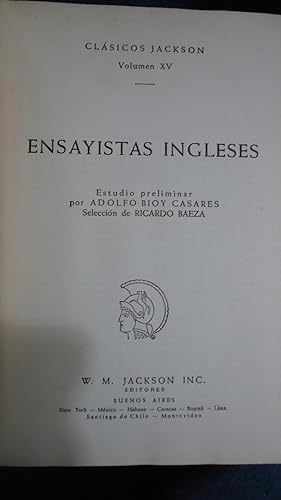
ENSAYISTAS INGLESES
Seller: Ernesto Julián Friedenthal, Buenos Aires, CABA, Argentina
Seller rating 5 out of 5 stars

First Edition
Encuadernación de tapa dura. Condition: Excelente. 1ª Edición. Buenos Aires, W.M. Jackson Editores, Clásicos Jackson, 1948, XXXII pp. + 471 pp. Primera Serie. Primera Edición. Frontispicio retrato del Dr. Johnson plena página. Encuadernación plena tela original de editor, lomo con tejuelo y títulos dorados. Extenso estudio preliminar original para esta edición, por Adolfo Bioy Casares. Selección por Ricardo Baeza. Traducción B.R. Hopenhaym y traducción y notas de Ricardo Baeza. Obras de: Lord. Bacon. Jonathan Swift. Richard Steele y Joseph Addison. Samuel Johnson. Oliver Goldsmith. Samuel Taylor Coleridge. Charles Lamb. William Hazlitt. James Henry Leigh Hunt. Thomas de Quincey. Thomas Babington Macaulay. John Ruskin. Matthew Arnold. Walter Horatio Pater. Alice Christina Meynell. Robert Louis Stevenson. Oscar Wilde. Gilbert K. Chesterton. Virginia Woolf.Los libros se envían a través de DHL Courier Express. Estado excelente. 4to.
-
The North American Review, Vol. CCXXVII: January, 1929 - June, 1929 [Volume 227, No. 1 - 6]
Language: English
Published by North American Review Corporation, 1929
Seller: Yesterday's Muse, ABAA, ILAB, IOBA, Webster, NY, U.S.A.
Association Member: ABAA ILAB IOBA
Seller rating 5 out of 5 stars
Hard Cover. Condition: Good. No Jacket. Library binding with ink stamps on a few pages inside. Binding tight and square, text clean, bright, and unmarked. 1929 Hard Cover. 768 pp. A collection of numerous articles on current political and social events, along with letters to the editor, music and drama reviews, books of the month and book review sections, etc. This volume discusses everything from birth control to the dangers of cocaine to telepathy to the failure of the Federal Reserve.
-
hardcover. "Tudo, no mundo, existe para acabar em um livro." - Stéphane Mallarmé "De onde tiro tanto tempo para não ler tanta coisa?" - Karl Kraus "Uma pessoa que quer escrever coisas boas precisa ler coisas ótimas." - Ursula K. Le Guin Um livro-agenda pensado para amantes da literatura. Aqueles que fazem de tudo para encaixar uma leitura entre um compromisso e outro. Aforismos - Escritores e seu ofício é um planner (ou seja, uma agenda permanente, não datada), mas é também um livro. Enquanto o leitor folheia as páginas dedicadas à organização de suas tarefas e compromissos, ao longo de 54 semanas, acompanha uma seleção de 50 aforismos em que escritores e escritoras refletem sobre o seu ofício: ler, escrever, viver de literatura. De uma citação bíblica (sobre fazer livros!) a observações afiadas, o volume reúne frases de 50 escritores de séculos, latitudes e continentes diferentes. De grandes nomes da literatura brasileira, como Machado de Assis e Graciliano Ramos, a nomes essenciais da escrita contemporânea, como Jesmyn Ward e Bernardine Evaristo, sem deixar de lado clássicos como Jane Austen ou Gustave Flaubert. O livro-agenda traz páginas iniciais para planejamento mensal e, em seguida, cada página dupla é dedicada a uma semana. Ao final do volume, há páginas destinadas a um registro das leituras do ano, além, claro, de espaço para montar a lista dos livros que estão na fila para leitura. Encadernado em capa dura, com lombo redondo (para facilitar a abertura) e um fitilho em gorgurão servindo como marca-página, o volume traz, na capa, a referência a uma técnica milenar de decoração de livros, a marmorização. O planner está disponível em quatro modelos, com quatro capas variadas.
-

Condition: ESTADO EXCELENTE. TAPA DURA TELA EDITORIAL VERDE CON LOMO Y CANTONERAS SIMILPIEL VERDE CON GRABADOS DORADOS - LAMINA EN FRONTISPICIO CON HOJA PAPEL SEDA-GUARDAS PAPEL AGUA.
-
Enrico Caruso: Portrait lithograph, signed in margin in pencil, S.G. Woolf
Published by n.d., n.p.
Seller: James Cummins Bookseller, ABAA, New York, NY, U.S.A.
Seller rating 5 out of 5 stars
1 vols. Image 15 x 13 inches; matted. Fine full-face portrait of the great singer, in early middle age. 1 vols. Image 15 x 13 inches; matted.
-
Original Signed Portrait of Alexander Fleming, Drawn from Life by S. J. Woolf. Charcoal portrait of Alexander Fleming, heightened with white chalk, 19" x 15 1/2". Stamped on back "New York Times Magazine" and with the S. J. Woolf estate stamp. SIGNED BY ALEXANDER FLEMING at lower left and SIGNED BY S. J. WOOLF at lower right.
Published by 1945., 1945
Seller: Scientia Books, ABAA ILAB, Arlington, MA, U.S.A.
Association Member: ABAA ILAB SNEAB
Seller rating 4 out of 5 stars
Manuscript / Paper Collectible Signed
No Binding. Condition: Very Good. Very Good. The original charcoal portrait used to illustrate S. J. Woolf's article on Alexander Fleming ("Man of Science and of Penicillin. Sir Alexander Fleming Talks of His Discovery and Its Future Promise"), published in the New York Times Sunday Magazine July 29, 1945. It was later exhibited at the Princeton University Library in 1949 as no. 10 in "Drawn from Life by S. J. Woolf--Original Charcoal Portraits of Contemporary Notables--First Published in the New York Times Sunday Magazine 1923-1946." In 1932 Woolf published his book entitled Drawn from Life: "There is no surer way of getting to know a person than by drawing his picture. The silence that is broken only by the scratch of charcoal upon paper or brush on canvas seems to remove restraint. The artist has his sitter at an unfair advantage. One is working; the other sits quietly self-conscious. It rarely happens that the subject does not relax and as a usual thing in a short time he starts to talk. In this respect the man who also draws has an advantage over his less fortunate brother who only writes. His victim is disarmed. Nothing makes for taciturnity or at least care in what is said so much as a writer's pad and pencil; nothing is so likely to make even a shy person talk as the quietness of a room in which some one else is working. And so, sitting in their offices, in their homes, or in their workshops, these men have talked to me while I have been drawing their portraits. The light and shade falling upon their heads brought out their features and I tried to reproduce what I saw, while at the same time I jotted down the high lights of their conversations on the margin of the paper. In both cases I have endeavored to give the impression that the subjects made upon me. My drawings are not photographs nor are the articles phonographic reproductions. A broad sweeping line may better portray the contour of a face than a narrow halting one which delineates distracting details, and the same is true of quotations. A man's speech, in both manner and subject, has as many characteristics as his nose or eyes or mouth. In a drawing the artist seizes upon those forms which to him appear vital and perhaps exaggerates them in order to convey the impression that his sitter makes. I have done the same thing in words that I have done in line (pp. 4-5)." Woolf wrote of Alexander Fleming in his 1945 New York Times article: "A little over a year ago I went to see Prof. Alexander Fleming. . . . Rummaging through a cluttered closet he took out a small, hermetically sealed glass tray and handing it to me said, 'Entombed in here are the ancestors of most of the penicillin in the world.' The other day when I again saw the bacteriologist who discovered in certain molds one of the most powerful agents in the fight against microbes, I recalled this incident to him. He got up from his chair, went over to the bed in his hotel room, picked up his rumpled coat and pulled from a pocket a small, round glass locket resembling a monocle, in which there was a small object that looked like a flower. 'Here,' he said, 'are some of the descendants of that original mold'." NOTE: A copy of Woolf's 1932 book Drawn from Life containing 42 portraits is included. Samuel Johnson Woolf (1880-1948) is represented in collections of the Metropolitan Museum of Art; New York Public Library; University of Michigan; College of the City of New York; Brook Club; Catholic Club; etc. His work was exhibited at the National Academy of Design; Pennsylvania Academy of Fine Arts; Carnegie; Corcoran; and St. Louis Expo (See Mantle Fielding, Dictionary of American Painters, Sculptors and Engravers (1986), pp. 1057-58). Julie Melby, "Drawn from Life", Princeton University Library Chronicle, Vol 73, no. 3, Spring 2012, pp. 481-483. Signed by Author(s).



![Seller image for The North American Review, Vol. CCXXVII: January, 1929 - June, 1929 [Volume 227, No. 1 - 6] for sale by Yesterday's Muse, ABAA, ILAB, IOBA](https://pictures.abebooks.com/inventory/md/md32365582441.jpg)

