Order Total (1 Item Items):
Shipping Destination:

Workers United Auto (11 results)
Skip to main search results
Search filters
Product Type
- All Product Types
- Books (8)
- Magazines & Periodicals (No further results match this refinement)
- Comics (No further results match this refinement)
- Sheet Music (No further results match this refinement)
- Art, Prints & Posters (No further results match this refinement)
- Photographs (3)
- Maps (No further results match this refinement)
- Manuscripts & Paper Collectibles (No further results match this refinement)
Condition Learn more
- New (1)
- As New, Fine or Near Fine (2)
- Very Good or Good (4)
- Fair or Poor (No further results match this refinement)
- As Described (4)
Binding
Collectible Attributes
Language (2)
Free Shipping
Seller Location
Seller Rating
-

A Stiff Paper Cover. Condition: Good. 1967 detroit converntion.
-
Our Days Together at Buick City 1998 UAW GM Flint Michigan Hardcover Rare
Language: English
Published by United Auto Workers (UAW), Michigan, 1998
Seller: Timeless Reads & Treasures (TRT Books), Oxford, MI, U.S.A.
Seller rating 4 out of 5 stars

First Edition
Our Days Together at Buick City is a heartfelt tribute to the workers, families, and community connected to Buicks legendary Buick City manufacturing complex in Flint, Michigan. Through memories, photographs, and personal stories, the book captures the pride, friendships, hard work, and everyday experiences shared by generations who helped shape one of Americas most iconic automotive plants. The book focuses on the history and memories of Buick City and the workers connected to Buick manufacturing and has become a collectible piece of Flint and automotive history. Book appears unread and in as new (AN) condition, all 170 pages are pristine, intact, and free of any markings. The blue colored covers and binding are clean and well-preserved, and also as new (AN) condition. Perfect for automotive enthusiasts, former GM employees, labor history readers, and anyone connected to the proud legacy of Buick City and Flint manufacturing history.
-
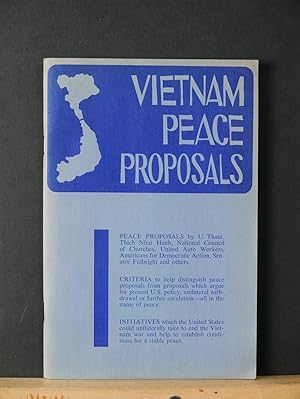
Vietnam Peace Proposals
Published by World Without War Council, 1967
Seller: Tree Frog Fine Books and Graphic Arts, Beaverton, OR, U.S.A.
Seller rating 5 out of 5 stars

First Edition
Soft cover. Condition: Very Good. 1st Edition. Pamphlet. First Printing. 9 x 5 1/2 pages. Staple bound with 52 pages. VERY GOOD. All corners pointed but for bottom right slight curl. Binding firm and tight without stress creasing. Without tears, creases, or chips. With tanning from age near cover eddges. All books carefully wrapped and sent boxed.
-

'76 auto contracts - a time to fight!
Published by Auto Workers United to Fight, Detroit, 1976
Seller: Bolerium Books Inc., San Francisco, CA, U.S.A.
Seller rating 5 out of 5 stars
4p, 11 x 15.5 inches, folded tabloid, closed tear at right edge of the fold. Part of 1976 UAW contract effort that took a harder line than the union's leadership; affiliated with the Revolutionary Communist Party.
-
Quotations of Social Significance to Union Leaders.
Published by UAW Education Dept., May 1968., 1968
Seller: Motte & Bailey, Booksellers, Ann Arbor, MI, U.S.A.
Association Member: IOBA
Seller rating 4 out of 5 stars
Trade Paperback. Condition: Good. Softcover in good condition with illustrated wrapper. Some wear and rubbing to the edges of the wrapper with browning along the edges and some scuffing to the covers. Page edges are a little browned. Small blue dot on lower edges of the pages. 139 pages with illustrations and index of authors. A scarce work featuring a collection of quotes on work, labor, and unions taken from individuals varying from Aristotle to Mother Jones to E. Zola.
-

Feminism in the Labor Movement: Women and the United Auto Workers, 1935-1975 Gabin, Nancy Felice
Language: English
Published by Cornell University Press, 1990
ISBN 10: 0801497256 ISBN 13: 9780801497254
Condition: New.
-
The Many and the Few; A chronicle of the dynamic auto workers
Published by The Plantin Press, Los Angeles, 1947
Seller: The First Edition Rare Books, LLC, Cincinnati, OH, U.S.A.
Association Member: ABAA ILAB IOBA MWABA
Seller rating 5 out of 5 stars
First Edition Signed
Cloth. Condition: Very good. Dust Jacket Condition: very good. Signed first edition of The Many and the Few, from the personal collection of former President of the United Auto Workers, Leonard Woodcock. (illustrator). First Edition, Second Printing. Octavo, xv, 293pp. Maroon cloth, title in silver on front cover and spine. Stated "Second printing, March 1947" on copyright page. Solid text block, light wear to corners and spine, faint offsetting to endpapers. In the publisher's dust jacket, $2.50 retail price to front flap, sunned spine with chipping to edges, short closed tear to front cover repaired with archival glue, a very good example. Signed by the author on the front free endpaper. Includes a UAW - CIO Convention Souvenir sticker affixed to front free endpaper, commemorating the 1947 convention. Leonard Woodcock (1911-2001) was the President of the United Auto Workers and the first United States Ambassador to China. Woodcock dropped out of college in 1933 and began working as a machine assembler in Detroit. As manufacturing unions grew, he joined the United Auto Workers. After the tragic airplane accident resulting in the death of former UAW president Walter Reuther, Woodcock was selected to lead, and would remain president of the union from 1970 through 1977. Due to his progressive ideals, Woodcock was listed #9 on Nixon's Enemies List, with the notation "No comments necessary.". Signed.
-
The Legend of Henry Ford; with a new preface by William Greenleaf
Published by Atheneum, New York, 1968
Seller: The First Edition Rare Books, LLC, Cincinnati, OH, U.S.A.
Association Member: ABAA ILAB IOBA MWABA
Seller rating 5 out of 5 stars
First Edition Signed
Paperback original. Condition: Near fine. Inscribed to the former President of the United Auto Workers, the new edition of The Legend of Henry Ford by Keith Sward. (illustrator). Later Printing. Octavo, xviii, 550pp. Original soft cover, title in black on front cover and spine. Lacking the first edition statemen and features a new preface by William Greenleaf. Solid text block, sunned spine, light wear and creasing to corners, mild shelf wear. A bright example. Inscribed on the front free endpaper: "From the Bearer, Ray Goodman + the Author, Keith Sward / To Leonard Woodcock who helped to right some of the wrongs in the house that Ford built. August, 1978." Leonard Woodcock (1911-2001) was the President of the United Auto Workers and the first United States Ambassador to China. Woodcock dropped out of college in 1933 and began working as a machine assembler in Detroit. As manufacturing unions grew, he joined the United Auto Workers. After the tragic airplane accident resulting in the death of former UAW president Walter Reuther, Woodcock was selected to lead, and would remain president of the union from 1970 through 1977. Due to his progressive ideals, Woodcock was listed #9 on Nixon's Enemies List, with the notation "No comments necessary.". Signed.
-
United Auto Worker Strikes and Labor Organizing at Ford's River Rouge Plant in Dearborn Michigan Press Photo Archive, 1941-53
Publication Date: 1941
Seller: Max Rambod Inc, Woodland Hills, CA, U.S.A.
Association Member: ABAA ILAB PADA
Seller rating 5 out of 5 stars
Photograph
[Labor Organizing] Ford River Rouge plant labor photo archive documenting the struggle over union recognition, strike enforcement, and industrial bargaining at Ford Motor Company between 1941 and 1953. River Rouge was Ford's massive Dearborn complex, where raw materials, blast furnaces, rail lines, ships, assembly shops, and tens of thousands of workers were concentrated at one site. Ford resisted the United Auto Workers longer than General Motors and Chrysler, and the 1941 strike forced the company into an NLRB-supervised vote that led to UAW representation at Rouge. The later 1949 strike over speed-up conditions demonstrates the continued role of the union in protecting workers from unreasonable production paces, giving bargaining authority, and strengthening worker control inside the plant. Photo archive of 7 Large silver gelatin press photographs, measuring between 7 x 8 and 8 x 10 inches, Dearborn and Detroit, Michigan, 1941-1953. Workers stream across elevated pedestrian bridges into the Rouge gates, crowd plant entrances, receive ballots under the supervision of officials and a Michigan State Police officer, and stand in picket lines outside Ford buildings. A Black worker charges toward a picket while a state policeman advances with club raised, with the Acme caption identifying the incident as "Vengeance at River Rouge" on April 4, 1941. Other captions identify Sunday dinner served to pickets on April 6, 1941; thousands returning to work after settlement of the UAW-CIO strike on April 14, 1941; workers voting in the NLRB election on May 21, 1941; pickets entertained from a truck during the May 1949 walkout; and Ford's River Rouge plant in 1953, described by the Ford News Department as employing more than 60,000 and able to turn raw materials into a finished car in 28 hours. The archive records both the scale of River Rouge and the mechanics of labor conflict: police interference, union voting, picketing crowds, and shop workers moving between strike and production. It connects the 1941 recognition fight to the postwar UAW's continuing battles over working conditions at one of the most closely watched industrial sites in the United States. Creasing, handling wear, surface marks, and caption wear; images remain intact and legible. Overall in good condition.
-
United Auto Worker Strike Action at Ford's River Rouge Plant in Dearborn Michigan, Press Photo Archive, 1941-67
Publication Date: 1941
Seller: Max Rambod Inc, Woodland Hills, CA, U.S.A.
Association Member: ABAA ILAB PADA
Seller rating 5 out of 5 stars
Photograph Signed
[Labor Organizing] Ford River Rouge plant press photographs documenting labor conflict, picketing, and union organization at the largest industrial complex in the United States from the early UAW recognition battles of 1941 through the major Ford walkouts of 1949 and 1967. The River Rouge plant in Dearborn employed tens of thousands of workers and was the center of Ford's anti-union resistance during the rise of the Congress of Industrial Organizations (CIO). Ford Motor Company remained the last major Detroit automaker to recognize the United Auto Workers after General Motors and Chrysler signed contracts following the 1936-1937 sit-down strikes. Several scenes here connect directly to the April 1941 strike that finally forced Ford to negotiate with the UAW after years of union busting and company sanctioned violence against organizers. Later scenes document the 1949 strike involving roughly 65,000 workers and the 1967 Rouge walkout, documenting three decades of union activity in the American auto labor history. Photo archive of 9 black-and-white press photographs, silver gelatin prints, ranging from 7 x 9" to 8 x 11", Dearborn and Detroit, Michigan, 1941-1967. Photographs show UAW members at Rouge plant gates carrying placards reading "Ford Is On Strike," while reporters and cameramen surround circular picket formations outside the factory entrances. One scene records women from the Women's Auxiliary of UAW Local 600 marching in orderly formation with American flags during an April 1941 demonstration outside the Rouge complex. Another captures a state policeman advancing with baton raised as two men recoil during violence near a plant gate; the attached caption identifies one figure as an unidentified Black man striking a UAW picket captain. Additional scenes show workers waiting in line for pay envelopes during the strike, men gathered outside plant entrances under heavy guard, and a largely idle assembly floor where a lone foreman sits beside silent production lines after tens of thousands of workers walked out. Typed press captions affixed to versos on image margins, including references to the May 1949 strike and September 1967 Rouge picketing. The Ford strikes were some of the most consequential labor battles in twentieth-century American industry. Ford's Service Department under Harry Bennett built an extensive anti-union apparatus that used labor spies, intimidation, and physical violence against organizers, culminating in nationally publicized confrontations such as the 1937 "Battle of the Overpass." The April 1941 strike represented the decisive collapse of Ford's resistance to industrial unionism and secured UAW recognition at the Rouge plant, fundamentally changing labor relations in the American automobile industry. These scenes preserve not only the mechanics of organized strike action but also the scale of industrial labor mobilization in midcentury Detroit, where mass demonstrations were central in the struggle between organized labor and corporate management. Light creasing, scattered surface wear, and minor handling marks consistent with newsroom use; captions and editorial markings largely intact and legible. Overall good to very good condition. Signed.
-
United Auto Workers and CIO Strike and Bargaining Action Demanding Labor Reform in the U.S. Auto Industry Photo Archive, 1938-1949
Publication Date: 1938
Seller: Max Rambod Inc, Woodland Hills, CA, U.S.A.
Association Member: ABAA ILAB PADA
Seller rating 5 out of 5 stars
Photograph
[Labor Organizing] United Auto Workers and CIO labor photograph archive documenting strike action, union leadership, and collective bargaining negotiations during the expansion of organized labor in the American automobile industry, 1938-1949. The archive traces the period immediately following the 1935 Wagner Act, when unions gained federal legal protection for collective bargaining but still faced violent resistance from corporations, police departments, and municipal governments. Several scenes connect directly to the years surrounding the 1937 Battle of the Overpass in Dearborn, when Ford security men beat UAW organizers attempting to distribute union literature outside the River Rouge complex, and to the broader wave of sit-down strikes and factory shutdowns that forced General Motors, Chrysler, and eventually Ford into formal negotiations with the UAW. The captions identify senior labor figures including Walter Reuther, R. J. Thomas, George Addes, and Richard T. Leonard, establishing the archive as documentation not merely of rank-and-file unrest but of the institutional consolidation of the UAW-CIO into one of the most powerful industrial unions in the United States. The material also records how labor disputes extended beyond factory gates into courts, city halls, state legislatures, and police jurisdictions, revealing the political dimensions of industrial unionism during the New Deal and early Cold War years. Photo archive of 12 Large silver gelatin press photographs, one large panorama measuring 9.5 x 16.5 inches, 11 press photos ranging from 6 x 8 inches to 8 x 10 inches, primarily Detroit, Dearborn, South Gate, and Atlantic City, circa 1938-1949. A large-format scene dated 1939 records tear gas and street violence during a UAW strike at the Fisher Body plant, with clouds of gas spreading across trolley tracks as helmeted police advance toward crowds of fleeing workers and spectators. Another image shows hundreds of demonstrators carrying a massive American flag through downtown Detroit toward City Hall during protests following clashes between union pickets and police at Federal Screw Works; the verso caption notes approximately forty injuries and references accusations of "police brutality" raised before city council. Additional photographs show UAW-CIO officials seated at conference tables, negotiating contracts and appearing in municipal hearing rooms beneath desk microphones and courthouse lighting. Captions identify figures including Walter Reuther, George Addes, and R. J. Thomas, while a 1940 Dearborn caption records the arrest of union leaders for distributing handbills asserting workers' rights under the National Labor Relations Act. South Gate strike scenes outside a General Motors facility show workers carrying placards demanding a thirty percent wage increase while Rev. Louis R. Loe conducts prayer services along the picket line. Convention and leadership photographs from Atlantic City and Washington document labor leaders gathered under the authority of Samuel Gompers and later CIO leadership structures, linking local strike activity to national labor organization. The archive illustrates the transformation of the automobile industry from one of the nation's most violently anti-union industrial sectors into the center of postwar collective bargaining power. Ford Motor Company resisted union recognition longer than General Motors or Chrysler, relying on private security forces, local police cooperation, labor espionage, and anti-handbill ordinances to suppress organizing inside and outside its plants. Several captions directly reference these legal confrontations, including arrests tied to leaflet distribution and disputes over municipal authority to restrict labor organizing in public space. By the late 1940s, many of the same figures shown here were negotiating contracts that established wage standards, pensions, grievance procedures, and health benefits that reshaped industrial employment across the United States. Creasing, edge wear, scattered minor losses, adhesive residue, and newsroom markings to versos; images remain clear and intact overall. Overall good condition.