
Worm Olaus (3 results)
 More images
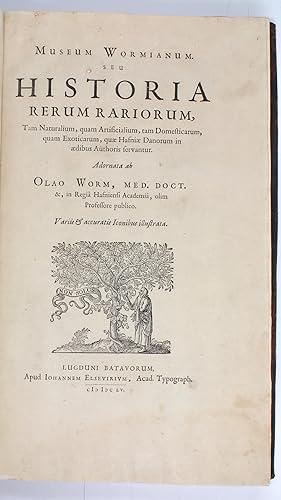
Published by Leiden, Jan Elzevier, 1655. 1655
- Hardcover
- First Edition
Seller: Antiquariat INLIBRIS Gilhofer Nfg. GmbH, Vienna, A, AustriaAntiquariat INLIBRIS Gilhofer Nfg. GmbH
Contact seller5-star sellerCondition: Used
US$ 14,900.65
US$ 34.72 shippingShips from Austria to U.S.A.Quantity: 1 available
Folio (243 x 372 mm). (12), 389, (3) pp. With double-page-sized engraved frontispiece (G. Wingendorp sc., bound after p. 8), 12 engravings in the text, and 139 woodcuts in the text (wants the engraved portrait). 18th century full calf with giltstamped red label to gilt spine in seven compartments. All edges red. First edition of… this description of the important natural-historical and ethnological collection assembled by the famous Danish physician and naturalist Worm (1588-1654), forming the nucleus of the museum he founded, one of the first natural history museums ever established. The double-page frontispiece (sometimes counted as an additional engraved title page) shows his natural history collection inboxes, on shelves and hanging from walls and ceiling. This plentiful text illustrations show exotic as well as Scandinavian animals, plants, fossils, ethnological trophies, archeological discoveries, etc. For many items in the mineralogical and chemical section, the Arabic names are given (such as Borax or "Baurach", Alkali, Tinkur, etc.). Among the exotic flora are many plants endemic to the Middle East and Arabia, including the "Nabuch Arabum", the "Nux indica" (with reference to Avicenna), the date palm, pistachio ("ex Persia, Arabia & Syria"), gum arabic etc. - Binding slightly scuffed in places, but well preserved. Slight browning and brownstaining to interior, mainly confined to blank margins. A few early marginalia and underlinings in ink (trimmed by binder's knife when rebound in the later 18th century). As virtually all copies available for comparison, ours lacks the portrait (to be bound after the preliminaries). - Nissen, ZBI 4473. Willems 772 ("Description raisonnée du cabinet d'histoire naturelle formé par le savant danois Olaus Worm").

- Hardcover
- Print on Demand
Seller: True World of Books, Delhi, , IndiaTrue World of Books
Contact seller5-star sellerLeatherBound. Condition: New. BOOKS ARE EXEMPT FROM IMPORT DUTIES AND TARIFFS; NO EXTRA CHARGES APPLY. LeatherBound edition. Condition: New. Reprinted from 1641 edition. Leather Binding on Spine and Corners with Golden leaf printing on spine. Bound in genuine leather with Satin ribbon page markers and Spine with raised gilt band…s. A perfect gift for your loved ones. Pages: 91 NO changes have been made to the original text. This is NOT a retyped or an ocr'd reprint. Illustrations, Index, if any, are included in black and white. Each page is checked manually before printing. As this print on demand book is reprinted from a very old book, there could be some missing or flawed pages, but we always try to make the book as complete as possible. Fold-outs, if any, are not part of the book. If the original book was published in multiple volumes then this reprint is of only one volume, not the whole set. Sewing binding for longer life, where the book block is actually sewn (smythe sewn/section sewn) with thread before binding which results in a more durable type of binding. Pages: 91.
 More images
- First Edition
Seller: Herman H. J. Lynge & Søn ILAB-ABF, Copenhagen, , DenmarkHerman H. J. Lynge & Søn ILAB-ABF
Contact seller4-star sellerCondition: Used
US$ 2,391.63
Free ShippingShips from Denmark to U.S.A.Quantity: 1 available
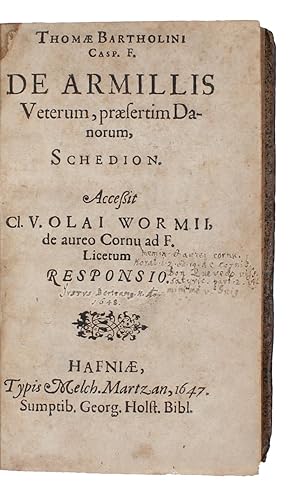
Hafniae (Copenhagen), Melchior Marzan, 1647. Small 8vo. Later brown half calf from ab. 1800 with blindstamped lettering to spine. Spine worn at capitals and hinges. A bit of browning and brownspotting. Contemporary owner's inscription to title-page, dated "1648" and signed Justus Bertram. Marginal notes in the same hand to a cou…ple of pages. Woodcut vignettes and initials. Six woodcut illustrations in the text, one full-page. (16), 128 pp. The very rare first edition of Bartholin's first non-scientific publication, his important work on Nordic bracelets, which helped form the basis for the study of Scandinavian jewelry. The work also contains Worm's 16 pp. long response to Licetus' 1645 interpretation of the Golden Horn of Gallehus. Thomas Bartholin and Ole Worm were two of the leading physicians of their time, both splendid and gifted polymaths, whose knowledge and interests reached far beyond their original field. The present work represents a unique combination of their personal interests combined with their scientific knowledge, through which they present us with a valuable approach to the golden artifacts of their heritage. The first edition of the work is of great scarcity. It became highly popular and influential, and in 1676, a new edition appeared, in Amsterdam, followed by a title-issue in 1676. Thomas Bartholin (1616-1680) was one of the leading physicians of his time, now remembered, among many other things, as the discoverer of the lymphatic system. He "was the most celebrated physician of his period in Denmark and perhaps in all of Europe". (Kronick, p. 81). He is considered "a typical representative of the "Curiosi naturae" of the 17th century with all their learning, diligence and insatiable spirit of curiosity. He belonged with all his heart to the learned period, and yet he made an anatomical-physiological discovery of high mark when he found, and demonstrated, a hitherto entirely unknown vascular system in animals, and later in man - the lymphatic." (Meisen, p. 25). He was a hugely influential and extremely productive man. Apart from his seminal discovery of the lymphatic system, he wrote a number of highly influential treatises, published a series of very influential anatomical papers, published his vast correspondence with other scientists, which has the character of a scientific archive at a time when there were not yet periodicals of natural science, provided us with the most extensive information about medicine in Denmark and about the conditions of the physicians, called attention to the significance of pathological anatomy, etc., etc.,Ole Worm (Olaus Wormius) (1588-1655) was a famous Danish polymath, who was widely travelled and who had studied at a range of different European universities. Like many of the great intellectuals of the Early Modern era, Worm's primary occupation was as a physician, for which he gained wide renown. He later became court doctor to King Christian IV of Denmark. In 1621, Worm had become professor of physics, but already the year before, in 1620, had he begun the famous collection that would become one of the greatest cabinets of curiosites in Europe (and one of the first museums) and which would earn him the position as the first great systematic collector (within natural history) in Scandinavia. It was his then newly begun collection that enabled him, as professor of physics, to introduce demonstrative subject teaching at the university, as something completely new. He continued building and adding to his magnificent collection, now known as "Museum Wormianum", throughout the rest of his life. Worm's fascination for antiquarian subjects not only resulted in his famous "Museum Wormianum", but also in a deep fascination with early Scandinavian and runic literature and the history and meaning of runestones. These monuments found throughout Scandinavia, were carved with runic inscriptions and set in place from about the fourth to the twelfth centuries. In most cases, they are burial headstones, presumably for heroes and warriors.Worm published works on the runic calendar, translations of runic texts and explications of folklore associated with the runestone histories and he wrote the most important treatises ever published on the Golden Horn. For Danes, the Golden Horns, discovered on 1639 and 1734 respectively, with their amazing, complicated, and tragic story, constitute the Scandinavian equivalent to the Egyptian pyramids and have been the object of the same kind of fascination here in the North, causing a wealth of fantastical interpretations, both historical, literary, mystical, linguistic, and artistic. Thesaurus: 353.


