

Order Total (1 Item Items):
Shipping Destination:

Zavadovsky (10 results)
Skip to main search results
Search filters
Product Type
- All Product Types
- Books (10)
- Magazines & Periodicals (No further results match this refinement)
- Comics (No further results match this refinement)
- Sheet Music (No further results match this refinement)
- Art, Prints & Posters (No further results match this refinement)
- Photographs (No further results match this refinement)
- Maps (No further results match this refinement)
- Manuscripts & Paper Collectibles (No further results match this refinement)
Condition Learn more
- New (No further results match this refinement)
- As New, Fine or Near Fine (No further results match this refinement)
- Very Good or Good (6)
- Fair or Poor (No further results match this refinement)
- As Described (4)
Binding
Collectible Attributes
Language (3)
Free Shipping
- Free Shipping to U.S.A. (No further results match this refinement)
Seller Location
Seller Rating
-

Arabic Dialects of the Mahgreb (text in Russian)
Language: Russian
Published by Publishing House of Eastern Literatures, Moscow., 1962
Seller: Librairie Sheehy (Theologia Books), La Charite sur Loire, France
Seller rating 4 out of 5 stars

Paper Covers. Condition: Good. 130 pages, foldout map & chart. Includes some vocabulary in Arabic.
-
Science at the cross roads
Language: English
Published by Kniga
Seller: Henry Pordes Books Ltd, London, United Kingdom
Association Member: PBFA
Seller rating 5 out of 5 stars

US$ 138.82
US$ 20.22 shipping
Ships from United Kingdom to U.S.A.Quantity: 1 available
Add to basketHardcover. Condition: Very Good. Brown cloth bound hard cover, no dust jacket, with gilt lettering to front board and spine. Board edges slightly worn. Spine has turned brown. The binding is tight and this is a Very Good copy. The book is essentially a series of Papers presented to the International Congress of the History of Science and Technology held in London from June 29th to July 3rd, 1931 by the Delegates of the U.S.S.R. It is divided into 11 sections on a range of topics from Dialectical Materialism, Physics and technology, relations of Science, technology and economics under Capitalism and in the Soviet Union, etc.
-
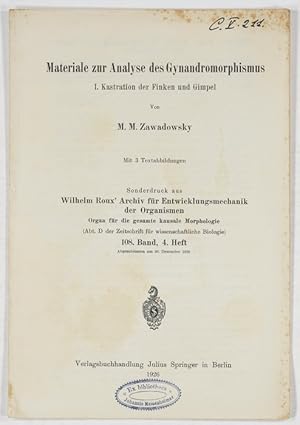
Materiale zur Analyse des Gynandromorphismus. I. Kastration der Finken und Gimpel.
Publication Date: 1926
Seller: Antiq. F.-D. Söhn - Medicusbooks.Com, Marburg, Germany
Seller rating 5 out of 5 stars
Arch. Entw.mech. Organ., 108/4. - Berlin, Verlagsbuchhandlung Julius Springer, 1926, 8°, pp.563-571, 3 Abbildungen, orig. Broschur. Seltener Sonderdruck! Mikhail Mikhailovich Zavadovsky (German form Zawadowsky); 29 July 1891 - 28 March 1957) was a Russian and Soviet biologist who specialized in the reproductive biology of livestock. A professor at Moscow University, he conducted experiments on sex hormones, the control of sexual characters and hormonal cycles. He noted that there was a balance between the sex hormones and was able to produce male or female characteristics during development by altering the balance experimentally. He termed them plus-minus interactions. Zavadovsky introduced the term "biotechnology" in 1932. His brother Boris Mikhailovich (1895-1951) also worked on endocrinology. Michail Michailowitsch Sawadowski; * 17. Julijul. / 29. Juli 1891greg. im Dorf Pokrowka-Skoritschewo, Ujesd Elisabethgrad, Gouvernement Cherson; ? 28. März 1957 in Moskau) war ein sowjetischer Biologe, Genetiker und Hochschullehrer.
-
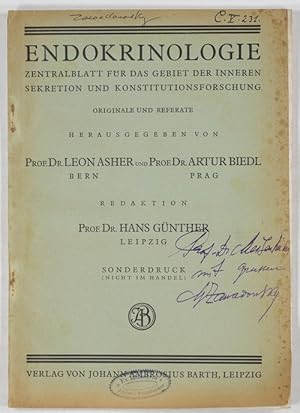
Die Äquipotentialität der Gewebe des Männchens und Weibchens bei Vögeln und Säugetieren.
Publication Date: 1929
Seller: Antiq. F.-D. Söhn - Medicusbooks.Com, Marburg, Germany
Seller rating 5 out of 5 stars
Signed
Endokrinologie, 5. - Leipzig, Verlag von Johann Ambosius Barth, 1929, 8°, pp.363-464, 11 Abb., orig. Broschur; Umschlag minimal fleckig; mit eigenhändiger Widmung des Verfassers. Seltener Sonderdruck! Mikhail Mikhailovich Zavadovsky (German form Zawadowsky); 29 July 1891 - 28 March 1957) was a Russian and Soviet biologist who specialized in the reproductive biology of livestock. A professor at Moscow University, he conducted experiments on sex hormones, the control of sexual characters and hormonal cycles. He noted that there was a balance between the sex hormones and was able to produce male or female characteristics during development by altering the balance experimentally. He termed them plus-minus interactions. Zavadovsky introduced the term "biotechnology" in 1932. His brother Boris Mikhailovich (1895-1951) also worked on endocrinology. Michail Michailowitsch Sawadowski; * 17. Julijul. / 29. Juli 1891greg. im Dorf Pokrowka-Skoritschewo, Ujesd Elisabethgrad, Gouvernement Cherson; ? 28. März 1957 in Moskau) war ein sowjetischer Biologe, Genetiker und Hochschullehrer.
-

Science At The Cross Roads by Bukharin, N.I., Joffe, A.F., Rubinstein, M., Zavadovsky, B., Colman, E., Vavilov, N.I., Mitkewich, W.T., Hessen, B.,
Language: English
Published by Kniga Ltd.
Seller: Robinson Street Books, IOBA, Binghamton, NY, U.S.A.
Association Member: IOBA
Seller rating 4 out of 5 stars
Condition: Very Good. Prompt Shipment, shipped in Boxes, Tracking PROVIDEDVery good copy with clean pages. Papers were presented to the International Congress of the History of Science and Technology held in London from June 29, 1931-July 3, 1931 by the delegates of the U.S.S.R. Paper included:-Theory and Practice from the Standpoint of Dialectical Materialism by N.I. Bukharin-Physics and Technology by A.F. Joffe-Relations of Science, Technology, and Economics Under Capitalism and in the Soviet Union by M. Rubinstein-The "Physical" and "Biological" In The Process of Organic Evolution by B. Zavadovsky-Dynamic and Statistical Regularity in Physics and Biology by E. Colman -The Problem of the Origin of the World's Agriculture in the Light of the Latest Investigations by N.I. Vavilov-The Works of Faraday and Modern Developments in the Application of Electrical Energy by W. Th. Mitkewich-Electrification as the Basis of Technical Reconstruction in the Soviet Union by M. Rubinstein-The Social and Economic Roots of Newton's 'Principia' by B. Hessen-The Present Crisis in the Mathematical Sciences and General Outline for their Reconstruction by E. Colman-Short Communication on the Unpublished Writings of Karl Marx Dealing With Mathematics, The Natural Sciences, Technology, and the History of these Subjects by E. Colman8vo. Published in London, 1931. 235 pages.rm.
-

Hardcover. Condition: Good. In Russian. Zavadovsky, Yuri Stepanovich. Experience of the port of Osetrovsk in improving the organization of work in the processing of bulk cargoes. Moscow: 1971. All images are for identification of editions only. Several books of the same edition may be available. Please feel free to request photos of available books.SKU7083570.
-

Hardcover. Condition: Good. In Russian. Zavadovsky, Yuri Nikolaevich. Meroite language. Moscow: Science, All images are for identification of editions only. Several books of the same edition may be available. Please feel free to request photos of available books.SKU1017603.
-

Hardcover. Condition: Good. In Russian. Zavadovsky, Nikolai Nikolaevich. Issues of Efficiency in Promoting Science, Technology and Advanced Production Practices. Kyiv: Knowledge of the Ukrainian SSR, 1977. All images are for identification of editions only. Several books of the same edition may be available. Please feel free to request photos of available books.SKU7646614.
-
Pol i razvitie ego priznakov. K analizu formoobrazovania u zhivotnykh. Das Geschlecht und die Entwickelung der Geschlechtsmerkmale
Published by Gosudarstvennoe Izdatel'stvo, Moscow, 1922
Seller: Jeremy Norman's historyofscience, Novato, CA, U.S.A.
Seller rating 2 out of 5 stars

First Edition Signed
First Edition. Zavadovsky, Mikhail Michailovich (1891-1957). [In Cyrillic:] Pol i razvitie ego priznakov. K analizu formoobrazovania u zhivotnykh. Das Geschlecht und die Entwickelung der Geschlechtsmerkmale. 255pp. 20 colored plates, text illustrations. Moscow: Gosudarstvennoe Izdatel'stvo, 1922. Original printed boards, worn at edges, corners and spine, one corner bumped. Minor dampstaining on first few leaves, light finger-soiling, but very good. Presentation copy, inscribed by Zavadovsky to Raymond Pearl (1879-1940) on the front free endpaper: "An sehr geerhrten Herrn Prof. R. Pearl, M. Zavadovsky. Moscau Universität Institut Exper. Zool." Pearl's bookplate on the front pastedown. First Edition. Zavadovsky, an experimental biologist, studied the development of primary and secondary sexual characteristics in domestic and laboratory animals. "Detailed studies of the effects of castration and the transplantation of sex glands in chickens led him to conclude that some of the secondary sexual characteristics depend on their development in the hormones of the sex glands and that some are independent of it. . . . Zavadovsky established that the monosexuality of female birds and the bisexuality of the male-and the opposite among mammals and amphibians-correspond to the distribution of sex chromosomes: XY in female and XX in male birds, and the reverse among mammals and amphibians. Zavadovsky investigated the interrelationships between secondary sexual characteristics and the sex glands and studied the interaction of the endocrine glands. He concluded that a ± mutual influence exists: an organ that stimulates another also is inhibited by it. This was an important application to biology of the cybernetic principle of positive or negative feedback" (Dictionary of Scientific Biography). Zavadovsky presented this copy of his work to American biologist and biostatistician Raymond Pearl; see Garrison-Morton 137, 1712, 1714. .
-

Analyse der Erscheinungen von Hermaphroditismus. Von M.M. Zawadowsky.
Publication Date: 1926
Seller: Antiq. F.-D. Söhn - Medicusbooks.Com, Marburg, Germany
Seller rating 5 out of 5 stars
Arch. Entw.mech. Organ., 108/4. - Berlin, Verlagsbuchhandlung Julius Springer, 1926, 8°, pp.531-562, 23 Abbildungen, orig. Broschur. Seltener Sonderabdruck! "Zusammenfasung: Bei der Analyse von Zwittererscheinungen ist folgendes zu berücksichtigen: 1. Die sekundären Gechlechtsmerkmale können der Mechanik ihrer Entwicklung nach, in drei Gruppen geteilt werdn: 1. <psudosexuelle, 2. Eusexuelle, 3. Somosexuelle. Bei hybriden Individuen ist noch an die 4. Konkordosexuelle Gruppe zu denken. 2. Die Geschelchtsmorphohormon, welches die sexuellen Merkmale enttwickelt, bleibt nur kurze Zeit im Blut" (24 Stunden oder etwa" länger). 3. Nachdem das Morphohormon entfernt, ist, beginnen einige von den unabhängigen Merkmalen "ich umgekehrt zu entwickeln, andere dieser Umkehrentwicklung nicht unterworfen sind. Die ersten können wir kurz Reversible nennen, die zweiten Irreversible. 4. Einige der eusexuellen Merkmale (z. B. Federpigmenten einer Henne) bedürfen für ihre Entwicklung einer beständigen Wirkung des Morphohormons. 5. Andere eusexuelle Merkmale (z. B. die Hörner der Schafe) verlangen nur einen Stoß von dem Morphohormon und können sich ohne seine Hilfe weiterentwickeln. 6. Diese Fähigkeit des Gewebes, welches einen Stoß von Seiten des Morphohormons verlangt, um sich ohne seine Hilfe weiter zu entwickeln, habe ich als die Reaktionsträgheit des Gewebes zu bezeichnen vorgeschlagen. 7. Der Entwicklungsgrad einiger Merkmale (z. B. die Menge des Pigmentes) ist der Menge des Morphohormons proportional. 8. Der Entwicklungsgrad anderer Merkmale ist möglicherweise dem Gesetze "Alles oder Nichts" untergeordnet. 9. Diejenigen Gewebe, welche eusexuelle Merkmale entwickeln, haben verschiedene Reizschwellen. Man kann daher diese Gewebe ihrer Reizschwelle nach anordnen. 10. Während der Regeneration der Geschlechtsdrüse treten die Merkmale in einer bestimmten Reihenfolge auf; wenn die Geschlechtsdrüse zugrunde geht, verschwinden diese Merkmale in umgekehrter Reihenfolge. 11. Es ist nicht möglich alle eusexullen Merkmale ihrer Reizschwelle nach anzuordnen. Dieser Umstand spricht dafür, daß das Geschlechtshormon (in unserem Falle das der Henne) aus unabhängigen Komponenten besteht." Mikhail Mikhailovich Zavadovsky (German form Zawadowsky); 29 July 1891 - 28 March 1957) was a Russian and Soviet biologist who specialized in the reproductive biology of livestock. A professor at Moscow University, he conducted experiments on sex hormones, the control of sexual characters and hormonal cycles. He noted that there was a balance between the sex hormones and was able to produce male or female characteristics during development by altering the balance experimentally. He termed them plus-minus interactions. Zavadovsky introduced the term "biotechnology" in 1932. His brother Boris Mikhailovich (1895-1951) also worked on endocrinology. Michail Michailowitsch Sawadowski; * 17. Julijul. / 29. Juli 1891greg. im Dorf Pokrowka-Skoritschewo, Ujesd Elisabethgrad, Gouvernement Cherson; ? 28. März 1957 in Moskau) war ein sowjetischer Biologe, Genetiker und Hochschullehrer.


