

Order Total (1 Item Items):
Shipping Destination:

Accedens Armory (5 results)
Skip to main search results
Search filters
Product Type
- All Product Types
- Books (5)
- Magazines & Periodicals (No further results match this refinement)
- Comics (No further results match this refinement)
- Sheet Music (No further results match this refinement)
- Art, Prints & Posters (No further results match this refinement)
- Photographs (No further results match this refinement)
- Maps (No further results match this refinement)
- Manuscripts & Paper Collectibles (No further results match this refinement)
Condition Learn more
- New (1)
- As New, Fine or Near Fine (No further results match this refinement)
- Very Good or Good (1)
- Fair or Poor (No further results match this refinement)
- As Described (3)
Binding
- All Bindings
- Hardcover (3)
- Softcover (No further results match this refinement)
Collectible Attributes
- First Edition (1)
- Signed (No further results match this refinement)
- Dust Jacket (No further results match this refinement)
- Seller-Supplied Images (4)
- Not Print on Demand (4)
Language (2)
Price
- Any Price
- Under US$ 25 (No further results match this refinement)
- US$ 25 to US$ 50
- Over US$ 50
Free Shipping
Seller Location
Seller Rating
-
![Seller image for The Accedens of armory 1576 [LeatherBound] for sale by S N Books World](https://pictures.abebooks.com/inventory/md/md30639540885.jpg)
The Accedens of armory 1576 [LeatherBound]
Language: English
Publication Date: 2025
Leatherbound. Condition: NEW. BOOKS ARE EXEMPT FROM IMPORT DUTIES AND TARIFFS; NO EXTRA CHARGES APPLY. Leatherbound edition. Condition: New. Leather Binding on Spine and Corners with Golden leaf printing on spine. Bound in genuine leather with Satin ribbon page markers and Spine with raised gilt bands. Pages: 326. A perfect gift for your loved ones. Reprinted from 1576 edition. NO changes have been made to the original text. This is NOT a retyped or an ocr'd reprint. Illustrations, Index, if any, are included in black and white. Each page is checked manually before printing. As this print on demand book is reprinted from a very old book, there could be some missing or flawed pages, but we always try to make the book as complete as possible. Fold-outs, if any, are not part of the book. If the original book was published in multiple volumes then this reprint is of only one volume, not the whole set. IF YOU WISH TO ORDER PARTICULAR VOLUME OR ALL THE VOLUMES YOU CAN CONTACT US. Resized as per current standards. Sewing binding for longer life, where the book block is actually sewn (smythe sewn/section sewn) with thread before binding which results in a more durable type of binding. Language: English Pages: 326.
-

THE ACCEDENS OF ARMORY.
Published by Imprinted at London : In Flete strete within Temple barre at the signe of the hand and starre by Richard Tottill the last day of December. An. do, 1562
Seller: Francis Edwards ABA ILAB, Hay on Wye, United Kingdom
Association Member: ABA ILAB PBFA
Seller rating 5 out of 5 stars

First Edition
US$ 3,572.15
US$ 25.49 shipping
Ships from United Kingdom to U.S.A.Quantity: 1 available
Add to basket1st Ed. Sm. 8vo. [9] leaves, 232 leaves, [3] leaves. Engraved title page (coat-of-arms), 2 woodcuts, numerous woodcuts of coats-of-arms including 4 full page, decorative/initial letters. Sporadic waterstain heavier in parts, light age toning, some leaves lightly creased to upper corner, contemporary mottled calf, sm. lump to upper board, hinges cracked though firm, dec. gilt compartments to spine, lacking title label. Ex.-libris Sir Philip Sydenham, probably the 3rd Baronet, of Brimpton in Somerset. He represented Helston and Somerset in Parliament in 1700 and 1705. An extravagant man, he sold Brimpton to his cousin Humphrey Sydenham, and used the proceeds to collect books. He is said to have had twenty three different bookplates, the last dated 1738, and used three different crests. He never married, and on his death the baronetcy became extinct.ESTC S101100 'Imprint from colophon. With engraved title page. The preface to the reader is by Richard Argall. Last leaf bears woodcut illustration. Entered 1562-63.''This book was a popular work on heraldry in the late sixteenth century. Written by Gerard Legh, it takes the form of a dialogue between two men Gerarde the Herehaught and Legh the Caligat Knight on various aspects of heraldry. The text was not sponsored by the College of Arms, so, for fear of reprisal, Legh purposely kept the book vague and obscure in its discussions of coats of arms. The Accedens of Armory went through several editions from its first publication in 1562.' Royal Collections Trust. US$3490.
-
The Accedens of Armory
Published by Richard Tottel, 1576
Seller: Sokol Books Ltd. ABA ILAB, London, United Kingdom
Seller rating 5 out of 5 stars
US$ 4,076.54
US$ 56.35 shipping
Ships from United Kingdom to U.S.A.Quantity: 1 available
Add to basketHardcover. Condition: Very Good. 3rd Edition. 4to. ff. (vii) 135 (ii) plus final folding plate. Roman letter, very numerous heraldic illustrations, curious full-page woodcuts on title, ff. 133 and [137] and folding woodcut plate on f. [139], often missing. White on black decorated initials, early marginalia, mostly on ff. 59v-60r, slightly trimmed affecting a couple of words of manuscripts on each. Very small marginal flaw on ff.22-23, small hole to text on f.97, little rust stain on ff. 46-47. A very good, crisp, well-margined, copy in early nineteenth-century diced Russia, cover bordered and spine lettered gilt. Catalogue entry for this copy of Thomas Thorpe, December 1942, 4 guineas, loosely inserted. A fine copy of Legh's The Accedens of Armory, first published in 1562 a year before his death. This is the third edition, all by the same printer with spaces mainly to spacing and layout. After his education, funded by Robert Wroth of Durants in Enfield, Middlesex; Legh was apprenticed as a draper under his father and became a member of the Drapers' Company. He was later distanced from the association after taking the side of the government over the city in an unknown matter, and returned to scholarship to write this work. The text details the colours, shapes, and figures found in heraldry with in-depth descriptions of their appearance as well as illustrative woodcuts. Legh provides historical and symbolic context, noting the heraldic imagery attributed to various antique and classical figures or groups, such as the shield of Perseus and the symbols of Troy. He also notes the heraldic colours and symbols associated with personal qualities such as royalty, valour, loyalty, or hospitality. Biblical anecdotes or historical figures are provided to explain much of the history and symbolism associated with particular elements of a shield. Described as the most popular heraldic work of the later 16th century, Legh uses the form of two avatars of the author, Gerarde the Herehaught and Legh the Caligat Knight, discussing the art of heraldry. Much of the discussion is theoretical and oblique to avoid transgressing the official privileges of the College of Arms. Legh provides detail on elements that might be unknown to the newcomer such as an explanation of the colours used, and lays out the detailing and illustration of shield by appearance to make them easier to describe and navigate. The preface opens: 'To the honorable assembly of gentlemen in the Innes of Court and Chauncery, Gerard Legh vvisheth loialtie'. A second is addressed to the reader by Richard Argall of the Inner Temple, Richard was the father of Samuel Argall, the naval officer and adventurer who was the first to determine a shorter northern route from England to Virginia. He is best known as the captain who brought Pocahontas to the British, having abducted her from her father, the Chief of the Powhatan Confederacy. The manuscript notes on ff. 59v-60r describe specific armorials similar to those in the text. ESTC S108418, STC 15390, Moule XVII, not in Lowndes.
-
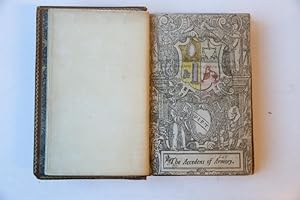
The accedens of Armory.
Seller: Antiquariaat Arine van der Steur / ILAB, Den Haag, Netherlands
Seller rating 4 out of 5 stars

US$ 4,173.87
US$ 34.85 shipping
Ships from Netherlands to U.S.A.Quantity: 1 available
Add to basketLondon, R. Totell, 1562. 12o, 19th century full leather. Some writing in ink on the title page, a few annotations in the margins. Cut short, with some loss. Exlibris of Daniel de Bruin. (18) 464 (numbered 1-232) (6) pag. Illustrated with a woodcut title (coat-of-arms partly hand coloured), 2 full page woodcuts in the text and numerous woodcuts of coats-of-arms in the text. This first edition does not have the folding Hercules plate. Gerard Legh (?-1563) produced only one publication, of which this is the first edition (later editions 1568, 1572, 1576, 1591, 1597, and 1612). This indicates the wide popularity of the book, probably the most read heraldic work in the 16th century. It is written in form of a colloquy between 'Gerarde the Herehaught and Legh the Caligat Knight.' Richard Argall of the Inner Temple supplied a prefatory address and probably part of the latter passages of the book. In endeavouring to explain the art of heraldry, Legh is purposely obscure from fear of trenching on the official privileges of the College of Arms. The work supplies what appears to be a portrait of Legh himself in the fictitious character of 'Panther Herald'. The author died of the plague on 13 October 1563, and was buried on the 15th at St. Dunstan-in-the-West, where a monument was erected to his memory. H79.
-

The Accedens of Armory.
Publication Date: 1568
Seller: Berkelouw Rare Books, Berrima, NSW, Australia
Association Member: ANZAAB ILAB
Seller rating 4 out of 5 stars
London: Rychard Totell 1568. 8vo. Later full calf. Spine gilt with raised bands and contrasting morocco titling-labels. xiv 270 4pp. Complete with engrv. title-page dec. initials numerous heraldic text-illusts some of which are full-page a folding plate and a full-page dec. colophon. Fine bearing the armorial bookplate of George Weare Braikenridge Broomwell House inside front cover. Scarce. NOTE: This was Legh's only work issued over a period of 50 years in seven editions the above being the second issue. It is written in the form of a colluquy and put forth as an elementary treatise.


