Order Total (1 Item Items):
Shipping Destination:

Aloyse, Signed (8 results)
Skip to main search results
Search filters
Product Type
- All Product Types
- Books (7)
- Magazines & Periodicals (No further results match this refinement)
- Comics (No further results match this refinement)
- Sheet Music (No further results match this refinement)
- Art, Prints & Posters (No further results match this refinement)
- Photographs (No further results match this refinement)
- Maps (No further results match this refinement)
- Manuscripts & Paper Collectibles (1)
Condition Learn more
- New (No further results match this refinement)
- As New, Fine or Near Fine (1)
- Very Good or Good (1)
- Fair or Poor (No further results match this refinement)
- As Described (6)
Binding
- All Bindings
- Hardcover (No further results match this refinement)
- Softcover (4)
Collectible Attributes
- First Edition (4)
- Signed (8)
- Dust Jacket (No further results match this refinement)
- Seller-Supplied Images (5)
- Not Print on Demand (8)
Language (1)
Free Shipping
- Free Shipping to U.S.A. (No further results match this refinement)
Seller Location
Seller Rating
-

A Aloyse.
Published by Toronto & Paris: Oasis,, 1976
Seller: Jeff Maser, Bookseller - ABAA, Berkeley, CA, U.S.A.
Seller rating 4 out of 5 stars

First Edition Signed
First edition. [20 pp]. Fine in stapled wrappers. A long poem in Spanish with surrealist/erotic drawings by Susana Wald. Two small holograph corrections to Zeller's concluding statement. One of 270 numbered copies. SIGNED by Zeller.
-
Propos Fribourgeois. Le chanoine [Charles-Aloyse] Fontaine [1754-1834]. Conférence en la salle de la Grenette, à Fribourg, le 28 novembre 1919.
Published by Fribourg, Fragnière frères, éditeurs 1920 -, 1920
Seller: Franz Kühne Antiquariat und Kunsthandel, Affoltern am Albis, Switzerland
Seller rating 5 out of 5 stars

Signed
Gr.-8°. 38 SS. 2 Portr.-Abbn. OBrosch. (blau; min. bestossen, marginal leicht gebräunt/verfärbt). Seiten marginal etwas gebräunt. Etwas Alters- u. Gebrauchsspuren, signierte Widmung des Autors a. Vorderdeckel. Gesamthaft weitestgehend sauberes, recht gutes Exemplar / Widmungsexemplar - - SD aus / Extrait des Annales fribourgeoises [8e année 1920, nos. 1-3] - BSG 1920, Zürich 1921, p. 38, Nr. 585 - swissbib mit 5 Standorten (davon 4 Westschweiz, +SNB) - Digitalis. in e-periodica - Widmung: 'A Monsieur le professeur Büchi cordialement Auguste Schorderet'; i.e. Prof. Dr. Albert Büchi, Frauenfeld 1864-1930 Freiburg, von Ettenhausen. Ab 1889 PD, ab 1891 o. Prof. für Schweizer Geschichte an der Universität Fribourg, Förderer der katholischen Geschichtswissenschaft in der Schweiz; s. HLS) - Porträts: 1. Kinderbildnis Charles-Louis [?-sic] Fontaine à l'âge de 2 ans et demi (1756), 2. Le chanoine Fontaine peint par G. Locher en 1791 - Charles-Aloyse (ou Johann Karl Anton Aloys) Fontaine (Fribourg/Freiburg 1754-1834 ibid.), kath., von Freiburg. Fontaine entra dans l'ordre des Jésuites à Landsberg (Bavière) en 1769. Etudes à Ingolstadt jusqu'à la suppression de l'ordre en 1773, études de théologie à Fribourg, ordination vers 1777. [Il] enseigna la grammaire au collège Saint-Michel de Fribourg de 1773 à 1779, puis séjourna en France (1780-1781), avant de revenir à Fribourg, où il devint chanoine de Saint-Nicolas. "Fontaine s'était lié d'amitié avec les pédagogues et les réformateurs les plus renommés de son temps, tels Johann Heinrich Pestalozzi, Philipp Emanuel von Fellenberg, Philipp Albert Stapfer, Ignaz Heinrich von Wessenberg, ainsi que son cousin Grégoire Girard" (ec.; DHS). -- Auguste Schorderet (1879-1937), von Freiburg, Lehrer an der Töchterhandelsschule seit 1918, Professor der französischen Literatur am Freiburger Collège St. Michael seit 1922, 1922-33 Direktor der Ecole secondaire des jeunes filles (HBLS, u. 200 Jahre Lehrerinnen- und Lehrerbildung im Kanton Freiburg, 2006, p. 405). - Sprache: fr.
-
Aloÿse Valérien
Published by Paris, Librairie Académique Perrin et Cie, 1908, 1908
First Edition Signed
in 12 broché Edition originale sur papier d'édition après 20 Hollande. Envoi de l'auteur. Important manque en pied du premier plat de couverture. Bon papier. Ex-libris.
-
Aloÿse Valérien.
Published by Paris, Perrin et Cie, 1908,, 1908
Seller: Harteveld Rare Books Ltd., Marly, Switzerland
Association Member: ILAB VEBUKU
Seller rating 4 out of 5 stars
Signed
in-8vo, VI + 306 p.+ 1 feuille, envoi autograph de l?auteur à Mons. René Morax + ex-libris de ?René MORAX?, (1873-1963), reliure en d.-toile, dos orné de titre et vignette , bel exemplaire signé par l?auteur. Please notify before visiting to see a book. Prices are excl. VAT/TVA (only Switzerland) & postage.
-
A Aloyse
Published by Escuela Nacional de Artes Gráficas, 1964
Seller: Libros del Ayer ABA/ILAB, Santiago, Chile
Association Member: ALADA ILAB
Seller rating 4 out of 5 stars
First Edition Signed
Encuadernación de tapa blanda. Condition: Bien. 1ª Edición. Santiago: Escuela Nacional de Artes Gráficas, 1964. Poema impreso en una tira de papel rojo de dos metros de largo concebido originalmente como una cinta de Moebius; pertenece a una serie de cinco textos escritos en 1963; los otros cuatro se han extraviado. Dedicado por Zeller al poeta Alberto Urbina. Dedicatoria autógrafa del autor.
-
Aloyse. Psychopathologie und Bildnerischer Ausdruck. Eine internationale ikonographische Sammlung. 22. Serie.
Published by Basel. Herausgegeben von Sandoz., 1975
Seller: Daniel Thierstein, Bern, Switzerland
Association Member: GIAQ ILAB VEBUKU
Seller rating 4 out of 5 stars
Signed
31,7x23,5 cm. 8seitiges Textheft mit 4 s/w. Abbildungen und 14 (recte 13: Tafel 10/11 doppelblattgross) farbige Tafeln. In Originalbroschurdecke. Mit handschriftlicher Widmung und Signatur von Hans Steck, datiert Lausanne, 26. Juli 1975. Sprache: deutsch.
-
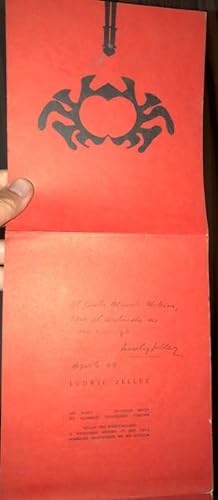
A Aloyse.
Published by Escuela Nacional De Artes Gráficas, 1964
Seller: Libros del Ayer ABA/ILAB, Santiago, Chile
Association Member: ALADA ILAB
Seller rating 4 out of 5 stars
First Edition Signed
Sin Encuadernar. Condition: Excelente. 1ª Edición. Ludwig Zeller. A Aloyse. Santiago, Escuela Nacional De Artes Gráficas, 1964. Poema guardado en un sobre Impreso en una tira de papel rojo de 150 x 15 cm de largo concebido originalmente como una cinta de Moebius. Pertenece a una serie de cinco textos escritos en 1963. Los otros cuatro se han extraviado. Dedicado por Zeller al poeta Roberto Lima. Dedicatoria autógrafa del autor.
-
Collection of 21 autograph letters signed from Aloyse (Aloysius) Huber to Proudhon, and 2 autograph letters signed from Proudhon to Huber.
Published by Paris, 1851-1853., 1853
Seller: Antiquariat INLIBRIS Gilhofer Nfg. GmbH, Vienna, A, Austria
Association Member: ILAB PADA VDA VDAO
Seller rating 5 out of 5 stars
Manuscript / Paper Collectible Signed
Small folio and 8vo. Altogether 66 pp. on 22 bifolia and 1 single sheet, one with autograph address on verso, one with pencil notes on verso. Emotional correspondence between Proudhon and the entrepreneur Aloysius Huber (1815-65) about the Besançon-Mulhouse railway project. In the early 1850s several rival companies vied for a government concession for the route, including the company founded by Huber, an Alsatian veteran of the Revolution of 1848 who had been Proudhon's neighbour at Doullens gaol. Proudhon managed to arouse the interest of Jerome Bonaparte in the projected railway, and in the process seems to have convinced himself that the plan had an idealistic side, as a decentralised pattern of small railroads would be superior - at least according to his social theories - to a unified system. As Huber struggled to obtain a concession, he regularly informed Proudhon of his progress in the matter, frequently appearing in a rather desperate mood, at one point even proclaiming in frustration: "un diable les chemins de fer!" (23 May 1853). - Completely invested in the project, Huber considers his obtaining the concession "a matter of life and death", and invokes Jean-Gilbert Victor Fialin, Duc de Persigny, Minister of the Interior, who supposedly told Proudhon that all it takes is a company presenting favourable conditions: "Le moment est decisif et c'est pour nous, pour moi sutout qui n'ai pas d'autre avenir, une question de vie et de mort [.] Quant tu es allé auprès de M. de Persigny, celui-ci t'a repdondu qu'il suffisait de présenter une pareille compagnie avec des conditions aussi avantageuses pour que le gouvernement lui accorde la concession [.]" (8 April 1851). He urges Proudhon to act quickly, fearing that one of the other companies might beat them to the concession: "Ne perdons pas de temps, mon cher Proudhon, je t'assure que si la concession du chemin de fer de Besançon à Mulhouse ne nous est pas accordée, elle sera très prochainement accordée à une autre compagnie []" (16 Jan. 185?). - Some six weeks after he agreed to function as solicitor in the project, Proudhon appears irritated, doubting the sincerity of the company as well as its need of Huber himself: "Je te l'ai dit dès le commencement: Je ne crois pas de deux choses [] or que ta Compagnie soit sérieuse [] or qu'elle ait besoin de toi []" (17 Feb. 1853). Huber repeatedly mentions his dire financial situation, as he is struggling with substantial debt: "En attendant, je suis moi-même profondement decouragé, je me suis donné tant de peine, j'ai fait tant de dettes dans l'intérêt de ma compagnie, que je ne saurai jamais comment me liquider []" (23 July 1853). - Eventually, the railway concession went to Pereire, a former Saint-Simonian who became an economic pillar of the Bonapartist regime. Pereire offered an indemnity of 40,000 francs to be shared between Proudhon and Huber as compensation for their disappointment. In one of his letters Huber wonders whether Proudhon will take the money (in the end he did not): "Que veux-tu faire avec les vingt mille francs qui sont à la disposition chez M. Pereire? Les prends-tu? o en fais-tu présent à ce Juif? ou enfin veux-tu que je les prenne? []" (24 Sept. 1853). - Includes further documents on the same matter: ALS by Huber to the Minister of Public Works; ALS by Huber to a friend; autograph transcript by Huber of an article in "La Patrie"; ALS by Camillo Marsuzi de Aguirre with autograph reply signed by Huber; ADS by Proudhon describing three rivaling companies. - Occasional small marginal flaws and traces of worming; one letter with some loss to text. - Not in the Correspondance de P.-J. Proudhon. For Huber, who in 1838 had participated in a conspiracy to assassinate Louis-Philippe I and may later have worked as a police agent, see J.-P. Kintz, "Aloyse Huber", in Nouveau dictionnaire de biographie alsacienne 17 (1991), p. 1678.


![Seller image for Propos Fribourgeois. Le chanoine [Charles-Aloyse] Fontaine [1754-1834]. Conférence en la salle de la Grenette, à Fribourg, le 28 novembre 1919. for sale by Franz Kühne Antiquariat und Kunsthandel](https://pictures.abebooks.com/inventory/md/md30743006391.jpg)